
To go by stories in the trades, Martin Scorsese is out of the Martin Scorsese business for the time being. Take Thursday’s news about his intention to co-produce (along with Initial Entertainment Group’s Graham King) a damn Queen Victoria movie (i.e., “the early life of the famed British monarch,” etc.) combined with last year’s announcement that Scorsese’s next directing project will be a Japan-set drama called Silence, a “martyrdom-themed tale of two 17th century Portuguese missionaries who return to Japan to minister to Christians,” blah, blah, and you’re left with one sinking realization — the master of The Departed is going back to the realms of Kundun and cufflinks. Terrific. He’s going to make these films and we’re all going to have to suffer through them, and then after three or four or five years — maybe, if God smiles — he’ll have gotten it out of his system, and this will allow him to finally go back and make another Scorsese film.
Month: February 2007
Dying film schools
In a phrase, film school courses teaching the craft of filmmaking are on the downswirl, and may even be going the way of newspapers. But film studies courses are eternal.

Perfect blogger storm
“One sure winner at this year’s Academy Awards will be the internet,” writes Denver Post freelancer Steven Rosen.
“More specifically, it will be the awards-oriented websites and blogs that have come together — in a perfect storm convergence of complementary and conflicting interests — to incessantly write about the insider’s world of Oscar campaigning. Some are independent, entrepreneurial or fan-based; others are part of print media taking risks with new technology.
“As they post items leading to the Feb. 25 Oscar telecast, they open the process to a global audience of movie fans. They also make the seemingly mysterious motives of the Academy of Motion Picture Arts and Science’s 5,830 voting members more transparent. To a point.”
Lucas was joking
George Lucas was definitely joking the other day, I’ve been told, when he said The Empire Strikes Back was the “worst” Star Wars film, etc. “Say what you will about Lucas, his personality, his qualities as a filmmaker or lack thereof,” says a person who attended the Publicist Guild luncheon in question. “But on that day, in that speech, he was 100% making a joke.
“He opened his speech — on a day filled with teleprompters — by saying that he never used a script when making a speech, something that drove his publicists crazy. (He’s not exactly a great public speaker, either, so perhaps he should change that habit.) At any rate, he spoke for about five minutes in a seemingly off-the-cuff manner, and made several ‘jokes.’ Others can judge whether or not he was actually funny, but yeah, he was joking.”
Genre death
“I do think there’s a hardening of the culture that’s undeniable. I think reality TV — if you just look at what’s going on this week on ‘American Idol,’ meanness is king. That offbeat behavior. You’re left wondering about the legitimacy of relationships. Reality TV has, I believe, lowered the standards of entertainment, to put it mildly. I think it’s probably harder to entertain the same people with a more classic form of writing, and romantic comedies are a classic genre.” — director-writer Nancy Meyers (The Holiday, Something’s Got to Give) speaking to L.A. Times reporter Rachel Abramowitz about the near-death (i.e., near-total irrelevance) of romantic comedies these days.
Lucas asshole
According to a David Poland/Hot Blog posting, Star Wars creator George Lucas was introducing an award being given to Sid Ganis at the Publicists’ Guild luncheon (Ganis having been the in-house publicist on The Empire Strikes Back), and said the following: “Sid is the reason why The Empire Strikes Back is always written about as the best of the films, when it actually was the worst one.” If Lucas was kidding, whatever. If he wasn’t, or if he was only half-kidding, he’s reaffirmed his rep as one of the thickest and most clueless big wheels in the history of motion pictures.
Black moviegoers on Sunday
You’re not supposed to say this and I’m not “saying” it myself — I’m just asking what people think. I realize there’s something in this that sounds a wee bit racist and lunk-headed, but an industry friend passed along a supposed distributor- exhibitor belief earlier today, which is that African-American audiences go to movies in proportionately bigger numbers on Sunday than other demos do. With every other group moviegoing falls off slightly on the day of rest, but with blacks attendance either holds steady or goes up. I heard this same view from a marketing executive five or six months ago. Both guys said this is backed up by surveys, data, etc. Is this a widely understood, research-verified cultural thing, or is it something else? And if it’s accurate, why does it happen?
WGA Awards predix
The only Sunday night awards presentation that matters is the Writers Guild Awards, but interest levels are barely there because the Best Original Screenplay award is a lockdown for Little Miss Sunshine‘s Michael Arndt and the Best Adapted Screenplay trophy belongs to The Departed‘s William Monahan….right? The BAFTA Awards are strictly a second-tier deal, and too quirky besides.
Two Spartan flicks
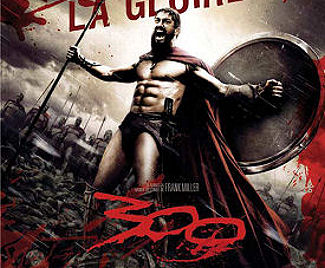
No one remembers or cares about a so-so Battle of Thermopylae movie called The 300 Spartans (1962), and I seriously doubt if fans of Zack Snyder‘s 300 (Warner Bros., 3.9.07), which is about the exact same thing, will like it very much if and when they rent it out of curiosity over the next four or five weeks.
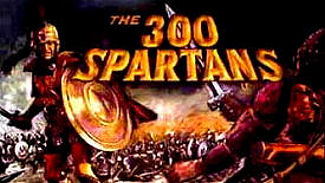
I’ve seen the older film a couple of times, and it always played way too tame and talky. Snyder’s film, on the other hand, is a visual mindblower — organic live-action footage simulating the brushstrokes of a graphic novel — with all kinds of sex scenes, beheadings and whatnot. The admiration of journalists like Anne Thompson and Suzie Woz aside, it’s a fanboy thing waiting to happen.
Zacharek on “Others”
The opening sequence in The Lives of Others “isn’t particularly graphic or even suspenseful: the camera movement is almost placid, as if it were faking disinterest. But [it] gives a firm sense of a country in which paranoia is a part of the air, like a toxin leeching oxygen from it.
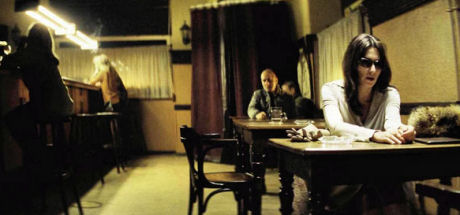
“And with it, director and writer Florian Henckel von Donnersmarck begins building the layers of emotional texture that ultimately make The Lives of Others — an Academy Award nominee for best foreign-language film — so moving, and so deeply satisfying.” — from Stephanie Zacharek‘s Salon review. The Sony Classics release has a 92% positive rating on Rotten Tomatoes.
Bach’s “Leni” bio
Hard on the heels of Jurgen Trimborn‘s Leni Reifenstahl: A Life (Faber and Faber, 1./23.07), a galley proof of Stephen Bach‘s Leni:, The Life and Work of Leni Reifenstahl arrived yesterday via messenger. I went through 30 or so pages last night during dinner, and it’s obviously a very smart and perceptive read — thorough, respectful, in some ways admiring but always clear-eyed and carefully measured.

I was struck by the following graph in the final chapter: “Thomas Mann once wrote that ‘art is moral in that it awakens,’ but Leni’s art dulled and deceived. It is the perfect expression of the machinery of amnipulation it glorifies” in her two Nazi-era classics, Triumph of the Will and Olympia. Her films are, in the words of David Thomson, ‘the most honest and compelling fruit of fascist temperament — triumphant, certain and dreadful.'”