Animal Planet

I had a seat-saving confrontation with two twentysomethings at a Superbad screening at the Grove yesterday. Jett and I entered theatre #1 only a minute before the lights went down, and there were only a few scattered seats so we split up. Just as the trailers began I noticed three unmarked seats — no articles of clothing, no handbags, no newspapers sitting on them — near the back. A woman sitting to the right of these seats said they were “saved,” so I backed off. But I thought to myself, “Saved how? Because she verbally says so?”

My position is a basic Animal Planet view that you can’t “save” seats without marking them, just like dogs and wolves and coyotes mark territory by urinating on the ground and Alaskan gold miners used to stake claims with little piles of rocks. All you have to do is put something on the seat — a jacket, a magazine or an L.A. Weekly page, even a folded paper napkin. But you can’t just point to three or four seats (or six or ten seats…there has to be a limit) and say, “These are saved.” Certainly not when the lights are going down. You can try this with one or two seats, maybe, but not with three.

So I said to the girl, “Sorry but the film’s starting and there’s nothing on these seats. I’ll respect saving two but not three seats, so I’m taking the third.” And then her friend — a youngish Asian guy — sauntered along four or five minutes later, just as the film was starting, and said the seat I was sitting in was “saved.” And I said, “Verbal saves without territorial markings don’t cut it.” He went “huh?” and I repeated my opinion. He said, “So you’re not leaving?” and I said “correct.” So he stormed off, presumably to get the manager or an usher, but Part Two never happened.

On the other hand, I saved two seats once in a Santa Monica theatre with my sport jacket spread across both of them and a newspaper folded across one, and when I returned with my popcorn a guy and a girl had taken them. “Hey…I saved these seats!” I said to the guy. He gave me one of those chickenshit “who me?” shrugs. “I put my jacket on these seats!,” I told him. “Where’s my jacket?” It was on the sticky-ass floor under one of the seats. The guy wouldn’t move, but I knew he’d tossed the jacket and taken the seats in defiance of natural jungle law. I let it go but he was wrong just as I was right yesterday. Markings are everything.
Finke, Munoz on ICM situation

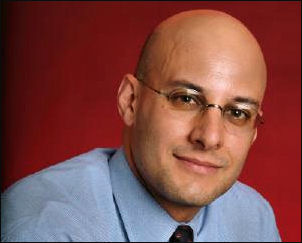
To hear it from Deadline Hollywood Daily‘s Nikki Finke, last Friday’s Lorenza Munoz L.A. Times article about whether or not Chris Silbermann, the 39-year-old television agent “being groomed” to lead Int’l Creative Management (ICM), can reverse the agency’s declining fortunes was late out of the gate.


ICM president Chris Silbermann

Plus, says Finke, the story contained a lead-graph error about Julia Roberts having followed Jim Wiatt from ICM to William Morris eight years ago. “Never happened,” she says.

But from a writer’s standpoint, you can’t help but admire the clarity of Munoz’s third paragraph, which is composed of a tight 21 words: “Once the runner-up to powerhouse Creative Artists Agency, ICM is no longer part of the big leagues in the movie business.” For all of her crackerjack bullwhip reporting about the agencies, I don’t recall having read a Finke sentence that conveyed the awful-truthitude of the ICM situation quite as bluntly or concisely.

(Finke wrote following on 8.14: “What’s interesting is how rival tenpercenteries are trying to use the Limato brouhaha to spin the town about ICM. Recently, I’ve heard both Endeavor and CAA use the phrase that Hollywood now has “only four major agencies,” with the implication that ICM is no longer comparable to them or UTA or Morris because of the losses to its motion picture department.” That has a certain ring, but then she adds (however correctly or incorrectly) that this claim is “ridiculous,” adding that ICM and/or its investors “are looking to buy an agency with a strong motion picture department.”)

Attempting to recover some of the agency’s former glitter.”could be the most difficult mountain Silbermann, an avid hiker, has ever climbed,” Munoz writes. “The ICM president, who until recently shared that title with [the departed Ed] Limato, is highly regarded in the television world, having put together the talent for one of ABC’s biggest shows, Grey’s Anatomy.

“But Silbermann is a virtual unknown in movie circles. Most of Hollywood’s top studio executives, including Sony Pictures’ Amy Pascal, DreamWorks SKG’s Stacey Snider and Warner Bros.’ production chief Jeff Robinov, have either never met Silbermann or have had little contact with him since he joined ICM a year ago.”

Broomfield on “Haditha”

Battle for Haditha director-writer Nick Broomfield speaking this afternoon from Berlin (where he’s doing the final mix) about this partly improvised au natural drama that uses various points of view to tell the story of the massacre of 24 men, women and children in Haditha, Iraq, in November 2005, by four U.S. Marines in retaliation for the death of a U.S. Marine killed by a roadside bomb.

Filmed in Jordan around the same time that Brian DePalma was shooting Redacted, Battle for Haditha will have its world premiere at next month’s Toronto Film Festival. It will open in England in October, says Broomfield, and, he expects, probably in U.S. theatres before the end of the year.

“I thought it would be interesting to do a film about the Iraq War, but also to do something that reflects quite a complex story, where you couldn’t just choose an easy side,” Broomfield told the London TimesCatherine Phillip last May. “And Haditha is a compelling story. There are lots and lots of Hadithas in any war. When you throw together people of different cultures, different outlooks, no language in common, these things happen.”

“Godfather” restorations

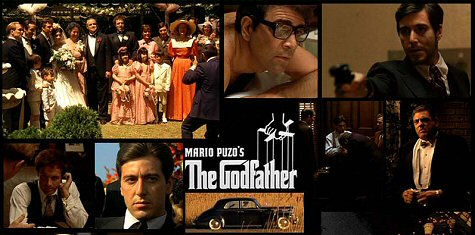
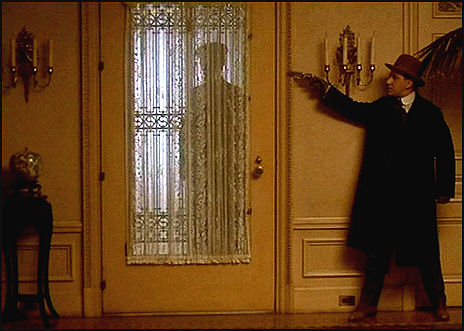
Blue-chip restoration guru Robert Harris has been working on a photo-chemical restoration of all three Godfather films for the last few months, and the results may be digitally viewable as soon as December (a Danish DVD site is stating that restored DVDs of the first two Godfather pics are due for release on 12.6.07). Harris declined comment, but Francis Coppola said after an 8.6 Godfather III screening at the Academy’s Samuel Goldwyn theatre that Steven Spielberg is the restoration project’s financial savior.

Coppola said that Paramount was initially not interested in funding the restoration (deemed necessary due to the original negative having been “purposefuly damaged by idiots…misued, cut up”) but all that changed when Spielberg stepped into the breach and said, “This is going to happen.”

According to an 8.18 posting by “Adam S.” on a Godfather restoration discussion at Home Theatre Forum, “Coppola showed up on Monday August 6th, after a screening of Godfather III at the Academy’s Samuel Goldwyn theater. He didn’t arrive until about an hour into a six person q & a with a variety of people in or attached to the film. He said it was a bit surreal to be there after we’ve been watching Godfather III because he had just come from the first viewing of the new restoration of the original Godfather, which he said ‘it looks ‘incredible.’

“Coppola also mentioned that the negative was basically going to dissolve, or very close to complete loss and it would have cost millions of dollars to restore. Paramount was not going to foot the bill for it, he said, but that after Paramount became Dreamamount Spielberg himself made sure they knew they had to restore The Godfather, and the restoration went forward. [But] there was absolutely no mention of a DVD release.”

I called Paramount Home Video’s Brenda Ciccone on Friday afternoon to learn what I could learn, but the whole lot is taking Friday afternoons off during the summer — a Brad Grey idea.

Paramount management was probably taking the view that the film was fine as long as it existed in good digital form, but any responsible archivist will tell you that photo-chemical film elements have to be restored and preserved because they comprise the core elements in their original state — the actual “film” in its pure and most pristine form — and that these elements will enable home-video technicians to deliver top-grade transfers in the decades to come as well as ensure the film’s general future survival.

I for one would love to one day see a mint-condition chronological Godfather Saga with all those deleted scenes that were shown on broadcast TV in the late ’70s. But with the remastering of both films, this seems like a perfect opportunity to also remaster all the deleted scenes and put the big saga on DVD as a stand-alone separate release.

Troubles at Raleigh

There was a screening the other night at Raleigh Studios — the Fairbanks room — of an anamorphic (2.35 to 1) film, except that it started without an anamorphic lens attached, hence the image was horizontally compressed with an aspect ratio of 1.85. I spotted this within a few seconds, of course, and ran out and told the guy in the projection booth, who quickly found another guy who ran into the booth and went “oh, Jesus” and screwed on the right lens and then popped in the right aperture plate.

But the first couple of minutes were screwed up as a result and the delicate starting-off vibe was shattered. I was a projectionist in Connecticut in the late ’70s, and I’m presuming this happened because someone didn’t put the right instructions on the film-can labels that always tell the projectionist which lens to use, and what aperture plate to use, and what the correct aspect ratio should be. Crap happens and life is imperfect, but it went further than that.

The lamp being used for the projector didn’t have enough candle power (i.e., foot lamberts). The careful lighting in the darkish, shadowy scenes in the film we were watching — captured by an absolutely first-rate dp — wasn’t well represented. I’d seen the film once before, and the beautiful values I saw simply weren’t there. The shadowed elements looked murky, muddy.

And the the focus wasn’t even 100%. It was okay, maybe 85% or 90% satisfactory, but I was saying “this isn’t good enough” to myself over and over. I was imagining the filmmakers going to all kinds of trouble to light these scenes just so and then making sure the final master looks exactly right in post, and then a few months later some media people go to see their film at Raleigh and they encounter projection that diminishes all that effort by a good 15% or 20%.

It’s a regrettable fact that movies frequently don’t look as good as they should in mainstream commercial cinemas. But when they’re being shown to editors and journalists they should look as good as they possibly can and should unspool perfectly — no hiccups, speed bumps, “uh-ohs.” Maybe I’m a little pickier than most, I’ll admit that, but still…

This is obviously not about the film that was shown (which I’m not going to disclose), but about an absolute need for the very highest projection standards for media and industry screenings.

Johansson’s period problem

Discerning moviegoers of both genders are probably down with the idea of Scarlet Johansson playing a pilates instructor and would-be singer who has an affair with a married guy in Ken Kwapis‘s He’s Just Not That Into You, and the jelly-bellied fanboys will most likely want to catch her as an enticingly-clad femme fatale in Frank Miller‘s The Spirit (technical title: Will Eisner’s The Spirit).

But however The Other Boleyn Girl and Mary, Queen of Scots turn out as films, the odds are that Johansson will not be regarded as a radiant asset in either one. To play powerful period women you need that RADA (Royal Acdademy of Dramatic Arts) thing going on, and Johansson is absolutely lacking that pedigree. Period pieces work against her natural chemical leanings, or vice versa. The Girl in the Pearl Earring was all about her slightly parted lips, and nobody I know bought her in The Black Dahlia or The Prestige.

Fosters fights back

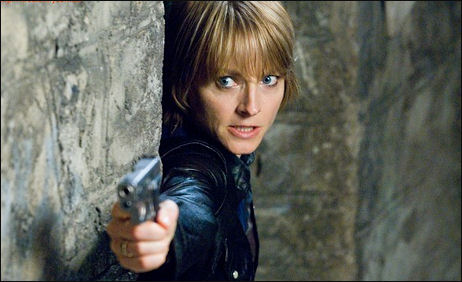
Variety‘s Anne Thompson seems to be of two minds about Jodie Foster doing Charles Bronson in Neil Jordan‘s The Brave One (Warner Bros., 9.14). On one hand she suspects that “some” will find depictions of Foster blowing away a succession of New York-area bad guys “very uncomfortable to watch,” but on the other she finds it personally “exhilarating to watch Foster embrace a power usually only accorded to male actors.”

So who’s the “some” who might have a hard time with this film? The older and somewhat older female audience, right? And, I suppose, the teenage and twentysomething girly-girls who always squeal with laughter when they sit together in bars or at any Starbucks in any state. Guys will almost certainly have no problem with this film at all. Unless it’s a problem movie in some other way.

“Women in mainstream Hollywood dramas rarely use guns,” Thomson notes. “Outside of the action fantasy realm, they don’t kill, and if they do, it’s a crime of passion involving a husband or lover. And they don’t kill repeatedly, for revenge.

“When The Brave One debuts at the Toronto Int’l Film Festival, some will view it as a response to the countless women in film who have been assaulted by violent men, from Foster’s 13-year-old prostitute in Taxi Driver to her rape victim in The Accused, which won her the actress Oscar. In The Brave One, Foster fights back.

“I see the movie as in the great tradition of the 1970s anti-hero,” Foster tells Thompson. “Travis Bickle in Taxi Driver or Dustin Hoffman in Straw Dogs or Investigation of a Citizen Above Suspicion. [This is a film in which] you’re led, strategically and architecturally, through each killing. Where the line is that you wouldn’t cross becomes extremely blurry.”

March of Inconvenient Truths

“Documentaries that look back on the sins of the past are different than documentaries about the sins of the moment. We’re right in the thick of the terrors of the moment.” — HBO documentary unit president Sheila Nevins speaking to Wall Street Journal reporter Sam Schechner in an 8.17 piece called “March of the Inconvenient Truths.”

“Superbad” surprises

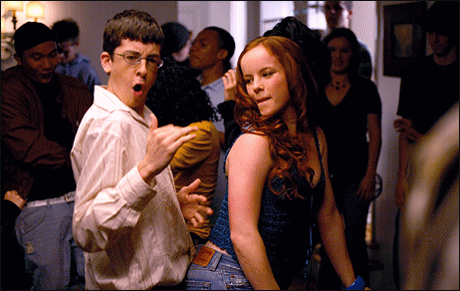
Superbad (Sony) will do much, much better than expected this weekend. Depending on who you listen to, the classic Greg Mottola-Judd Apatow-Seth Rogen-Evan Goldberg-Michael Cera- Jonah Hill-Christopher Mintz-Plasse-Bill Hader comedy will either pull in a projected $33,607,000 (about $11,400,000 was earned on Friday) or an estimated $30,300,000.

Sony’s own modest projection had been in the $25 million range, which is what I was hearing also. Fantasy Moguls’ Steve Mason was a little closer to the mark by predicting $27 million and change.

The other big news is that the fifth-place The Invasion, which opened this weekend, won’t even take in the projected best-case-scenario $10 million. One studio estimate has it topping out at $5,350,000 or about $1500 per theatre for the weekend. Steve Mason has it earning $5.7 million for the weekend. They might have done a little better — who knows? — if they’d just left the Oliver HIirschbiegel version alone and released. This movie had “wipe-out” painted on its forehead for a long time, but a failure of this dimension won’t do much for Nicole Kidman‘s quote. “She doesn’t sell tickets,” my marketing guy says.

Rush Hour 3 (New Line) will drop a bit more than 60% for the weekend, with estimates ranging between $16. 2million abd $18 million, give or take.

The Bourne Ultimatum will take in $17,763,000 for an approximate cume of $162,000,000. It could end up in the $200 million range, which would make it the biggest Bourne ever. The Bourne Supremacy topped out at $176,049,130 domestically. The Bourne Identity finished with $121,468,960.

I can let the rest go for now. (Robert Mitchum in Out of the Past: “I can let it all go.”) Read Mason’s account if you want to know how every last little film did.

Mottola needs a publicist

“Great news for Greg Mottola: Superbad, the greatest film since the invention of the motion camera, looks to be box-office smash. The bad news: Everyone thinks Judd Apatow directed it.

“‘Some of my friends said I should get a publicist just to tell people that I directed the movie, because I’m not getting any credit,’ Mottola told us yesterday. ‘It was just surreal at Comic-Con in San Diego. I was on the panel, but all the questions were going to Judd. But he was very quick to let the fanboys know who directed the movie and that he was hands-off for most of the shoot.'” — from a New York magazine “Vulture” item by Steve Ramos.