Owen Wilson’s sadness

I never write about personal stuff unless it’s an occasion for a snarky joke, or unless an actor’s dependency issue has been revealed in such a way that it’s become a big unavoidable news story (like the pull-overs involving Mel Gibson or Lindsay Lohan, say). But this time I’m feeling something else — a tremendous sadness over a near-tragedy, and a kind of anger about the usual Hollywood response to such things, which is to brush it under the carpet.

I’m a Libertarian in the sense that I think people are fully entitled to do anything they want to their bodies without prosecution from the law, but yesterday’s Owen Wilson episode is different for four reasons. I used to know him, I residually care about him, I’ve loved almost every one of his performances, and I think what apparently happened yesterday was a subconscious attempt on his part to bring certain matters to the fore.

In other words, by dramatizing his issues in this fashion, Owen has half-intentionally sparked a conversation that will amount to a kind of public intervention. A tree didn’t fall on Owen yesterday, but at the same time I don’t think he really meant to do what he apparently attempted to do.

Wilson has toldTMZ.com that “I respectfully ask that the media allow me to receive care and heal in private during this difficult time.” On a personal healing note it’s obviously no one’s business but his. I would never allude to anything ever — there are dozens of stories that get around that I’ve never touched — but at the same time Wilson knew before doing this to himself that whatever the outcome it would be a huge story and widely commented upon.

I’ve known a guy for a long time who’s known Owen for a long time, and this guy has been telling me all along that there have been Owen issues that have never really gone away…not really. I could never quite make sense of this because Owen always worked so much and had been so productive. He looked terrific — bright smile, good color, alive and crackling — when I saw him with Kate Hudson last April in San Francisco at Cafe Trieste in North Beach.

A close Wilson friend calls this matter “a heartbreak…a real heartbreak. I’m so damn sad I really don’t know what else to say. I’m in tears. I just feel so bad for him and now [for him] to have to go through it publicly…” I don’t want to drag anyone through any personal muck, but life is choices and to continue living it’s sometimes necessary to stop playing the same old game that we all play when someone has a problem, which is never to talk about it until they’re dead. It’s only allowable to talk about how much they’re liked and how much talent they have and how much we care for them, followed by a shrug of the shoulders and “Oh, well…not my business.”

The guy I know spoke this morning to a Dallas guy who also knows Owen from way back when, and the Big D guy said that what apparently happened is a “hinky” thing for Owen to have done. (“Hinky” is Dallas slang for “sissy.”)

“This has always been Owen’s life,” my source says. “He’s always been this little child, this quick-witted survivor. His canniness and his cunning in order to survive has been all over his movie characters since the beginning. He’s Dignan, he’s all those guys.

“Owen figured out a long time ago that if you act, you don’t have to work. He’s a great writer, but he has no discipline. But he’s got this character, this persona — he plays the same guy every time, and it connects to who he is and in a general way to his generation, and he created this character on his own.”

A colleague told me this morning that “its really just so sad — I feel for him and his family. I hope Owen make its through this and gets stronger from it.”
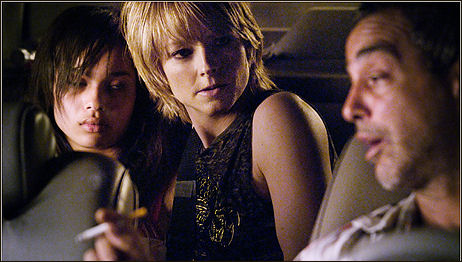
Get the bad guys!

There’s an 8.26 David Halbfinger N.Y. Times piece that searches for meaning in two noteworthy rage-and-revenge moviesNeil Jordan‘s The Brave One (Warner Bros., 9.14) and James Wan‘s Death Sentence (Fox Atomic, 8.31) with Jodie Foster and Kevin Bacon, respectively — as well as the less prominent Descent, which starred Rosario Dawson, and a British revenge movie called Outlaw, which starred Sean Bean.

The piece asks whether audiences today might be ready for a new wave of cathartic, rough justice at the movies. Halbfinger quotes original “Death Wish” author Brian Garfield as saying that “people are just sort of simmering with the kind of anger that they can’t really define, and this kind of movie gives them some kind of release.” But this anger seems incompletely defined by Halbfinger also.

Street crime, after all, is not the nationwide virus or pestilence it once seemed to be. New York City is thought to be a much safer place it was in the early ’70s, when Garfield wrote the book, or when the Michael Winner-Charles Bronson film of Death Wish came out in ’74.

I think these films are about getting revenge upon a general “themn” — an unruly, assaultive, disenfranchised element that would puncture our indoor-shopping-mall complacency and invade our air-conditioned membranes inside our SUVs. This includes not just criminals but the whole Middle Eastern crew..anyone lobbing grenades in our direction. In this sense the best post-9.11 revenge movie of them all has been Tony Scott‘s Man on Fire — a movie that Bush and Cheney probably loved, and which I genuinely respected as one of the best right-wing propaganda films ever made.

150 minutes of “Caution”

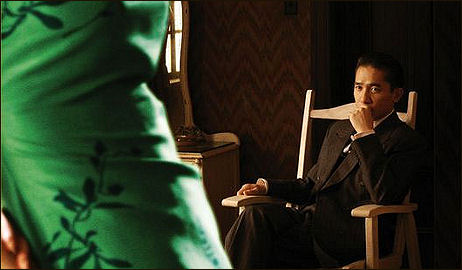
Writing in an 8.26 N.Y. Times piece about Ang Lee‘s Lust, Caution, which will show at the Venice and Toronto film festivals before opening on 9.28, Dennis Lim has reported that the film, which is in Mandarin, “runs two and a half hours.” He also says that the sex scenes between Tony Leung and Tang Wei, which resulted in an NC-17 rating judgment a few days ago, are “notably revealing and acrobatic.”

Gonzalez is gone

“Turning and turning in the widening gyre, the falcon cannot hear the falconer. Things fall apart, the center cannot hold, and mere anarchy is loosed upon the world. The blood-dimmed tide is loosed, and everywhere the ceremony of innocence is drowned. The best lack all conviction while the worst are full of passionate intensity.” — W.B. Yeats, “The Second Coming.”

Beatty and the sound of cannons

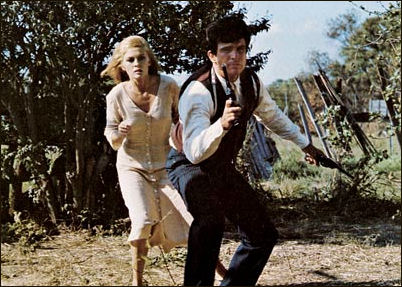
Another looking-back-on-Bonnie and Clyde-40-years-later piece? This one being from London (i.e., the Guardian‘s Philip French), it reminds me of Warren Beattys’ story of a London freakout he experienced with this film, and how it all began with his wanting the Bonnie and Clyde gunfire to have a cannon-roar sound like the guns in Shane, and how Beatty gone to director George Stevens and asked him how to create the exact same sound.

Flash forward to the the film’s late-1967 premiere in London (at a prime theatre in Leicester Square), and Beatty noticing that the gunfire sounded soft and muffled.

Enraged, Beatty runs upstairs to the projection booth to see what’s up. The projectionist, surprised to see Beatty, tells him that he ran Bonnie and Clyde earlier that afternoon and realized it had an atrocious sound mix, especially regarding the gunfire. So he did Beatty a favor by making up a time chart telling him at what exact points to turn down the sound as the gunfire wouldn’t sound so cannon-like. “This is one of the worst mixed films I’ve ever seen,” the guy said . “In fact, I haven’t seen a film mixed this badly since Shane.”

Sad News

I tried finding out what the real Owen Wilson situation might be from sources after I heard the reports around 9:15 pm, but I started too late in the evening. When Joe Leydon called to ask what I knew (not knowing himself what had or hadn’t happened), my first reaction was “oh, God.” I’m very sorry if it’s true, and may the worst of it (whatever “it” might be) be over. A little recovery, and then on to Darjeeling Limited press duties, making Justice League, etc. Life isn’t perfect but you have to live it anyway.

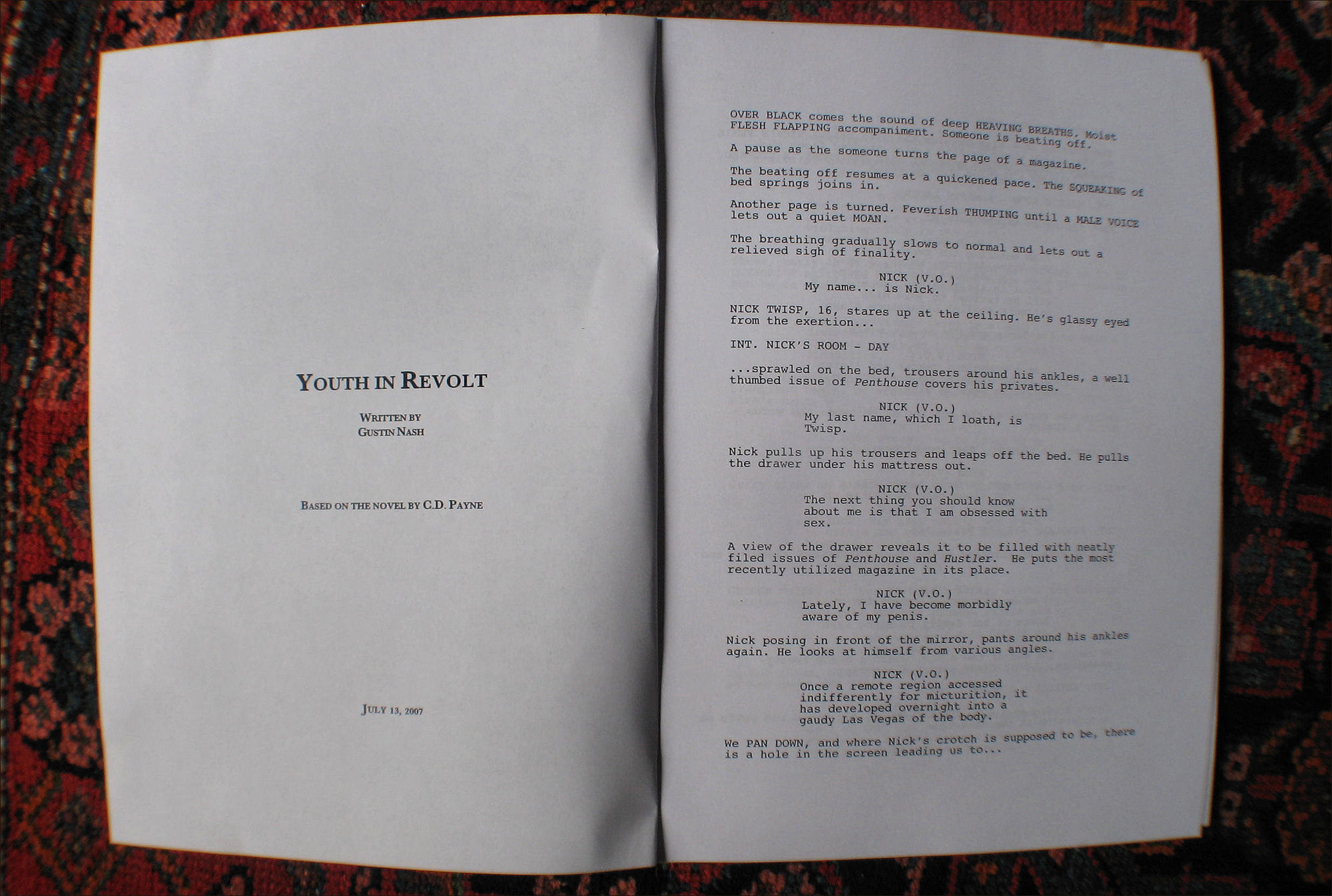
“Youth in Revolt” script

Gustin Nash‘s 125-page screenplay based on C.D. Payne‘s Youth in Revolt. The film will star Michael Cera (the wry, moralistic, level-headed thin guy with the I’m-only-partially-here personality in Superbad — I’m explaining because he’s not a household name) as “Nick Twist” when it goes before the camera sometime…I don’t know when it’s going before the cameras.


The drive and industriousness in getting hold of this script is equally matched by my laziness in having failed to read it despite it being on my dining-room table for neary two weeks

“Bourne” vomit in the room

Shaky-cam Bourne vomiting has been brought up by Roger Ebert by way of a letter forwarded by David Bordwell (“the most respected film academic,” Ebert says) that was posted on movies.com a while back by “sfjockdawg,” to wit:

“We went to see The Bourne Ultimatum on the IMAX in San Francisco. Near the end, when Webb is having the flashback to when he [was] forced to show his commitment to the project, the lady next to me spontaneously unleashes a huge amount of vomit all over my leg and all over the floor in front of her! I’ve never experienced anything like it in my life! All the action sequences, the nauseating use of moving cameras and the relentless score were enough to make anyone dizzy, but to throw up?”

Like Jason Bourne himself, this item triggered a repressed memory in the brain of yours truly — a vomit-splatter that happened during an early-ish screening of The Bourne Supremacy on 7.12.04.

Sometime during the third act of a showing at the Writers Guild theatre, an older woman sitting on the left side spewed on the floor. It was kind of alphabet soup-y mixed with pumpkin puree and chopped Spanish peanuts. A few people got up and moved away. A guy who was sitting nearby told me later it smelled pretty awful in that section of the room.

The next day I mentioned the episode to a Universal publicist in an e-mail, not as something that was necessarily caused by Paul Greengrass shaky-cam but as something funny that had merely “happened.” I was chuckling the way a fifth- grader would chuckle with his friends if the really smart girl with the freckles and the pigtails had vomited in arithmetic class, but the publicist wasn’t in fifth grade — she was coming from the office of Roy Cohn during the Army-McCarthy hearings.

Her voice shrill and agitated, she read the riot act in order to dissuade me from mentioning the incident in the column. I felt so overwhelmed with bludgeonings and bad vibes that I caved (wimp that I am deep down) and said, “Okay, all right…good God.”

Only now, three years and 40 days later, can the story be told.

I’m wondering if Roger Ebert would have gotten the same phone call and had to deal with the same agitation from this very willful publicist if he were based in Los Angeles and had been in the Writers Guild auditorium on Doheny that fateful night.

Spilled coffee

True story, no names, happened a few years ago: A big-name actor is being driven out to a location shoot in a rural area with a producer, a p.a. and someone else. The actor has a styrofoam cup with steaming black coffee in his hand. The producer, sitting next to the actor in the back seat, reminds that they’ll be driving on a dirt road filled with big potholes, and that he needs to put a plastic top on the cup or else.

The actor says nothing, but it would be putting it mildly to describe the look he gives the producer as “hostile.” The producer drops it, turns away…whatever.

Ten minutes later they’re into the potholes and sure enough they hit a big one and almost half of the actor’s coffee spills on his lap. Right on his balls. Big dark stain. You can almost see the steam coming off his pants, but the actor just sits there, looking out the window and sipping what remains of the coffee — not a yelp, not a word. Because admitting he was wrong in ignoring the producer’s advice would be totally unthinkable.

Looking back at “Revolutions”

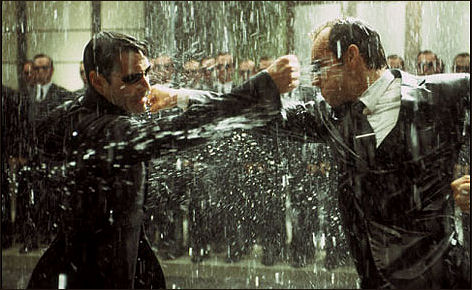
We’re approaching the four-year anniversary of the final collapse of the Matrix theology that came with the 10.27.03 release of The Matrix Revolutions. Too bad it’s not the fifth anniversary or I could tap out a stock-taking piece. It was a pretty amazing meltdown; hard to believe it all happened the way it did.

Are the second and third Matrix films still the most despised and discredited franchise films ever made? Is there anyone in the world except for the 300 or 400 remaining Wachowski geeks out there who’s even watched Matrix Reloaded or Matrix Revolutions on DVD over the past three or four years?

I wrote a piece called “Neo Schmeo” that summed it all up back in October 2003:

“I never would have guessed after getting my first look at The Matrix — a movie that freed my heart and made me levitate — that the sequels-to-come would turn out as badly as they have.

“Now the word is spreading like a huge fart and it’s all over but the revenues. This franchise went spiritually belly-up after the release of The Matrix Reloaded last summer, and now here’s The Matrix Revolutions to drive the final stake in and kill it for good. The legend, the faith, the magic…dead.

“You may be able to figure out most of what’s going on in Revolutions…or not. Point is, if your experience is anything like mine you’re going to stop caring anyway because you’re going to find yourself realizing with a jolt you’re totally done with looking at Carrie Ann Moss and fat Larry Fishburne doing that deadpan superhero thing in those shades and leather outfits.

“It hit me around 25 minutes in. I said to myself, ‘I’m done. I don’t want to watch this shit any more…ever.” I see the Matrix Reloaded DVD on the shelves at my local DVD store and a thought never even occurs to me about renting it. I don’t want to look at a scene, a snippet…nothing.

“I could go on for six or seven paragraphs trying to pick through what made sense to me and what I’m still trying to figure out, but why should I write anything in this column that will pay even an oblique tribute to something I believe everyone should wash their hands of?

“I saw Keanu Reeves in Nancy MeyersSomething’s Gotta Give last night (i.e., Monday) and I was so grateful he wasn’t wearing his leather Neo outfit I almost teared up. He looked so normal and natural and regular guy-ish. Considering the metaphorical implications made me feel light in the head.

“It doesn’t matter what Revolutions makes. Either it gets people where they live (like The Matrix did) or it doesn’t. Millions are going to go this weekend and what of it? Ticket sales don’t mean anything. Not with big-studio tentpolers.

The Matrix Revolutions is like a bowl of narrative spaghetti, meant to be savored (I presume) for being a wonderful tangle that geek boys can dive into and try to put together in some fashion. But there is no one strand that leads to any kind of thematic core or foundation that seems to support the whole thing. The story hasn’t been told — it’s been heaped upon us like some kind of bizarre attack of live pasta and CGI squid.

“The big attack sequence on Zion is too overwhelming to make much of an impact. Too many millions of sentinels, no way of keeping score, and I don’t want or need this in my life.

“”I know this: When inquiring minds feel they need to compare notes in order to get their heads straight about what may or may not have happened story-wise, which I was doing with friends in front of the Fox Village last Thursday night and then on the phone and internet after that, the movie hasn’t done its job.. Journo after journo raised their eyebrows and gave me that ‘look’ after the all-media screening.

“One guy said, ‘Oh, well…!’ Another said, ‘I hated it!’ Another said, ‘Who was that big Wizard of Oz guy with the big deep voice at the end? Where was he during the last two installments…?’

“The single best bit in the whole thing is when Neo tries running on foot out of the train station, and finds himself right back where he started a second later.

“The second best scenes in the film both belong to Hugo Weaving. His scene with the Oracle, and his scene at the end when he talks about the meaninglessness of it all, blah, blah. That was great.

“They should have left it alone with the original The Matrix, and been proud of that triumph, and gone on to something new and fresh. But no — Joel and the boys and Keanu Reeves wanted to make all that money. And money’s all they’re going to get.”