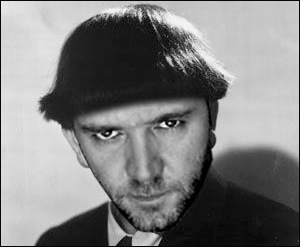
Russell crowe as Moe

It hit me last weekend (along with several thousand others) that the failure of The Heartbreak Kid could mean that the Farrelly brothers are finished. It seems as if they are right now — yes, I’ll admit that, the curtain has come down. But they can get it right back if they make that Three Stooges movie they’ve been talking about for three or four years now, and I mean with Russell Crowe as Moe. I don’t care if he’s told them “no” a hundred times. He’s the only guy for that part. No one else.

It’s true that the Farrelly’s moment of perfect cultural synchronicity — a four-year stretch that began with Dumb and Dumber and ended with There’s Something About Mary — has passed, and that Judd Apatow has taken the king of comedy crown away from them. (Mary was nine years ago…the train has moved on.) It all comes down to the Stooges. Make it right (which hinges upon casting it right) and all is forgiven. And they can do it. I know they can.

Dean scream movie

The killing of Howard Dean‘s Presidential primary campaign was a deliberate media hit job. News producers played that “yeeahhhhh!” video clip (pulled from Dean’s speech to followers after his third-place showing in the 2004 Iowa caucus) hundreds and hundreds of times over the next two or three days until Dean had been turned into a complete clown, a punchline, a living Wilhelm scream.

And now Leonardo DiCaprio wants to portray Dean in a film version of a play called Farragut North, written by former Dean staffer Beau Willimon about “a novice but inspired campaign staffer who works for an unorthodox presidential candidate. George Clooney would direct and produced the film for Warner Bros.

The most interesting story, for me, wouldn’t be about the experience of a Dean campaign worker, but about how and why the “yeaahh!” clip was seized upon and exploited by the media in order to destroy Dean. He might have lost the nomination to John Kerry in the long run, but the clip killed him. It was one of those amazing media moments in which a political movement was assassinated so that a few hundred TV stations could broadcast a cheap laugh and maybe boost ratings. It was a defining triumph of media mediocrity.

Here are two of the best YouTube “yeaaaah!” clips I could find — clip #1 and clip #2.

Weekend numbers

Yesterday Variety‘s Ben Fritz and Dave McNary reported that Elizabeth: The Golden Age, Michael Clayton, Tyler Perry’s Why Did I Get Married? and We Own the Night “are expected to gross in the low- to mid-teens” in a kind of even-steven fashion, and I said I’d been told that Why Did I Get Married? would do “$20 million-plus, and that the others will come in at $10 to $12 million lowball, and $12 to $14 million at best.” That’s more or less what’s happened. My estimate, I mean, and not Variety‘s.

There’s too much product out there and product kills product, but despite the glut Why Did I Get Married? — far and away the weekend’s #1 film — will end up with $22,151,000 by Sunday night, give or take.

The Game Plan will be second with $11,226,000 — almost exactly half of Perry’s earnings. James Gray’s We Own The Night will come in third with $10,948,000 — a little over $4000 a print and going nowhere. The fourth-place Michael Clayton is probably doing well in the uptown regions, but the rurals are giving it the bum’s rush — a projected $9,893,000, under $4000 a print, dying in Middle America.

The Heartbreak Kid is down 50% for a projected $7,064,000 and a fifth-place showing.

Elizabeth: The Golden Age has gone down to the sea in ships. It will take in $6,383,000 — 2000 theatres, $3200 a print. The women and older couples read the reviews and said “later.” Cate Blanchett‘s Ziggy Stardust has slipped beneath the waves and been embraced by Bill Nighy‘s Davy Jones. “You are one of us now,” he says as he looks into her eyes and her soul. “Tug on my facial squid tentacles and join us in eternal damnation.”

The Kingdom will come in seventh with $4,467,000. Across The Universe is eighth with $3,921,000 and $4100 a print. I don;t care about the ninth- and tenth-place finishers. Sleuth opened in 9 theatres and only made $4000 a print…disaster. Control , the best of them all, has been playing in one theatre in the Village and will take in $28,000.

Bart on feel-bad genre

“A strike looms, the war seems unrelenting and the country is fragmented politically,” notes Variety‘s Peter Bart. “So here’s Hollywood’s response: a new genre called the feel-bad movie.”


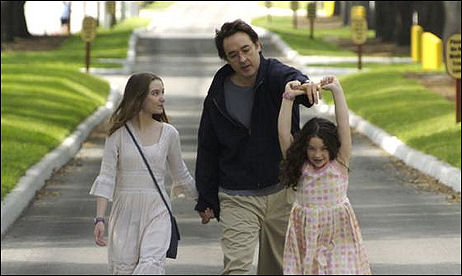
Grace Is Gone — a sad movie that makes you feel pretty good because it mostly feels right and true and uncluttered.

Bart is talking about movies about “revenge-seeking crime victims” (The Brave One), “terrorist assaults” (The Kingdom), “disappearing Iraq vets” (In The Valley of Elah) and “lovers who’ve learned to hate each other” (clueless). I wasn’t the least bit depressed by these three myself. You want depressing? Go see Elizabeth: The Golden Age. I honestly had thoughts about being taken to a hospital in an ambulance after seeing this film in Toronto.

Jodie Foster and Neil Jordan‘s film didn’t make me feel bad except at the end because I didn’t buy a cop saying to a pretty middle-aged perp he’s attracted to, “Shoot me in the fleshy part of my arm…fuck, that hurts!” The Kingdom‘s terrorist attack at the beginning wasn’t depressing in the least. People are getting blown up all the time in the Middle East these days…what? Plus it had a kind of jolting impact quality. And that cloying Annie Lennox song aside, I was turned on by Elah — by Tommy Lee Jones‘ immensely sad craggy face, the general depth of feeling, Roger Deakins‘ cinematography, etc. One of the least “depressing” films of the year, if you ask me.

In any case, feel-bad or feel-good isn’t what most people go to movies for. (Except for the idiots.) The idea is to experience some kind of distillation of something true and whole and eternal in life, and from this feel (and perhaps even learn) something that fortifies the soul — an absorption of values that stick to the ribs. I really don’t think people don’t want happy or sad — they want a sense of justice, insight, calm and recognition.

Grace is Gone is not a gloom trip, although some are probably muttering this to their friends. There’s a difference between sad and depressing. Sad is feeling that stirs you in a hurting, chest-flooding kind of way and makes you moisten or tear up. Depressing is being in a kind of jail in which you have three choices — suffer in silence, catch some zees or escape from Alcatraz (i.e., slip out the door after the publicists have left).

If a movie conveys a fundamental truth — something that makes you say to yourself, “Yup, that’s the way it is out there…the way people are, the way life sometimes goes” — and does so with clarity and economy with a little wit and edge with some likable, talented actors, people will usually come. Unless they’re really young or pathetically uneducated or red-state rube-ish (“Which movie gives the best quaalude high?”).

“I’m not a cinematic philistine,” Bart writes. “I applaud filmmakers for dealing with real issues in the real world. At the same time, the feel-bad genre (which is only in its early stages) is becoming downright oppressive. Filmgoers have a right to ask: When do we get some comic relief?”

Give us the pat homilies of The Bucket List, he seems to be saying. (I’m reading the script as we speak.) Give us a solid movie about values and setting straight the sins of the past like The Kite Runner. And please, not too many arterial throat soakings in olde London. We know There Will be Blood will be great, but not too violent at the end! And most of all, give us a nice feel-good movie about Tom Hanks, Phillip Seymour Hoffman and Julia Roberts single-handedly helping the Muhjadeen to kick the Russians out of Afghanistan in the 1980s.

Pro and Con

Sometimes your opinion is in line with almost everyone else’s, and sometimes you’re on an island with maybe four or five others keeping you company. You have to chill down and get philosophical ’bout dat island, dawg. If you’re not in with a fairly small minority at least once or twice each year, you’re probably doing something wrong.

Cases in point: Elizabeth: The Golden Age and Things We Lost in the Fire.

My reaction to Elizabeth during the Toronto Film Festival (“Is it me or the movie, or should I just take the elevator up to the roof and jump off?”) may have seemed extreme to some at the time, but it has a rank 25% positive on Rotten Tomatoes on this, the day it opens nationwide.

I’ve heard from enough people since running my review last weekend of Things We Lost tin the Fire that while nearly everyone admires Benicio del Toro‘s perform- ance, people are generally mixed about or cool to the film itself. A publicist (and a friend) told me today I’m the only writer she knows of who really loves it. I saw it again last night and I know what I know. I’m not Zelig.

My favorite line from Manohla Dargis‘s N.Y. Times pan of Elizabeth: The Golden Age: “The queenly body quakes as history and fantasy explode.”

Will Tyler Perry win out?

Variety‘s Ben Fritz and Dave McNary have reported that weekend’s four big openers — Elizabeth: The Golden Age, Michael Clayton, Tyler Perry’s Why Did I Get Married? and We Own the Night — “will all be released or expanded at 2,000-plus theaters and are expected to gross in the low- to mid-teens.

“Studio sources uniformly agreed that the weekend looks like a toss-up, with any of the four debuts having the potential to break out. The four bows are aiming at somewhat different auds, leading studios to hope they can co-exist peacefully.”

I’m not hearing that. One guy, anyway, is telling me Why Did I Get Married? is looking at $20 million-plus, and that the others will come in at $10 to $12 million lowball, and $12 to $14 million at best.

Bevan, Fellner laundry list

It’s a law of nature that even the best-liked producers with the finest taste buds have to make an occasional stinker. Nobody bats .1000. The law of nature, averages, expediency…one of those. And so Working Title co-chiefs Tim Bevan and Eric Fellner have produced Elizabeth: The Golden Age, Love Actually, Bridget Jones: The Edge of Reason, Smokin’ Aces, Chicago Joe and the Showgirl and two or three other clunkers.


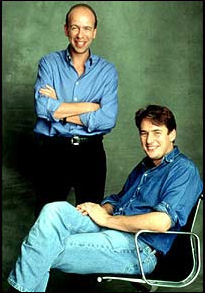
Tim Bevan (l.), Eric Fellner (r.)

But for a couple of guys who’ve been been a hot team for 22 or 23 years and have made close to 100 films since the Ronald Reagan era, a mere seven or eight duds in all that time is an amazing record. Seriously.

It is therefore allowable that Variety‘s Anne Thompson has written a kiss-blowing, laundry-list profile of these guys. Every now and then the subjects of these trade- magazine pieces actually merit the gymnastic kowtowing.

Especially with Joe Wright‘s Atonement, which Bevan and Fellner produced, being a more-than-likely Best Picture contender. And with well-scripted films like Paul Greengrass‘s Imperial Life in the Emerald City, the Coen Bros.’ Burn After Reading, Ron Howard‘s Frost/Nixon, Kevin McDonald‘s State of Play and Beeban Kidron‘s Hippie Hippie Shake coming down the pike.

All that said, there’s a very small part of me that can never forgive and will never forgive Bevan and Fellner for producing Love Actually.

Blanchett as Dylan

“It seems a safe bet that Cate Blanchett will be in the race for Elizabeth: The Golden Age,” Hollywood Reporter columnist Martin Grove has written. “Blanchett won a best supporting actress Oscar in 2005 for The Aviator, [and] her already acclaimed second performance as the 16th Century English Queen could bring her a second Oscar, but this time for best actress.”

Not happening. No way. The Cate performance of note is her Blonde on Blonde Dylan in I’m Not There.

In his review of Elizabeth: The Golden Age, Maxim critic Pete Hammond says “[it] will most likely be admired by those who have actually already reached their own ‘golden age’, say around 60 or so. This one is squarely aimed at the kind of crowd who loves seeing big, blustering epics where monarchs dress in what looks like opulently appointed outdoor tents and ferociously shout lines like, ‘I have a hurricane in me that will strip Spain bare if you dare to try me!’ No problem, we believe you.”

Kenny vs. Finke

Yesterday Premiere critic-columnist Glenn Kenny disputed Nikki Finke‘s recent claim, as stated in an Elle magazine interview, that she her campaign against torture porn was somewhat successful in shutting the sub-genre down.

In response to which Finke posted a response this morning to Kenny, to wit: “Didn’t your dumb-ass movie magazine go out of business in the U.S. because (a) it sucked, and (b) it sucked up to Hollywood so pathetically that even the movie biz lost respect for it?” In response to which Kenny replied, “Hey, great to hear from you, Nikki. Say, are you ready to file that Ovitz piece yet? When did we assign it to you — 1997? Stay classy!”

“Band’s Visit” turndown confirmed

Academy spokesperson Teni Melidonian, who works for Leslie Unger, confirmed this morning that the Academy has in fact ruled against Eran Kolirin‘s The Band’s Visit from competing for the Best Foreign Language Film Oscar because the Academy’s foreign branch has determined that more ” a majority” of the dialogue is in English. Melidonian also said that no appeal will be considered. On top of which three Israeli news sources — Haaretz, the Jerusalem Post and Israeli blogger Yair Ravehreported yesterday that this decision had been reached.

And yet Indiewire‘s Brian Brooks wrote this morning that that reports of The Band’s Visit being disqualified are “rumors” that are “unconfirmed.” Brooks also included an observation that Sony Classics chief Michael Barker was “not bothered by the rumors” and that The Band’s Visit “is in keeping in a long tradition of foreign language films that have some English.” On top of which Variety had filed nothing at all (to judge by a search on the Variety website plus several calls made to Variety editors and reporters) about the decision.

Donhohue vs. “Golden Compass”

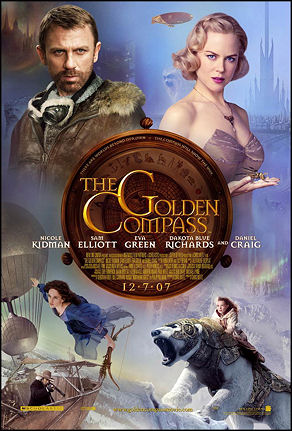
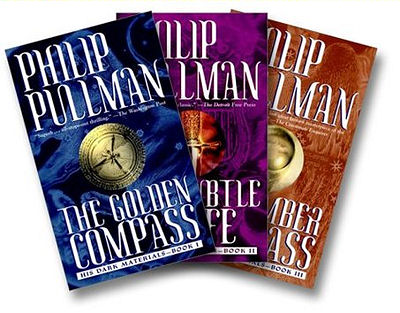
The Catholic League’s Bill Donohue occasionally rips into this or that Hollywood movie for delivering his idea of an un-Christian or anti-Catholic message (ask Kevin Smith), and his latest salvo is against director-writer Chris Weitz and New Line Cinema’s The Golden Compass (New Line 12.7), an adaptation of Philip Pullman‘s fantasy novel that is one of a trilogy called “His Dark Materials.”
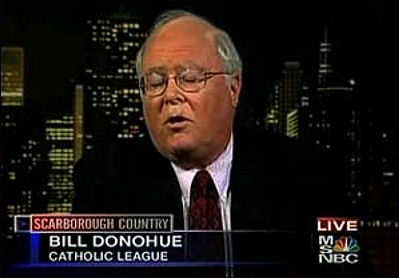

Catholic League spokesperson Bill Donohue
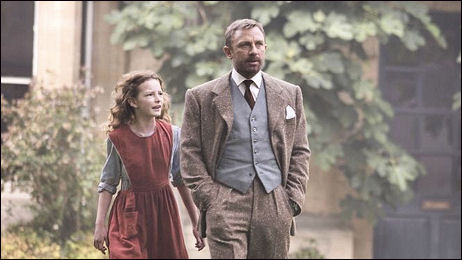
Dakota Blue Richards, Daniel Craig in The Golden Compass

Donohue is not actually not ripping into the film as much as trying to warn Catholics parents not to give the “Dark Materials” trilogy to their children as a Christmas present, which would be tantamount, he feels, to indoctrinating them into the evils of atheism.

Donohue’s basic beef is that unlike C.S. Lewis‘s The Chronicles of Narnia, which spawned the popular ’06 Disney film that was widely seen as an allegory about Christianity, Pullman’s “Materials” trilogy basically pushes an atheist, anti- Christian message.

Weitz’s film has been “toned down so that Catholics, as well as Protestants, are not enraged,” says Donohue, but he wants Catholics to be wary of the film because it might lead to parents buying the “Dark Materials” trilogy for their kids.

A New Line spokesperson said this morning that a statement about Donohue’s attack would be forthcoming.

The movie stars Nicole Kidman, Daniel Craig and Dakota Blue Richards. Weitz directed and wrote the screenplay. Set in an imaginary/parallel/metaphorical universe, it’s about a young girl named Lyra Belacqua (Richards) who journeys to snowy northern terrain in order to “save her best friend and other kidnapped children from terrible experiments by a mysterious organization,” etc. Aaah, but what real-life mysterious organization could Pullman be referring to?

Here’s Donohue’s written statement, and here’s a video presentation that spells it out.

“A film called The Golden Compass opens December 7,” be begins. “It is based on the first book of a trilogy titled ‘His Dark Materials.’ The author of this children’s fantasy is Philip Pullman, a noted English atheist. It is his objective to bash Christianity and promote atheism. To kids. The Golden Compass is a film version of the book by that name, and it is being toned down so that Catholics, as well as Protestants, are not enraged.

“The second book of the trilogy, ‘The Subtle Knife,’ is more overt in its hatred of Christianity than the first book, and the third entry, ‘The Amber Spyglass,’ is even more blatant. Because The Golden Compass is based on the least offensive of the three books, and because it is being further watered down for the big screen, some might wonder why parents should be wary of the film.

“The Catholic League wants Christians to stay away from this movie precisely because it knows that the film is bait for the books: unsuspecting parents who take their children to see the movie may be impelled to buy the three books as a Christmas present. And no parent who wants to bring their children up in the faith will want any part of these books.

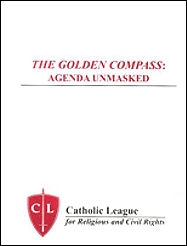
“‘The Golden Compass: Agenda Unmasked’ is the Catholic League’s response. It provides information about the film, The Golden Compass, and details what book reviewers have said about Pullman’s books; a synopsis of his trilogy is also included.”

Newark Star-Ledger critic/columnist Stephen Whitty knows about these books a lot more than I do — here‘s his take on the matter.