Parallel stories

So there’s a mild story-telling phenomenon afoot these days: movies about two strong assertive alpha males who never meet during the course of the film until the very end, which a friend feels amounts to a kind of cheat. I think parallel-fate stories are interesting as hell, but I know what thsi guy means. You see two tough male leads on the poster and you figure, okay, these guys are going to mix it up on some level. And then they don’t.

The worst case, he feels, was War, the Jason Statham/Jet Li flick “that marketed itself as a big action movie pitting them, when in fact they were only screen together for about 10 minutes and fighting for about five.

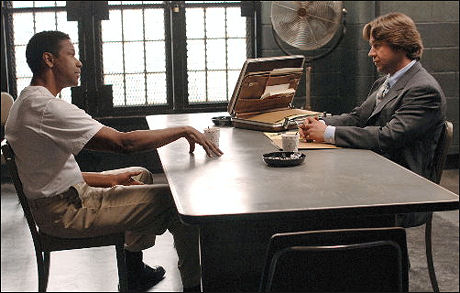
American Gangster is like that too, cutting back and forth between Russell Crowe and Denzel Washington and only putting them face to face at the very end.

“By its nature, The Departed was like that, too, where we never saw Matt Damon and Leonardo DiCaprio on screen together except for that chase sequence in Boston’s North End.

Reservation Road is another example, he feels. “Joaquin Pheonix and Mark Ruffalo meet a couple of times, but they only really come together at the end for that memorable scene.

“I realize that the film is assembled like the book (which has one chapter called ‘Ethan’ and the next called ‘Dwight’) but I wonder if this is something that’s being done to help with budget since you only need the big stars for half the scenes you would normally (i.e., 3 weeks rather than 6 weeks) with little overlap?”

“Can you think of any other movies recently or in the past that followed this trend?”

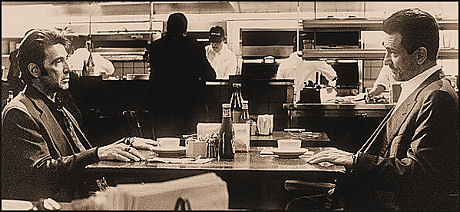
Yeah, but an excellent one — Michael Mann‘s Heat. Robert De Niro and Al Pacino spoke to each other in just one scene (i.e., the face-to-face over coffee at Kate Mantilini) but is was as good as mano e mano dialogue scenes get, and it was all the movie needed. Note: They also speak to each other in the final scene, of course, but barely. De Niro: “Told you I wasn’t going back [to jail].” Pacino: “Yeah.”

Pete Hammond reminded me that Sidney Poitier and Anne Bancroft never meet at all in a 1965 drama called A Slender Thread — about Poitier trying to talk Bancroft out of committing suicide. And of course, Claude Lelouch used parallel stories (i.e., the lovers never meeting until the end) in in at least two of films — And Now, Ladies and Gentleman and (as I recall) Another Man, Another Chance.

I can’t think of any others, although I’m sure they’re numerous.

Weekend numbers

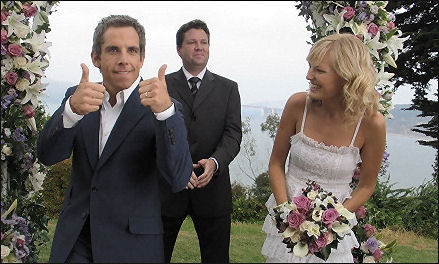
The Heartbreak Kid was never tracking through the roof, but “it looked like $20 million” or something close to that. Nikki Finke reported late yesterday afternoon that this projection had been scaled back to $15 to $16 million, and now even that figure hasn’t been met. The Farrelly Brothers/Ben Stiller film did about $4,585,000 yesterday and is projected to earn $14,434,000.

That’s a bit of a stunner. Obviously people detected something in the ads and trailers that turned them off to some degree, but what? Marital discord, betrayal, embarassment, humiliation….something. I suspected that the film’s mysogynist element might hurt business after a few days in theatres, but I didn’t see a first-weekend shortfall. The reviews were pretty bad (some were downright hateful), but this is a very funny film at times. Anyway, a big downer for Peter and Bobby Farrelly (remember those Something About Mary days when they were the kings of screen comedy and Judd Apatow wasn’t?) and not such a good thing either for Ben Stiller. It’s a tough world out there.

Good new for Michael Clayton, though. Tony Gilroy and George Clooney‘s corporate thriller opened in 15 theatres, pulled down about a little $12,000 per screen yesterday and is looking at a $44,000 average over three days and a cume of $688,000.

Wes Anderson‘s The Darjeeling Limited expanded to 19 locations and will have earned $29,000 a print by Sunday night.

The Kingdom will be #2 with $9,471,000, off 45% last weekend’s opener. It’s not going anywhere. What does Jamie Foxx‘s quote have to do with the price of rice? Nothing, but the Kingdom shortall will almost certainly be affected by this.

The fifth-place 3:10 to Yuma will end up with $3,190,000. The cume will be about $48,700,000 by Sunday night. It will obviously top $50 million before it’s done, which is pretty good for a so-so western.

Into The Wild expanded from 102 to 135 theatres, and will take in about $9000 a print for a $1.2 million weekend cume.

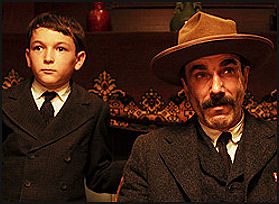
The Assassination of Jesse James expanded to 61 theatres and will pull in about $6700 a print for a cume of $409,000. It’s pretty much dead. I did everything I could to spread the word about Andrew Dominik‘s superb film, but if the dogs don’t want to eat the dog food you can’t stop them. (That’s a Samuel Goldwyn-ism mixed in with something else.) I pleaded with HE readers to drag their reluctant friends to this film, but very few obviously did. The moviegoers of this country are like unwashed junkies, walking around looking for quick-fix, feel-good movie highs. They don’t read reviews, they don’t care about ’70s movies, they have no depth or patience with anything, and too many of them actually enjoy hanging around Disneyland pod-people environments like the Grove, which are being replicated in every city and country around the globe. It’s pathetic, and on top of everything else it’s going to be Hilary Clinton vs. Rudy Giuliani in the Presidential race.

Hammond on hunkering down

It’s good to have Pete Hammond‘s Oscar- handicap column back in play, although it’s running on the Envelope this year instead of Hollywood Wiretap. His opening shot is that “a little game is being played” in order to keep the profiles of likely Oscar contenders low, or at least low-ish. As in Presidential politics, nobody wants to be seen as the front-runner too early.

“Smart Academy consultants — battered by this year-round internet and mainstream media interest in the hunt for awards — are starting to act like CIA operatives, doing everything they can to prevent their prime contenders from peaking and burning out before they even open,” Hammond writes.

“One consultant, knowing this column was starting, pleaded with us not to anoint their holiday hopeful (an early front-runner) as an early front-runner. ‘If you mention the movie just don’t say we’re leading anything,’ the consultant begged.

“Another savvy campaigner, having just seen a preview of a late-December entry, waxed rhapsodic about the film’s attributes and called the film absolute perfection, a ‘real contender,’ but then warned us not to say a word. Your secret is safe here!”

A late December entry? Not much of a secret there — There Will Be Blood or The Bucket List or Charlie Wilson’s War, right? And who in their right mind would call a Rob Reiner film “a real contender” and “absolute perfection”?

Things We Lost in the Fire

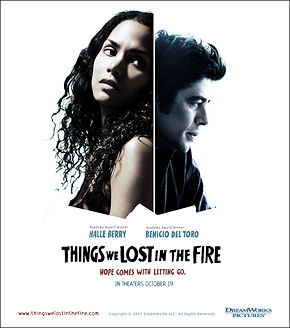
Susanne Bier‘s Things We Lost in the Fire (Dreamamount, 10.19) is like a thousand emotional wind-chimes made into a quiet symphony. It’s my idea of a flat-out masterpiece, certainly within the realm of the family-tragedy drama. Bier knows exactly how to make every moment feel true and on-target, and Benicio del Toro‘s lead performance as a heroin addict struggling to recover and stay that way is the best I’ve seen this year from anyone of either gender, country or classification. Yeah, that’s what I said.
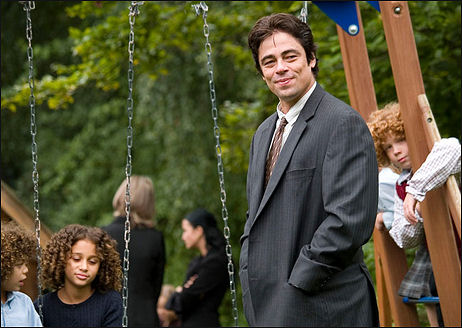

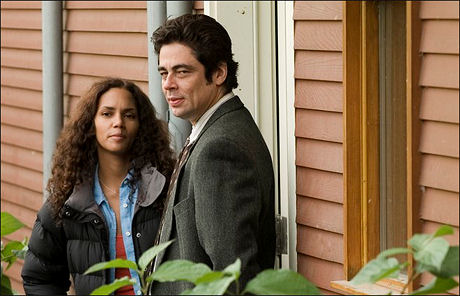
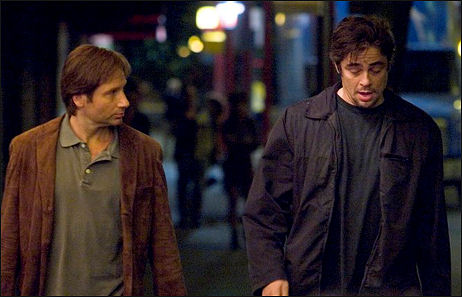
Benicio del Toro in Things We Lost in the Fire

I saw Bier’s film yesterday afternoon and came out weak-kneed. I knew it was doing something really right and dead-center five minutes in. Films about healing and recovery (the oppressors in this case being grief and drug addiction) can sound dreary as hell when you read the capsule descriptions, but there are some that settle down into themselves and strike deep, sonorous chords (in the vein of, say, Ordinary People, which isn’t as subtle and carefully shaded as this one). Add the curious but unmistakable chemistry of spot-on performances (i.e., the ones that never seem to try to do anything but wind up doing everything) and you’re left with something that can feel almost miraculous.

Dreamamount is sitting on Things We Lost in the Fire like a chicken sits on an egg. Bluhhhhck! They’re keeping it warm and protected, but they’re not exactly doing the old ballyhoo cartwheel. I’m guessing that the film hasn’t played all that strongly with Average Joes (i.e., a distaste for stories dealing with drug users?), and that reactions from critics haven’t been universally ecstatic (despite others having had reactions similar to mine), and that a logical decision has been made by marketers to (one deduces) put a cap on spending. Promote the film modestly, put it into theatres two weeks from now, and let it die.

Good smallish films like Things We Lost in the Fire are faintly promoted to death all the time by big-studio marketing departments, who are best (here we go with the cliche) at selling “event” movies, tentpolers, comedies. A movie like Bier’s should probably be released by a TLC outfit like Picturehouse or Fox Searchlight or ThinkFilm or Sony Classics. Movies this good should somehow be given flight. I only know I’m not feeling the presence of this film anywhere (not from ads or from fellow journalists…nothing), and it makes me want to kick something.

I don’t care what others may be saying. I know it when I’ve seen something truly exceptional. Movies about small emotional brewings that gradually turn into magic potions simply don’t get any better than this.

And there can be no beating around the bush about Del Toro’s performance as Jerry the junkie, a once-successful lawyer who’s slid down into the pit. Over the course of this two-hour film he climbs out of his drug hole, brightens up, chills out and settles in, relapses, almost dies, and then gradually climbs out of it again. I’m starting to see this actor (whom his friends and Esquire magazine profilers call “Benny”) as almost God-like. He’s holding bigger mountains in the palm of his hand, right now, than De Niro held in the ’70s and ’80s. He’s one of the top four or five superman actors we have out there. There isn’t a frame of his performance that doesn’t hit some kind of behavioral bulls-eye.

I’ll tell you this — when journalists who’ve seen Things We Lost in the Fire go “I don’t know…meh” and then say in the same breath that some other so-so film is “pretty good” there’s some kind of virus out there that I don’t want to give a name to.

I know that at least two critic friends (one of whom I saw it with yesterday) aren’t big fans. But this is a film that’s been kissed by something. Bier (Open Hearts, Brothers, After The Wedding) is a master of intimacy and soul-searchings that feel un-rhymed and.uncalculated, but which really sink in. The behavior in her films never seems pushed or “performed,” and this is no exception. There’s no question in my head that Fire is her best ever.

I’m really not understanding the subdued response so far to Del Toro’s perform- ance. He might floor everyone next year with his Che Guevara in The Argentine and Guerilla, but Jerry is the best thing he’s done up to now — twitchier than Fenster in The Usual Suspects, weaker and more vulnerable than Javier Rodriguez in Traffic, less ravaged and down-heady than Jack Jordan in 21 Grams.

And Halle Berry has saved her career with her fine performance as Audrey, a Seattle-based mother of two who loses her husband Brian (David Duchovny, rejoicing in his best part since The Rapture), a very successful architect and house-builder, to an act of idiotic violence one night. It’s easily her finest work since Monster’s Ball.

Audrey isn’t a weakling, but she’s prone to emotionally needy behavior at times. Her kids, a six year old buy named Dory (Micah Berry) and a ten year old girl named Harper (Alexis Llewellyn), are as stunned as Audrey but, being kids, seem to have it in them to cope better and recover faster.

Jerry, caught up in a long downswirl and living in a flop house, had been Brian’s best friend since childhood. He’s dazed and out of it when told of Brian’s death, and has to be driven to the funeral reception. Audrey resented him when Brian was alive — she saw him as pure deadweight –but she feels lost and zombified in the days and weeks after the funeral, and one day she invites Jerry to live with her and the kids in a room attached to, but not part of, the house. Not as a mercy or pity gesture (although it’s partly that), but because she feels on some level that she needs some remnant of Brian to keep on with, or at least be near to.

So she helps Jerry out, and then he helps her out (particularly with the kids), and then things suddenly go wrong due to some moments of near-panic on Audrey’s part, which triggers the same in Jerry and before you know it it’s recovery time again and the slow, always difficult process.

Bier and screenwriter Allan Loeb stay as far away as you can imagine from the standard beats and turns in stories like these, first and foremost being the avoid- ance of romantic entanglement (although this is flirted with briefly). The sense of restraint and searching for “a different way to milk it” in Things We Lost in the Fire is constant and, in its own way, quite soothing. Delightful, in fact.

Cheers to a superb supporting cast, particularly John Carroll Lynch (as a next- door neighbor going through his own strife and uncertainty), Alison Lohman and Omar Benson Miller.
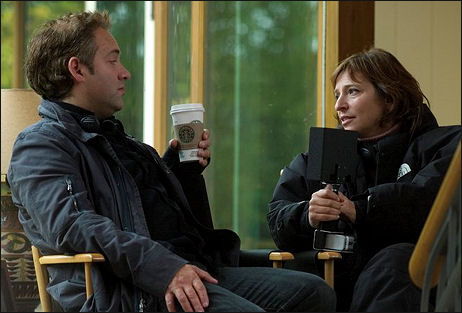

Things We Lost in the Fire producer Sam Mendes (l.), director Susanne Bier (r.)

Sam Mendes, director of American Beauty, Road to Perdition and Jarhead, is one of the producers. I don’t know what he specifically did to help make it turn out this well, but whatever it was, good for him. (Maybe he just got Bier hired, and then sat around and drank Starbucks coffee on the set.) In fact, hooray for everyone and anyone who had anything to do with the making of this film.

I can’t guarantee that N.Y. Times critic Manohla Dargis will dislike this film, and that her kinder, gentler colleague A.O. Scott will review it and say complimentary things, but I suspect this may be the case. A little voice is telling me this.

Breakfast with Gilroy

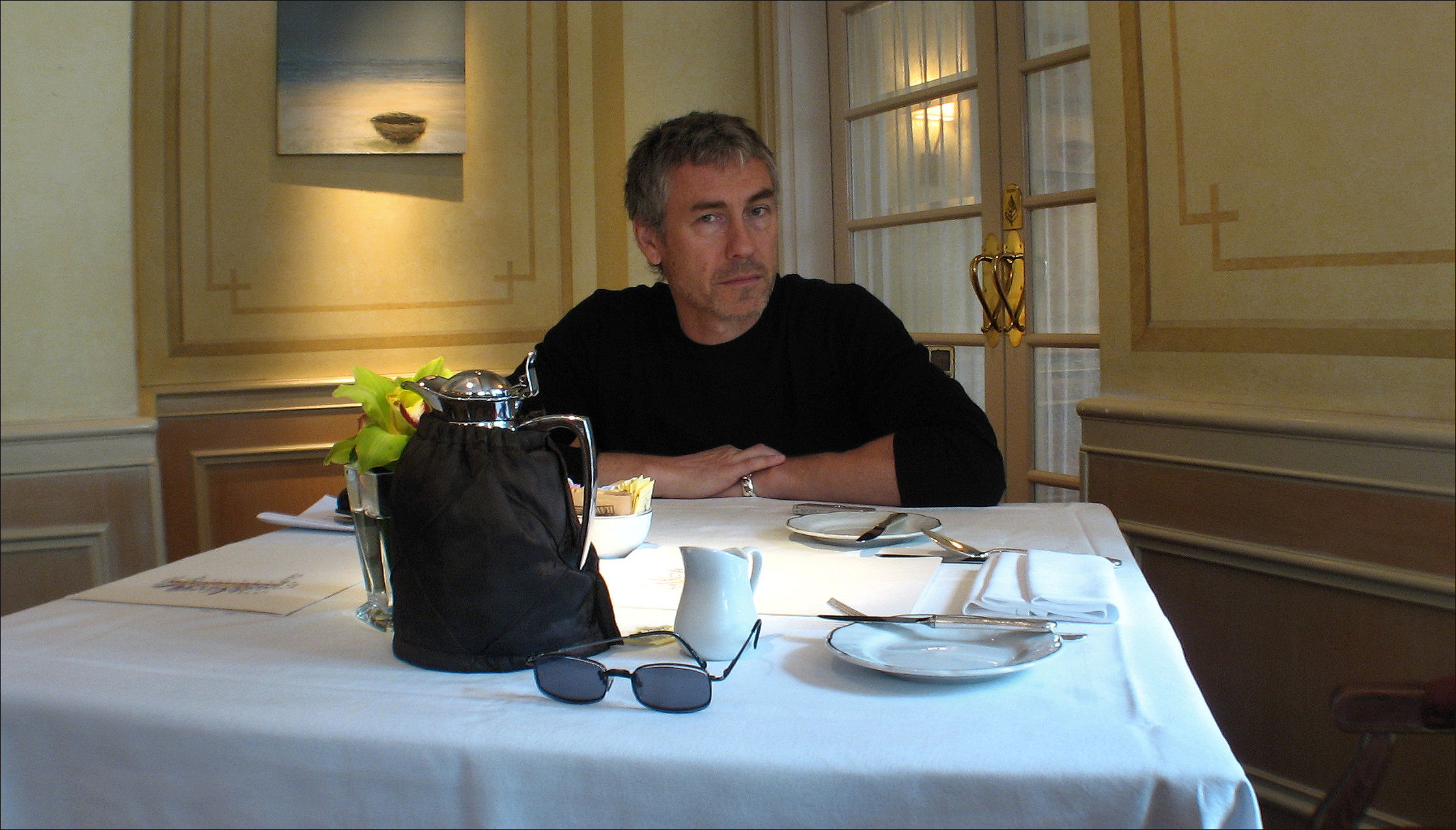
I ran down to the Four Seasons this morning for a breakfast chat with Michael Clayton director-writer Tony Gilroy, and right away it was relaxation time. I asked him two or three toughies, but we talked about everything and could have gone on and on. It felt so easy and unforced that I figured I’d run 95% of the recording, or about 45 minutes worth. It involves the ordering of food and personal stuff here and there, and the sound skips once or twice.


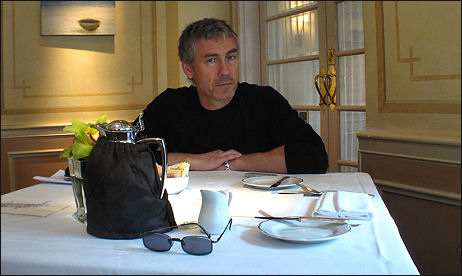
Michael Clayton director-writer Tony Gilroy in the Four Seasons dining room — Friday, 10.5.07, 10:20 am

Michael Clayton is a tense adult thriller about some unsettled and anxious people, but it’s also the kind of film you’d almost like to crawl inside of and settle down in. (I wanted to taste the Italian bread that Tom Wilkinson carries around in a certain scene.) Like American Gangster, I could have rolled with a three-hour version. Said it last month, saying it again — Gilroy’s film is “always ‘on the case’ and never boring. The material that Gilroy, the director-writer, runs with feels as seasoned and authentic as this kind of thing can be. There’s no shovelling — no ‘oh, come on…give me a fucking break’ moments whatsoever.”

“When critics complain about the dumbing down of movies into franchise popcorn, what we’re really doing is yearning for a terrifically engrossing, tethered-to-the-real-world drama like Michael Clayton.” — Owen Gleiberman, Entertainment Weekly.

“This uncommonly intelligent thriller evokes the great films of the 1970s (All the President’s Men, Klute, Three Days of the Condor) that managed to elicit gritty urban realism while maintaining a suave sense of style and moral complexity.” — Ann Hornaday, Washington Post.

Incidentally, Gilroy mentioned that the latest rumor is that the Writers Guild now may be looking to strike on November 1st. Anyone…?

Running times & fighting weights

Anne Thompson‘s 10.4 Variety column about the pitfalls and benefits of long running times observes that “every film has its own shape and focus, to be sure, but figuring out a movie’s ideal scale requires a delicate balance of art, commerce and talent relations.

“Cut a would-be epic too slim,” she writes, “and you wind up with truncated frustrations like Ridley Scott‘s Kingdom of Heaven, Sergio Leone’s Once Upon a Time in America or Oliver Stone’s Alexander, three forced edits that later blossomed in longer form on DVD. [But] let a film run too long and you limit its audience appeal. Think Martin Scorsese‘s meandering Gangs of New York, Michael Bay‘s inflated Pearl Harbor or Peter Jackson‘s King Kong, which added 1and 1/2 hours to the 1933 film’s 100 minutes.”

The universal maxim is that every film has its own fighting weight, so there ‘s no hard and fast rule.

The “fighting weight” line was given to me roughly 14 years ago by Universal marketing guy Marc Schmuger (who is today the studio’s co-chairman). It was for an L.A. Times piece I wrote about Martin Brest‘s Scent of a Woman, which was released at two hours and 39 minutes. Long, yes, but after testing shorter versions (including one running a mere 110 minutes) Universal decided it worked best at that 159 minutes.

Brest’s Scent experience no doubt strengthened his hand, but this, it turned out, worked against him. The length of his next film, Meet Joe Black, was 178 minutes, and this time most reviewers and audiences said “forget it…way too long.”

Lumenick on “Gangster”

From Lou Lumenick‘s N.Y. Post movie blog, posted this morning: “One of the biggest compliments I can pay a movie is that I wish it were longer. Such is the case with Ridley Scott‘s masterful American Gangster. At 158 minutes, it left me wanting more — only the second film this year (after Zodiac) that I can say this about. Like David Fincher‘s film, it’s an exquisitely detailed period piece set in the early 1970s that warrants a full three-hour running time.”

From my own Gangster review of a week or two ago: “I was a wee bit disappointed at the 158-minute running time. I wanted more. This is one of those movies that is so good and cocksure in its New York textures and tough hammer-like attitude, that you’re saying to yourself early on, ‘I don’t want this to end.’ I wanted the indulgent director’s cut right then and there. I wanted Ridley to swing for the bleachers and make it three hours. Hell, I could have gone for three and a half. I wanted to pig out.”

English with German accents

I was speaking a little while ago to Michael Clayton director Tony Gilroy, and we got into the subject of actors speaking English with foreign accents in movies set in foreign-speaking countries. We agreed on two things: (1) It’s entirely the right thing for Benicio del Toro and his costars tp speak Spanish in the two Che Guevara films (The Argentine and Guerilla) for director Steven Soderbergh but (2) Tom Cruise and his mostly British costars speaking with a German accents in Bryan Singer‘s Valkyrie might be a problem.


Maximilian Schell in Judgment at Nuremberg

It might be difficult also if the Valkyrie Germans speak a plain, unaffected mid-Atlantic accent, and it may be okay — I’m not sure. But Cruise trying to sound like Walter Slezak in Lifeboat would be a huge speed-bump. 50 years ago audiences accepted Marlon Brando, May Britt, Parley Baer and Maximillian Schell speaking with German-accented English in Edward Dmytryk‘s The Young Lions, but that belief system may not work any more. Right now I’m hearing Cruise’s voice going through the Brando/Young Lions paces, and I’m going “uh-oh.”

Singer, I think, will have to begin Valkyrie with everyone speaking actual German and then do a sudden Stanley Kramer switch. I’m referring to an early courtroom scene in Kramer’s Judgment at Nuremberg (’61) when the camera zooms in on the German-speaking Schell — a kind of visual announcement to the audience that the film is suddenly shifting gears — and then wham, Schell is speaking English. It works perfectly.

Cruise/Wagner redemption

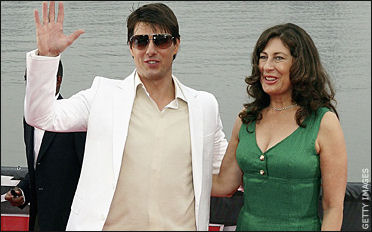
“In Hollywood, there’s redemption, and then there’s redemption,” writes Business Week‘s Ron Grover. “For most folks who make or star in films, redemption is having a hit after a real stinker — when, say, Jim Carrey actually makes another movie that someone other than his immediate family wants to see. The other type of redemption is the kind that superstar Tom Cruise and his longtime producing partner Paula Wagner hope to enjoy soon.”

Fair enough — Cruise and Wagner have bounced back. But then Grover goes into a little tap-dance. This is a piece about redemption, but first Grover has to deal with the very first film coming out of the new Cruise-Wagner United Artists/MGM pipeline..

“On Nov. 9, Lions for Lambs, a political flick starring Cruise, hits theaters,” he writes. “It’s the first in an expected long line of films produced by the duo through United Artists, the company they jointly own with MGM. Will it be a hit? Who knows. The gods of Hollywood can be cruel.” In other words, he’s heard it’s a tank. There isn’t an industry journalist, analyst or pulse-taker out there who hasn’t picked up this scent, and usually — not absolutely but more often than not — this much smoke indicates fire.

I’ve heard one good thing. A friend recently spoke to an actor who has a friend who’s seen it, and this friend-of-the-actor (and you have to watch out for friends- of-actors, as they tend to gladhand) that Cruise’s performance as a right-wing U.S. Senator is “very good.” That’s not surprising, if true. Cruise is excellent at playing adamant and dead-sure-of-himself — think of his interrogation of Jack Nicholson in A Few Good Men, his misogynist messiah in Magnolia, his Today show argument with Matt Lauer.

The unpleasant bump-in-the-road acknowledged and dispensed with, Grover recovers and gets back to the basic theme: “The fact that Cruise and Wagner are in business making films again,” he says, “speaks volumes about human determination, the power of an A-list superstar, and, well, mountains of money.”

Some critics loathe “Kid”

The Heartbreak Kid has obviously touched a nerve among critics. They aren’t just panning it (it has a 34% positive from Rotten Tomatoes) — many of them are vomiting on the sidewalk. A random sampling: (a) “An ugly, hateful and deeply unfunny bit of hackwork that not only stinks on its own but also tarnishes the reputation of a genuinely funny and inspired comedy.” — Peter Sobczynski, efilmcritic.com; (b) “A grim, shrill, deluded and incredibly depressing movie…bewilderingly mean-spirited.” — Carina Chocano, L.A. Times; (c) “Based on the 1972 movie… much in the same way that a breakfast of Pop Tarts and Mountain Dew is based on a petit dejeuner of fresh-baked croissants and cafe au lait.” — MaryAnn Johanson, The Flick Philosopher; (d) “A shabby, sleazy train wreck…anyone who backed it should feel, if they can feel at all, something like shame.” — James Rocchi, Cinematical.

Scott on “Darjeeling”

N.Y. Times critic A.O. Scott says he’s “not dogmatically opposed to remakes, and I’ve admired much of the Farrelly brothers’ earlier work. At their best — in Shallow Hal or Kingpin, say — they show a rare ability to mix the nasty and the nice, to combine humor based in the grossness of the body and its functions with a sweet, humanistic spirit.

“But that generosity seems to have abandoned them here,” Scott observes. “Their squeamish, childish fascination with bodily ickiness, when crossed with the iffy sexual politics of the original, yields a comic vision remarkable for its hysterical misogyny.”

Precisely, and the Farrellys don’t present this squeamishly. They stick to their guns. They stand up, don’t back off. Their viewpoint probably won’t wind up warming the hearts of a significant moviegoing sector — i.e., intelligent women, not to mention guys like Scott — and you have to at least respect the willingness of the Farrellys to ride that horse right into the valley. The Heartbreak Kid is not “nasty and nice” — it is much more single-minded in its view of male-female relationships, and it explains this pretty well.

To repeat: “I’ll tell you the secret to a happy marriage. It is grovelling and kowtow- ing and jumping through hoops whenever she barks for decades and decades as you wait for the sweet embrace of death.”