Ding-dong, Schwartz is toast

I’d be lying through my teeth if I said everyone in the dysfunctional family known as New Line Cinema is sad or heartbroken over the departure of marketing president Russell Schwartz. A guy up to his neck in the mucky-muck called the news “great…a good thing for New Line.” A former New Line executive said everyone in the pipeline had known for months that Schwartz was a dead man, but when told of the actual axe-falling this afternoon he responded with an effusive “wow…it finally happened!”
Variety‘s Dave McNary wrote that Schwartz’s departure “did not come as a huge surprise…he’d been rumored to be on the way out since last year.”
Until Hairspray opened and made (as of last weekend )$78.9 million, New Line’s slate “had chalked up undistinguished box office results on such pics as Snakes on a Plane, The Nativity Story, The New World, Fracture, The Last Mimzy, Hoot, The Number 23, Tenacious D and the Pick of Destiny and Texas Chainsaw Massacre: The Beginning,” McNary wrote. “During 2006, its top performing pic was Final Destination 3 with $55 million.”
Schwartz “is a very nice guy but he never had a clue about mass distribution,” said a marketing veteran. “He’s used to doing small art films…mass distribution is off his radar.”
The former New Line exec said “the marketing over there has been broken for a while, and the talk about Schwartz being on the way out has been happening for a good five or six months. They tried to hire a couple of people to replace [Schwartz] but they couldn’t make it work. There was talk at one time that he would partner up with someone and they’d both report to [New Line’s distribution/marketing president and COO] Rolf Mittweg, but no one wanted to come into that situation.
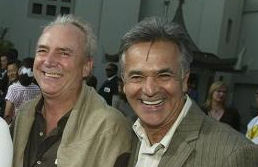

Rolf Mittweg, Russell Schwartz

“The company was split” over the Schwartz situation, the former exec said. “[Production president] Toby Emmerich and his camp wanted to get rid of him, and Rolf and his gang wanted to protect him.
“They had raised expectations so high for Hairspray — they really thought it was a $200 million movie — and its failure to get there may be a part of what happened today. The failure of The Last Mimzy didn’t help. There were people who thought Schwartz should go after the failure of Snakes on a Plane. There were some who said he should be out the door after Nativity went south. The fact that they finally stepped up and did this means they’ve probably got somebody in the wings to take his place.”
Schwartz won’t actually leave the building until the end of August, according to Variety, but where does this leave New Line’s Shoot ‘Em Up , which opens on 9.7? Probably unaffected. Whatever happens box-office-wise, it’ll come into the market- place boosted or depleted by certain Schwartz decisions about this and that. Schwartz, after all, will be out the door only seven days before it opens, according to Variety.

Bad dogs

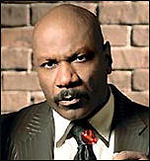
What is with big muscular black guys and their affection for angry snarly dogs that bite, gouge and kill each other in illegal dogfight rings, and sometimes kill the occasional human? Last week Atlanta Falcons quarterback Michael Vick was busted for owning several snarling attack dogs for the purpose of putting them in fight-to-the-death dog battles, and last Friday Ving Rhames stepped into it when two of his dogs (possibly a pair of Fila Brasileiro mastiffs) killed a 40 year-old housekeeper.


Ving Rhames (center) flanked by Fila Brasileiro mastiffs

Rhames wasn’t around when it happened, but who owns dogs with that kind of temperament and potential? It has something to do with a belligerent macho attitude, and I think it’s despicable. Those dogs should be strung up or put before a firing squad. And I were a producer, I’d try to find an excuse not to hire Rhames the next time I need to cast a guy like him. What a brute. According to an MSNBC report, Rhames “bragged” to Time magazine in 2001 that he owned “eight Fila Brasileiro mastiffs — the national dog of Brazil, also used by U.S. Marines in jungle warfare.”
We all know that the dog we own is the person we are deep down. We all laughed when George C. Scott‘s Patton bought “Willie,” the ugly white bull terrier with the pink eyes, because we saw the resemblance. My favorite dogs are love dogs — golden retrievers, in particular, because they’re into hugging and making out and licking your hands and snuggling. I’m also partial to collies and golden labs.

Movie composer doc sucks

Film scores and their composers (and their relationships with directors) could make for a fascinating multi-part series. It’s therefore dispiriting to read that Dan Lieberstein‘s Lights! Action! Music!, a doc that airs tonight on New York’s WLIW , is, in the opinion of N.Y. Times critic Stephen Holden, “a fluffy, disorganized, woefully incomplete compendium of interviews and film clips about movie music…a sampler for a larger and deeper exploration….even on its own terms, a frivolous diversion.”

Rocket Science shout-out

“One of the pleasures of Jeffrey Blitz‘s film is that it immerses us in the fraught, competitive pressures of the high-school debate world — like Spellbound, it gets the details right. Blitz’s brainy kids, who run the gamut from the pathetically awkward to the brazenly self-assured, are a far cry from the usual horny adolescents Hollywood comedies serve up to flatter their target audience. They’re no less hormonal, but a lot more human.” — from David Ansen‘s review of Rocket Science (Picturehouse, 8.10).

Global Warming Denial

“If you think those who have long challenged the mainstream scientific findings about global warming recognize that the game is over, think again. Yes, 19 million people watched the ‘Live Earth’ concerts last month, titans of corporate America are calling for laws mandating greenhouse cuts, ‘green’ magazines fill newsstands, and Al Gore’s An Inconvenient Truth won an Oscar. But outside Hollywood, Manhattan and other habitats of the chattering classes, the denial machine is running at full throttle — and continuing to shape both government policy and public opinion.” — from an 8.13 Newsweek piece by Sharon Begley about the global-warming denial crowd, and the ample funding behind them.

Coarse hedge-funders

Tom Wolfe‘s “The Pirate Pose,” a Conde Nast Portfolio piece about the coarse (and in some cases appalling) social profiles of hedge-fund multi-millionaires, the 21st Century masters of the universe, is an amusing, well-composed read. It was clear two years ago that the hedge-funders were the eager-beavers one needed to talk to about independent movie financing, website-purchasing and any other mode of financial entertainment-industry investment, but I wonder what the very latest tea-leaf reading may be in this realm.

“The collision of new money and old money or, to be more accurate in our American context, slightly older money, has been a recurring drama,” Wolfe notes early on. “At the turn of the 20th century, Edith Wharton established herself as perhaps America’s greatest female novelist by focusing on precisely that. But the current new breed stands apart from all the rest for two reasons.
“First, they have more money, infinitely more, than any of the various waves of new money that preceded them, with the possible exception of robber barons on the order of John D. Rockefeller, who, incidentally, was regarded as a rude Pocantico hillbilly Baptist by society in New York a hundred years ago. Second, hedge fund managers are possessed by a previously unheard-of status fixation.”
And I love this graph about a certain coloration of hedge-fund multi-millionaire trophy wives, whom Wolfe describes in aggregate terms as “Twinkies”:
“The twinkies who have their eggs fertilized by their husbands’ sperm in a laboratory, creating embryos for implantation in the wombs of surrogate mothers who are paid to manufacture children for delivery in nine months, since why on earth should any wife whose husband is worth a billion or even $500 million have to endure the distended belly, bilious mornings, back cramps, not to mention a cramped social life, to end up with her perfect personal-trainer-sculpted boy-with-breasts body she has spent thousands of sweaty hours attaining, ruined… tempting her husband to survey all the little man-eaters out there, including those former wives who used to meet regularly at the Boxing Cat Grill until it burned down, whereas the current wives leave their husbands catatonic before the plasma TV and meet three or four times a week at one local bar or another and drive home in their Hummers and bobtail Mercedes S.U.V.’s, bombed out of their minds, while waiting for the baby to come from the factory…”
I’m now searching around for two or three easy-reading columnists who’ve been keeping tabs on hedge-fund investment activity in the entertainment industry and reporting about it in layman’s terms, and if anyone has any tips…

“Yuma” boy

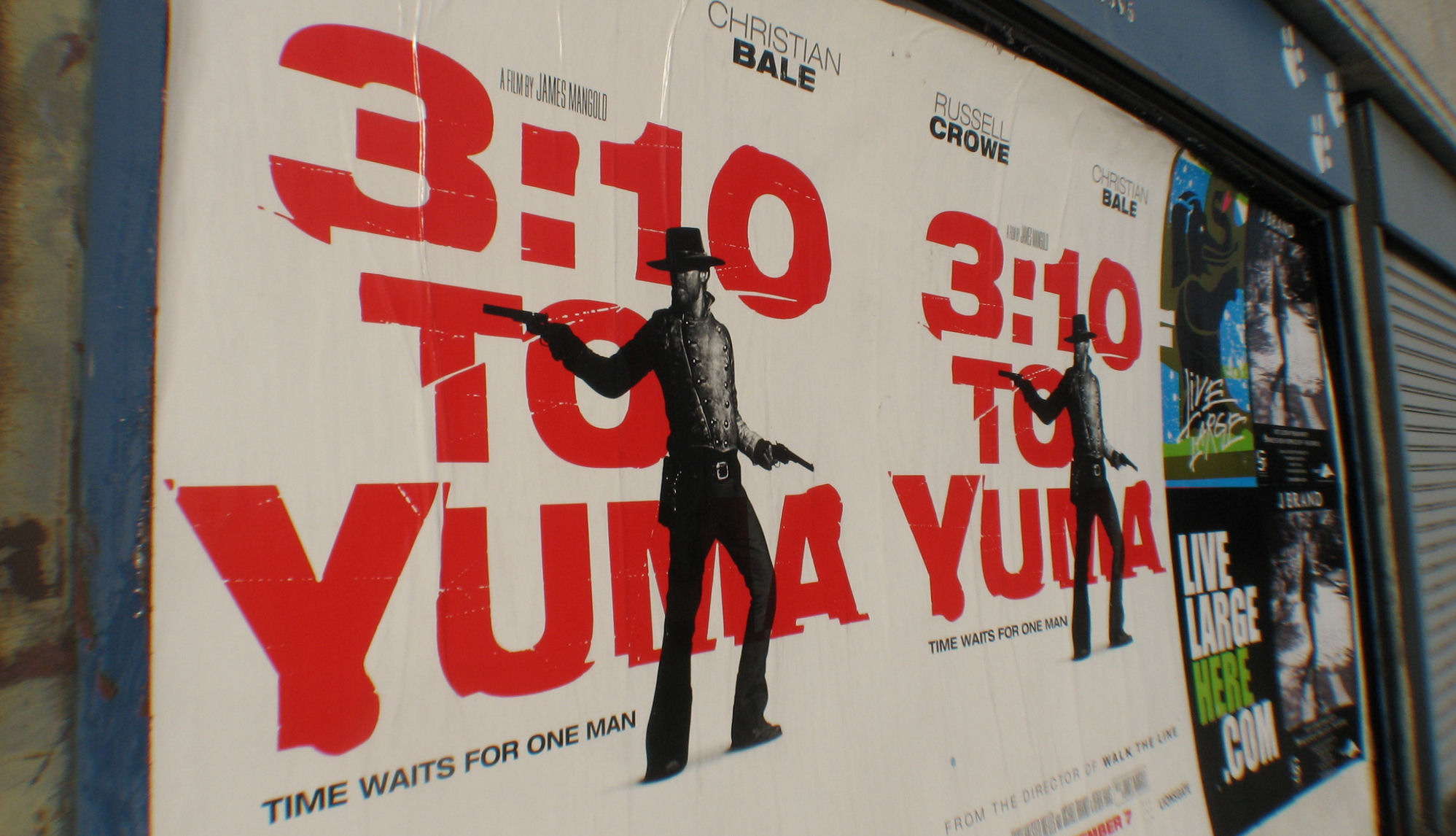
What’s with the slightly bent left leg? Again — the guy looks like a dancer in a rehearsal hall on West 45th Street going over his moves as a hot gunslinger in a B’way musical called Yuma Boy. Seriously… what is it with Lionsgate’s creative ad guys and their gay-appealing (or at the very least flagrantly metrosexual) ad campaign for James Mangold‘s allegedly gritty, unaffected, very down-to-it western?


The only thing missing in this shot is a ballet bar — snapped Sunday, 8.5.07, 5:40 pm near the corner of Cole and Sunset.

One look at the trailer tells you there’s nothing Michael Bennett or Bob Fosse-ish about this film whatsover. Mangold is a gifted craftsman who knows exactly what he’s doing and I’ve heard nothing but very good things about the film, so I’m trying to forget the ads and just wait for the movie, but those Lionsgate marketers keep messing with my head.

Shitty “Bull” sound

Every now and then someone writes a looking-back-on-Raging Bull piece (like this one from the Guardian‘s Ryan Gilbey, a nod to the film’s re-release in England on 8.17). And they all report that Martin Scorsese‘s classic wasn’t tremendously popular critically or commercially when it first opened in November of 1980. But what’ s never mentioned is that moviegoers couldn’t hear many of the quieter dialogue scenes with any real clarity, even in the better big-city theatres. And that this almost surely had an effect upon the general reception.

I distinctly remember watching a public screening of Raging Bull in the Sutton Theatre on 57th Street just before Thanksgiving, and leaning forward and cupping my ears and getting angry as I asked myself, “Dammit, why don’t they turn the damn sound up?” I had this reaction every time Robert De Niro, Joe Pesci or Cathy Moriarty were murmuring or muttering their thoughts in their middle-class Bronx apartments, or when “Tommy” the mafia guy was laying things out in his two quiet scenes.

Raging Bull‘s sound was apparently rendered with an intentionally murky-crude quality so it would seem unaffected and working-classy — the idea being that naturalism was equivalent to a kind of aural muck. This almost certainly resulted in tens of thousands of ear-cuppings across the nation given that the sound systems in all but a few big-city theatres back then were atrocious, for the most part. By today’s standards, it was truly the aural Dark Ages.

This sound issue is briefly addressed in the commentary track on the special edition DVD came out in ’05.

I would guess that the murky sound issues probably turned a few people off when it came to recommending Raging Bull to their friends, and that it probably affected the opinions of some critics, if only on a subliminal level. If you can clearly hear what’s being said in a film or a play, you’ll mainly respond to what’s being said — to the content. But if it’s a chore to hear this, then a percentage of critics are going to inwardly say to themselves “fuck this.” And I don’t blame them. So the responsi- bility for Raging Bull‘s underwhelming reception 27 years ago must fall squarely on the shoulders of director Scorsese and editor Thelma Schoonmaker.

I never really heard Raging Bull properly until it came out on laser disc in the early ’90s, and it didn’t sound really great until the special edition DVD hit stores two years ago.

Freaks and Geeks

“In the last few decades the emergence of a geek elite has helped legitimize [an] outsider culture and helped bring legions of 97-pound weaklings into the sightlines of the industrial entertainment complex,” writes N.Y. Times critic Manohla Dargis in a late-to-the-table but remarkably perceptive Comic-Con piece that went up on 8.3.

“In some respects America is now a country of freaks and geeks, self- professed outsiders who imagine themselves somehow different from the herd, perhaps because they are Americans — radical individuals who are united if only by their increasingly narrow interests and obsessions.
“This kind of atomization of the culture has its problems, as we know deep in our bones. Yet for all my worries that we are turning into a nation of iPod people, that√ɬ¢√¢‚Äö¬¨√¢‚Äû¬¢s only part of the big, postmodern, late-capitalism picture. Despite all the plastic and dissembling, events like Comic-Con represent something genuine and true and, yes, powerful about how people live in the modern world.
“Every day we wake up to navigate through a faceless, inhuman, Made-in-China existence. Some of us escape through literature, some of us burrow deep into movies. And some of us find sweet relief in what, to the outside world, looks entirely disposable, useless and — here√ɬ¢√¢‚Äö¬¨√¢‚Äû¬¢s that word again — childish.”

Another “Bourne” report

My box-office guy is telling me The Bourne Ultimatum earned $25,437,000 on Saturday. That’s a 3% increase over Friday, which is especially impressive considering that Friday’s total included a number of Thursday midnight shows. Tonight’s final count, I’m told, will be in the vicinity of $70,181,000, or about a million less than Steve Mason‘s prediction of $71,250,000.