Denzel Whitaker = James Farmer?

In Denzel Washington‘s The Great Debaters (Weinstein Co., 12.25), a primarily true period story (set in 1935) about student debaters from the African-American Wiley College in Texas having a climactic match with debaters from Harvard University, the 17 year-old Denzel Whitaker plays James Farmer, the renowned founder of CORE and civil-rights leader who was one of the Wiley debaters.


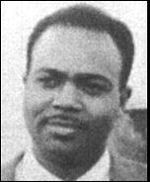
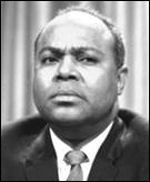
(l. to r.) Great Debaters costar Denzel Whitaker; James Farmer in the ’40s; in the mid ’60s

Listen to this recording of Farmer, and you can sense his debating skills quite readily. He was only 15 when the Great Debaters story occured, but had a deep James Earl Jones-type voice and an elegant vocabulary as an adult — qualities he presumably had the beginnings of as a youth. Whitaker (no relation to costar Forest Whitaker) has a thinner, far-from-stentorian voice. Farmer stood well over six feet (which he would have also been in ’35, as most 15 year-olds have reached adult height), but Whitaker stands only 5′ 6″. And Whitaker doesn’t resemble the youthful Farmer at all — he looks more like an adolescent Muhammad Ali.

The likable and appealing Whitaker plays Farmer as well as he can, which is to say satisfactorily. I’m not putting him down, and this is not a forecast of a Great Debaters review. But given the qualities of the Real McCoy, it’s hard not to wonder why Washington cast Whitaker in the first place. The result is a bit like watching Chris Rock portray Paul Robeson.


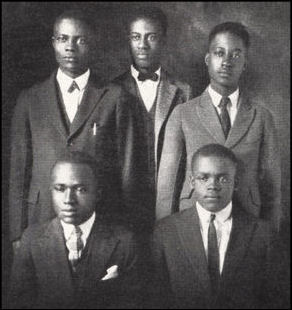
The real “great debaters” — professor Melvin B. Tollson (played by Denzel Washington in the film) stands in the center.

Shatner verdict again

Complaining once again about not being cast in JJ AbramsStar Trek remake, William Shatner has said “how could you not put one of the founding figures into a movie that’s being resurrected?”

Once again, the answer: In Rob Burnett‘s Free Enterprise (’98), Shatner traded in the legend of the stalwart Cpt. Kirk for the persona of an amusingly deranged septugenarian actor. That was nine years ago, and the wackjob routine — a career rejuvenator — has fed into Shatner’s acting (it’s obviously in his Boston Legal character) and pretty much taken over. His cameo time in Abrams’ Star Trek would be primarily regarded as a hoot.

Lumenick vs. Jesse James

Happy Thanksgiving wishes to N.Y. Post critic/bogger Lou Lumenick and his ninth annual Turkey Awards, despite the bizarre hostility shown to The Assassination of Jesse James by the Coward Robert Ford.

Brad Pitt didn’t “stink up empty theaters posing and mumbling his way through the title role” — he gave something close to the finest performance of his career. And Andrew Dominik‘s film wasn’t “longer than its title” — it was a time-travel journey so immaculate I never once thought about my watch.

Cheers once more to Warner Brothers for releasing this phenomenal film with all the passion of someone popping quarters into a parking meter. I realize they’ve recently stepped up to the plate with “For Your Consideration” trade ads and a two-disc screener sent to Academy members and elite press, but the initial build-up and theatrical release couldn’t have been less passionate.

Thursday numbers

Enchanted is #1 by far — did about $8 million yesterday, projecting $41 million over 3 days and $58 million over the full 5-day holiday. This Christmas is #2 — $4 million yesterday, $28 million for 3 days, $38 million for 5 days. Hitman is #3 with $21 million for 3 days, $31 million for 5 days. Beowulf is projecting $18 million for 3 days, $28 million for 5. (“Not very good,” the numbers guy says. “Five-day second weekend should exceed the first three days, but instead it matches it. Cume is now under 70 million, going into post-turkey dead time…not good.”)

I realize that a projected $58 million for Enchanted sounds unlikely given the $8 million opener, but “the kids weren’t there yesterday,” as one guy has explained. $58 million is a crude spitball for now, but this is what I was given by a studio source.

Jerry Seinfeld‘s fifth-place Bee Movie is projecting about $11.9 for three days, $16 for five days — the cume will crest $100 million by weekend’s end. The Mist — $11 for 3, $15 for 5. Fred Claus — $10 for 3, $15 for 5. American Gangster — $11 for 3, $14 for 5. August Rush, $10 and $14. Mr. Magorium, $9 and $12 No Country for Old Men will do about $8 and $11….880 theatres, about $12 grand a print.

Moguls boasts about digital revenues

How come the only time the internet seems to confuse the studios is when it’s time to pay the writers for it? A short video brief starring Bob Iger, Sumner Redstone, Ben Silverman, Rupert Murdoch and Les Moonves. (Originally posted 11.12.07.)

Re-posting “I’m Not There” review

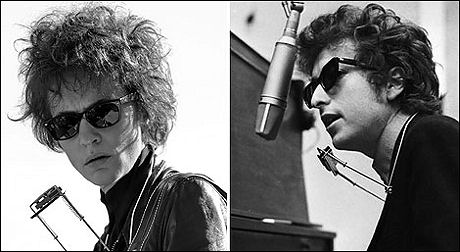
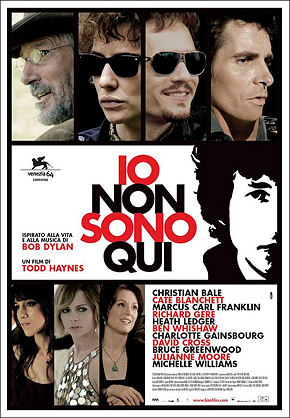
(In honor of the the limited opening of Todd HaynesI’m Not There, a repeat run of my 9.11 Toronto Film Festival review): Anyone who says this isn’t an essential film to see — not just for the portions that “deliver” but the ones that are radiantly, eye-poppingly alive — is operating without the DNA of a true movie lover…it’s that simple. This is a great poetry-weave film, a reanimation of ’60s spiritual-cultural energy like no feature I can recall, and a magnificent head-tease that is always arresting, even during the fumble portions.

It’s not all-the-way fantastic (20% or 30% drags and meanders and sometimes confounds), but I’m saying for sure that you can’t not see it. You can blow it off when it opens theatrically and wait for the DVD, sure, but this will probably incur the suspicion of trusted friends and colleagues. Honestly, do you want that?

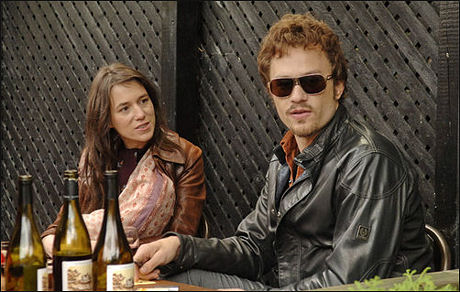
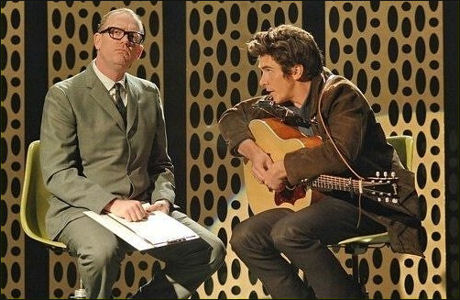
I knew Haynes had taken a huge bite going in with this ultra-ambitious patchwork exploration of Bob Dylan‘s life and legend (spanning from the late ’50s to late ’60s), in which he uses six different actors (Cate Blanchett, Christian Bale, Carl Franklin, Richard Gere, Heath Ledger and Ben Whishaw) along with numerous styles and palettes to convey various aspects.

What I didn’t anticipate was his impressive use of montage that ties together the various strands and makes a kind of harmony out of what could have been serious chaos. Nor did I expect the magnificent detail in each frame, the always-brisk pacing and the sheer “fun” aspect.

An example of the latter is a Dylan-frolics-with-the-Beatles-in-”64 moment that’s absolutely hilarious in a kind of of Jacques Tati-meets-Charlie Chaplin-meets A Hard Day’s Night sense.

Did I mention this is Haynes’ absolute best film? That he’s pulled off one of the most exciting growth-surge displays of any directorial career, ever?

I’d heard from a friend at Telluride that I’m Not There is “an inside joke for Dylanologists” and okay, yeah, it is that…but for anyone open to full-crank cinematic stimulation it’s one of the most inventive and dazzling head-trip films I’ve ever seen. I went into it this afternoon with some trepidation, and then realized within minutes it would be much, much better than anticipated. It doesn’t really have much of a “thread” (by the classic definition of that term) and it loses tension from time to time, but when it’s “on” and rolling full steam it’s a wild-ass thing to behold.

On top of which it has to be seen for Blanchett’s knockout performance (captured entirely in black and white) as the Highway 61 Revisited/Blonde on Blonde Dylan. Forget Cate’s game performance in the catastrophic Elizabeth: The Golden Age and absolutely count on the fact that she’ll be nominated for Best Supporting Actress in the Haynes pic. Dylan fans are going to be blown away, but I can see others digging it as one of the best woman-playing-a man tour de forces ever put to film.

On one level her inhabiting of the ’65-to-’66 Dylan doesn’t feel entirely sincere — it’s a piece of performance art that feels a wee bit put-onny — but another level it’s psychologically “real” and shattering. For me Blanchett delivers as much of a knockout punch as Marion Cotillard‘s Edith Piaf does in La Vie en Rose or Jamie Foxx did in Ray, and perhaps even more so.

I’m speaking about much more than a physical capturing — the frizzy big hair, black shades, tight pants, Beatle boots and whatnot — or Blanchett’s spot-on imitation of his mumbly voice and guarded manner. I’m talking mainly about a convincing communion with that Dylan-esque otherness…that sense of odd, connected whimsy and all-knowing, tapped-in power that indicated all kinds of fascinating currents in the real guy.

Yes, the Gere-in-the-country portion (a chapter evoking the reclusive John Wesley Harding/New Morning era) slows things down a bit, but even this section has its odd carnival-like charms. I’ll admit I was feeling a wee bit anxious and impatient, but Haynes saves it somewhat by cutting back to the Blanchett, Ledger, Bale and Whishaw portions now and then and thereby creating a welcome whatever-ness that at least staves off boredom.

Will those who’ve never listened to a Dylan album or seen Martin Scorsese‘s masterful No Direction Home be able to get into this film? Probably not, but the Dylan-deprived aren’t going to see it in the first place so the question is moot.

I felt alive and tingly as I walked down Bloor Street after seeing this film early this afternoon. I was saying to myself “this is what it feels like to feel charged up by a movie, by transcendent thought, by ravishing lyrics…by the whole magilla.”

Forget “The Mist”

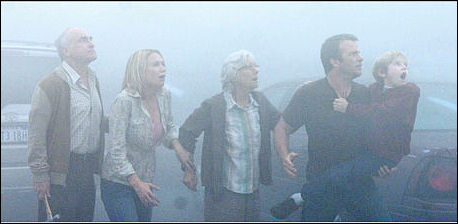
Frank Darabont‘s The Mist is a moderately cool little film during the first act when none of the characters knows what’s happening, when all they know is that the heavy mist — call it thick fog — enveloping their small town is a bringer of something wicked. But once it moves out of Twilight Zone territory and becomes a slimey-ass monster film, forget it. That’s all you need to hear.

“Zodiac” is not dead

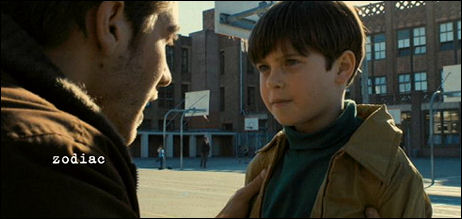
David Fincher‘s Zodiac “is another movie that isn’t gaining Oscar momentum,” writes Variety‘s Anne Thompson. One reason this hasn’t happened is that good journalists like Thompson have been dismissing its Oscar chances all along. She acknowledges it was “well-reviewed last summer” (despite having opened last March) and that “many critics may include it on their ten-bests,” but says “its time has come and gone.”

Thompson is probably right, but I take no satisfaction in admitting this. If this racket has taught us anything, it’s that conventional industry wisdom is truly the poison mist floating across the lake. Besides, Zodiac isn’t “done” the way Thompson says it is. It’s back on the stove and the water is heating up. The director’s cut DVD has been sent out, Fincher will be doing a q & a following an 11.29 Variety Arclight screening of this, and Paramount is paying for trade and online ads here and there. If enough people jump in, the ball could stay in the air.

Thompson and others have written it off because it “was an expensive big-budget studio failure,” it doesn’t unfold according to the rules of your father’s police procedural, and because hunt-for-a-serial-killer movies, even art-film variations like Zodiac, don’t seem deep or moving enough to qualify as Oscar bait.

None of these observations consider what some regard as a simple fact and others as a growing realization, which is that Zodiac is the Best Film of 2007. I for one have begun to believe it is that, and it only took me seven months to get there.

Thompson says Zodiac “is indulgently long,” which it emphatically is not. Given the hall-of-mirrrors, obsession-within-an-obsession scheme, it could actually stand to be a bit longer.

“Fincher’s insistence on verisimilitude meant not giving viewers a satisfying narrative arc,” Anne writes. Wrong again. Zodiac has an immensely satisfying arc according to its own termite-art rules. It operates on such a profoundly original high-altitude plane that even I didn’t really understand what it was finally up to until I’d seen it the second time. (Or was it the third?)

“The movie has its merits — hell, it will be on my ten best list — but an Oscar contender needs to have enthusiastic supporters, few detractors and a passionate push behind it,” Thompson concludes. “It needs confidence, and Zodiac has too many deficits.”

And by this logic, it is implied, astute industry watchers would do well to get off the Zodiac train and start facing the fact that truly valuable and timeless contenders like Juno are the ones with a real shot at making Oscar history. Good. Fucking. God.

Dismissing “I’m Not There”

The Envelope‘s Pete Hammond is reporting that Todd HaynesI’m Not There didn’t play very well with a smallish Academy group. The Bob Dylan epic “lived up to its title and gathered a much smaller academy group that saw a few walkouts,” he writes, “according to two members who were both unimpressed — even by Cate Blanchett‘s bravura supporting turn as one of six Dylans.

“‘I think the only people who will like this thing are the ones who love this guy’s music,” one academy voter told Hammond. Once again, obiter dicta — “this guy’s music” — has revealed a bit more than intended.

Academy members are not obliged to worship, like or even admire I’m Not There, but Academy slugs like the person quoted above are an embarassment. More than that — they’re an obstruction. They cheapen and devalue movie culture by dismissing rich, valuable films, not out of conviction or distaste but impatient sloth. Like an ADD-afflicted child might toss aside a toy or video game, or the way my father — a shadow of the man he used to be — dismisses new writers and movies because he doesn’t care to get into anything new. The mind-blowing element is that Dylan is ancient history and the person quoted above still regards him askance.

What a revoltin’ development that all this Oscar season energy and passion and promotion being focused on trying to second-guess the opinions of people like this. The colors and currents of the world streaming into our souls through esprit du cinema, and yet many handicappers will only talk up the Oscar potential of films that have the approval of obviously stunted people — folks who’ve worked long and hard and distinguished themselves in this or that way over the course of their lives, but are alive and engaged right now only in the barest sense.

“Michael Clayton” is over the hump

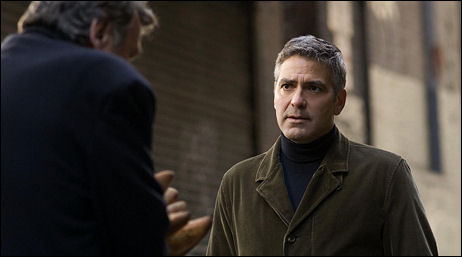
Just acknowledging what I’ve failed to point out (despite everyone else having done so), which is that Michael Clayton will probably break even — made for $20 million (George Clooney took nothing), now at $37,181,284, will hit $40 million — so that early rap of being a financial under-performer that was slung around its neck for a few weeks doesn’t apply. For a smart, mildly grim, somewhat challenging film about corporate lawyers pulling this and that string, that’s an accomplishment.

Pete Hammond has written about having done a recent post-screening q & a with Clooney, and quotes him as saying he “made slightly more [for Clayton] than I did on Return of the Killer Tomatoes, but not much.”

I’ve never felt that Clayton is Best Picture material. It’s a very smart, complex adult drama. It played for me a little better the second time than the first, and it’s been building ever since. I wouldn’t argue against Tony Gilroy‘s film if someone were to say to me, “No, it’s sublime! It’s one of the top five!” I would just say “yeah, I love it too, but do you honestly feel it’s on the same level as Zodiac or There Will Be Blood or No Country for Old Men or I’m Not There?” But I wouldn’t argue against it.

Best of the best

Choosing big-category favorites each week for the weekly Envelope Oscar prognosticator chart is not something I look forward to. I sit there and I choose, but it’s like throwing darts. It feels vaguely irritating because I can’t quite give myself over to saying this film or that performance is “better.” Something’s not kicking in. All I’m certain of is that I don’t like the idea of choosing a comfort-blanket movie for Best Picture simply because it’s soothes, caresses and reassures.

The aroma, the prevailing winds and the dandelion pollen hall have all but convinced me that Charlie Wilson’s War and Sweeney Todd are out of the Best Picture race. I know without question that the top seven “best of the best” are American Gangster, Before The Devil Knows You’re Dead, No Country for Old Men, Once, The Assassination of Jesse James by the Coward Robert Ford, Things We Lost in the Fire and Zodiac.

And right behind these are I’m Not There, Atonement , The Bourne Ultimatum, Control, In The Valley of Elah (the rough-cut version minus the Annie Lennox song) and Ratatouile.