The Hollowest

“Perhaps no vilifier of Hillary Clinton traipses across the footlights with a bigger satchel of calumnies than Andrew Sullivan, who diagnosed Mrs. Clinton as ‘the hollowest form of political life,’ a ‘sociopath.’ His solo act had and has a symptomatic significance. Published under the aegis of The Atlantic‘s stable of notable byliners, Sullivan’s Daily Dish blog is must-reading among the media elite, those sheep.


Wolcott’s anti-Sulllivan sympathies aside, the creator of this illustration, a guy named “Darrow,” is clearly anti-Hillary as he’s placed her in the position of Stephen Boyd‘s evil Messala and Barack Obama in the position of Charlton Heston‘s Judah Ben-Hur during the chariot race scene in William Wyler’s film.

“His words extend wider ripples in the ocean of emotion that passes for opinion journalism than did those of his fellow cobblers. In a column for The Times of London entitled ‘The Clintons, a Horror Film That Never Ends,’ Sullivan compared Hillary to Glenn Close‘s bunny boiler in Fatal Attraction — ‘Whoosh! She’s back at your throat’ — and the Clintons as a couple to the fast-running zombies in 28 Days Later. ‘The Clintons live off psychodrama,’ he contended in a classic pot-kettle-black moment.'” — from James Wolcott’s current (June 2008) online Vanity Fair column, titled “When Democrats Go Post-al.”
Adjustment

Indiana Jones and the Kingdom of the Crystal Skull (Paramount, 5.22) will actually show at the Cannes Film Festival on Sunday, 5.18, at 1 pmnot 8:30 am, as I wrote earlier. (The big film of the day is always shown at that hour.) And the press conference that will follow at 3 pm or thereabouts will be the only time, I’m being told, that director Steven Spielberg will give quotes about the film to general hoi-polloi press. (He’ s gotten on the phone with elite journos, of course, as he always does — Vanity Fair, etc.)

Uh-Oh…

David Gordon Green‘s Pineapple Express (Sony, 8.8) has been showing here and there, and a friend is telling me that aside from James Franco‘s career-changing performance as a stupid pot dealer, it’s a little coarse. It’s loud, “lots of mayhem,” youth-market-pandering, an “Abbott & Costello chase film,” full of explosions and “very, very violent,” he says. One comment was especially disturbing: “I’m not sure this is your kind of film.” What?, I said. I love smart stoner humor, I said. The Big Lebowski, Wonder Boys …that kind of thing. Guys with baked brains. It’s not on that level, he said. It’s louder, noisier…lots of explosions. Oh, I said. Well, there’s always Franco.
That aside, the friend said, the young audience he saw it with “ate it up…laughed at everything, even the women.” So it’s not for stoner sophisticates…fine. Basically an animal movie. Another Harold and Kumar thing except on a slightly higher level, a young girl said last night. “But it’s not Superbad,” my guy says. It’s not? “I don’t know what it is but David Gordon Green was never directed comedy before and….well, the violence is a much bigger factor than I expected.”
What about “episodic stoner segues,” I said? Side episodes in which they get all tangled up and confused over stuff that a normal person without pot issues would be able to handle but the stoners can’t because they’re too fried? “It’s not on that level,” he said. “It’s not as steeped in dry stoner humor as Lebowski is. It’s a little more pandering than that.”

Visions of Light

Another brilliant, perfectly-cut video piece from Jamie Stuart, and a good quote to go with it: “I’ve never been a big fan of ‘movie lighting’ (where exactly does rim light come from anyway?), although some filmmakers do it in a way that works for me.

“Movie lighting — and, by extension, photography lighting — came about, in part, because film stocks in the past weren’t fast enough to shoot in low light levels. At the dawn of the medium, electric lights weren’t even bright enough, so the filmmakers created roofless sets that the sun could illuminate.
“Eventually, cameramen started to stylize their lighting and created a whole slew of affectations; it was exceedingly rare to see light fall in movies as it actually does in real life. Eventually, film stocks improved and filmmakers took their cameras out into the world from studios. Things changed.”
Here‘s the location of the original article.

Tweed-Jacket Kingsley

Vanity Fair Daily‘s Julian Sancton recently spoke to distinguished wackazoid actor Ben Kinglsey, who’s portraying yet another psychiatrist in Martin Scorsese‘s Shutter Island and, he says, playing it fairly straight and tweed-jackety. (The working title, he says, is Ash Cliff….terrible! Means nothing!)
Kingsley discusses his craft and his background as a classically trained Shakespearean interpreter. He’s a superb actor — one of the best — but don’t be fooled by such talk. Just as the Superman TV series in the 1950s taught us that George Reeves wore tights and could fly faster than a speeding bullet, Sexy Beast and his other nutter roles (You Kill Me, The Wackness, Lucky Number Sleven, Mrs. Harris, etc.) taught us that Kingsley is a raving loon under the skin. All that Gandhi and Turtle Diary and Betrayal stuff was a put-on. He was having us off!

“Elegy” Acquired

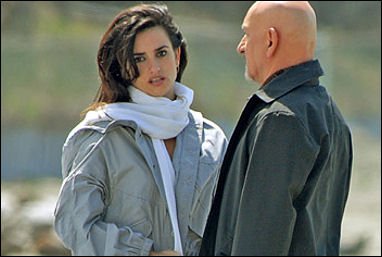
Isabel Coixet‘s Elegy, the Penelope Cruz-Ben Kingsley drama that debuted at the Berlin Film Festival, is going to be domestically distributed by Samuel Goldwyn Films and Sony Pictures Worldwide Acquisitions Group…whatever that means. Indiewire is reporting that Netflix’s Red Envelope Entertainment “is also on board for the release and will work to promote the film to their 7 million subscribers,” blah blah. Pic is based on Philip Roth‘s short novel The Dying Animal.

Presumably Elegy will be released domestically sometime this year.
Variety‘s Leslie Felperin gave Elegy a thumbs-up response. Key passage: “Scenes unfold in a series of near-musical dialogue duets, with Ben Kingsley offering finely-phrased arias of self-deprecation and despair. Despite the age difference, he and Penelope Cruz (who’s never been better in English) look somehow chemically balanced and credible as a couple in a way Nicole Kidman and Anthony Hopkins never did in The Human Stain.”

Fair Play for Towelhead

After seeing Alan Ball‘s Towelhead (formerly Nothing Is Private) in Toronto last September, I wrote that “there’s no question about it being smart, thoughtful and high-grade. It’s not 100% flawless (I had two or three speed-bump issues) but it’s certainly a sturdy, complex character drama that’s 100% deserving of respect. It’s obviously one of the most original, daring films about adolescent sexuality ever delivered by a quasi-mainstreamer. It’s also a sharp look at racism (and not just the American-bred kind) and a sobering portrait of the rifts and tensions between American and Middle-Eastern mindsets.”

Picturehouse Tumbling Down?

Somebody help me out here because this is weird. Warner Bros. has two dependent distribution arms, Warner Independent and Picturehouse, under its wing, and Defamer‘s Stu Van Airsdale is reporting that Picturehouse, seen by most veterans of the trench as the more shrewdly guided, successful and geared-up of the two, may soon be shut down? What?
A story posted this evening by Variety‘s Anne Thompson said that Picturehouse chief Bob Berney and Warner Independent prexy Polly Cohen are “likely” to accept a bicoastal power-sharing arrangement that will preside over a merged operation — Warner Indiepicturehouse.
“We have yet to hear where Berney will wind up,” Van Airsdale writes, “though a popular rumor has him sharing power at Warners’ other struggling boutique outpost, Warner Independent Pictures, with current WIP boss Polly Cohen.” I commented last night that this sounds like a post-Ides of March power-sharing deal between Octavian and Marc Antony. I’ve been told all along that Berney has been squeamish about the deal that Warner Bros. has wanted him to go with.
Van Airsdale has also reported another scenario with Berney “starting fresh at a new company underwritten with hedge fund cash, [which] would suit him well with Cannes on the horizon and Warners’ decreasing overall interest in the volatile indie marketplace. Warner Bros. would gladly get out anytime, but we hear they’re willing to move ahead with Berney if he’s interested.”

Jenkins’ Career Booster

Nobody can be called a near-lock for a Best Actor nomination at this stage of the game. With the start of awards season being a good four months away, it’s way too early to even speculate. Except, arguably, when it comes to Richard Jenkins‘ work in The Visitor. A quiet, heart-melting lead performance by one of the finest character actors in the business, Jenkins’ Walter Vale is one of those career-lifting roles that SAG members tend to warm to, remember and single out.


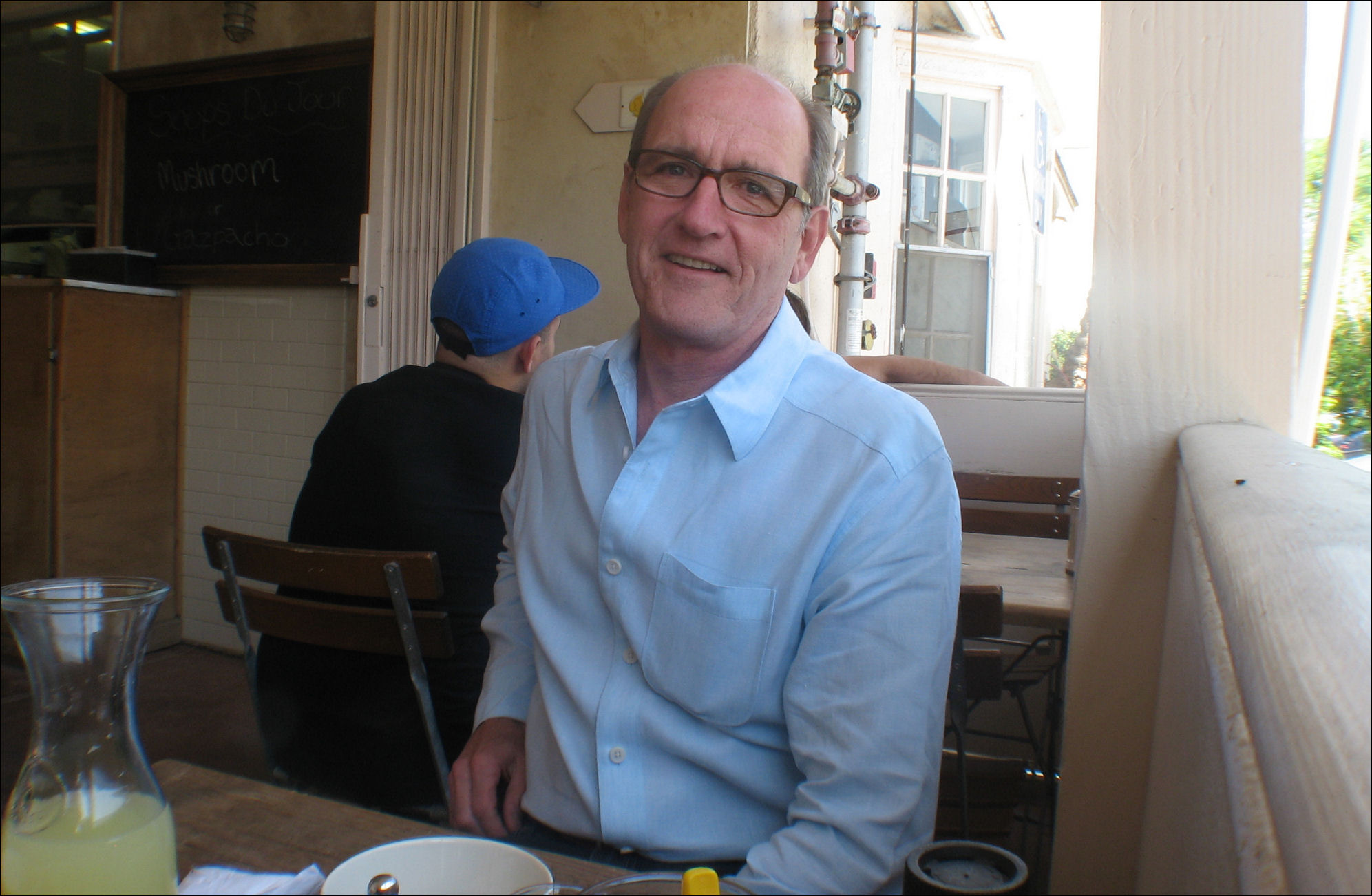
The Visitor star Richard Jenkins during today’s interview at West Hollywood’s Le Pain Quotidien — Thursday, 5.1.08, 1:45 pm

Especially when the actor in question has been stand-out superb in a long run of supporting roles over the last 20-plus years. For me Jenkins began to come into his own in the mid ’90s with two lawman parts — a police detective in Mike NicholsWolf (’94) and a gay FBI agent in David O. Russell‘s Flirting With Disaster (’96). I think Jenkins’ career took off with one scene in particular — when his agent reacts to a dose of LSD that’s been put into his food. It’s the single most hilarious drug-related scene in modern cinema.
That was twelve years ago, and for my money Jenkins has hit long doubles or triples with eight performances since, not counting his work in The Visitor. I’m thinking of the psychiatrist in There’s Something About Mary, the sheriff in Scott HicksSnow Falling on Cedars, some kind of offical or investigator in Sydney Pollack‘s Random Hearts, an EPA agent in Me, Myself & Irene, an aging racist murderer in am FX feature called Sins of the Father, a divorce attorney in Intolerable Cruelty, an uncredited but hilarious part in I Heart Huckabees, and 10 episodes as Nathaniel Fisher in HBO’s Six Feet Under.
The Visitor‘s Vale is a morose 50ish college professor who goes through a spiritual wake-up by helping out a couple of illegal immigrants, and then falling in love with the Palestinian mother of one of them, a young man who teaches him how to play a native drum.
His next three features are a British horror-thriller called The Broken, Adam McKay‘s comedic Step Brothers(Sony, 7.25) with Will Ferrell and John C. Reilly, and the Coen brothersBurn After Reading (Focus, 9.12).
Jenkins is doing interviews to plug the recent theatrical expansion of The Visitor, which is now playing in some 300 situations. We met at lunch time at Le Pain Quotidien and spoke for over an hour. Here are two portions of that chat, totalling maybe 15 minutes — selection #1 and selection #2. We’re tallking about Burn After Reading as the first mp3 begins. We get into the Flirtiing LSD scene in the second portion.

Read more

Day-and-Date Deal

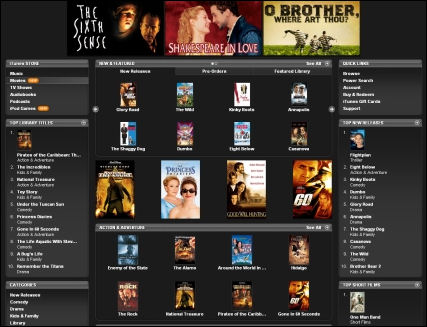
Apple has reportedly cut a deal with several major distributors — Warner Bros., 20th Century Fox, Disney, Paramount, Universal, Sony Pictures, Lionsgate, etc. — to offer many (but not all) new releases for purchase at its iTunes Stores day-and-date with home video releases. Obviously this will really hurt DVD retail, which will in turn diminish the sense of community we all get from going to DVD stores and poking around the aisles and talking with the checkout guys. A crying shame.

The Hollywood Reporter‘s Andrew Wallenstein notes that “the deal comes on the heels of Apple’s announcement [last] January that it had signed all of the studios to movie rentals, with each title costing just $3 to $4 for consumers to access for a 30-day period. Movie purchases, however, could cost as much as $15.
“Apple hasn’t moved as aggressively to date on film as it has in TV, with most download-to-own devoted to older titles in studio libraries. But Apple’s success with those deals, which included MGM, Disney and Paramount, likely encouraged studios to take the next step.”

Huffington

Reviled ABC news guy Charles Gibson (who, along with George Stephanopoulos, degraded the level of discussion during the Pennsylvania presidential primary debate), interviews author Arianna Huffington about her book, “Right is Wrong,” which explains how the lunatic right has taken over the conversation on values and patriotism.

Turan’s Grim Slide

Youth-pandering summer movies have been a cultural sludge pit for a long time. Not so much over their emphasis on brute sensation and animal hormones leading to a degradation and devaluation of whatever sensitivity and spirituality may be in the air (although that’s always been a problem), as much as the levels of talent and inspiration being too often lacking. There just aren’t enough Superbads or Dark Knights or Indy 4‘s to go around.
As much as this trend has pained me over the years, I was mostly amused when I read L.A. Times critic Kenneth Turan complaining about this because the fall-of-the-Roman-empire, mongrel-celebrating aspect of mainstream American movie culture seems to be just hitting him
“The reality is that, except for the ghettoized adult window in the fall, this dumber-is-better attitude is threatening to take over all of the major studios’ output,” he writes. “Not to put too fine a point on it, but the summer is killing American movie culture.
“With corporate owners demanding predictable profits, the studios have understandably narrowed their focus to the kinds of undemanding entertainments favored by the 25-and-younger audience that dominates theatrical attendance. And they are not just doing it during the summer, they’re doing it almost year-round.
“In all likelihood that tendency is even contributing to the nationwide loss of film-critic jobs that’s been so commented on of late. With so many films coming out that don’t really demand serious examination, and an aging readership that is going to fewer and fewer movies, newspaper editors in cities where (unlike Los Angeles, New York and a few other places) films are not an intrinsic part of local culture are probably figuring that it’s not worth the expense of paying anyone to examine them.
“And if critics go, the mechanism for encouraging audiences to go to good small films, for creating a demand for alternatives to what critic Richard Schickel has called Hollywood’s ‘big clanking machines’ goes with them. Is there any way out?”
Answer: Critics aren’t “going.” The power is simply migrating away from old-media critics with cushy salaries and abundant perks who dispense lordly judgments as if from a pulpit. Readers are more and more into conversing and arguing online (like they do on this site) than the practice of receiving wisdom from on-high print poobahs. Simple.