Pull The Plug

I’m sorry, but when Rep. Gary Ackerman essentially called Caroline Kennedy the Democratic Sarah Palin, a voice within begrudgingly admitted that he wasn’t far off. Kennedy has been acting way too timid and reclusive and un-Kennedy-like to be handed Hilary Clinton‘s Senate seat. She just doesn’t have the strength of character that people generally want from a big-time legislator, let alone one with her lineage and last name.
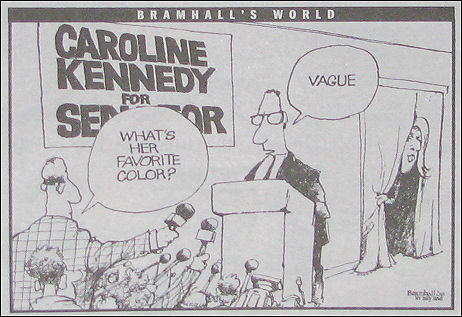
The lady is clearly unwilling to intellectually engage off the cuff. She seems wimpy. She lacks pizazz. I’m not detecting any serious gumption or intestinal fortitude. There’s absolutely none of that Chris Matthews quality in her at all…none of that basic back-slapping, yaw-haw, gregarious, chug-a-brewski-with-the-proles quality that a good politician is supposed to have or at least simulate on the campaign trail.

Between the Palin comparison, her hide-away “listening tour” of upper New York State and recently declining to release her financial background, I think Kennedy should just pack it in. She doesn’t have it. I love the idea of a strong, bright, compassionate woman with a marquee name serving as New York’s Senator, but Kennedy doesn’t seem to have the ability to stand the heat in the kitchen, and I really do think she’s done at this point because of this.

Ackerman said “Kennedy’s name and family wouldn’t, and shouldn’t, be enough to get her appointed to the U.S. Senate seat that Hillary Rodham Clinton will vacate once she is sworn in as secretary of state. Everyone knows who she is, but I’m not sure what she is. Eventually she has to get in the ring and face the public.'”

Strange

I was too lazy to respond to Roger Friedman‘s 12.22 item about Speed-the-Plow costar Raul Esparza addressing a Sunday-matinee audience about the departed, sushi-afflicted, mercury-poisoned Jeremy Piven…so here it is 24 hours late.

The puzzler for me wasn’t Esparza (whose performance was more off-the-wall manic than Piven’s when I caught a performance in late November) saying “today was the first time I really enjoyed playing this show” and “I hope you weren’t expecting a big TV star.” The puzzler was about how costar Elizabeth Moss allegedly “sobbed” while Esparza was dissing Piven, presumably out of sympathy. Why? Who sobs for a spoiled temperamental weenie ? What kind of value system does Wilson live and feel by?

Newman Rules

Vanity Fair‘s Julian Sancton has assembled a jukebox sampler of 11 movie-music clips, and after listening to most of them (I refuse to sample David Hirtschfelder‘s Australia music) it finally hit me why I’ve been so taken with Revolutionary Road all this time. Thomas Newman‘s score is so moving in its sadness and simplicity, so finely woven into the mood of the film (and vice versa) that it’s like a character unto itself.

The other films and their composers sampled in Sancton’s piece: Che (Alberto Iglesias), The Curious Case of Benjamin Button (Alexandre Desplat), The Dark Knight (Hans Zimmer and James Newton Howard), Defiance (Joshua Bell), Frost/Nixon (Hans Zimmer ), Indiana Jones and the Kingdom of the Crystal Skull ( John Williams), The Reader (Nico Muhly), Slumdog Millionaire (A.R. Rahman) and WALL*E (Thomas Newman again).

Grumpy Xmas

I’ve noted previously that the “air” in Southbury, Connecticut, is awful. It’s more or less the dark side of the moon. One of the few commercial establishments with any kind of tangible semi-reliable wi-fi is a just-opened Borders in the main shopping center, which is where I’m sitting now. But not for long. Within minutes I’ll be submerged in the black hole of The Watermark, the retirement community where my mom lives.


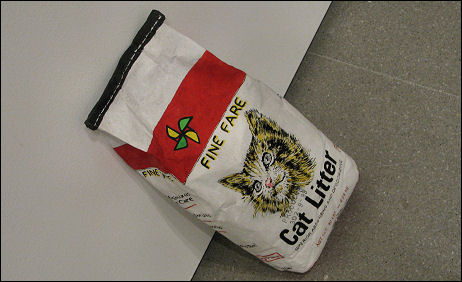
Object d’art at Museum of Modern Art…seriously. Located on a second or third-floor gallery, just leaning against the wall.

Annual Suffering

Getting on a train up to Connecticut, and then driving up to Northern Siberia, New York — i.e., west of Rochester — tomorrow. It’s going to be a howling frozen hell with lots of boredom thrown in, and too many calories. As an exercise, I’m going to take a picture of something on the way into Grand Central and post it from the moving train, using the AT&T Air Card.

Nostalgia Sex

Update: Steve Martin isn’t playing Meryl Streep ‘s ex-husband in Nancy Meyers‘ new film — he’s the new suitor. Alec Baldwin plays her ex, which is the larger dominant role. Martin’s role is essentially an extended cameo.

Original Post: During a round-table Doubt interview Meryl Streep confirmed that she’s starring in Nancy Meyers‘ upcoming movie with Alec Baldwin and Steve Martin, and provided Collider‘s Steve Weintraub (among others) with a synopsis:

“It’s a kind of a…it’s a comedy, but it has a little basis in something very real and a dilemma that people meet at a certain age. This is about a divorced couple. They have been divorced for ten years and they have three grown children in their 20s. The youngest is graduating from college. And he has moved on. He has gotten a young wife, and is embarking on his toddler marriage, new family and she hasn’t really had a boyfriend in a long time. And she just meets somebody interesting just before the graduation.”

Note: I worship Baldwin’s wit and bile, but when you play someone in a romantic situation you need to get on the treadmill and slim down and “young up” a bit — you can’t look like a middle-aged side of bloviating beef.

“She goes to the graduation,” Streep continues, “her ex-husband is there, they meet in the bar, they have a few drinks, they start dancing and he’s re-smitten. And it’s not clear if [this situation] is exacerbated by the presence of this other man in her life for the first time. And that’s what it’s about. And all the kids are very happy that everyone is together again, but it’s about ‘has the ship sailed at some point.’ When you have a big-shared history with somebody, but you have a big break, what do you retain from that? And is it possible to fall in love again. So, that’s what it’s about. It’s sweet. It’s cool.”

Trust me — the re-smitten thing on the part of ex-husband is at least partly a competitive, put-the-new-guy-in-his-place, show-him-who’s-boss type of thing. Anyone with a semblance of over-40 life experience knows that nostalgia sex is…well, some have gone there, but you can’t go home again and that’s that.

Not This Time

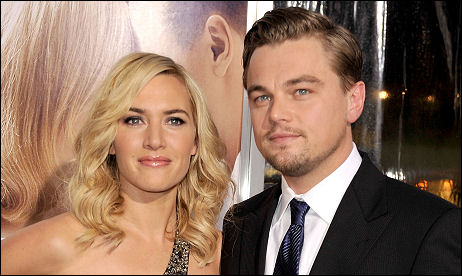
If you want something you need to say to yourself “I want this thing,” and then you have to make the moves. Outside of the realm of royalty, nothing is handed to anyone on a silver platter. And if you’ve (a) cumulatively earned your laurels, as Kate Winslet clearly has, and (b) delivered a phenomenally sad and searing performance, as Winslet has in Revolutionary Road , then you’re entitled to stand up and do what you need to do.

The following was posted five days ago — five days ago! — on gofugyourself. The dialogue isn’t grade-A, but some of it isn’t bad.

Kate: I will not be Susan Lucci, Leo. I will not be the goddamn Susan Lucci of Real Acting.

Leo: I won’t let it happen.

Kate: Nineteen tries. It took her nineteen tries to win the Daytime Emmy. I’ve had eleven tries and I haven’t even won a fucking Globe. A Globe! They’re not even real awards.

The IMDB says Winslet has been Oscar-nominated for Best Actress five times, and nominated for a Golden Globe Best Actress award five times.

Thundercats!

The basic DNA of every bullshit CG fantasy action-mythology epic of the last 25 years is contained in this mock-trailer for Thundercats, and will be repeated again and again as long as bullshit CG fantasy action-mythology epics continue to be made. Brilliant career moves by Brad Pitt, Vin Diesel and Hugh Jackman, but who’s the actress under the makeup — Scarlett Johansson? I’ve only watched it once. (Congrats to WormyT, thanks to Jack Morrissey.)

The Wormy T guys are saying all the effects were done frame-by-frame in Photoshop, and that the footage was edited in Adobe Premiere.

Lighten Up, Guys

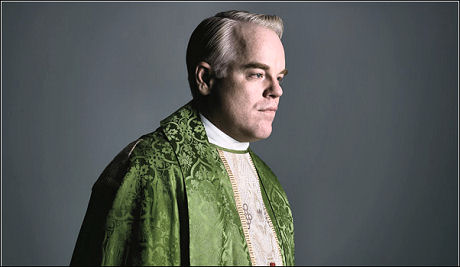
The character of Caden Cotard in Synecdoche “seems to echo many of Philip Seymour Hoffman‘s own internal debates and anxieties,” writes Lynn Hirschberg in her 12.21 N.Y. Times Sunday Magazine profile called “A Higher Calling.”

“I took Synecdoche on because I was turning 40, and I had two kids, and I was thinking about this stuff — death and loss — all the time,” Hoffman explains. “The workload was hard, but what made it really difficult was playing a character who is trying to incorporate the inevitable pull of death into his art. Somewhere, Philip Roth writes: ‘Old age isn’t a battle; old age is a massacre.’ And Charlie, like Roth, is quite aware of the fact that we’re all going to die.”

Yeah, and so what? This is why Synecdoche was a tank, despite the talent, brains and impressive chops of everyone concerned. We all know we’re dead meat. We all know the only way out is through the smokestacks. What matters is the luscious aroma of living, for Chrissake. And whether or not she’s inclined to slip you her phone number when her boyfriend isn’t looking.

“In 80 years,” Hoffman goes on, “no one I’m seeing now will be alive. Hopefully, the art will remain.” Yes, okay, hopefully. But I’m more with this Woody Allen remark: “I don’t want to achieve immortality through my work — I want to achieve it through not dying.”

Fool For The Ages

“The story of the ongoing financial meltdown is “partly of President Bush’s own making, according to a review of his tenure that included interviews with dozens of current and former administration officials,” begins a 12.20 N.Y. Times story by Jo Becker, Sheryl Gay Stolberg and Stephen Labaton.

“From his earliest days in office, Mr. Bush paired his belief that Americans do best when they own their own home with his conviction that markets do best when let alone.

“He pushed hard to expand homeownership, especially among minorities, an initiative that dovetailed with his ambition to expand the Republican tent — and with the business interests of some of his biggest donors. But his housing policies and hands-off approach to regulation encouraged lax lending standards.

“Mr. Bush did foresee the danger posed by Fannie Mae and Freddie Mac, the government-sponsored mortgage finance giants. The president spent years pushing a recalcitrant Congress to toughen regulation of the companies, but was unwilling to compromise when his former Treasury secretary wanted to cut a deal. And the regulator Mr. Bush chose to oversee them — an old prep school buddy — pronounced the companies sound even as they headed toward insolvency.

“As early as 2006, top advisers to Mr. Bush dismissed warnings from people inside and outside the White House that housing prices were inflated and that a foreclosure crisis was looming. And when the economy deteriorated, Mr. Bush and his team misdiagnosed the reasons and scope of the downturn; as recently as February, for example, Mr. Bush was still calling it a ‘rough patch.’

“The result was a series of piecemeal policy prescriptions that lagged behind the escalating crisis.

“‘There is no question we did not recognize the severity of the problems,’ said Al Hubbard, Mr. Bush’s former chief economics adviser, who left the White House in December 2007. ‘Had we, we would have attacked them.’

“Looking back, Keith B. Hennessey, Mr. Bush’s current chief economics adviser, says he and his colleagues did the best they could ‘with the information we had at the time.’ But Mr. Hennessey did say he regretted that the administration did not pay more heed to the dangers of easy lending practices. And both Mr. Paulson and his predecessor, John W. Snow, say the housing push went too far.

“‘The Bush administration took a lot of pride that homeownership had reached historic highs,’ Mr. Snow said in an interview. ‘But what we forgot in the process was that it has to be done in the context of people being able to afford their house. We now realize there was a high cost.'”

Plummer

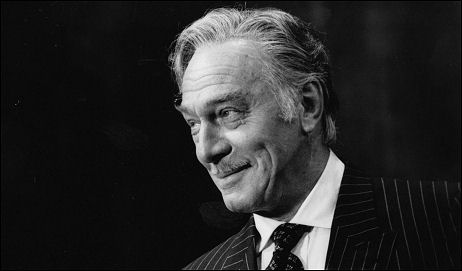
In the final graph of her entertaining N.Y. Times review of Christopher Plummer‘s In Spite Of Myself: A Memoir (Knopf), Alex Witchel writes, “If your stock in trade is feeling for a living — think about that — you are required to make some messes along the way.


Christopher Plummer

“In spite of himself — his relentlessly high artistic principles; his penchant for playing the underdog, even when he was the star; his keen ear, equally attuned to the precision of Elizabethan verse and to what passes as truth across a whiskey at 5 a.m. — [Christopher Plummer] has experienced a life rich in textures, and he is able to give most of them glorious voice. His is a life in the theater lived hard and true, in the grand tradition of those distinguished players who went before, whom he has surely made proud.”

I’ve always known — understood, believed — that Plummer is a classical stage actor of a very high order, but for decades in movies he’s always played elite pricks of one sort of another — sinister-villain types who were (or certainly seemed to be) way ahead of the hero-protagonist, almost teeming with pleasure at the exercising of their snootiness or venality, or both.

How many times have I “liked” (i.e., felt a form of emotional kinship with) Plummer in a film? In exactly one role — Mike Wallace in The Insider — but really only in that one scene when he talks to Al Pacino in that hotel room about his legacy, his doubts, “what future?” And in that early scene when he has that big argument with the flunkies for that Middle Eastern guy, and when he pitches his first question (“Are you a terrorist?”).

I’ve always enjoyed his creepy psychopathology (the bad guy in The Silent Partner, the sinister book publisher in Wolf) but of course, that’s par for the course.