Lurie Thanks, Clarifies

“Thanks for the kind words,” director Rod Lurie wrote earlier this evening, “and the kind regret you expressed over what happened to Nothing but the Truth (and, for that matter, What Doesn’t Kill You — the terrific film by Brian Goodman).

“However, it’s a tad misleading to say that the film made just 3K before it was yanked from theaters. That seems to indicate that some sort of disinterest is responsible for those numbers. The film was put into a couple of theaters as part of an Academy qualification procedure. Both films were only scheduled for a one-week run. But about nine days earlier, YFG went into Chapter 11. The films opened in more or less a four-wall situation without any ads, really. Indeed, no posters were even printed for Nothing but the Truth

“It’s very upsetting, of course. My producing partner Marc Frydman and I had worked for a long time on NBTT and even longer on WDKY. Both films received terrific reviews and I think it was reasonable to think that Kate Beckinsale, Vera Farmiga, Mark Ruffalo and Ethan Hawke could be in the awards mix. Kate and Vera, after all, got BFCA noms.

“Honestly, I can say that this all feels like a bit of a drive-by shooting. YFG has been doing the best they can by allowing the films to play in festivals all over the country, but they’re in a tough, tough spot. I respect them for how they are dealing with all this. Remember, they have several other films in the pipeline.”

“That said, we have really gone for it in the Nothing But The Truth DVDs — very honest commentaries, amazingly produced docs, and some fun deleted scenes.”

“Hopeless Nostalgics”

Speaking to Wired‘s Adam Rogers, Watchmen creator Alan Moore puts the fanboys in their proper place with a six-paragraph quote: “I have to say that I haven’t seen a comic, much less a superhero comic, for a very, very long time now,” he begins. “But it seems to be that things that were meant satirically or critically in Watchmen now seem to be simply accepted as kind of what they appear to be on the surface.

“If you remember back in the ’80s, there was an incredible spate of monumentally lazy headlines in British and American magazine and newspapers. But also something along the lines of ‘Bam! Sock! Pow! Comic Books Aren’t Just for Kids Anymore.’ I used to think those headlines were just irritating, but it’s only recently that I’ve looked back and realized how incredibly inaccurate they were. Comics had not grown up, bam-sock-pow.

“What had happened was that you’d gotten two or three comics that had gotten, perhaps for the first time, serious adult elements in their compositions. This was judged as miraculous as a dog riding a bicycle back in the 1980s. It doesn’t matter whether he’s riding it particularly well; it matters that he’s riding it at all.

“I think that a lot of people, irrespective of whether they’d ever read a book like Watchmen, took it basically as a form of license. I think there were a surprising number of people out there who secretly longed to keep up with the adventures of Green Lantern but who felt they would have been socially ostracized if they had been seen reading a comic book in a public place.

“With the advent of books like Watchmen, I think these people were given license by the term graphic novel. Everybody knew that comics were for children and for intellectually subnormal people, whereas graphic novel sounds like a much more sophisticated proposition.

“That sounds like the kind of thing a 30-year-old — or a 40-year-old, even — could be caught reading on the tube, upon the subway, without embarrassment. When I started work for DC Comics, I figured that my readership was probably somewhere between — they’d previously been 9 to 13 years old, and now they were around 13 to 18.

“The average age of the audience now for comics, and this has been the case since the late 1980s, probably is late thirties to early fifties — which tends to support the idea that these things are not being bought by children. They’re being bought in many cases by hopeless nostalgics or, putting the worst construction on it, perhaps cases of arrested development who are not prepared to let their childhoods go, no matter how trite the adventures of their various heroes and idols.”

Watchmen Uptick

We’re now in the third phase of Watchmen reaction buzz — a turning of the karma that is now starting to point upwards with Devin Faraci‘s very lengthy praise review that went up today on CHUD and Drew McWeeny‘s Hitfix rave. Slight counter-boosts, temporary mood changers. But don’t be surprised if the naysayers rise again.

The first phase began eight days ago (on 2.16) with that rancid, embargo-ignoring, anal-ecstasy fanboy piece by Time blogger and Simpsons exec producer Matt Selman.

That prompted Phase 2 — a series of angry counter-reactions in this and other corners, and my posting of three negative (but agenda-free) responses to the film — “Staggering Failure” on 2.17, “That Whooshing Feeling” on 2.19 and “Watchmen Pan #3” on 2.23. (As well as that stirring review by music-industry fringe player Mike Rogogna!)

Now we’ve got Phase 3 underway with Faraci and McWeeny’s hitback raves and this reader comment from longtime reader “Will,” who saw Watchmen in Austin last night:

Watchmen dives into the serious social commentary that set The Dark Knight apart from previous comic book-based movies, but that’s part of the reason it’s been a classic in the comic book medium for so long. Is it too faithful to the book? I don’t think so. The film does the source material justice in every way possible outside of a frame-by-frame, panel-by-panel reenactment.

“The changes made from the source are all for the better in terms of plausibility except for the pseudo-superpowers the main characters (aside from Dr. Manhattan) have had added. That’s the only part where this comic fan came out going ‘whaah?’ The friend I went with didn’t care, I don’t think, so take that for what it’s worth. They don’t push you to feel as if you have to like any of the main characters (as in the book), which will turn off some general audience types. That is part of the whole point.

“The thing is that the cut we all saw last night won’t please everyone, but for the first time I don’t think that’s a bad thing. You chop more out, the movie doesn’t work. You make the fans happy and do the whole director’s cut, you limit your audience exponentially. The acting was good all around, the effects weren’t over-CGed, and the slo-mo wasn’t as crazy as it was in 300. Snyder did the material justice better than anyone has done Alan Moore’s work. Even non-fans will probably go back and see it in IMAX if able.

“I honestly expected to be let down in a big way, because I love the source book. Defying all my expectations, I had to tell my brain to stop thinking about the book because I liked the movie so much. I’ll have to see it again to really soak it all up. You shouldn’t read the graphic novel right before going to see it, and if you have and you’re insisting on it being JUST like it, you’re an idiot who should go back to directing from their sofa.

“The reason I felt I had to write in was that anything posted at Ain’t It Cool will look too much like the original Time blog rave to most readers, and the three pans HE has printed are too smug for their own good. They read like these three guys are reacting not to the movie, but to the first guy’s review and his type of person.

“I know there are people out there that want an adapted work to play like a radical auteur take on existing material. That works for Batman, but not these characters. They have their multi-issue miniseries and that’s it. No dark Frank Miller run in the 80’s, no rebirthing storyline or ultimate super-awesome reset of existing continuity exists for these characters.

“I’m not a slavish devotee of the comic, but I read it some years ago, respected it, and thought the movie did everything it needed to and then some in translating it. The only thing I’ll directly echo from the original Time blog reviewer is that I didn’t think it was possible to do it well or at all. Take the film for what it is, and don’t let the deterrent personality of some anonymous guy reviewing it change your mind.

“Ask yourself a question: do you like movies or do you like criticizing them to look smart with no repercussions to your credibility? The answer to that question determines whether or not I care what you think about this or any film.”

Final Wells comment: I say again that only non-vested straight-talkers who were never that into comic book geekdom can be trusted on this movie. It may be a great film, or a very good or deeply stirring one, but only the pure of heart and the culturally uncommitted can determine this. Trust no one with any kind of deep-rooted, strongly Catholic investment in geek fanboy culture.

Hebrew Oscar Scandal

In a righteously angry L.A. Weekly piece about the awarding of the Best Foreign Language Film Oscar to the “relentlessly medicore” Departures instead of the much more deserving Waltz With Bashir , critic Scott Foundas has written that “it seems likely that Ari Folman‘s film was simply too innovative for the Academy’s notoriously calcified tastes.

“Certainly, by Academy standards, it was one of the more radical works ever to be nominated in the Foreign Language category — a fragmented memory film in which truth and illusion collide on a tide of uncertain recollection. There are multiple narrators, dreams masquerading as reality (and vice-versa), and so many genres exploded moment by moment that it becomes impossible to squeeze the film into an easily definable box.

“And while Waltz builds to a conclusion that many (including this critic) counted among the most emotionally devastating in movies last year, it is a moment that is earned by the film rather than cheaply calculated, and which raises more questions than it answers. That’s something that many viewers of Folman’s film have found thrilling to behold, but which may well have inspired paroxysms of rage in Academy voters who stand by the belief that a movie should have a clear beginning, middle and end and send people out of the theater feeling better about ‘humanity.'”

Departures Hasn’t Got It

I just came from a screening of Departures, and Kris Tapley‘s 2.21 assessment of this film was definitely a bit kind. It’s a “sensitive,” curiously comedic at times, sometimes affecting, often cloying and very “middle class” film about transitions and coming to terms with death (and with your dead dad who abandoned you as a child) and feeling the sadness and showing the respect. There are moments when you don’t feel a strenuous, pull-out-the-stops effort by director Yojiro Takitato to emotionally “get” you, but they are few. A movie that makes you feel the effort and hear the grinding gears as much as this one does is in trouble from the get-go.

It certainly was with me minutes after it began. It’s a nice kindly movie in some respects, one that says the right things about life, identity, love, family and the end of life, but in no way is it an Oscar calibre thing, much less an Oscar winning one. It does some things affectingly, yes, but it’s mainly and primarily a second-tier, tonally erratic, touch-feely Japanese James L. Brooks movie with a gimmick (i.e., the Japanese custom of preparing the dead and paying final respects in a gentle way) that is used over and over and over and over. And I’m sorry but Scott Feinberg was wrong, wrong, wildly WRONG for saying in an HE talkback comment Departures deserved the Best Picture Oscar over Waltz With Bashir and The Class.

Basic Values

According to Kim Masters2.24 Daily Beast article about Peter Chernin‘s resignation from 20th Century Fox, former Fox Studio chief and present-day producer Bill Mechanic is an “outspoken detractor” of Chernin.

“Peter’s in the Peter business,” Mechanic tells Masters. “That’s his job. Every day is focused on, `How do I do something for myself?’ Certainly when I was there, he was not a popular guy.”

Certainly, people who play their cards too much in a “me, me, me” vein lose out in the end. You have to try and be a mensch in life, in business, on the subway, on the golf links….everywhere you go, whatever you do. Everything starts to taste like ashes if you don’t.

But I also have to say that few of the people I know in this business are selfless good samaritan types. Most of them are friendly and supportive as far it goes but in the final analysis who isn’t out for number one? I appreciate favors as much as the next guy, but I don’t expect anyone to pave my way or make my bed or pick up my dry cleaning. We all try and mitigate our selfish tendencies with as much kindliness and generosity and graciousness as we can muster, but c’mon…how many people can you turn to in a pinch and rely upon for serious help, knowing full well that they’ll stand up for you? Be honest.

Angle of the Dangle

I’m seeing Departures, the Japanese-produced film that won the Best Foreign Language Film Oscar, late this afternoon in Manhattan. Two press screenings are also set for Los Angeles on Friday, 2.27, and Wednesday, 3.4. Regent Releasing will be opening Yojiro Takita‘s drama sometime in May.

Take this with a grain but I’ve been told that Departures won due to a very old but still effective hide-the-ball screening strategy. The fact that it won the Oscar surprised a lot of people so theories have been kicking around. The hide-the-ball strategy, while hardly complex, certainly sounds clever.

Since those foreign-film committee members who vote for the foreign film Oscar have to verify that they’ve seen all five nominees, the Departures team decided to try to eliminate potential votes for their chief competitors, Waltz with Bashir and The Class, by simply restricting the number of Departures screenings.

The fewer the screenings, the fewer chances existed that Bashir and Class supporters could get to see Departures. The odds that they might miss the Japanese film altogether were therefore increased, as well as possibly disqualifying themselves from casting final ballots.

This scenario basically alludes to the efforts of L.A.-based publicist Fredel Pogodin and not so much Sophie Gluck in Manhattan, who mainly looks after local journalists. Pogodin obviously couldn’t control who liked which film, but being an experienced publicist she does know, I’m told, who the older impressionable softies are among the foreign-film committee. So her strategy became to make sure that the softies voted and also to try and increase the odds that hipper, edgier, more discerning voters — the ones who were theoretically more likely to vote for Bashir or The Class — might potentially be kept from voting by failing to see Departures. Simple.

The older and more conservative types, according to this theory, were likely to respond to the delicate emotional character of Departures. They also might also be more uncomfortable with Bashir‘s unusual combination of animation and documentary realism, and with its criticism of Israel’s conduct during the Lebanon war.

The oldies, one hears, also tend to be a bit bored with a film like The Class, which uses an intellectual, underplayed, soft-spoken approach in telling a story of a group of French high-school teachers and students.

To keep Departures as hidden as possible, it wasn’t shown to press at all during the Oscar campaign time. Not for nothing was Pogodin’s first e-mailed invitation for the two press screenings (or at least the first one I received) sent out on 2.17.09 — the deadline day for final Oscar ballots. (Gluck, in turn, didn’t invite New York-area press until 2.23, the day after the Oscar telecast.)

How did In Contention‘s Kris Tapley see Departures ? A publicist (not Pogodin) slipped him a DVD screener.

Brutal Game

When Doug Liman‘s Fair Game arrives sometime in 2010 or the following year, we will have had two movies based on the the outing of former CIA agent Valerie Plame WilsonLiman’s, which will probably costar Sean Penn and Naomi Watts, and Rod Lurie‘s Nothing But The Truth, which was also partially based on the trials and incarceration of Susan McDougal.

It still blows my mind how Lurie’s film was abruptly scuttled and gone in a flash when Bob Yari’s company went belly up a little more than two months ago. Nothing But The Truth cost $11 million and change to produce, and it took in just over $3 grand before being pulled from theatres. I can’t verify this with a link that I like, but a friend tells me that Sony is releasing the Nothing But The Truth DVD on 4.28.09.

Bleach Baby

That deliberately degraded, snow-grained Blu-ray of William Freidkin‘s The French Connection is out today, and I’m searching for reactions from non-reviewers. You can’t trust regular DVD reviewers since they tend to bend over backwards to say nice things because they don’t want to alienate the folks who send them free copies. If anyone was dumb enough to buy this thing (as I was), please send along your reactions. You don’t have to hate it.

Still Hiding

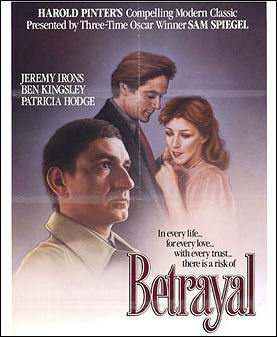
I was stunned when I noticed the absence this morning of David JonesBetrayal, the notoriously missing 1983 adaptation with Ben Kingsley, Jeremy Irons and Patricia Hodges, among films that will compose a three-day Harold Pinter tribute at the American Cinematheque from 3.26 through 3.28.

I thought after Pinter’s passing that this captivating, jewel-like drama would at begin to turn up at special venues like the Cinematheque, at the very least. Even when a rights issue has prevented a DVD release of a film, the elite venues (AC, Aero, Film Forum, Film Society fo Lincoln Center, etc.) almost always manage to score a print for a single showing. But not this time.

Written by Pinter as a play in 1978 and then adapted for the screen three or four years later, Betrayal is easily the most elegant, accessible and well-liked Pinter movie ever made. It follows that any film programmer showing a series of Pinter films can’t exclude it without having to answer to guys like myself.

“Nothing Pinter has written for the stage has ever been as simply and grandly realized on the screen as [this],” wrote N.Y. Times critic Vincent Canby 26 years and 4 days ago. “I can’t think of another recent film that is simultaneously so funny, so moving and so rigorously unsentimental. The writing is superb, and so quintessentially Pinter that it sometimes comes close to sounding like parody, though, in the entire screenplay, there’s not one predictable line or gesture, the sort of thing that would expose the fake or the merely hackneyed. This is pure Pinter well served by collaborators.”

I’ve been ranting about wanting to see Betrayal on DVD for at least ten years. And yet no one in a position to explain the whys and wherefores has ever written or called. Nice.

This morning I wrote Chris, the AC programmer, and asked if he could help with info about who owns the prints and control the rights. The family of the film’s producer Sam Spiegel, perhaps? Spiegel died 24 years ago, and you know how weird and conflicted families can sometimes be about inherited assets.

“As you know, there’s no Betrayal DVD at all, and the film hasn’t been seen on video since ’84 when CBS-Fox put out a VHS version,” I wrote. “I find it mind-blowing that you guys weren’t able to at least score a print for a single showing. This means (a) there’s no decent-looking print anywhere and/or (b) whoever owns prints and the rights doesn’t give a hoot, hasn’t tried to preserve or restore the film, isn’t into the potential, etc.”

The three-day American Cinematheque program will show Pinter’s The Comfort of Strangers , The Homecoming, The Servant, The Caretaker, The Go-Between and The Pumpkin Eater.

The Wall

AmEx was shot and edited in a day and a half back in April 2006, as a sardonic response to the multitude of big-name filmmakers [Wes Anderson, etc.] appearing in American Express commercials. Three years later, with the collapsed state of indie film and the strangled economy/credit market, it seems more relevant than ever.” — Jamie Stuart.


AmEx (2006) from The Mutiny Company on Vimeo.