Prisoners of Sex

In his 4.9 review of Observe and Report, Time‘s Richard Corliss wrote the following: “About an hour in, mall cop Ronnie Barnhardt (Seth Rogen) has finally achieved his dream and taken the blonde, egotistical, doltish perfume saleslady Brandi (Anna Faris) to bed, basically by getting her drunk. Problem is, she’s pretty much passed out, her puke staining the pillow, as Ronnie happily, obliviously churns away. He pauses for a moment to notice her comatose state, and without opening her eyes, Brandi mutters, ‘Why’d you stop, malefactor?’ Or a 12-letter word to that effect.

“Now that‘s character comedy, I mean tragedy, I mean tromedy, of the highest, I mean lowest, I mean high-lowest order. Beyond the weirdness, if you can get there, is a quick portrait of trailer-park America pursuing its urges by any means necessary. It’s clear that Ronnie, no babe magnet, will take what he can get on this night of nights, even if it’s not quite the exalted ecstasy he had hoped for; and that Brandi, who’s been in this position once or twice before, wants the sexual exercise, even if she’s not awake to take an active role in it — somewhere in her stupor, she’s feeling a rote rumble of pleasure.

“The scene achieves what few American movies even attempt: to pinpoint the grim compromise, the desperation, that can attend the sex act. Don’t call it love; don’t call it grand; but whatever it is, don’t stop.”
Racist Snark?

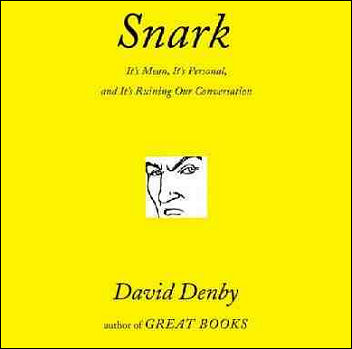
I’ve long regaded Tom Wolfe as a political conservative, but I’ve never thought of him as an old-line racist. This is nonetheless the view of New Yorker critic David Denby in a new hardback essay he’s written called Snark. Here’s an excerpt from a review/summary/critque by reasononline’s Michael C. Moynihan.

“Denby identifies Wolfe’s Radical Chic as a progenitor of today’s snarky style, but it fails, he says, because the writer’s teasing of haute-liberal infatuation with the Black Panthers ‘now seems more fatuous than the assembled partygoers,'” Moynihan writes. “How so? Because, according to Denby, ‘In the end, [Wolfe’s trademark] white suit may have been less an ironic joke than the heraldic uniform of a man born in Richmond, Virginia, who entertained fancies of a distinguished Old South in which blacks kept their mouths shut, a conservative who had never accustomed himself to the new money in the Northeast.’

“While denouncing bloggers for rumor-mongering and for besmirching reputations with nothing but conjecture, Denby nevertheless finds it appropriate to imply that Wolfe’s writing is steeped in white supremacy.”

“Anyone who has been exposed to the subliterate animosities and grudges of the cruder anonymous commenters or bloggers, or has bristled at the lowered bar of what passes as clever satire on snark-heavy websites, will have some sympathy for Denby’s effort to attack against the ‘everyone-sucks-but-me’ culture,” Moynihan notes. “But his bizarre choice of targets and imprecise definition of ‘snarky’ derails his argument from the beginning.

“At its core, Snark is a deeply political book and, therefore, Denby offers special dispensations for a Right On!-variety of ideological snark.

“‘Snark is irresistible,’ he writes, when discussing our previous president (and who could disagree with that?), but it apparently becomes gauche when directed at Democrats peddling hope and change. A large chunk of his argument is ceded to score-settling and a post-election outpouring of anger against those who said impolite things about Hillary Clinton and Barack Obama. (Denby may be the only writer alive who would describe Sarah Palin‘s description of Barack Obama as ‘palling around with terrorists’ as snarky.)

“Denby tags the Fox News screamer Bill O’Reilly as a boorish knuckle-dragger, but his liberal counterpart Keith Olbermann is something else entirely: ‘One can’t help but noticing…that Olbermann’s tirades are voluminously factual, astoundingly syntactical…and always logically organized.’ The leftist writer Gore Vidal is a ‘master of high snark,’ while his conservative counterpart Tom Wolfe is an overrated racist. If you agree with the snark, it probably isn’t snark.”

Death in Pittsburgh

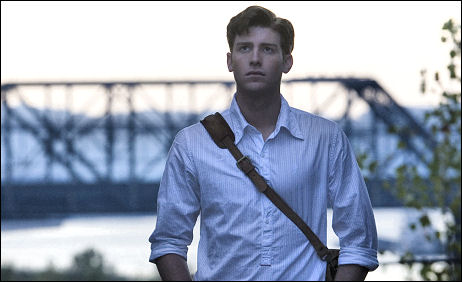
It was obvious within ten or fifteen minutes of watching The Mysteries of Pittsburgh what the central flaw is — it’s the way Art Bechstein, the lead character (and narrator), has been written, and particularly the aura of the actor who plays him — the almost 100% repellent Jon Foster. I paid to see Pittsburgh on Friday night at the AMC Empire, and I really can’t remember feeling such acute dislike for any non-villain character in so short a time. One result is that it was a serious struggle to force myself to watch the film to the end.

The problem is that time and again, Bechstein is shown to be a timid and inarticulate liar. His narration (said to be taken straight from Michael Chabon‘s 1989 best-seller) is wry, sharp and candid, but Bechstein is anything but. He’s a dull blob — a kind of bland sociopath — with a skinny frame and a face that is all about non-disclosure. This is not Bechstein from Chabon’s novel, which I remember reading in ’90 or thereabouts.

Foster stares glumly at his gangster father (Nick Nolte) and offers nothing but stupidly evasive half-replies to his questions. Out of boredom he has a hot-sex affair with his book-store boss (Mena Suvari) and treats her like dirt, and lies to her face, ineptly, when she accuses him of dissing her. He obviously hungers for Sienna Miller ‘s girlfriend-of-Peter Sarsgaard character but pushes it all down in spasms of suppression that lead nowhere. You just want to shoot him.

Foster conveys a single emotional condition throughout the entire film — a sense of quiet panic that people might actually be reading who and what he is (i.e., a cypher), and the absolute necessity of preventing this from happening.

On top of which Foster is a bore on his own terms. He has good bones and is somewhat handsome (if you don’t have an aversion to people with red hair) but I’m having trouble remembering another actor who’s conveyed less of an inner life of any kind — less vigor, less aliveness, less wit or humor. His eyes are like little brown pebbles on the side of a road. He needs to be play villains. Pittsburgh director Rawson Marshall Thurber probably would have bored me without Foster in the lead role, but his decison to cast Foster was absolutely fatal.

Reds

Another thing I don’t like about Mysteries of Pittsburgh star Jon Foster is the fact that he has red hair (along with the attendant pale skin and freckles). This is another one of my shallow and irrational objections, I realize, but red hair has always been a problem for me. It’s not as if I write redheads off when I meet them because I don’t — that would be incredibly stupid — but there’s something a little bit off-putting about them regardless. It’s not like I’m Rod Taylor and they’re morlocks. But I do tend to say to myself when I meet a redhead, “Oh…okay. Well, grow up and get past it.” Except I don’t.

I love the almost pumpkinish shade of Tilda Swinton‘s hair in real life, but it’s a kind of blockage at the same time. Cate Blanchett may be a redhead (not sure) but I know I tend to respond to her more favorably when she’s blonde — I distinctly remember recoiling when I saw her red hair in the first Elizabeth movie. I loved David Caruso ‘s performance in Mad Dog and Glory but there’s something about his pale freckly skin that’s always seemed a bit icky. I’ve never liked Carrottop. I could never warm to Red Buttons. The only red-headed actor I’ve really and truly liked without reservation was James Cagney, but the vast majority of his performances were captured in black and white. (I tried finding a color photo of a young Cagney — the only way I could get one would be to secure a frame capture from Captains of the Clouds.) Rita Hayworth also escaped the prejudice of people like me due to her mostly monochrome resume.

I’ve always loved Jack Warden (particularly his performances in Shampoo and Heaven Can Wait) and have never allowed this idiotic blockage to get in the way. Ditto Malcolm X — a man I’ve admired almost my entire life, and certainly one of greatest spiritual seekers of the 20th Century.

There’s a reason, I’m figuring, why I’ve never had a relationship with a red-haired woman in my life.

“Little Skinny For My Taste…”

Andy Garcia is 53 today. He’s been at it since the late ’70s, broke through in the mid ’80s (his role in Hal Ashby‘s Eight Million Ways to Die), has obviously made his bones. But he’ll never top this acting moment with Richard Gere in Internal Affairs (’90) — a scene that flashes through my head every time I think of him. It’s all the more remarkable because Gere’s doing most of the talking, and with great perverse charm. But Garcia owns it.

So which movie is Garcia directing first — Clemente or the Ernest Hemingway film? Items about both projects popped up within a two-day period late last month.

Purist Robes

“The Republican Party is like a dying tyrant, mad with syphilis, ironically like that very Stalin they would accuse their enemies of associating with. How else to account for their desperation to resurrect the wraith of Joseph McCarthy; the hammy and baffling utterances from high-level party officials like Boehner and McConnell; the blatant desire on their part to let the country fail out of sheer resentment; the wanton sedition of conservative shit-stirrers ranging from the quasi Madame Defarge Michele Bachmann to the porcine, pill-popping porcine propagandist Rush Limbaugh?

“It is an all-out assault on reason, on progress, on truth. What is the difference between the Republican Party and, say, the Taliban? A rogue by any other name would smell as rank. Their frantic accusations all churned out in a futile effort to explain their current pariah status is as pathetic and draconian as stoning a woman in the street.” — from Steven Weber‘s 4.11 HuffPost, titled “G.O.P. R.I. P.”

The stakes and some of the particulars have changed over the last five years, but as noted in a December 2004 review of Adam Curtis‘s The Power of Nightmares, the differences between the purist Republican right and the Taliban are actually fairly slight.

“The film contends that the anti-western terrorists and the neo-con hardliners in the George W. Bush White House are two peas in a fundamentalist pod, and that they seem to be almost made for each other in an odd way, and they need each other’s hatred to fuel their respective power bases but are, in fact, almost identical in their purist fervor, and are pretty much cut from the same philosophical cloth.

“They’re both enemies of liberal thought and the pursuit of personal fulfillment in the anti-traditionalist, hastened-gratification sense of that term. And they believe that liberal freedoms have eroded the spiritual fabric that has held their respective societies together in the past. Curtis’s doc shows how these two movements have pushed their hardcore agendas over the last four or five decades to save their cultures from what they see as encroaching moral rot.”