Last of Heath

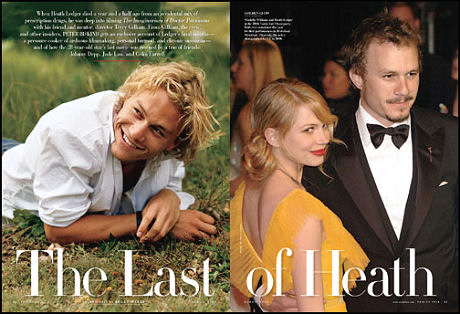
Heath Ledger “was always hesitant to be in a summer blockbuster with the dolls and action figures and everything else that comes with one of those movies,” the late actor’s friend and agent, Steven Alexander, tells Peter Biskind in an upcoming Vanity Fair. “He was afraid it would define him and limit his choices.”

Alexander and other confidantes tell Biskind that “one of the reasons Ledger agreed to do The Dark Knight was that it would be such a long shoot it would give him an excuse to turn down other offers. Ledger had a pay-or-play deal on The Dark Knight — meaning he’d get compensated no matter what — so he felt he had the freedom to do whatever he wanted as the Joker.”

He hoped in fact, that “his performance would be so far-out he’d be fired, and thus become the beneficiary of a lengthy, paid vacation.”

Which is why his Joker performance was so great. Because Ledger didn’t care. The best creative work always….okay, often comes out of a fuck-it mindset. Worry about what you’re going to create or whether or not you’ll be good enough and you’re dead.

No Despair

Not every day can be well organized and super-productive. I was going to bang out my Bruno review (the green light is up) but it wouldn’t happen. When the plane doesn’t lift off the ground and it’s suddenly 4:30 pm when it was only noon an hour earlier, you just have to suck it in and try to do better the next day. And now I have to catch a 6 pm screening of Nia VardalosI Hate Valentine’s Day. And my early-bird DVD seller still doesn’t have Lonely Are The Brave, which streets on 7.7.

Mess

There’s just no end to the ick factor in the Michael Jackson tragedy. Everything that’s being reported sounds sordid and sad. Or it’s been made up. The Sun posted a story today about the late pop singer’s ghastly physical state — appalling — and then TMZ reported that the story is fake. And 95% of the world is repeating the same mantra — “Ignore the facts, deny the damage, ignore what Michael Jackson became — just listen to the music and focus only on his peak-of-popularity years in the ’80s and early ’90s.”

I found it moderately unpleasant to watch Al SharptonAl Sharpton? — and Joe Jackson hold a news conference this morning about delayed funeral arrangements for Michael, matters of executorship and custody of the kids, etc. Because there was no shaking off the feeling that these guys are basically hustlers looking to self-promote, revive the MJ brand, get their cut, bask in media attention, spread around the b.s. and blah-blah.

And on top of all this Universal has decided to cut the 100% non-offensive LaToya Jackson scene out of Bruno altogether.

Split Decision

Denby Delighted: “Michael Mann’s Public Enemies is a ravishing dream of violent gangster life in the thirties — not a tough, funny, and, finally, tragic dream like Bonnie and Clyde but a flowing, velvety fantasia of the crime wave that mesmerized the nation early in the decade.

“The scowling men in long dark coats and hats, led by the fashion-plate bandit John Dillinger (Johnny Depp), march into a grand Midwestern bank with marble floors and brass railings, take over the place, throw the cash in bags, and make their getaway, jumping onto the sideboards of flat-topped black Fords — beautiful cars with curved grilles and rounded headlights that stand straight up from the cars’ bodies.

“It’s the American poetry of crime. Throughout the movie, blazing tommy guns emit little spearheads of flame, just as in a comic book. Men get their skulls bashed with gun butts, and get thrown out of cars, but, despite all the violence, the movie is aesthetically shaped and slightly distanced by the pictorial verve of gangland effrontery — the public aggression that Mann makes inseparable from high style. He keeps the camera moving, and the editing (by Paul Rubell and Jeffrey Ford) reinforces the speed without jamming ragged fragments together in the manner of hack filmmaking. As a piece of direction, Public Enemies is often breathtakingly fast, but it’s always lucid.”

Denby Troubled: “[The film] needed a charge of surprise, and I wish the filmmakers had more forcefully developed two ironies embedded in the material. For all of Hoover and Purvis’s talk of ‘scientific methods,’ the new F.B.I. wins the war not by arresting criminals and sending them to prison but by massacring them.

“And Dillinger, as the movie readily shows, is deluded about himself. He embraces the future, but, actually, his time is over; the new crime syndicates dismiss him as a troublemaking fool. And although the screenplay keeps insisting that he’s intelligent and shrewd, the movie demonstrates the opposite. The character doesn’t quite add up. If he had been given a wild destructive streak, the conception might have made more sense, but Mann seems to trip over his own story by making Dillinger so self-contained and cool. The problem with casting a star as low-key and attractive as Johnny Depp is that you can’t turn him into a man who is, at bottom, a loser.”

Eternal Cage

In recognition of Bernie Madoff having been sentenced to 150 years behind bars, here’s a re-link to that 3.14.09 piece about how I would have escaped and cavorted it if I’d been in Bernie’s shoes. Excerpt: “I’d hire three full-time prostitutes to travel with me, but they’d have to be prostitutes who know how to sail.”

Why didn’t Madoff get 500 years? Or a thousand? I’ve always loved the poetic ring of 20,000 Years in Sing Sing, which is the title of a 1932 Michael Curtiz crime-prison drama with Spencer Tracy and Bette Davis. It comes from author Lewis E. Lawes‘s 1932 novel.

“Been To The Gym?”

I may as well join the crowd and post this HD trailer for Ricky Gervais and Matthew Robinson‘s The Invention of Lying (Warner Bros., 9.25). Trailers always seem to misrepresent what a film actually is (i.e., how it plays) so you always need to take them with a grain. But the basic impression I’m getting is that TIOL may be a little too on-the-nose — an explicit comic thesis going through the movie motions. But maybe not.

Mann’s Women & Mortality Itself

Responding to my recent praise for Michael Mann‘s Public Enemies, legendary film critic F.X. Feeney shared some thoughts earlier this evening, focusing especially on Mann’s history of writing strong and defiant female characters.

“I’m so glad we agree about Public Enemies,” he began. “I think it’s a beautiful confluence of everything I ever loved about Last of the Mohicans and Heat — especially in its sense of America as a still-embattled frontier where men and women continuously invent and re-invent themselves, and protagonists (whether they live within the law or without it) who are defined by their refusals to conform.

“This is one reason I take exception to Mark Harris‘s view that Mann short-shrifts his female characters. Gong Li in Miami Vice goes her own way, at huge risk. So do Madeline Stowe‘s Cora in Mohicans, Ashley Judd in Heat, the angry women played by Diane Venora in Heat and The Insider, Tuesday Weld in Thief.

“Everywhere you look in Mann’s work (The Keep, Manhunter) women are all deeply observed, self-reliant and fully dimensional..

“I will admit La Cotillard takes the coupe du monde in their honors, but then she is not only great in herself but that magnificent hall-of-mirrors moment when Dillinger contemplates her angelic double, Myrna Loy, in Manhattan Melodrama. It seems to me that here, Mann grandly contradicts the old saw that men’s ‘immortal dreams of women’ are ‘unattainable.’ From where Dillinger sits, that dream has been attained quite fully, thank-you-very-much. A ticklish mystery, this.

“I love, too, that Public Enemies dramatizes the great line from Miami Vice — ‘time is luck’ — without having to state it aloud. Mann is contemplating mortality in this movie, more directly and philosophically than ever before — and doing so in the Ernest Hemingway sense of action as a philosophy.

“This is a soulful film that calls no attention to its soulfulness, trusting us to tune in.”

Feeney added the following early this morning:

“I offer what follows with a word of caution to your readers that they really should see Public Enemies before they read too much more about it. Although I’m careful to avoid blatant spoilers here, everybody should have the great pleasure of seeing this unique movie for the first time by their own lights.

“Rereading what I wrote about Dillinger watching Myrna Loy (who bears such a pleasing resemblance to Marion Cotillard’s Billie Frechette), I don’t feel I did this scene or my feelings about it justice.

“The moment is extremely moving in context, as a development in Dillinger’s psyche — he’s not a very reflective guy, but in this moment (courtesy of Mann’s fine filmmaking and Johnny Depp’s translucent acting) we’re given a privileged glimpse as he takes stock of his life.

“That JD has been loved and tasted goodness is something we know well, courtesy of Cotillard. That he’s able to see and appreciate this, as if he were a disembodied spirit regarding his own life with the clarity and compassion of a stranger, is a gift that comes to him courtesy of — wouldn’t you know it — the movies.

“I don’t think there’s another instance in Mann’s work where he’s ever so directly regarded ‘movies’ as a factor in our lives and culture. Celebrity (Ali), yes. Crusading jounalism (The Insider), absolutely. Mann has always been sensitive to the ways people project their personalities in any public arena, but he’s tended to leave ‘movies’ out of the equation.

“Indeed, you could argue that his films are ‘anti-movies’ in the sense that he is relentless about drawing from life, and not the work of other filmmakers. Yet here is a rare moment in which the silver screen is shown to reconcile a man to the chaos of his life.

“This is what I mean when I characterize Public Enemies as a meditation on mortality. It strikes me that Mann is casting a conscious, wondering eye at this art form where he’s spent so much of his own life, and its impact upon souls.”

Reaction: In Contention‘s Kris Tapley respectfully disagrees with some of what Feeney has to say.

MJ’s Passing Hurt Enemies

“I respect your love for Public Enemies,” a critic friend wrote this evening. “I have to say it didn’t bowl me over — it’s too diffuse, too uncertain on what story it really wanted to tell. Although, agreed, Marion Cotillard is terrific and there’s no doubt the film looks wonderful, like every Mann project.

“But there’s a point here — and maybe a post — in how the externals of last Thursday’s big NY screening at Leows’ 84th Street may have critically affected its reception.

“As I’m sure you know, the Manhattan screening was a clusterfuck — long lines, not enough seats, etc. Several major critics were heard loudly complaining about all of this, and while this is petty shit and shouldn’t influence any pro’s opinion — I remember giving raves to movies I saw sitting on the floor of the Eccles — it definitely can.

“The other imponderable was, bizarrely, Michael Jackson.

“What does he have to do with John Dillinger? Nothing. But, again, one big-time reviewer told me, having heard about the death just minutes before the film started, ‘I don’t think I can sit down and watch this movie now.’ Jackson’s tragedy was, at the very least, a distraction from what was about to demand (and deserve) our full attention as it unfolded onscreen.

“Is any of this Mann’s fault? Obviously not. And I can honestly say my feelings about the film had nothing to do with the mismanaged screening or the death of a pop star. I’m used to cattle-call screenings (and usually just bully my way through). And I thought Jackson’s death was sad, but weirdly predictable.

“But did all this strangely, subtly, unfairly, bring down other people’s enjoyment of the film? Yeah, probably.”

Soraya, Wah Do Dem Win

The L.A. Film Festival Audience Award for Best Narrative Feature went to Cyrus Nowrasteh‘s The Stoning of Soraya M. — a valuable selling point. (I respected and admired it but couldn’t get past the horrific subject matter.) The Audience Award for Best Documentary Feature went to Jeffrey Levy-Hinte‘s Soul Power. And Eva Norvind‘s Born Without won the Audience Award for Best International Feature.

The Target Filmmaker Narrative Award — the confusing moniker for the jury award — went to Sam Fleischner and Ben Chace‘s Wah Do Dem (What They Do), which I didn’t see and which no one told me to see and which no one told me anything about during my six days at the festival. The Target Documentary Award was given to Juan Carlos Rulfo and Carlos Hagerman‘s Those Who Remain (Los Que se Quedan).

Piggy Feet

This portion of a paragraph from a two-day-old Patrick Goldstein column made me blink: “When they weren’t dancing, Brett Ratner and Michael Jackson would watch movies together. [Ratner] says they must’ve watched the original version of Willie Wonka and the Chocolate Factory 50 times over the years.” Ratner is exaggerating, of course, but still. Speaking as someone who’s watched some great films as many as 25 or 30 times (like North by Northwest, say), the idea of anyone eagerly watching that 1971 film more than four or five times seems awfully strange. It’s good but not that good.

Why hasn’t Warner Home Video come out with at least a seasonal release date for the North by Northwest Bluray? George Feltenstein told High-Def Digest last February that they were preparing one.

Huddled Masses

Variety‘s Pamela McClintock is reporting that Transformers: Revenge of the Fallen has earned an estimated domestic haul of $201.2 million domestic, a result of business at 4,234 theaters. This is the biggest five-day haul ever after The Dark Knight. Pic’s worldwide total through Sunday was $387 million, one of the best global debuts of all time.

Excuse me but I need to go slit my wrists now.

The good news is that The Hurt Locker had a great opening also. The three-day estimate is $144,000, which came from playing at four theaters for a per-theater average of $36,000. Some were guessing a $30k-per-screen average based on Friday’s business. As Coming Soon’s Ed Douglas puts it, “This is pretty strong for a movie with no big name actors. It played to sold-out audiences at all 4 theaters (2 in NY, 2 in LA). It’s important to note that unlike other limited run films that have multiple prints at each theater, this was not the case for The Hurt Locker, thus demonstrating the true audience demand for the film and a representation of the film’s potential.”