
Woodstock Replay

Originally posted on 5.15.09 in Cannes: “I don’t know what I was expecting exactly from Ang Lee‘s Taking Woodstock (Focus Features, opening today), but what I saw didn’t deliver. This backstory saga about the legendary Woodstock Music Festival of ’69 works in spots and spurts, but it too often feels ragged and unsure of itself, and doesn’t coalesce in a way that feels truly solid or self-knowing.
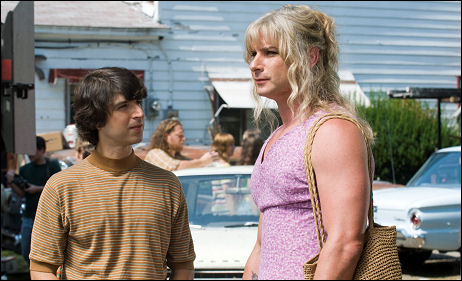
At best it’s a decent try, an in-and-outer. Spit it out — it’s a letdown. I wish it were otherwise. I’d like to be more obliging because I love many of Lee’s films and fully respect his talent. I remember and cherish the spirit and the legend of the 1969 Woodstock Music Festival. And I appreciate what a massive undertaking it must have been to try and recreate it all within a dramatic prism.

James Schamus‘s script is based on the story of Eliot Tiber, the artist who stepped in and pretty much saved the disenfranchised festival by finagling a land permit in Bethel, New York. (The source is a same-titled book by Tiber and Tom Monte.) The story is basically about how a closeted gay Jewish guy got over feeling obliged to help his parents survive by helping them run their rundown El Monaco motel in White Lake, N.Y., and freed himself to live his own life.

This story comes through but it feels analagous to a story of the D-Day Invasion that focuses on Francois, a closeted young man in his 30s who doesn’t want to work at his parents’ Normandy bakery any more. “Merci, General Eisenhower, for allowing me to finally move to Nice and be openly gay!”

And the Eliot story is weakened, in my book, by Imelda Staunton‘s strident and braying portrayal of Tiber’s mother-from-hell. I’ve known my share of Jewish moms and I didn’t believe her. Nobody is that humorless or stupid (in terms of recognizing economic opportunity) or dark-hearted.

And as noted, the big sprawling back-saga of how the festival came together — the element that audiences will be coming to see when it opens — too often feels catch-as-catch-can. It doesn’t seem to develop or intensify, and there’s no clean sense of chronology.
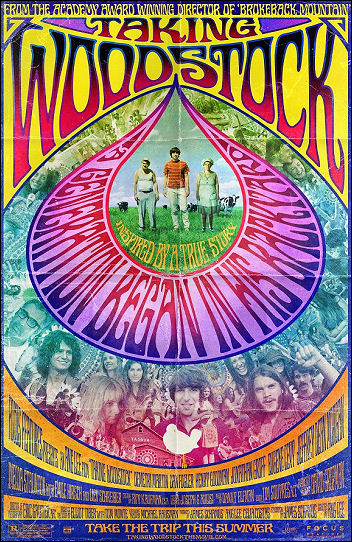
And there’s at least one glaring inaccuracy when a random festivalgoer declares a day or two before the event begins that “it’s a free concert, man…haven’t you heard?” My recollection is that it wasn’t declared free until the concert had begun and the fences had come down and the organizers realized they’d lost control.

Taking Woodstock should have been dated here and there like The Longest Day. That way, at least, we’d have an idea of how many days are left before the festival begins, a sense of “okay, getting closer, things are heating up.”

Lee references Wadleigh’s 1970 doc by using the same split-screen editing style and by shooting it with a semblance of ’70s grainy color. But no Woodstock concert footage is mixed into Lee’s movie, and this just seems unfulfilling somehow. It’s a shame that Lee and Schamus (who also produced) and Focus Features couldn’t have worked out a cross-promotional deal with Warner Bros. that would have allowed for this. I kept telling myself that it’s Eliot’s story, not Woodstock II, but I wanted glimpses of the real thing, dammit.

Comedian Demetri Martin is steady and likable as Tiber, although too much of the time he’s been directed to look overwhelmed or mildly freaked. (This was a man of 34 who’d been around a bit — Martin plays him like Dustin Hoffman‘s Benjamin Braddock.)

Eugene Levy is quite good as Max Yagur, the kindly but shrewd dairy farmer who leased the land to Woodstock Ventures. Liev Schreiber delivers a mildly amusing turn as Vilma, a blond-haired cross-dresser whom Eliot hires to provide security for the El Monaco, but his character has no real function or arc — he’s just providing Greek-chorus commentary. Jonathan Groff does a decent job as Michael Lang, the most well-known of the concert promoters, playing him as a serenely confident Zen type. (I loved the way he gets around on horseback in the second half of the film, whether or not that’s accurate — it’s a good bit.)


Emile Hirsch, Ang Lee during shooting.

It may be impossible to have characters speak in ’60s cliches without the effort feeling tiresome, but that’s what happens here. I realize that people actually used the terms “groovy” and “far out, man” back then, but every time you hear them in the film…God!

Taking Woodstock was just too big an undertaking, I suppose. In the same way that Lang and his partners instigated but couldn’t control the enormity and chaos of the ’69 festival, Lee was also overwhelmed. Tough fame, tough call, I’m sorry. Better luck next time.
How It Is

In the old days negative critical word was naturally regarded as a bad thing. If a majority of film critics said a certain film really stinks this was definitely thought to be a harbinger of box-office calamity, and more often than not the box-office tallies tended to bear this out. Nowadays, of course, the Eloi and the Joe Popcorn crowd will pay to see whatever the hell they want to see regardless of good or bad critical buzz. True, within a certain rarified strata of moviegoers (i.e., that miniscule micro-minority that actually cares about seeing good stuff), the views of critics and online columnists matter. But as far as the mob is concerned it almost doesn’t matter what is said about a film as long as a film gets talked and argued about.

In other words, the kiss of death these days is not being talked or argued about at all. What matters for a film, marketing-wise, is to be “in the national conversation.” What’s being said about a film (i.e., the substantive yea-nay verdict) is really a secondary consideration. Therefore all the dumps that I took on Inglourious Basterds mattered not. What mattered is that guys like me were talking about it all the time (along with the endless stream of talk-show appearances by Quentin and Brad Pitt and Christoph Waltz). And it became a film that everyone was talking about and which had to be seen. This is more or less how things work now, I think. Agree?

O’Brien’s Meltdown

Observe how Conan O’Brien becomes more and more uncomfortable as Bill Maher gets more and more adamant about how stupid people are and how President Obama needs to just push through health care and ignore the crazies, etc. Seriously, look at O’Brien. The man is obviously in pain. Maher says toward the end of the stint that “your eyes are watering.” Pathetic.

Roadkill

Here’s an over-cranked music sequence from Ashutosh Gowariker‘s What’s Your Rashee?, which will show at the Toronto Film Festival. Imagine how this seqence could have played if the guy (Harman Baweja) had played his guitar in a natural, sitting-in-a-car sort of way and just sung along with his own unamplified voice. This is the Bollywood-influenced aesthetic that has made Indian films into unwatchable junk.

The pretty girl, by the way, is Priyanka Chopra, who plays 12 diferent parts in the film. Notice how she refuses to look at the road for long stretches of time? If only David Cronenberg had directed…

Mumbo Jumbo

And by the way that isn’t a damn “driedel” — it’s a plain old spinning silver top. I’m not Hassidic and I didn’t go to school in Tel Aviv. They’re called tops. That’s what they used to call them in Westfield, New Jersey, where I grew up was a kid and a young teen.

Limited Space

I took some time earlier today to think about my contribution to Peter Howell‘s annual Toronto Star “Chasing the Buzz” feature, in which a selection of hardcore know-it-alls get to pick three Toronto Film Festival films they’re most looking forward to. That’s pretty limiting in itself but you also have explain why in one sentence…Jesus. I might change my mind but right now my faves are Jason Reitman‘s Up in the Air, Joel and Ethan Coen‘s A Serious Man and Rodrigo Garcia‘s Mother and Child. I’ll figure out the copy later on.


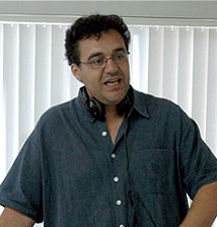
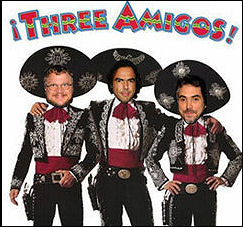
Mother and Child director Rodrigo Garcia; dopey 3 Amigos art

Howell won’t let me adequately explain the Mother and Child thing so I’ll do so here and now. All I’ve read is that it’s about an older woman (Annette Bening), the daughter she gave up for adoption 35 years ago (Naomi Watts), and an African American woman (Kerry Washington) looking to adopt a child of her own. I also know that Garcia, based on the evidence of his earlier Nine Lives, is excellent at getting into the souls of women and divining their relationships and so on.

But it’s mainly because one of the shorts in Nine Lives — a piece called “Diana” with Robin Wright Penn and Jason Isaccs — is one of the most intensely emotional portrayals of an unresolved relationship that I’ve ever seen. Here‘s what I wrote about it four years ago.

On top of which Mother and Child has been produced by the Cha Cha Cha guys — Guillermo del Toro, Alfonso Cuaron and Alejandro Gonzalez Inarritu.

And here, by the way, is an excellent all-in-one, wheat-separated-from-the-chaff lineup of all the best-looking films showing during the festival. It’s been painstakingly assembled by Greg Cruse, described by Howell as “a blogger, film buff and fellow buzz chaser.”

The story and results from Howell’spoll will be published in the Saturday, Sept. 5 edition of The Toronto Star, and also appear online at TheStar.com the same day.

Dream Bandits

In Contention‘s Kris Tapley‘s hasn’t read the script for Chris Nolan‘s Inception, but a source has so KT has decided to pass along a second-hand synopsis of the plot. He says he can’t be 100% sure of the particulars because WB publicity won’t comment “but it all seems fairly legitimate to me.”

The Big McGuffin, he says, is that some kind of ability/technology used by a team of shady espionage operatives led by Leonardo DiCaprio‘s “Cobb” to nefariously dive into people’s dreams and extract information.

Leo’s team members (this will eventually become a kind of Mission Impossible-like TV series with operatives hired each week to solve a problem by mind-scanning this and that “mark”) include Joseph Gordon-Levitt‘s Arthur, Tom Hardy‘s Eames and Ellen Page‘s Ariadne, a college student studying in Paris.

Jacob’s team, says Tapley, “creates” the dreams and Ariadne is an “architect” or “engineer” of sorts. I’m already lost. If Team Leo is diving into people’s dreams and extracting info, how and why would they want to create dreams? Wait…perhaps they don’t just steal information from people’s minds but implant information of their own? Information that is (a) designed to manipulate and (b) may or may not be false?

Jacob’s team enters this and that dream via some kind of injection, and the technology can easily be transported in a suitcase, Tapley says. “In one scene (featured briefly in the trailer?), the team actually enters a person’s dream while on an airplane,” he writes.

Cillian Murphy stars as Fischer, “a business-type who is soon to become the head of a company. Jacob’s team is attempting to insert an idea into Fischer’s mind to compel him to separate the company into two smaller companies.

Ken Watanabe plays Saito, a character who’s blackmailing Jacob. Aside from Watanabe there is no classic villain in the story, but Cobb’s wife (Marion Cotillard) causes some trouble.

“Cobb and wife at some point find themselves stuck in many levels of a dream and she tries to convince him to stay in that world, that it is much better than real life. However, Cobb wants to return to his children and the real world.

“This plot point is a bit unclear, but I’m told that Lisa commits suicide in the dream in order to return to the real world. When Cobb himself returns, he is charged with his wife’s murder and has to flee with his children.

“The film will not be typical sci-fi fare at all,” Tapley conveys. “It’s set in the present-day real world” but with “virtually all of the ‘action’ scenes taking place in the dream environment. This should go a long way toward explaining the ‘Your mind is the scene of the crime’ tagline that accompanied the trailer. Ultimately it seems like a grounded, more tangible blend of Minority Report and The Matrix.”

Lady Crickets

Somebody asked me to name off my favorite under-40 female critics the other night. I forget how the subject came up or why under-40 was mentioned as opposed to under-30 or under-50, but off the top of my head I said Kim Morgan, Karina Longworth, Kim Voynar, Katey Rich, and…and…and I ran out of names.

There must be at least four or five I’m not thinking of so I’m asking for names and links and quotes. If LexG or anyone of that attitude/mindset mentions looks or hotness I’m going to erase the post — fair warning.

Tossing aside the age thing my favorite brilliant/eccentric/lunar-orbit female critic is Manohla Dargis of the N.Y. Times — I dearly love her writing. My second favorite is Washington Post critic Ann Hornaday, partly because she writes well and partly because I agree with her 90% of the time. I’m a fan of Slate‘s Dana Stevens and Salon‘s Stephanie Zacharek. And…uhm, no one else is coming to mind. Who am I missing?

Hit The Brakes

In the space of a few hours, In Contention‘s Kris Tapley, Rope of Silicon‘s Brad Brevet, and Awards Daily‘s Ryan Adams have suddenly seized on the notion of Trucker‘s Michelle Monaghan being this year’s Melissa Leo — an out-of-the-blue Best Actress contender for an allegedly exceptional performance as a negligent mom coping with an estranged son.

Do these guys have the same dope dealer? There are more than a couple indications that Trucker ain’t no Frozen River, and that it may be no more than an okay-but-no-cigar thing. And without the springboard of great reviews, Monaghan — however good she may be as hard-livin’ truck driver Diane Ford — hasn’t a snowball’s chance.

Trucker is an ’08 film that couldn’t land a usual-suspects distributor after playing the Tribeca and Austin film festivals 16 and 10 months ago, respectively. If it had any real mojo wouldn’t someone other than Monterey Media, which releases crap, have picked it up? Wouldn’t it have played at least a few other respected festivals? Wouldn’t Trucker (which opens on 10.9) have screened for at least some critics by now? I haven’t heard zip about it from anyone.

And wouldn’t Monaghan have found a respected champion other than the Hollywood Reporter‘s Stephen Farber, a solid critic known for dispensing occasional easy-lay raves? He wrote that Monaghan’s performance as a selfish blue-collar woman suddenly saddled with an estranged young son “elicits the same exhilarating sense of discovery that surrounded Sally Field‘s breakthrough in Norma Rae.”

Fine, but Variety‘s John Anderson said that Monaghan “has trouble finding a rhythm in the dialogue, or any sustained emotional plausibility in a film that relies on character-driven moments rather than narrative momentum. Like a runaway tractor-trailer, Trucker is carrying [Monaghan] directly from irresponsible to maternally alert. You can’t stop it. You can see it on the horizon as soon as the movie starts. What’s missing from the payload is surprise.”

Trucker has 13 producers and exec producers. Thirteen! That in itself spells trouble.

Trucker was directed and written by James Mottern. It costars Nathan Fillion, Benjamin Bratt, Joey Lauren Adams (alarm buzzer!), Jimmy Bennett.

I feel for Monagahn wanting to snag a strong role for herself and kick herself up to a new level and all, but Gran Shaggy Poo says we ain’t goin’ for it. Set up some NY and LA screenings and let’s see how Trucker plays…fine. But until that happens the Monaghan hoo-hah stops here.

Sidenote: In his 4.28.08 review Anderson described Monaghan as “elfin.” Except a Google search says she’s either 5’7″ or 5’8″. That’s not elfin — that’s par for the course. Ellen Page is the current standard for Hollywood elfin. Next to Page Monaghan towers.

Waltz’s Assurance

The Envelope/Gold Derby‘s Tom O’Neill reports that while Harvey Weinstein intends to use a “last-minute, ambush strategy” for Rob Marshall‘s Nine, he plans to use the Crash campaign model for Inglourious Basterds.

“Because the DVD will be a mass release, it won’t need to be watermarked with numerals identifying each disc with the name of an academy member or other award voter,” O’Neill writes. “That’s one of the sneaky ways Crash beat front-runner Brokeback Mountain for best picture of 2005 — Lionsgate blitzed Hollywood with more than 120,000 cheap DVDs.”

The only Inglourious Basterds Oscar nomination that’s going to happen is Christoph Waltz for Best Supporting Actor — end of story. Harvey can blanket Hollywood with DVDs to make sure this happens, but isn’t Waltz’s nomination already pasted into most people’s heads? Tarantino’s screenplay hasn’t a prayer of being nominated for Best Original Screenplay. Not with that damn baseball-bat/brain-matter scene. Gran Shaggy Poo sez the over-50s ain’t goin’ for it.