Stacked Deck

Michael Cieply‘s 10.10. N.Y. Times piece about Roman Polanski’s situation takes stock of today’s tougher attitudes and standards about congress between older men and younger women, and — for the first time in my readings — seems to forecast a longer sentence than expected for Polanski (i.e., more than 12 to 18 months) if and when he’s extradited to the States and faces a judge.

It suggests that Polanski really should have seen the process through back in ’78 rather than skip. It also tells me that it would be at least somewhat unfair to apply today’s mandates and mores in the matter of Polanski’s sentencing. It would almost be analagous to a man having been busted for illegally selling liquor in 1912, and then skipping for 10 years, being re-arrested and extradited and facing a sentence in 1922 during the height of prohibition. He was guilty by 1912 standards, of course, but would be seen as more guilty by 1922 standards. That doesn’t seem right to me.

“If [Polanski] is extradited from Switzerland, Mr. Polanski could face a more severe punishment than he did in the 1970s,” Cieply reports, “as a vigorous victims’ rights movement, a family-values revival and revelations of child abuse by clergy members have all helped change the moral and legal framework regarding sex with the young.

“Mr. Polanski’s lawyers — including Reid Weingarten, a Washington power player — are likely to argue that Mr. Polanski does not even qualify for extradition from Switzerland, because he was set to be given a jail term of less than one year when he fled to France in 1978.

“But Stephen L. Cooley, the Los Angeles County district attorney, has signaled that he believes much stiffer penalties may be in order. Questioned by reporters just after Mr. Polanski’s arrest, he said the filmmaker had received a ‘very, very, very lenient sentence’ that ‘would never be achievable under today’s laws.'”

And…?

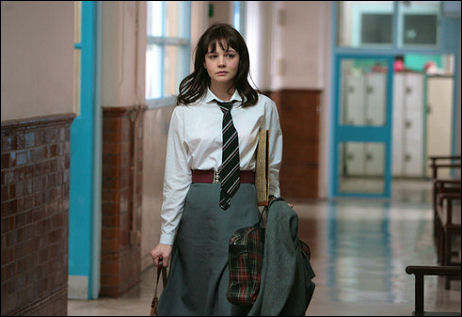
Nine months after An Education preemed at Sundance, it finally opened limited last Friday. I’m guessing that some of those who feel I’ve overpraised it and/or made too much of Carey Mulligan‘s performance were among the viewers. Reactions?

Down The Drain

I get why Couples Retreat, which almost every critic thinks is shit, is the #1 movie this weekend. People refuse to consider reviews (naturally!) and the trailer made it look half-decent and some imagined, I’m sure, that a remnant of the old Vince Vaughn/Wedding Crashers aura might be part of it. (Or that Vaughn plus Jon Favreau meant a possible reviving of the old Swingers thing.)

Sherman’s March

I’ve been in Atlanta since last night. A strictly personal thing. No industry tie-ins or allusions of any kind. Everyone deserves a little down time, and perhaps even an occasional semblance of a life. Out of here tomorrow morning and off to London tomorrow night for the Fantastic Mr. Fox junket.


Downtown Atlanta

Kaptur

“When Lincoln ran into trouble during the Civil War, he got new generals. He brought in Grant. I hope that President Obama will bring in some new generals on the financial front. I don’t think that any individual who had a responsibility in creating in creating this [financial] mess should be in charge of cleaning it up. I honestly don’t think they’re capable of it.” — Rep. Marcy Kaptur, the star of Capitalism: A Love Story, speaking on a just-aired Bill Moyers Journal.

I voted for Barack Obama, of course, and I can’t help loving the guy. But I’d really and truly rather have Rep. Kaptur running the show on the economy rather than he.

http://www.huffingtonpost.com/arianna-huffington/a-moment-of-truth-with-bi_b_314797.html

“You May Not Say That Word!”

“It’s a very sacred thing, the nest egg…the egg is a protector like a god, and we sit under it and we are protected by it. Without it…no protection!” Arguably the single greatest rant (certainly the funniest in a marital context) ever delivered in the history of American motion picture comedy.

Toy Story 3

For me, the Toy Story 3 standout factor — apart from the content of this relatively new trailer, and the slightly odd fact that it has no website despite a 6.18.10 release date — is that it was penned by Little Miss Sunshine Oscar-winner Michael Arndt.

The slogan is “no toy gets left behind.” The theme is about abandonment, homelessness.

Woody, Buzz, and the rest of their toy-box friends are dumped in a day-care center after their owner, Andy, departs for college. Voiced by Tom Hanks, Michael Keaton, Tim Allen, Whoopi Goldberg, Joan Cusack and R. Lee Ermey.

Bronson!

Nicholas Winding Refn‘s Bronson is an extreme-fury, absurd-testosterone package about a 57 year-old bellowing beast who’s spent almost all of the last 35 years in prison, and most of these in soilitary, primarily due to an anger-management problem of ridiculous animal proportions. Born Michael Petersen, he’s called himself “Charles Bronson” for much of his life behind bars. But his story, which I admit has a certain intrigue as an object d’art, isn’t nearly compelling enough to fill a feature-length film.

I began to think about escaping 35 or 40 minutes into it. Half my brain was processing the film, and half was figuring out what I could get done (i.e., write about) if I left early. As it happened I stayed to the end, but I had no idea what all the people who were praising this film at Sundance ’09 were on about. “This?” I said to a couple of them. L.A. Times guy Mark Olsen has called Bronson “a searing operatic vision…a phantasmagori\a motored by a dazzling performance by Tom Hardy.” Actually, it’s an oppressive and confining vision because it forces the viewer to sit in prison for year after year, and because it gives the viewer little more to contemplate than Hardy screaming and howling and banging his head against the bars.

JoMo Goes Gaga

An Education, which was shot by John De Borman and designed by Andrew McAlpine, is a morality tale that often plays like high comedy,” says Wall Street Journal criicket Joe Morgenstern. That’s due in large part to Carey Mulligan.


An Education‘s Carey Mulligan

“After seeing the movie last month at the Telluride Film Festival, I wrote that everyone there seemed to be comparing her to Audrey Hepburn. The comparison is irresistible, and not only because Jenny sometimes wears her hair upswept in a Holly Golightly do, or because Hepburn played a young woman opposite an older man in at least three movies — Sabrina, Love in the Afternoon and My Fair Lady. (In five if you count Funny Face and Charade, neither of which dwelled on the age difference.)

“The 24 year-old Mulligan, like Hepburn has a way of endearing herself with little more than a lilting phrase — her speaking voice is as rich as Juliet Greco‘s singing voice — or a flashing glance. But it’s her own way, and she’s her own special edition of a dazzling new star.

“The first time I saw her was almost a year ago, in a superb Broadway production of The Seagull, with a cast that included Peter Sarsgaard as Trigorin; she played Nina, the sacrificial creature of Chekhov’s title. She was electrifying from her first entrance, when Nina speaks of having been in a fever all day, and cries joyously, ‘The sky is clear, the moon is rising!’ Either an actress has the skill to make those extravagant lines her own or she doesn’t, and Ms. Mulligan had skill, and passion, to burn.

“In An Education, where she’s completely convincing as a 16-year-old — the movie was shot two years ago — she has created a complete original. Jenny is, to toss off a French phrase, always on the qui vive; it’s as if she’s listening intently to the life around her for clues about how it works. Both her beauty and her agile mind allow her to be precocious without being insufferable. And she isn’t merely sufferable, she’s admirable for the purity of her responses to culture — Jenny plays the cello as an ardent amateur — if not the clarity of her insights about love.

“When David takes her and a couple of his philistine friends to a concert, she’s the only one who loves the music. (The cello is a magnificent instrument, but I do wish filmmakers would occasionally use another one to signify a lyrical spirit.)

“If purity were Jenny’s main quality, she, and the movie, would be a bore. No danger of that, though, because her motives are mixed, her gift for deviousness is impressive and she, like her semidrab middle-class parents, becomes complicit in a series of choices that may put an end to her dreams of going to Oxford, and bring down the shining promise of her life before she’s ever had a chance to take off.

“The director, Ms. Scherfig, is Danish, but she is manifestly at home working in English. (Her previous English-language features, both highly recommended, are Wilbur Wants to Kill Himself and Italian for Beginners.) Direction can’t be seen, but Ms. Scherfig’s approach makes itself felt in a sparkling stream of felicitous choices. She’s a poet of natural rhythms and intimate insights, and this new film will make her a star in her own realm.

“What it will do for the movie’s star is another matter. One thinks not only of Hepburn, but of Julie Christie bursting upon the world in Billy Liar. That was a very small role, though. Ms. Mulligan is the heart and soul of An Education, and she’s phenomenal. The whole film is phenomenal. I love it.”

Southbound

I have to catch a 6 pm Newark plane so I have to start the run-around now or I’ll wind up missing it. So that’s it until I hit the airport around 4:30 or so. I’ll see how it goes.

Zapata For A Day

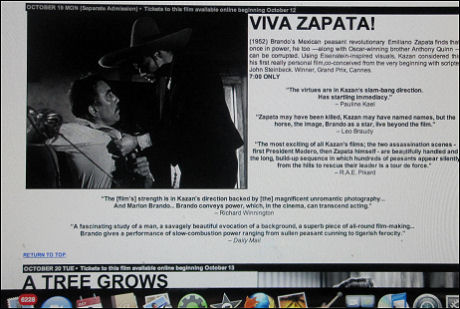
Since Elia Kazan‘s Viva Zapata still isn’t out on DVD (and apparently won’t be any time soon, according to a guy I recently spoke to who seemed to know a few things), it’s a priority for me to see it at the Film Forum on Monday, 10.19, as part of a three-week Kazan series.

The effete snooties have been putting this film down for years, calling it a sentimentalized, white-liberal view of the Mexican revolution. And the fact that John McCain has called it his favorite film can’t be interpreted as a good thing. But the craft, heart and political conviction in Viva Zapata still feel genuine to me. Kazan was coming to terms with ratting (i.e., confirming names) when he made it, but he was still an old leftie from the ’30s and knew about the emotion behind a rebellion.

Zapata is one of Brando’s three golden-era Kazan collaborations, two years before Waterfront and a year after Streetcar. And he’s truly great in the lead role. Ditto Anthony Quinn and Joseph Wiseman in theirs. (I’ve always loved how Wiseman, playing a manic political agitator type, shouts in a crazy manic stream, “Zapata, in thenameofeverythingwefoughtfor don’t go!”) And Brando’s death scene near the finale (i.e., getting shot 112 times) is a classic of its kind.

Werc Werk Works

I had a brief but pleasant chat yesterday afternoon with Elizabeth Redleaf and Christine Kunewa Walker, the co-founders of the Minneapolis-based production company Werc Werk Works. They’re basically into using private-equity funding (drawn from the coffers of their rich pallies in Minneapolis) and financing arthouse movies at a price. I didn’t ask them what that price is exactly, but figure something low. (Or…you know, kinda lowish.)


Werc Werk Works’ Christine Kunewa Walker and Elizabeth Redleaf — Thursday, 10.8, 6:35 pm.

At one point I mentioned the financing philosophy of producer Robert Evans , which is basically that talent needs to take a little upfront but primarily be ready to gamble. If the film works out, we’ll all make out and if it doesn’t…well, there’s always the next one. Or words to that effect. One of the partners (I forget if it was Redleaf or Walker) said they’re more or less operating according to the Evans plan.

They’ve made (i.e., largely financed and produced) three films so far — Todd Solondz‘s Life During Wartime, Rob Epstein and Jeffrey Friedman‘s Howl and Bela Tarr‘s The Turin Horse. And they recently announced a fourth — Jill and Karen Sprecher‘s The Convincer, about “a salesman who seeks to acquire a rare musical instrument,” according to a trade announcement.

These are basically upscale wine-and-cheese movies, which Redleaf and Walker are obviously into. Minneapolis is a very hip and liberal town and these two are very much woven into that fabric, and they’ve figured out a way to finance films of this stripe in a way that makes financial sense, and…hey, that’s cool. And “wine and cheese” is not a perjorative term. It simply means movies attuned to educated people with seasoned taste buds. (The three-toed sloth who lives above my place wouldn’t touch any of their films with a ten-foot pole, and good for that.)

I can’t honestly say I’m a huge cartwheeling fan of Life During Wartime, but I know what Howl is (i.e., about Allen Ginsberg‘s famous ’50s poem and the obscenity charges he faced because of it) and I’m a big fan of James Franco (who plays Ginsberg) and I know about the aesthetic tendencies of Bela Tarr so I think I get it. Refined serious-edgy stuff and no popcorn pablum…right?

It’s a very tough world out there now and a lot of producer-financiers are on shaky ground or have been knocked out of the game altogether, but Werc Werk Works is well-planted and viable and committed and all that other good jazz.

They first met through the Walker Arts Center Film Society in Minneapolis, which Redleaf founded a few years ago and which functions as a kind of Lincoln Center-esque institution. Redleaf is also a member of the Telluride Film Festival board and serves on the IFP Minnesota board. Walker wrote and produced Older Than America, produced Factotum and line-produced American Splendor, which won the Grand Jury Prize at the 2003 Sundance Film Festival and the International Critics Award at the Cannes Film Festival.

Yesterday I was having trouble remembering their production company’s name, to be honest. I was trying to think of it as I rode uptown on the IRT to meet them at a place on Broadway and 69th. I knew it was three variations of the word “work” but I just couldn’t remember which one has a “c” and which has a “k” or whatever, but it’s starting to stick to the grooves in my brain. I get the game. I’m down with the program.