Gone With The Wind Reborn

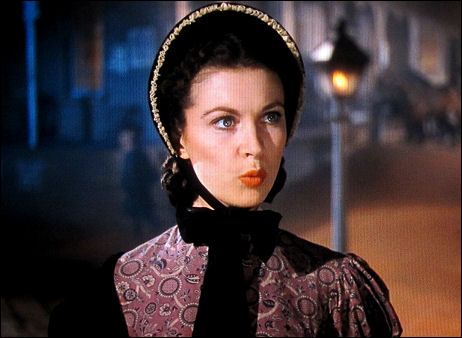
I’ve just watched the first half of the new Gone With The Wind Bluray, and I’m truly dazzled. No, levitated. This is by far the most beautifully rendered old-time Technicolor film I’ve ever seen on a high-def system — razor-sharp, pulsing with color, pretty close to grain-free and significantly upgraded over the 2004 DVD version, which was excellent for what it was.

I haven’t talked to Robert Harris or George Feltenstein or anyone else in the know, but I do know what my eyes tell me. This Gone With The Wind is amazing — a candy-store Technicolor eye-bath like nothing I’ve ever sunk into before. The key element is “next to no grain.” I haven’t come up with a term that conveys the opposite of a “grainstorm” but this delivers that. Hallelujah — somebody finally heard!

The grain levels are roughly at par with WHV’s Casablanca Bluray, which didn’t have a digitally scrubbed-down look but a naturally clean quality. Why didn’t WHV deliver the same nearly-grain-free quality (or an approximation of same) in the sepia-tone sections of The Wizard of Oz?

My approving-but-not-exactly-blown-away reactions to Warner Home Video’s other two “Murderer’s Row” Blu-ray titlles — Oz and North by Northwest — led me to expect that GWTW would be of a similar quality, which is to say noticably but not mind-blowingly better than the last DVD. Riper, sharper and more fully rendered, okay, but not in a way that would make anyone gasp or drop their pants. Well, the GWTW Blu-ray is a serious gasper and pants-dropper.

That’s all I’m going to say for now except that for my money DVD Beaver’s Gary Tooze was too restrained in his recent review of this disc. He said that “there are times when it makes you gasp” and that “detail advances to as high a degree as we are likely to see for this 70-year old classic,” okay. But he didn’t convey sufficient excitement. He didn’t jump and down and say “this is the kind of Blu-ray of a Hollywood golden-age film that you’ve always dreamed of but not never quite saw.”

Veteran’s Day


Food fair off Fifth Ave. on 56th or 55th. A guy selling hot sausage and onion sandwiches had the temerity to charge $10. I would have gone to $5 or $6 bucks in a stretch, but $10? Get outta town. Wednesday, 11.11., 11:0 am.

11.9, 10:55 pm

11.11, 10:45 am

Laid Back in Italy

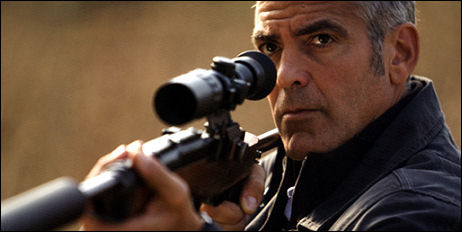
I ran into Men Who Stare at Goats director-writer Grant Heslov on 10.13 at the opening-night party for the London Film Festival. He had flown up from Italy with George Clooney, the star of Anton Corbijn‘s then-shooting The American, of which Heslov is one of the producers. It’s about an asssassin (Clooney) hanging back and chilling down in a Southern Italian village as he prepares for the proverbial final assignment while coping with a romantic entanglement and local friendships, etc.


Photo copied from an 11.11 Playlist posting.

You know what this sounds like? Local Hero with high-powered rifles and scopes and silencers.

I told Heslov I was especially excited to see this film because of my delight with the visual compositions in Corbijn’s last film, Control. I asked if there’s any chance that The American is being shot in black-and-white. “Nope,” said Heslov, faintly amused.

Worthington Again

It had somehow slipped my mind that Sam Worthington is the star of Louis Leterrier‘s Clash of the Titans (Warner Bros., 3.26). This on top of Avatar and the last Terminator film plus Last Night, The Debt and the possible/discussed The Candidate and The Tourist…it’s a kind of deluge. Worthington is into and all over everything in the same way that Christian Bale was the absolute go-to guy two or three years ago.

Part Arnold, part Clint, past Chuck Norris…I get it, fine. I’m just feeling like I’ve been Sam Worthington-ed in a Paul Simon/”A Simple Desultory Philippic” sense.

That said, I’m not sure how closely Leterrier and his screenwriters, Phil Hay and Matt Manfredi, have adhered to Beverley Cross‘s 1981 screenplay, but this version, to go by the trailer, will clearly be a lot crazier and 300-ish and visually ruthless than the almost 30 year-old original with its quaint Ray Harryhausen stop-motion animation and borderline embarassing visual effects.

What’s Different?

This Up In The Air trailer was posted yesterday, and it seems to be precisely the same one I was watching a month or so ago. The release-date shifts have thrown me off, so this is an opportunity to reiterate that the presumed Best Picture front-runner opens on 12.4.

Scott Foundas has written an eloquent opening for his Up In The Air review in the November/December issue of Film Comment:

“Contemporary Hollywood has steadfastly avoided the workplace — unless the jobs are particularly glamorous (Broadcast News, The Devil Wears Prada), or the workers unfairly exploited (Silkwood, North Country) or the fodder for gallows humor (the Mike Judge oeuvre). And so there’s an immediate and ingratiating novelty to the fact that so much of Jason Reitman‘s Up in the Air unfolds in cubicles and conference rooms in nondescript office buildings in Wichita, Kansas City, and other outposts of the great American in-between.

“Likewise, the people Up in the Air are neither the laugh-tracked eccentrics of TV sitcoms nor Michael Moore‘s congenitally oppressed proles. They are, rather, the white-collar career middle-managers, useful but ultimately inessential to their employers, who believed they had jobs for life — until a tough economy rendered them expendable. They may not be the stars of Up in the Air, but they are what gives the movie its soul.”

“The Hangover of 2010”?

Collider‘s Steve Weintraub caught up with a red-band trailer for Hot Tub Time Machine during his American Film Market wanderings. A red-band version has sitting on YouTube for several weeks — presumably Weintraub saw a new one. In any event he posted the following last night:

“If you haven’t heard of Hot Tub Time Machine, it stars John Cusack, Rob Corddry, Craig Robinson and Clark Duke. It centers on a group of high school pals who reunite at an old ski lodge party spot they went to when they were teenagers. After a night of binge drinking, they wake up in the same spot but it’s now 1986, due to the hot tub’s magical time-travel powers.

‘You may think this premise sounds crazy, but after watching the first footage from the film I’m almost ready to say this might be The Hangover of 2010. The trailer had me laughing out loud from beginning to end and it absolutely played like a 80’s movie except it knows it’s an 80’s movie. I also thought it was great that Cusack is returning to his roots.

“While I won’t spoil the jokes, I have to tell you one: When they wake up they wonder why everyone is dressed like it’s the 1980s. They can’t figure out what’s going on and slowly they begin to sense something’s up. Somehow Robinson realizes they might be in another era. He runs up to a random woman and asks her what color is Michael Jackson. When she says black, he freaks and runs off.

“Trust me, this movie is going to be huge.”

An All-Black Brubaker?

It’s time to ease up on Precious after yesterday’s double-header. But as a friend has passed along Raina Kelley‘s well-written “The Problem With Precious” essay (11.5) in Newsweek, I may as well keep the ball in the air a bit longer.

“Depending on who you are, where you grew up, and, frankly, the color of your skin, you’ll most likely react in one of two ways to Precious: Based on the Novel ‘Push’ by Sapphire,” Kelley begins. “The film tells the story of Claireece (Precious) Jones and her struggle to survive a life overfull with misery. Pregnant for the second time with a child fathered by her own father, abused physically, emotionally, and sexually by her mother, Precious is also illiterate, obese, and friendless.

Precious is not an easy movie to watch, and there are people in the black community who wish that you wouldn’t. They insist that it is yet another stereotypical, demonizing representation of black people. The other camp, however, is thrilled to see a depiction of a young African-American woman that, while heartbreaking, is a portrait of the black experience that has been overlooked on the sunny horizon that stretches from The Cosby Show to House of Payne.

“Unfortunately, both of those reactions miss the movie’s most searing message.

“I wish I could agree with those who say Precious is just one more movie that feeds our vision of ourselves as victims. Even that would have been better than what lies underneath: the fact that black people have begun to accept as unchangeable the lot of those stuck in the ghetto.

“How else to explain that while the film is set in 1987, no one seems outraged that so little has changed in the inner city in the more than 20 years since? Precious is a period piece that feels like a documentary. The public-education system is still failing to raise graduation rates above 50 percent in the worst neighborhoods. The public-welfare system has yet to offer a real path out of poverty, and child-protection services is still struggling to protect children. While I agree that we’ve gotten too comfortable seeing ourselves on film as martyrs and underdogs, so what? The real devastation at the heart of this film is that it can’t offer Precious a more concrete way out of her predicament.

“Yes, Precious is changed at the end of the movie, able not only to read and write but also to move toward a better life. But that isn’t enough. I wanted just a hint that she would also escape the hell that was (is) urban poverty. Precious was lucky to find the alternative school that could help her. But that’s fiction. In reality, there are far more Preciouses than there are teachers to help them. Movies such as this one allow us to forget that.

“Still, I understand people who complain about the lack of positive role models more than those who applaud just for telling this story. In their admiration of Precious’s strength and resilience, these people also implicitly accept the status quo. Precious’s parents are certainly villains, but they are also red herrings. Her situation feels so extreme that we lose sight of the bigger picture. I’m tired of movies presenting black people as grateful to find a helping hand to rise above their abusers. Not because we’ve seen this movie before — starring Sidney Poitier, Michelle Pfeiffer, Hilary Swank, Morgan Freeman, and even Matthew Perry — but because the story never changes.

“How about a ‘based on a true story’ tear-jerker that ends with some tangible improvements in the lives of impoverished children? Where’s the African-American Norma Rae or Silkwood? Hell, I’d even take an all-black remake of Brubaker. Anything that sends the message that one person — even one who is poor, black, fat, female, and abused — can change the system. Then I won’t feel like my tears have gone to waste.”

Vulnerable Precious Balloon

I’ve spoken to In Contention‘s Kris Tapley about Lee DanielsPrecious, and he’s not a flag-waving, come-this-way devotee. But he did officially predict yesterday that it would win the Best Picture Oscar, and he did call it the Best Picture front-runner on 10.21. And I think this view needs to be reconsidered.

Precious is probably a guaranteed Best Picture nominee, and it will translate all the awards heat into box-office revenue between now and early March, and good for that. And hey-ho to the people running the Precious campaign so far — excellent work. But it won’t take the Oscar. Count on it.

Precious is primarily about a film about compassion and reaching out, but mainly in the third act. Otherwise it’s an exploitation film that deals in ghastly abhorrent behavior. It drags the audience down into a pit of gross squalor and baldly manipulative chain-pullings. I respect Precious for providing the emotional comfort and catharsis that Gabby Sidibe‘s character (and the audience) so desperately needs, and I love Mariah Carey‘s quietly gripping performance. But I’ll never see it again. Because the first two acts are way too appalling.

I’m not sure there’s a whole lot of interest or enthusiasm for the Precious experience among Academy voters. There was an Academy screening of the film last Sunday night (11.8), and I’m told by two sources that only a bit more than 300 people showed up. (Roughly 1000 people showed up for a recent Academy screening of This Is It, the Michael Jackson doc, and District 9 allegedly drew a much larger crowd last August.) And the biggest applause was for Mo’Nique and Gabby Sidibe rather than Daniels. So they may be good to go for acting noms but the film? Maybe, perhaps…who knows?

Nobody will admit it, but Precious has been very effectively sold to mainstream white critics as an all-black, Oprah Winfrey-approved movie they need to respect if not praise because it’s a family-values film that wears its heart on its sleeve in the third act. And if they don’t wear this very same heart on their presumably liberal sleeves in their articles and postings then maybe, just maybe…well, who’s to say what they really feel deep down?

A producer friend reminded me a little while ago that “most people don’t want to see movies with unattractive stars.” Another guy I spoke to, industry-employed, says that “the problem with Precious is that this girl is in your face…the other part of it is that people have come to this film ready to accept, because of the marketing, that it would be an inspirational story, but the reaction I got from two guys was ‘I expected to be teary-eyed but I was dry-eyed throughout.'”

There’s a limit, I think, to the amounts of abuse and cruelty that audiences will sit through in a film — a line that Precious crosses, I feel. “At the end of the day it’s a movie, and you’re trying to get people to go to the movie, and you have to do something to get people out of their fucking homes,” the industry guy said. “At the end of the story she leaves at 17 with a child or two, and you’re left at the end with…what? And we’re supposed to ease up on the mother after the confession scene in Mariah Carey‘s office? The mom is a complete Satanic creature…beyond the pale.”

“This is a very flawed movie that’s playing on white guilt,” he continues. “Oprah and Tyler Perry are doing it to you. People can’t admit to guilt, but this is what’s in play.”

It’s been said that DreamWorks marketing honcho Terry Press tried playing the white-guilt card with Dreamgirls, and that it backfired in her face. “I don’t get up in the morning without remembering — this is an all-black cast in a musical, knowing an all-black cast has never won an Oscar,” she told L.A. Times columnist Patrick Goldstein in a 12.5.06 article. And it didn’t even get nominated for Best Picture.

There’s also the latent feeling, as expressed earlier today by Anthony Smith, that the basic situation in the film — i.e., the prolonged sexual and emotional abuse of a young girl by an evil mother and her rapist stepdad — is and should be repellent to middle-class African Americans because this sort of thing is an aberration that creates a demeaning stereotype about the lower end of African-American culture.

What does it say, exactly, about white moviegoers’ attitudes and beliefs about black culture that they’ve accepted the sexual-child-abuse story in Precious as being somewhat representative of a certain kind of down-at-the-heels African American family? I wonder how a movie like this would play if it was about sexual child abuse by a mother and father who were white lower-class crackers in Alabama or Southern Indiana? What would the reaction be if the same story involved a Spanish-speaking family in East LA or North Bergen, New Jersey? I’m just asking, wondering.

Are the makers of Precious trying to get us to see it by playing on vague feelings of racial guilt and that longing we all share of wanting to understand and somehow lend support to sad disenfranchised people by listening to their story and, for a couple of hours at least, living in their world?

Here’s a just-posted piece by The Envelope‘s Tom O’Neil that addresses the Precious situation. He thinks it might win but he’s basically hedging his bets.

Young Guy vs. Precious

I took the time to speak today to an obviously bright and articulate 29 year-old African American guy named Anthony Smith, who tells me he’s had two acquisition jobs so far (with Sony and First Look under Ruth Vitale) and has an MBA from Dartmouth, and who knows how to write fairly well. He recently sent an “open letter” to certain industry folk about Lee DanielsPrecious, claiming that it pushes dangerous stereotypes about values and conditions among African-American families. He’s the only African-American guy I know of besides Armond White who’s strongly criticized this highly praised Lionsgate release, and I wanted to suss him out a bit.

“I find it shocking that this film is being so well received across the board,” he said. “I think artistically it’s not excellent and socially it’s dangerous.” He didn’t disagree with my assessment that the behavior and pathology of Mo’Nique‘s mom-from-hell character qualifies Precious as a kind of horror film. “The reason I’m attacking the credibility is that there’s no explanation for Mo’Nique‘s character,” he said. “There’s no cause and effect…it is mental illness or what? I think the message is extremely dangerous.”

In his 11.10 “open letter,” Smith writes that “the central themes in black communities across the U.S. and in Harlem are not ones of incest, rape, teenage pregnancy, physical and mental-child abuse, obesity, poverty, welfare, illiteracy and AIDS. And yet director-producer Lee Daniels has said of Gabby Sidibe‘s Precious character, ‘I know this chick. You know her. But we just choose not to know her.’ Well, I don’t know Precious, and I have a hunch that most other black Americans don’t know her either.”

Smith went to see Precious last weekend at West L.A.’s Landmark, he says, “and there were four teenage girls sitting behind me, and they might not have been old enough to even be in that movie but they were laughing at some of it…they thought it was funny.

“All these glowing west coast and east coast positive reviews are very disturbing to me” he said. “The behavior by Mo’Nique’s character and her husband/boyfriend rapist is definitely an aberration, and these critics weren’t courageous to even address that honestly. [NY Times critic] AO Scott lives in Brooklyn…and his not questioning any of this is some kind of disconnect.

“This is in line with Tyler Perry because it’s in line with his taste, but I’m really shocked at Oprah…is this the best she can recommend? The friends of Precious saying ‘we know this, we see this on a daily basis’…I think they’re lying, they’re downright lying.”

Smith said he sent his letter to L.A. Times Op-Ed editors, but no response so far. He hasn’t sent it to the L.A. Weekly, he says.

“It is 2009 and sadly, Hollywood is stuck in the dark ages,” his letter concludes. “An industry that touts the membership of progressive-minded professionals and artists is, in fact, staunchly conservative in its refusal to finance, produce and distribute quality motion pictures by and for people of color.

“I make a sincere plea to all key decision makers at the major studios to rethink their diversity strategy. Include more talent diversity in your major label features and tentpoles. For pictures predominately about people of color, of different cultural origins, sexual orientations and religious affiliations, consider making honest investments in development, to actually produce a quality picture. These stories, like your audiences, deserve to be treated with integrity.”

Time To Show Brothers

Last night Envelope/Notes on a Season columnist Pete Hammond wrote with some enthusiasm about a Sunday DGA screening of Jim Sheridan‘s Brothers (Lionsgate, 12.4), the remake of Susanne Bier‘s 2004 film with Jake Gyllenhaal, Tobey Maguire and Natalie Portman costarring.


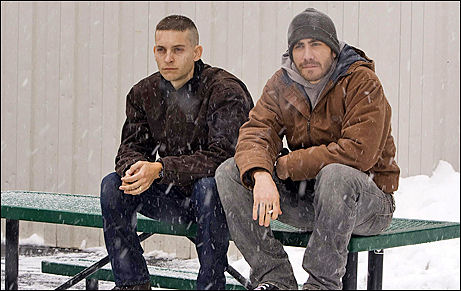
Tobey Maguire, Jake Gyllenhaal in Jim Sheridan’s Brothers.

Hammond asked “why no bloggers are buzzing about Brothers even with its Dec. 4 opening less than a month away”? Well, I’ve been writing about this film for over two years now, beginning with a start-of-filming announcement and into a 10.1.08 report that MGM had bumped Brothers out of a once-planned 12.4.08 release.

But to answer Hammond, no one’s blogging about Brothers because Lionsgate has been lagging on press screenings invites, or at least none as far as this inbox is concerned. I’m told there’s some kind of “special screening” in Manhattan slated for 11.22, and an L.A. premiere screening set for 12.1. Sheridan is currently in Toronto preparing to shoot Dream House, a psychological thriller with Daniel Craig starring. He flies to Ireland tomorrow and returns to this side of the pond a week or so later.

Sheridan’s remake follows Bier’s basic story. Maguire and Gyllenhaal are the brothers separated by character and philosophy (as well as four inches of height). Maguire is the older, “responsible,” married brother who goes off to Afghanistan and gets into a situation that results in a MIA report sent home. Portman plays Maguire’s wife. Gyllenhaal is the younger fuck-up brother who begins to fill his brother’s familial duties when Maguire disappears during a skirmish and is presumed dead.

Lionsgate is obviously much more interested in promoting Precious than Brothers at this stage, and who can blame them? But conspicuously not screening a film that will be released nearly three weeks hence seems like a weird way to play it. Being a huge fan of Bier’s original work, I refuse to believe that a film with this story and a cast of this calibre wouldn’t deliver in a significant and applaudable way.

“This powerful and timely story of a decorated Marine, presumed dead in Afghanistan, who comes home to great conflict within his family and within his own head, is a poignant and explosive look at the toll that combat exacts from veterans’ lives,” Hammond writes. “It feels especially pertinent now in the wake of the Ft. Hood tragedy and shows that war doesn’t really end for some vets once they return.

“Sheridan received a tremendous ovation Sunday afternoon when he was introduced for a q & a after a very well-received Directors Guild of America screening. The free-wheeling director engaged in a refreshingly honest and thoughtful conversation about the film’s bumpy journey to being remade.

“Sheridan pointed out that he doesn’t normally like the idea of remakes, but this one seemed irresistible, if full of minefields. In the end he believes it is quite faithful to the spirit of the Danish original and said Relativity Media, which financed the film, even did research screenings on Bier’s movie to get a take from an American audience for help in shaping the redo.

“[Sheridan] also mentioned there were some reshoots as he tried to get a grip on what the movie should be.

“The film was finished by November 2008 but Relativity agreed to hold it for a year to get just the right release date. Sheridan says selling any film with a war theme is tricky and fall is a better time for this particular subject matter. With Summit’s widely acclaimed Iraq war flick, The Hurt Locker opening last summer, it was probably a wise move.”


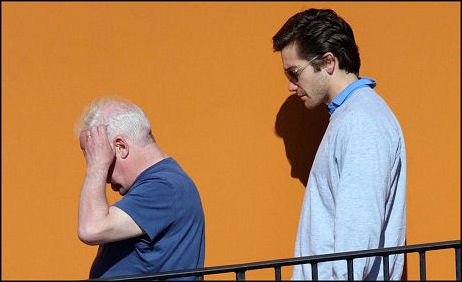
Jim Sheridan, Jake Gyllenhaal.

Hereafter

I’m very interested in snagging a PDF of Peter Morgan‘s Hereafter, if anyone has access. This is the now-shooting Clint Eastwood film, of course — a reportedly supernatural piece about three characters “touched by death in different ways,” etc.

Hereafter costars Matt Damon, Cecile de France, Marthe Keller (Marathon Man, Bobby Deerfield, Black Sunday — U.S. theatrical career seemingly killed by Fedora and The Formula), Mylene Jampanoi and Thierry Neuvic.

I’m forming an idea that whatever Invictus may or may not be, Hereafter may settle in and really touch home. It would be seen, of course, as a contemplation of realms beyond by a director obviously edging a bit closer to the take-off point as the years fall away, etc. We’re all going there sooner or later so what does it matter how soon or far off? Quality, not quantity.

Eastwood began shooting Hereafter last month in Paris, and then went to London. Filming in San Francisco and Hawaii is next. Eastwood, Kathleen Kennedy and Robert Lorenz are producing. Steven Spielberg, Frank Marshall, Tim Moore and Morgan are exec producing. Warner Bros. will open Hereafter in December 2010.

Apocalypse Gaga

I’ve forgotten if there’s a review embargo in effect for Roland Emmerich‘s 2012, but let’s assume there is and state unequivocally that this is not a review. But I do need to say that this mother-of-all-disaster-movies — this stunner, this train wreck, this howler that is Deep Impact, The Poseidon Adventure (Hackman/Winters/Lynley/Buttons version), Titanic, Airport and Hot Shots times infinity multiplied by five hits of blotter acid with CG that will make you plotz in your gourd — is absolutely, categorically and certifiably insane and must be seen because of this fearless wackazoid quality.

That’s all I’m going to say except hats off to John Cusack, the mother of all genius paycheck whores. This movie, believe it or not, is a Cusack score and not a fumble. Let’s raise a glass to Emmerich-level insanity and the nerve it took to make a film like this. As the medic said at the end of David Lean‘s The Bridge on the River Kwai, “Madness! Madness!”