Kavanaugh

I like Peter Bart‘s brief 11.19 profile of 34 year-old movie financier and Relativity Media honcho Ryan Kavanaugh more than the also-recent one by Chris Jones in Esquire. I prefer Bart’s because he mentions that Kavanaugh is “a moderate drinker [whose] driving is sufficiently erratic to provoke occasional run-ins with the cops” and who “can joke about melodramatic relationships with the opposite sex.”
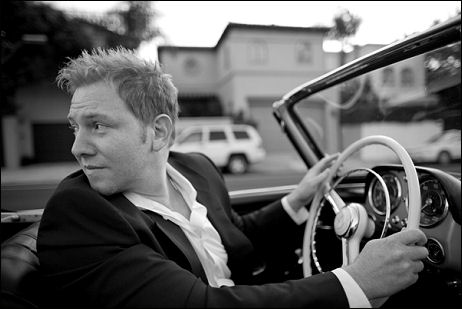

Relativity Media’s Ryan Kavanaugh

This humanizes the guy, you see. Makes him sound flawed and vulnerable and maybe a wee bit …not reckless, exactly, but…what’s the term, nocturnally spirited? It tells you Kavanaugh is no stone-faced Michael Corleone in The Godather, Part II, drinking a club soda with lime on a patio in Havana. There’s a little whiff of a heavy-hitters-gone-wild thing here. A red-haired, blue-Converse-wearing financial maestro who occasionally goes into party-animal mode like Benicio del Toro responding to an occasional full moon.

Because guys who know from melodramatic relationships and the West Hollywood bulls flashing their lights and telling them to pull over are guys who may have their professional lives set to high throttle but are still vaguely, anxiously hungry. Guys who have that itch. Where is it? What is it? Where’s the next reveal or turnover that will lead to the next moment of clarity or girl or piece of information that might lead to my way into the next thing?

In short, Kavanaugh is (or seems to be according to Bart’s description) a jazzman, a slight spiritual cousin of the candle-burning-at-both-ends Arthur Rimbaud, a seeker, a pedal to-the-metaler, a tripper, an oracular madman…a guy who could be played by a flash-mode Leonardo DiCaprio in a film directed by Oliver Stone or Craig Brewer or Tony Scott (whose crazily accelerated ADD photography might fit Kavanaugh to a T).

Unless, you know, Bart is misreading the guy and overplaying the stuff about the cops and the melodramatic whatever. I don’t know anything about him personally. I’m just reading Bart’s words and listening to the hums of the Movie Godz, who’ve been keeping tabs on Kavanaugh for three or four years now.
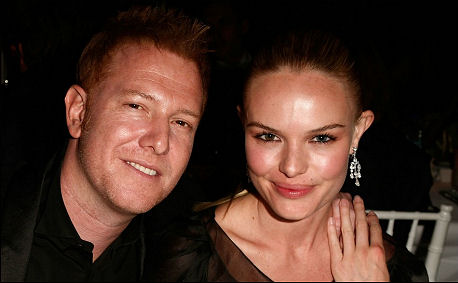

Kavanaugh, Kate Bosworth

“To many, Cavanaugh is still a mystery figure who manages to deliver large amounts of money to studios to co-finance their movies and whose name regularly appears on executive producer credits of big-budget movies,” Bart begins. “But who is he, and where did he come from?

“Some folks in the industry believe there are two Ryan Kavanaughs — at least two. The first Ryan is a convivial, chatty man who looks younger than his 34 years — an individual who likes to dish about industry intrigues, puts down his own financial accomplishments and can joke about his melodramatic relationships with the opposite sex.

“This Ryan is hardworking but accident prone — witness the fact that, though he’s a moderate drinker, his driving is sufficiently erratic to provoke occasional run-ins with the cops.

“The problem is that this Ryan — Ryan the Kid — can instantly transmogrify into the second Ryan, the Numbers Ryan.

“The second Ryan will suddenly start charting the numbers on a specific film project, summoning up data, weaving an intricate statistical web of revenue streams. This Ryan is a zealously competitive movie maven whose methodology may become esoteric but whose results have been consistently productive.

“As one Hollywood CEO puts it, ‘I don’t always follow his reasoning, and I don’t fully understand how he does it, but somehow he always comes through.’

“Thus while the two contrasting Ryans puzzle people, and catch them by surprise, they have won respect — even fond respect — from a town known for its toughness and competitiveness.

“Kavanaugh himself was all but enveloped by the financial business before he finished college. By the time he was a junior at UCLA, he was already working at the old Dean Witter, and by his senior year he had started a hedge fund — he dropped out with three classes left to complete.
“Kavanaugh comes by his financial cred through his family. His father, German-born, was both a doctor and an MBA and also played a role in several important mergers. He helped create Merck Pharmaceuticals and currently is chairman of a medical company developing drugs to help cure cataracts. He also speaks nine languages.

“His son speaks only two — English and numbers — both fluently.”

Here‘s Jones: “What separates Kavanaugh from most producers is not just that he’s making movies, it’s how he’s making movies. Ron Howard has to wait in the office lobby because, at the moment, Kavanaugh is delivering his own pitch to an author who has written a book that a lot of people want to turn into a movie.

“The author has been making the Hollywood rounds and has spent the last several minutes dropping the names of the famous directors he has met. Kavanaugh counters by telling the author that he, too, knows lots of famous directors — there might even be one waiting in the office lobby — and then he explains to the author why he would be foolish to sell the rights to his book to anyone else.

“‘We might not give you $10 million up front,’ Kavanaugh says. ‘But if we tell you we’re going to make a movie out of your book, we’ll actually make a movie out of your book.’

“That shouldn’t sound revolutionary — it should sound exactly like the point — but Hollywood has long bought much more than it sells. Every year, the six major studios shell out for hundreds, if not thousands, of pitches, scripts, and books, sometimes for millions of dollars a throw; on average, each studio will turn only eleven of those ideas into movies. The rest of all that hope and capital ends up lining shelves and clogging hard drives.

“‘There’s no other industry where that kind of waste would be acceptable,’ Kavanaugh says. ‘I’m not in this for the art, you know? I don’t care about awards. I want to make money. I want to own a business.”

“Since founding Relativity in 2003, Kavanaugh has, by learning from his failures as often as his successes, helped build a new studio model, soaking the guesswork out of movie-making and replacing it with a harder science every step of the way — starting with the idea. Kavanaugh claims that Relativity turns more than 90 percent of the raw material it buys into finished product, an almost ridiculous level of efficiency.
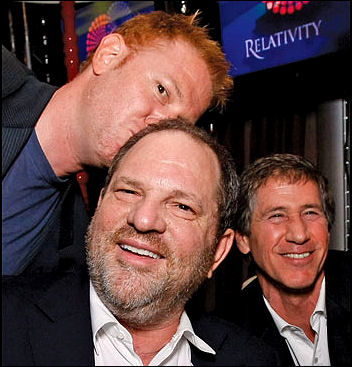

Kavanaugh, Harvey Weinstein, Jon Feltheimer

“He tells this to the author, and he tells the author that the real money comes when movies get made, at the back end, and that the author will surely collect later everything that someone else might promise him now, with the added benefit of boosted book sales and seeing his name in big letters on three thousand screens across America and in 110 countries around the world, perhaps even side by side with Ron Howard’s.

“The author finds himself nodding, because Ryan Kavanaugh’s greatest talent is his ability to make other people nod. The author is still nodding when he leaves the office, walking beside Tucker Tooley, Kavanaugh’s president of production. On his way to the elevators, he passes through the office lobby and sees Ron Howard rising from his chair, next in line. He stops, grabs Tooley by the arm, and says, ‘That was Ron Howard.’

“Tooley says, Yes, it was.

“The author looks as though he has witnessed something like a miracle. ‘He wasn’t lying,’ he says.”

Turn Me On, Dead Man

Will Ferrell‘s track record over the last five years (and particularly the titanic failure of Land of the Lost) has earned him the title of Hollywood’s most overpaid actor, according to an intensive survey announced a day or two ago by Forbes.com.

The survey is not, in other words, a portrait of who’s hot and who’s not right now, but a specially focused statistical assessment of the last five years. So Ferrell doesn’t have to put on shades and a fishing hat and drive out to Indio and rent an apartment there under an assumed name. He’s damaged, yes, but tomorrow is another day.

Never look back. Always look forward. Statistics always lie. Those who stand on train-station platforms and take notes about the size and speed of the trains pulling into the station and/or whizzing by at bullet speeds aren’t on them, and therefore they don’t really get it.

Ewan MacGregor was named the second most overpaid actor, Billy Bob Thornton came in third, Eddie Murphy (taken down by the bombing of Meet Dave and Imagine That) ranked fourth, and Tom Cruise (decimated by Lions for Lambs and to a lesser extent by Valkyrie) came in sixth. Oher top-tenners include Leonardo DiCaprio, Drew Barrymore and Jim Carrey.

Forbes began with a list of the 100 biggest stars in Hollywood who had starred over the last five years in at least three movies that opened in more than 500 theaters. The team then calculated a return-on-investment number for each star by dividing total operating income on the three films by the star’s total compensation, including up-front salaries and earnings from DVD and TV sales.

Forbes.com claims to offer a review of the full list but in fact refuses to do so. Go to the page and there’s no click-through option to the list — only one that takes you back to the main story

Ferrell’s films earned $3.29 for every dollar he was paid. A Hollywood Reporter story noted a contrast to the $160 that Shia LaBeouf‘s movies returned to the studios for every buck he earned. “No, no, no” LaBeouf — who starred in Transformers in 2007 and Indiana Jones and the Kingdom of the Crystal Skull in 2008 — sits at the top of Forbes list of Best Actors for the Buck (which you also can’t click on).

Also included on Forbes’ best-earner list are Robert Downey Jr., Christian Bale and Dennis Quaid. Wait…Dennis Quaid?

Side note: My guess is that 95% to 97% of the readers of the piece have no idea what “turn me on, dead man” is. Or where it came from, I mean.

“Dino Chickens” in Five Years

This is a peripheral Matt Drudge-like posting and I’m sorry, but as soon as I heard the term “dino-chickens” I was hooked. In my entire life I’ve never heard this term, and I’m speaking as a guy who once wrote a Roger Corman– or George Pal-type script called Killer Chickens. The size of ostriches, out for blood, looking to settle a score with humans…screaming overall-clad victims being chased around the barnyard and pecked to death. I would honestly pay to see this movie if somebody made it.


Watch CBS News Videos Online

Randoms


IFP Gotham Independent Award “Breakthrough Director” nominee Derick Martini (Lymelife) and Michelle Byrd, IFP Executive Director, at last night’s IFP celeberation for the nominees of the “Best Film Not Playing at a Theatre Near You” award.


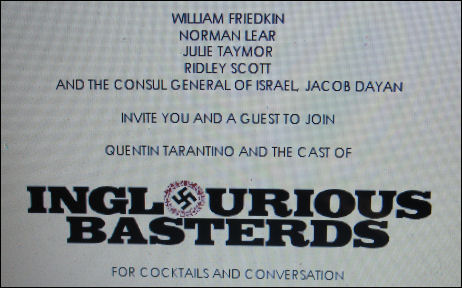
This is a private invitation to a private event (and the crop of this photo respects this), but the juxtaposition of the name of Jacob Dayan, senior representative of the State of Israel in the Southwestern United States, and the “o” Nazi swastika in the Inglourious Basterds title does seem a little jarring.


New Apple store on Upper West Side, almost right across from Lincoln Square plex at B’way and 68th. The store opened on 11.14.

“Everything’s Falling Apart”

A fellow Oscar handicapper recently conveyed this observation on the fly. He was talking about some late-breaking Oscar contending films that have begun to be seen and/or whispered about over the last week or so. (And no, Brothers was not part of the discussion since it only begins showing tonight.) I’m not saying or implying this myself — I was just struck by this guy’s powers of summation. I chuckled, I mean.

Wolfie

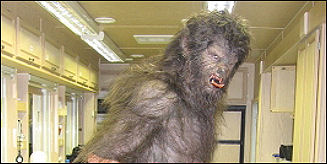
In lieu of recent reports that seasoned editors Walter Murch and Mark Goldblatt have been hired to try and punch up improve Joe Johnston‘s The Wolfman (Universal, 2.10), I heard from a guy a day or two ago who recently saw a research screening of the 19th Century-era horror film in Los Angeles, and who said three interesting things.

One, Benicio del Toro‘s role is that of a touring American Shakesperean actor along the lines of Edwin Booth. Two, his performance, which the guy didn’t think was all that terrific, is somewhat reminiscent of his landmark performance in Things We Lost in the Fire in that in involves his being in love with a woman he shouldn’t be in love with (i.e., Emily Blunt, playing his brother’s widow). And three, “You could almost relate his role to that of Lon Chaney, Jr.’s in real life and his always being overshadowed by his famous dad in the role, and connect that to the twist in this telling of the story, but that’s my fantasy.”

The best performance in the film, he feels, comes from Geraldine Chaplin “in a tiny little part, even though it’s conceived in such a way as to make no sense.”

Mumblecore

The one thing that’s always bothered me about The Hurt Locker. One scene, I mean. Actually a single line of dialogue. A jocular U.S. Colonel (David Morse) asks Jeremy Renner‘s Sgt. James, a bomb-defusal Jedi, “What’s the best way to defuse one of these things?” And Renner answers, “Duhwayuhdohndyesuh.” I’ve seen this over and over, and each time I’ve asked myself “what?…what is Renner saying, for God’s sake? Has he ever tried speaking with marbles in his mouth, or taken elocution lessons? Twenty dwarves took turns doing handstands on the carpet.”

It finally hit me the last time I saw it. Renner is saying “the way you don’t die, sir.”

Gilliam Hovering

There were two screenings yesterday of Peter Jackson‘s The Lovely Bones (Paramount, 12.11 limited) — an exhibitor screening on the Paramount lot and (according to a friend) a SAG screening at the Landmark Westside Pavillion. I heard some stuff from one guy, and of course (a) it’s just one guy and (b) one always needs to take any earlybird opinion with a grain, etc.


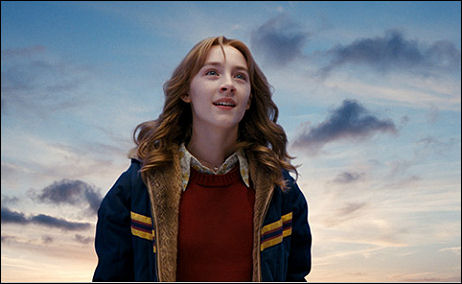
Saoirse Ronan in Peter Jackson’s The Lovely Bones.

But as I considered this guy’s views I was reminded of something I read in a Terrence Rafferty piece on the film that ran in the N.Y. Times on 11.1, to wit: After being shown “a few minutes of footage” plus “an exceptionally handsome trailer,” Rafferty said that Jackson “appears to have made the attempt to be faithful to the wistful, lyrical tone of Alice Sebold‘s book, but there are indications, too, that he hasn’t entirely abandoned his hyperbolic horror style: the looming close-ups, the ominous shadows, the fast, vertiginous tracking shots

In response to which I reiterated my opinion that Jackson “has gotten to a point in his career in which subject matter or theme or tone, even, matters less than it used to. There is really only one law, one rule — he must be ‘Peter Jackson.’ He must underline, be frenzied, be show-offy, whip up the lather, goad his actors into emphatic modes, etc.”

The guy I heard from (i.e., someone I know well who passed along impressions from another guy) said several things that I’m not going to share. Okay, I’ll pass along one thing. The guy who saw The Lovely Bones is “not a Peter Jackson hater…he liked the Rings trilogy, and is a fan of Heavenly Creatures. But if Terry Gilliam ever decided to make a serial killer movie, this would be it.”

I’m going to stop there. There’s time enough to sift things through and let the viewing process find its natural mojo, so no more. Okay, one last observation: “What Dreams May Come, Part II.”

Portman-Mulligan

Lionsgate has provided Hit Fix/Awards Campaign columnist Greg Ellwood with an exclusive clip from Jim Sheridan‘s Brothers (which I’m seeing this evening) in which costars Carey Mulligan — the Best Actress front-runner for her work in An Education — and Natalie Portman share a low-key scene. I say again — half of the British-born Mulligan’s natural charm goes out the window when she’s obliged to speak with an American accent. (I’ve posted the embed code twice and it doesn’t work — screw it.)

Collapse

Without copping to having seen New Moon (which he clearly has), The Wrap‘s Dominic Patten has listed six reasons why the Twilight franchise is doomed. Eventually, he means. Sapping of the spirit, downward marketing spiral, tank running dry, etc.

One, “nothing happens” in the books, the characters are “caricatures” and there’s only “pointless plodding for plot.” Two, the absence of Robert Pattinson in much of New Moon will provoke disappointment and turn his star current into a lower-wattage thing Three, the afore-mentioned Chris Weitz-is-not-Catherine Hardwicke factor. Four, the laws of diminishing returns on sequels. Five, the formulaic vibe that arises from Michael Sheen‘s presence as a lordly vampire. And six, Miley Cyrus having reportedly recently told a Cleveland radio show that she doesn’t “like” the film (or the book or the franchise or whatever) and, you know, like, “don’t even talk about it.”

No More Golden Eggs

Much of what’s wrong with New Moon seems tracable to director Chris Weitz. In the view of L.A. Times critic Kenneth Turan, Weitz is a “polished” and “smooth professional who makes the vampire trains of Melissa Rosenberg‘s capable script run on time, but he almost seems too rational a director for this kind of project. This lack of animating madness combined with the novel’s demands give much of New Moon a marking-time quality.”

It was precisely this animating madness, a kind of “crazy-in-love energy” that made Twilight work as well as it did, Turan believes. (As do I.) All of this seemed to come from original director Catherine Hardwicke, whom Turn calls “a filmmaker of intense, sometimes overwhelming and out of control emotionality who seemed to feel these teenage characters in her bones.”

The reason Weitz recently told Moviemaker magazine that he might hang it up before too long, or so I suspect, is that deep down he knows he dropped the ball and screwed the pooch. “I still feel that I’m learning,” he says, “and yet I also feel that the number of aspects that go into making a film of the sort that I’m making now have become so multifold that it’s really exhausting.

“Every time I make a movie I’m pretty much convinced it’s the last time I’m going to be able to do it and that really it’s a rather silly occupation to undertake. But I think I have maybe one more film in me.”

He also talks about wanting to “learn to be a better surfer,” and “learn to speak Spanish fluently…I’d like to travel around, live in Italy; I’d like to learn kung fu…It’s nice to make movies, but it’s also really hard.”

Weitz is also talking about the arduous making of The Golden Compass, and how his New Line cinema bosses were awful to deal with and how the failure of that film kind of broke his spirit. But his more recent New Moon experience is obviously weighing on his mind right now, and we all know that people don’t talk about wandering around Europe and eating elegant dinners at sunset and becoming better surfers unless their souls are in need of healing.