Ya Gotta Believe

Who in their right minds would want to watch, let alone Netflix or buy, the forthcoming Bluray of John Wayne‘s The Green Berets when it streets on 1.10.10? The only star-fortified Hollywood film that was wholly supportive of the U.S.war effort in Vietnam, The Green Berets (directed by Wayne and released in July 1968) became legendary for its ludicrousness — a turgid propaganda film that screamed “reality detachment!” at every turn.
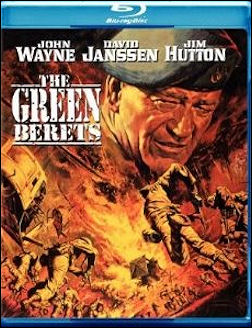
It’s set in Vietnam, of course, and is basically about a special Green Beret mission to capture a North Vietnamese general. (Or so I recall.) It feels informed by 1950s war movie cliches — totally divorced from the raggedy look and feel of the war as portrayed by Oliver Stone in Platoon, and not even imagining, much less trying for, the operatic psychedelia that Francis Coppola brought to Apocalypse Now. It is, however, a dream — a dream taking place in John Wayne’s head. It’s one of Roger Ebert‘s most-hated flicks — a “heavy-handed, remarkably old-fashioned film,” he wrote.

There are no Platoon-type lefties or complainers or pot-smokers in the Green Beret ranks, of course. We’re talking serious commandos who don’t fool around, which means no Willem Dafoe-ish Jesus-type sergeants either. All of the American good guys (including Wayne, Jim Hutton, Bruce Cabot and Aldo Ray) are older, beefier, sentimental, right-minded lunks who love Vietnamese kids and energetically dispense medicine to the peasants. The only lefty is an anti-war journalist, played by David Janseen, although he comes around during the third act.

Nothing seems remotely authentic in The Green Berets. The gulps and wrongos and what-the-fuckos come fast and furious. Because Wayne filmed it in Fort Benning, Georgia, there are white birch and pine trees in the Vietnam jungle. And the Asian-American actors Wayne hired to play South Vietnamese military intelligence advisors don’t look even a bit Vietnamese. (They represent a midway point between actual Vietnamese and Marlon Brando ‘s Sakini in Teahouse of the August Moon) I recall a line in Pauline Kael‘s review about how the North Vietnamese general “mews” like a kitten when Wayne’s team takes him prisoner. (Which happens just before he’s about to have his way with a slinky Asian hottie inside a plantation villa.) Really, it’s one hoot after another.

So again, honestly — who would want to spend two hours with this thing? Is someone at Warner Home Video trying to get people thinking about what a certain-to-fail fiasco our Afghanistan mission is?

DVD Beaver’s Gary Tooze has recounted the film’s troubled production and distribution history:

“Long before box office or critical response became a factor, Wayne had different worries prior to production. He needed some of the resources of the Pentagon to make his film as realistic as possible, but the military brass at the Pentagon were no fans of the 1965 national bestseller on which the movie was based. Robin Moore‘s collection of short stories called ‘The Green Berets‘ portrayed the crack commando unit as lawless, sadistic, and racist. Moore, who plays a cameo in the film and claimed to have trained as a Green Beret, stated that these attributes were the signs of ‘real men.’

“A feature-length, big budget movie that was to be based on such a depiction of the American military elite made the Pentagon quite nervous. Naturally, Pentagon officials demanded changes to the script before Wayne and company were granted access to Fort Benning, Georgia, with all its modern hardware at their disposal.

“These conflicts in pre-production, as well as normal shooting delays, hampered the film’s release until July, 1968, a full six months after the Communists’ Tet Offensive, which was the beginning of the end for an American victory in Vietnam. The delayed release proved unfortunate since The Green Berets arrived on the heels of the notorious My Lai massacre in March, 1968, an incident which seriously undermined the film’s credibility.”
Titles That Don’t Agree

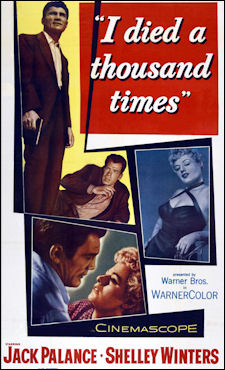
Stuart Heisler‘s I Died A Thousand Times, a 1955 remake of Raoul Walsh‘s High Sierra, doesn’t have much of a rep, but it has a great florid title. The forthcoming release of the DVD, in any event, triggered an idea for two lists — movies with great-sounding titles that made for difficult viewing, and excellent or very good films that were stuck with lousy titles.

Most good films are released with decent appealing titles. But every so often a title will come along that’s exceptionally stirring, flat, dull, catchy or off-putting, and which also argues with the quality of the film, be it high or low.

Snakes on a Plane — great title, shitty film. I Dismember Mama — classic title used for exploitation sludge. Bedtime for Bonzo is actually fairly brilliant. Stop! Or My Mom Will Shoot must have sounded good before the film was seen. The Human Stain was a mildly underwhelming drama with a title that sounded like a description of semen on the bedsheets. Ishtar was a misbegotten but half-decent comedy, but had a terrible title.

I realize that today’s audience doesn’t like titles that aren’t plain and hot-dog simple, but there’s something wrong with you if you don’t enjoy titles that sound like they came off a pulp paperback. I Died A Thousand Times is one of those noirish, dark-fate titles like Out of The Past, His Kind of Woman, Let No Man Write My Epitaph and O Lord, Please Don’t Let Me be Misunderstood.

Dog Houses

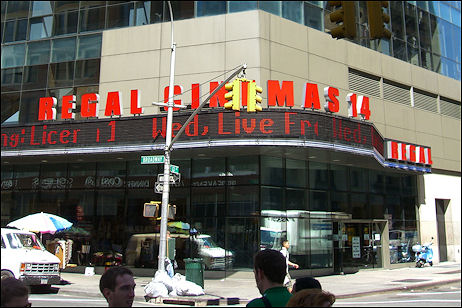
After complaining about the murky image projected during last evening’s Sherlock Homes showing at the Regal Union Square Stadium 14, HE reader Gordon 27 replied that the RUSS “is the worst chain theater in NYC…everything they do nickel-and-dimes their customers, right down to the weak lamps in the projectors.” He acknowledged that “every chain does this to some extent” but claimed that the RUSS is far guiltier than most.

Does this plex deserve the ugly crown? Opinions, refutations, further indictments, etc.

The RUSS is probably the worst I’ve ever been to in my life — worse than the AMC Empire on 42nd Street. The projection and sound levels are substandard, to put it gently. The rows don’t allow for sufficient leg room. The seats are too small. And the people who attend are largely riff-raff. Partly retirement-age Jews, partly screaming kids, partly nice couples, partly street homies, partly middle-aged, sullen-faced X-factor types, and partly wild African dogs from the Serenghetti, shouting and roaming around and eyeballing and “hey yo”-ing each other and carrying massive buckets of popcorn and super-sized cokes sloshing over the rim and onto the carpet and plastic floors…and I’m paying money to experience this?

If my only choice was to watch films at the Regal Union Square Stadium 14 or wait three or four months for DVD, I wouldn’t even think about it. Going to a place like this is torture. As soon as you walk in you’re thinking, “I’ve gotta get outta here.”

Perhaps we could take this opportunity to list the other exceptionally awful theatres in NY, LA and other burghs. Maybe we can come up with a top ten list of some kind.

Effusion

I still haven’t seen Terry Gilliam‘s The Imaginarium of Doctor Parnassus, even though it opened on 12.25 in NY and LA. I was invited to some LA press screenings in November but none at all in NYC. I guess I’ll just pay to see it sometime this week unless, of course, someone would like to send me a screener.

Johnny Depp and Jude Law, in any event, have released the following statements regarding their involvement the film (i.e., having been hired to complete Heath Ledger‘s role in the wake of his death in early ’08).

Deep: “Maestro Gilliam has made a sublime film. Wonderfully enchanting and beautiful, The Imaginarium Of Doctor Parnassus is a uniquely ingenious and captivating creation; by turns wild, thrilling and hilarious in all its crazed, dilapidated majesty. Pure Gilliam magic!”

Who edits this stuff? It’s all well and good to say what you feel at a testimonial dinner, but when you’re on the page you need to do it with brevity and restraint, less being more, etc.

“It was an honor to represent Heath,” Depp continues. “He was the only player out there breathing heavy down the back of every established actors neck with a thundering and ungovernable talent that came up on you quick, hissing rather mischievously with that cheeky grin, ‘hey…get on out of my way boys, i’m coming through…” and does he ever! Heath is a marvel,

“And Christopher Plummer goes beyond anything he’s ever done, Waits as the Devil is a God, Lily Cole and Andrew Garfield, the very foundation, are spectacular, Verne Troyer simply kicks ass and as for my other cohorts, Colin Farrell and Jude Law, they most certainly did Master Ledger very proud, I salute them.

“Though the circumstances of my involvement are extremely heart-rending and unbelievably sad, I feel privileged to have been asked aboard to stand in on behalf of dear Heath.”

Law: “I have always loved Terry Gilliam’s films. Their heart, their soul, their mind…always inventive, touching, funny and relevant. When I got the call, it was a double tug. I liked Heath very much as a man and admired him as an actor. To help finish his final piece of work was a tribute I felt compelled to make. To help Terry finish his film was an honor paid to a man I adore. I had a great time on the job. Though we were all there in remembrance, Heath’s heart pushed us with great lightness to the finish.”

So Well Remembered

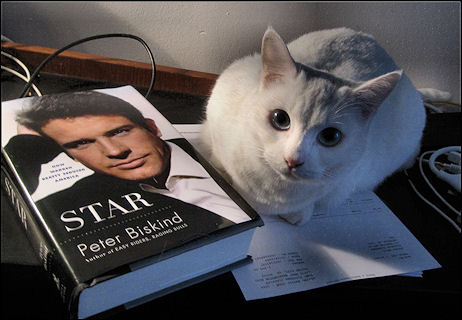
I’ve finally received a copy of Peter Biskind‘s Star: How Warren Beatty Seduced America (Simon & Schuster, 1.12.10), and have spent a total of 20 minutes of dancing through it and dwelling here and there. It’s a pleasure to read just for the quality of the writing and editing. Well-shaped sentences that are no longer than they need to be, and paragraphs that hatch and develop a thought or a mood or a theme, sometimes all three at the same time.

And I can tell right away that it’s been written as a kind of tragedy, or rather that Beatty’s career (as opposed to his life) has ended up that way, certainly over the last ten years, and that Biskind, being a diligent reporter and a sage fellow, has gone down that path because that’s where this beastly endeavor has taken him. Biskind has been on it since at least ’04.

“Finishing this book was like recovering from a lingering illness, although admittedly one that I had brought in myself,” Biskind writes at the start of “Warrenology: An Introduction,” about ten pages before the narrative begins.

Is “tragedy” too harsh or dismissive a term to use about Beatty’s gradual withdrawal from the hey-hey since Town and Country? Would it be fairer or kinder to say his lack of productivity (i.e., acting career over, not having directed a film) and his failure to become another Clint Eastwood has been simply due to his having gradually scared more and more would-be collaborators away because he’s so cautious and guarded and slow-moving and fickle? Would it be wrong to say that the regrettable lesson of Beatty’s late career has been (take your pick) if you cruise you lose, time is shorter than you think, shake it when you can, and keep dancing until you’re dead?

In the final chapter, on page 547, Biskind writes the following: “It is shocking to imagine a star as bright as Beatty was, as famous and powerful, and as gifted, being virtually unemployable.

“There’s no shortage of reasons that explain why filmmakers go into decline. In America, at least, the movie business has always been a young man’s game. Directing is hard, as physically and mentally demanding as any job on the planet. Filmmakers grow old and get tired like everyone else, while their audience seems to remain perennially young. Once directors become successful, they too often enter a bubble of privelege and lose whatever instincts enabled them to touch their audiences in the first place. As Billy Friedkin once put it, ‘When you take your first tennis lesson, your career is over.’

“‘It’s very hard to keep productive,’ Toback continues. ‘It’s very hard to keep the level up for the game, for the big fight, for the World Series, for the Super Bowl, and still have a life. It’s that game that people always want to talk about when they talk about talent. And when you put it out there in the world of insults and acrimony and envy and lividity, it has trouble surviving.’

“Perhaps it’s not Beatty’s last decade that makes people wonder,” Biskind writes, “but the years he spent, so unproductively, chasing skirt. Perhaps it’s the fact that Beatty turned down so many roles, in so many films and missed so many opportunities…he seemed to do so much less than someone with his gifts could have done. Perhaps it’s that he always seemed so emotionally closed, so self-protective that, as Mab Goldman put it, he was unable to ‘stand naked in the storm of life.'”