Celluloid Catholic

I’ve only just now noticed a 3.25 q & a between Inception director Chris Nolan and Collider‘s Steve Weintraub about the formats used to shoot his 7.16 Warner Bros. release.
The stand-outs for me are Nolan stating (a) that he’s not all that down with shooting for 3D because “you have to shoot on video [to do that], which I’m not a fan of…I like to shoot on film,” and (b) that one of the formats used for Inception was VistaVision, the side-to-side 1.66 to 1 aspect ratio process hatched in 1954.

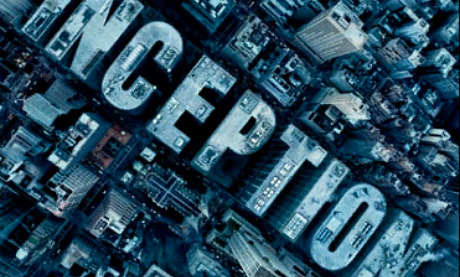
Of all the 2010 films in the pipeline, the one that seems the most ideally suited for genuine Avatar-level 3-D would be Inception, and yet Nolan, ironically, just wasn’t interested. Think of that already-famous shot of an entire section of Paris bending up and onto the sky in 3-D — it could be the most stunning 3-D sequence ever seen. But it’ll never happen, or at least not in proper 3-D.

“We shot the film with a mixture of mostly the predominant bulk of the film is anamorphic 35mm, which is the best quality sort of practical format to shoot on by far,” Nolan says. “We shot key sequences on 65mm, 5 perf not 15 perf, and we shot VistaVision on certain other sequences.”

Nolan is referring to special effects sequences, of course. As VV’s Wikipedia page states, “Although the last American VistaVision picture was 1961’s One-Eyed Jacks, VistaVision’s high resolution [has made] it attractive for some special effects work within some later feature films.”

Inception therefore “has a negative — a set of negative — that’s of the highest possible quality except IMAX,” Nolan explains. “We didn’t feel that we were going to be able to shoot in IMAX because of the size of the cameras because this film given that it deals with a potentially surreal area, the nature of dreams and so forth, I wanted it to be as realistic as possible. Not be bound by the scale of those IMAX cameras, even though I love the format dearly. So we went to the next best thing which was 65mm.

“So we have the highest quality image of any film that’s being made and that allows us to reformat the film for any distribution form that we’d like to put it in. We’re definitely going to do an IMAX release. We’re excited about doing that and using our original negative 65mm photography to maximize the effect of that release.

“3D, I think, is an interesting development in movies, or the resurgence of 3D. It’s something we’re looking at and watching. There are certain limitations of shooting in 3D. You have to shoot on video, which I’m not a fan of. I like shooting on film. And so then you’re looking at post-conversion processes which are moving forward in very exciting ways.”

“Exciting”? How about embarassing? Especially after the Clash of the Titans debacle.

“So really, for me, production of a large-scale film is all about recording the best, highest quality image possible so that you can then put it in any theatre in the best way possible. And 65mm film, IMAX film, VistaVision, 35mm — that’s the way you do that.”

I wish Michael Mann would give up on digital photography — it was a phase, let it go — and follow Nolan’s lead.


Only Sleeping

The death-of-MSM-film-criticism meme is what, at least five or six years old? Things have become more urgent over the last two years, one indicator being N.Y. Times media-watcher David Carr examining the trend in early April ’08. But for whatever reason it didn’t become fully obit-worthy to Washington Post columnist Howard Kurtz until the 3.24 cancellation of At The Movies, and particularly A.O. Scott‘s 3.31 take on the Big Changeover.

20 Brilliant Seconds

The rap against Joseph Mankiewicz‘s Cleopatra (1963) is that it’s stately, slow-moving, oppressively talky, etc. But the opening credits — black font, a series of faded wall paintings, Alex North‘s music — are arresting, and then fascinating during a 20-second passage (starting a little after 2:35). North’s score slips into a somber mood and then builds into slight fanfare as the final painting becomes more and more vivid in stages, and finally transitions into 70mm live action.

It’s a simple elegant conveying of the fact that the centuries have faded and blurred the histories of Cleopatra, Julius Caesar and Marc Antony, and that this film is not only un-fading and un-blurring what happened, but applying a sharp, super-costly Big Hollywood sheen.

I’ve really enjoyed this portion — a sliver really — of this otherwise negligible film for years, or since it’s been out on DVD, I should say. The full-boat 243-minute version is the only way to suffer through this thing.

There’s a portion of ten or twelve minutes after the credits with Rex Harrison and Martin Landau and the rest that’s fairly efficient, and then — about 16 or 17 minutes in — Elizabeth Taylor arrives, and the film soon becomes draggy, and then tedious, and then suffocating.

In his 6.13.63 review, N.Y. Times critic Bosley Crowther called Cleopatra “one of the great epic films of our day.”

Cousins

I didn’t realize before watching the trailer for Robert Luketic‘s Killers (Lionsgate, 6.4), a romantic action comedy with Ashton Kutcher and Katherine Hiegl, that it comes from the same concept-and-attitude seed as James Mangold ‘s Knight and Day (20th Century Fox, 6.25), a romantic action comedy with Tom Cruise and Cameron Diaz.

Heigl and Diaz both play 30ish spirited blondes who squeal and freak in the presence of guns and danger and squealing tires, etc. Their lives are turned upside down big-time by Kutcher and Cruise, who both play sardonic super-spy smoothies, exposing the ladies to all sorts of hair-raising, hair-trigger situations, etc. The films are presumably different in this way and that (perhaps vastly different in several ways — I haven’t seen either), but their respective trailers do suggest that they’re cut from the same cloth.

The Planes! The Planes!

In a Sunday, 4.11 article called “Scrutiny on the Bounty,” Variety editor Tim Gray complains about how internet columnists got it wrong about the staff eliminations of chief film critic Todd McCarthy, senior critic Derek Elley and chief theatre critic David Rooney. But even now, more than a month later, Gray presents a not-entirely-candid account himself.

“On March 8, Variety restructured its reviews department and eliminated full-time reviewers,” Gray writes. “We asked Todd McCarthy, David Rooney and Derek Elley to stay onboard, under new terms.” He later states that “from day one, we asked the review trio to assume central roles” among Variety‘s group of freelancers. “But many bloggers declined to ask details,” says Gray, “and just jumped to conclusions.”

I didn’t jump to conclusions. I spoke to McCarthy that very day, and he told me that Variety had only vaguely alluded to a freelance deal as a down-the-road thing. Rooney says also that Variety told him (a) no more staff employment with (a) no “concrete” offer of a freelance deal. Variety later wrote him “they would like to do a freelance deal…we are going to get back to you about that.” As most of us know, pledges of what employers would “like” to do plus $1.75 will get you a bus ticket.

I checked back today and was told in fact that it was only after the big media brouhaha about McCarthy being canned that Variety came back to McCarthy and began discussing terms of a freelance arrangement. So that “from day one” comment is questionable or, as one observer puts it, “creative.” I’m told McCarthy will make a yea-nay decision on that offer later this week.

So add up (a) a termination of your staff deal and (b) no specific offer of a freelance arrangement and whaddaya got? Most people would call that a severing of the ways or, as I put it on 3.8, a Joe Pesci-style whacking. Okay, so Variety came back later and offered to inject that green Re-animator serum and restore McCarthy to a semblance of life, fine. But they still cut him, Rooney and Elley loose upon heaving seas.

Off To The Showers

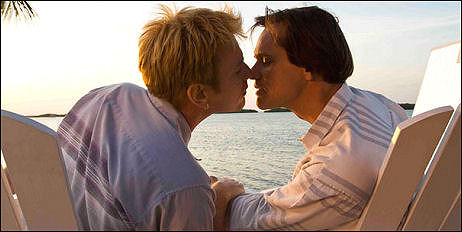
With the apparent theatrical demise of I Love You, Phillip Morris, the somewhat weird, no-laugh-funny but certainly respectable Jim Carrey-Ewan MacGregor gay farce, being reported, recapping my original 1.19.09 Sundance review seems fair:

“The tone of Glenn Ficarra and John Requa‘s I Love You Phillip Morris is hard to describe. It’s a kind of dark comedy (i.e., there are bits that are intended to draw laughter), but since it’s a tale of obsessive gay loony love there’s really not that much to ‘laugh’ at,” I began.

“But there’s conviction in it — the emotions are as real as it gets — and the performances by Jim Carrey and Ewan McGregor as the lovers are intense and out-there and fully grounded. Nobody’s putting anyone on, I mean.

“The tone is somewhere between high-toned soap opera and hyper-real absurdism, but it’s more or less fact-based. And the things that make it respectable and worthy and bold (which I feel it definitely is) are the sad moments, the irrational I-love-you acts, the bad behavior, the hurt. It’s nuts, this movie, and that’s what I liked about it.

“Love is strange, silly, demeaning, glorious, heartbreaking. A drug and a tidal wave that can destroy as easily as restore. And I Love You Phillip Morris is not laughing at this. At all. It’s a movie with balls and dicks and loads of heart and soul.

“I like this line from the Sundance notes: ‘As a primer on the irresistible power of a man who is either insane or in love (is there a difference?), I Love You Phillip Morris surely serves to remind us of the resilience of the human spirit.’

“Longtime writing partners Ficarra and Requa are making their directing debut with this. It’s based based on the true-life tale of Steve Russell (Carrey), a onetime married police officer turned gay Texan con man, and his passionate love he shares with ‘blonde southern queer’ named Phillip Morris (McGregor) whom he meets in prison, where he’s been sent for credit card fraud.

“Carrey’s website says that ‘after reading the script, he immediately signed to do the movie, explaining that there have been only three scripts that he truly felt compelled to do — The Truman Show, Eternal Sunshine of the Spotless Mind and this.

“‘The film had a very low budget, estimated to be just $14 million,’ it reads. ‘It was initially to be directed by Gus Van Sant, but he dropped out to make Milk. So Carrey agreed to let Ficarra and Requa direct. The financing is from director Luc Besson‘s EuropaCorp. The filmmakers hope to sell domestic rights at the Sundance Film Festival.”

It Comes

If you understand and agree with the concept of life improving as you get older (as long as you live it like Clint Eastwood, that is — amply funded, constant flexing of creative muscles, working out daily, cracking jokes and all that), leaving this mortal coil at age 70 is, I feel, a profoundly sad thing. Yesterday’s departure of 70 year-old actress Dixie Carter (Designing Women, That Evening Sun, Desperate Housewives) is noted in this context. A spokesperson wouldn’t say where or how, but husband Hal Holbrook‘s use of the term “tragedy” rather than, say, “quiet passing” suggests that she met with an unexpected, unfair-seeming affliction.

Grub Street


Looking north on Philadelphia’s South Carlisle Street near Morris — Sunday, 4.11, 8:20 am. Took Bolt Bus yesterday to visit Dylan, who’s close to finishing his sophomore year at University of the Arts.

Living room at 1647 15th Street, about two miles south of Philly’s tourist district.

3D Erosion Begins

How could the sharp decrease in Clash of the Titans dollars this weekend (off 68% yesterday morning) not be expected with the murky faux-3D? It’s hardly the fault of Sam Worthington (who, by the way, has a massive, buffalo-sized head, as do most movie stars). Clash was off 68% yesterday morning but the overall weekend drop may be less. Date Night, the #1 film, did $9.3 million Friday on approximately 4,600 screens for an average of $2021, or $2756 if you’re going by “engagements.”

"The Bird Is A Little Rubbery"

Now that I’ve located some decent Chrysler building machine-gun footage from Larry Cohen‘s Q: The Winged Serpent, it should be a small matter for some enterprising CG whiz kid to find the right clips of Russell Brand and paste them onto one of the two cops who get eaten. (You first have to get past the Michael Moriarty-Cathy Clark argument scene at the beginning.)

This trailer is brilliant, by the way. Inspired. Particularly the transition from Richard Roundtree‘s line (“What I wanna know is, how the hell does this tie in with the murders and mutilations?) to Candy Clark‘s “whah?” expression.