Run Like Thieves

A thought came to me just before dawn. It’s generally presumed that thieves are sociopaths and vice versa, and that the key tenet of a sociopathic personality is an indifference to social codes and standards, which is to say an absence of belief or investment in them. It follows that the most dangerously predatory and destructive thieves of our time — i.e., the big bankers and Wall Street speculators — are grabbing everything they can because they have no faith or trust whatsoever in anything — social cohesion, democratic institutions, or moral tradition even.

The world is a wild jungle, they’re figuring (or rationalizing), and so they must prey on the vulnerable in order to provide for and protect their own.

This is boilerplate stuff, of course — Charles Dickens came to the same conclusions about London industrialists and bankers 150 years ago. The difference today is that diminishing faith in most ethical-moral standards and growing indifference to the general social good is everywhere because fewer and fewer people among the educated ambitious classes believe in the future.

They see the writing on the wall — diminishing natural resources, the world economy essentially built upon a Ponzi scheme, ecological destruction, Jihadists, unsustainable population growth, greater gulfs between the haves and have-nots — and figure the only strategy that makes sense is to accumulate and hoard all you can and in so doing at least protect one’s family or property.

A culture that has no faith in tomorrow and in holding down the social fort for future generations will behave in ways that all but guarantee its own destruction. Because life is not just about now, but about what the current terms of life now will build into and manifest down the road. Except no one’s thinking this way any more.

The seeds of our current nihilist philosophy were evident almost 50 years ago, as Tom Wolfe pointed out in his mid ’70s essay “The Me Decade and the Third Great Awakening.” I recounted the basics of this observation in an August 2009 review of Doug Pray‘s Art and Copy, to wit:

“In 1961 a copywriter in the employ of Foote, Cone & Belding named Shirley Polykoff came up with the line: ‘If I’ve only one life, let me live it as a blonde!’ The basic attitude of having ‘only one life,’ said Wolfe, contradicted a general belief among families and nations that had existed for centuries, which you could sum up as a belief in ‘serial immortality.’

“Boiled down, serial immortality means that we’re all part of a familial stream — our lives being a completion or fulfillment of our parents’ lives and our children’s lives completing and fulfilling our own, and everyone understanding that we’re part of the same genetic river of existence and spirit.

“Polykoff’s copy line, which was written for Clairol hair coloring, basically said ‘the hell with that — it’s just me, it’s just my life and my goals, and I’m going to satisfy myself!’ By the time the early to mid ’70s rolled around the culture had begun to believe in the ‘me first’ philosophy en masse.” And now that philosophy has become a pandemic, and the chickens have come home to roost.
That's It?

Roman Polanski issued an official statement earlier today about his possible extradition to the U.S., blah blah, and the only phrase with any meat on it was one that accused authorities here of “trying to serve me on a platter to the media of the world.” I agree with what he’s basically saying — let it go, time already served, Judge Lawrence J. Rittenband was a scumbag, etc. — but after all the months of silence you’d think he’d show a little fire in the gut. I for one am disappointed.

For what it’s worth, the recently posted statement by David Poland strikes me as offensively harsh and absolutist. God protect the innocent man who would stand before Judge Poland, if life and fate had so ordered.

That's Right

In a 4.30 piece that includes some thoughts about the forthcoming Bluray of George Cukor‘s A Star Is Born (1954), N.Y. Times contributors Charles Taylor and Stephanie Zacharek note that Judy Garland “looks badly used up here” and “is just not believable as a fresh young star.”

In a 4.22 HE posting I wrote that Garland “was born in June 1922, and was between 31 and 32 years old when she made A Star Is Born. That’s fairly young in my book, but she looks closer to 40 in the film, certainly by today’s standards. She certainly doesn’t look like a young actress-singer just breaking through, which is what Esther Blodgett is supposed to be. She looks stressed, worn down and plain with a too-short haircut and her chin starting to disappear — there’s a straight line between the tip of her chin and the base of her neck. Garland had lived a tough life up that point, and it didn’t get any more peaceful. She died in 1969 at age 47 — barely into middle age.”

Saturday Night Special

James Franco‘s Saturday Night, which screened this afternoon under the aegis of the Tribeca Film Festival, is a highly intelligent, interesting, amusing, and very decently assembled doc about how the Saturday Night Live team puts a show together. The problem — mine, not the film’s — is that I wrote a full review a few hours ago only to see it wiped out due to not having saved it when Firefox decided to collapse out of the effin’ blue. And I don’t care enough to re-write it. Not now anyway. Too bummed.

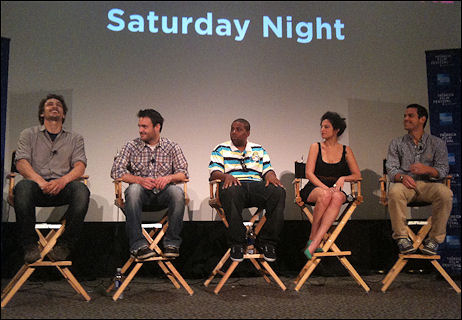
Saturday Night director James Franco (far left) and Entertainment Weekly writer David Karger (far right) during a q & a following a 3 pm screening at the DGA theatre on West 57th Street. That’s Kenan Thompson, of course, in the middle. Many people know the other guy and the girl, I presume — I just don’t happen to be one of them. I only watch SNL sporadically.
I can at least force this out: Franco has shot and cut his film with a sharp observational eye, and seems to have gone with a moderately laid-back, come-what-may, go-with-the flow strategy. Which is more or less how the preparation of the show goes, so it all fits. I came away with a newfound respect for Lorne Michaels and the gang.

The SNL process is a bitch. 50 sketches pitched on Monday, a reading on Wednesday, Lorne Michaels and his producers choosing nine finalists, two days or refining and rehearsals, a full-dress performance before a crowd early Saturday night to see what works and what doesn’t, and then the final airing at 11:30 pm. A day of non-rest for the eternally weary on Sunday, and then right back into it on Monday.

I just can’t get past having lost what I wrote. I’m so angry I can’t think.

Please forgive the quality of these two video clips. I forgot the trusty Canon SD 1400 IS; had to shoot with the iPhone.

No Ignoring Tillman

Last night I attended a special Tribeca Film Festival screening of Amir Bar-Lev‘s The Tillman Story (Weinstein Co., 8.20) — far and away one of the finest films I’ve seen this year, and a likely contender for the 2010 Best Feature Documentary Oscar. I know it’s early but this movie has the stuff that engages and holds and sinks in deep.

I felt just as stirred up last night — seething, close to tearful — as I was after my initial Sundance viewing three months ago. Because this is not a film about the Middle East conflict but about a stand-up American family and how they responded (and continue to respond) to an orchestrated governmental obscenity that tried to diminish the memory of a fallen son.

I’m speaking, of course, of former Arizona Cardinals safety and U.S. Army Ranger Pat Tillman, and particularly his April 2004 friendly-fire death in Afghanistan — a result of his being shot three times in the head by a fellow U.S. soldier. It happened because of the usual idiotic confusion, and some young intemperate guys who wanted to be in a fire fight and acted foolishly in the heat of the moment. Tillman was enraged that his own fellows were shooting at him, of course, and his last words were an attempt to get them to wake up — “I’m Pat fucking Tillman!”

The obscenity was the attempt in ’04 by the U.S. military and Bush administration to make political hay out of Tillman’s death by manufacturing a bullshit scenario that claimed he was killed by Taliban troops and that he died in an effort save his fellow troops.


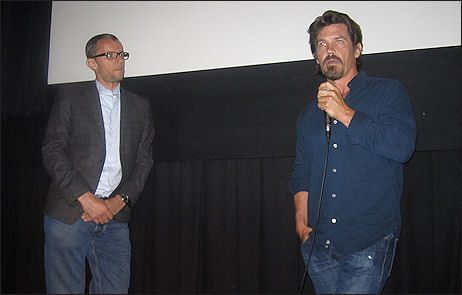
Tillman Story producer John Battsek, narrator Josh Brolin following last night’s special screening of The Tillman Story.

Of course, 97% of American moviegoers are going to ignore The Tillman Story when it opens because (a) they’re resolutely opposed to seeing any film that has anything to do with the conflicts in Iraq or Afghanistan and (b) they don’t much like documentaries anyway, and (c) they just want to chill out and be entertained. The fact that The Tillman Story leaves you feeling angry and alive and engaged with the actual world will most likely have no effect on this determination

Producer John Battsek and narrator Josh Brolin did a q & a following the screening, which ended around 11:40 pm. Brolin, a good hombre, mentioned he’ll be doing Cannes promotional duty for five days, partly for Oliver Stone‘s Wall Street 2 and partly for Woody Allen‘s You Will Meet a Tall Dark Stranger.

Not Quite Scorsese-Level

This was taken at last night’s final Tribeca Film Festival party, and in the immediate wake of the mystifying announcement about Rush: Beyond The Lighted Stage having won the Audience Award. Why is it that every house DJ at every New York party plays wretched disco jizz? Tracks, I mean, that I would instantly turn off if I heard them on my car radio? The people who throw these parties pay these guys to make people like me suffer.

Thumbs Down

Scott McFadyen and Sam Dunn‘s Rush: Beyond The Lighted Stage has just been named the winner of Tribeca Film Festival’s Audience Award. The doc isn’t bad, but Rush’s music, for me, is mute nostril agony and incessant torture. This award, trust me, is as much if not mostly about the fervor of Rush-heads stuffing the ballot box as an expression of general audience admiration for the film.

Two Guys & A Girl

I just saw this trailer for Xavier Dolan‘s Les Amours Imaginaires, which was posted yesterday on the alternate Playlist. The analysis is correct: it is a Pedro Almodovar film. The plot is about Francis (Dolan) and Marie (Monia Chokri) falling for the same guy — i.e., Nicolas (Neils Schneider). The Canadian-made feature reminds me of a 1977 Coline Serreau film called Pourqois Pas!.

Les Amours Imaginaires will play in the Un Certain Regard programming of the 2010 Cannes Film Festival. No U.S. distributor as we speak, but opening in Canada in early June.

Schneider is almost as pretty as the young boy everybody wanted in Fellini Satyricon.

Into London Boulevard

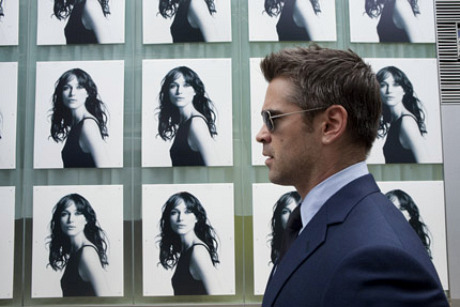
It suddenly hit me five minutes ago that I’ve never read Wlliam Monahan‘s London Boulevard script, so if anyone could forward…thanks. It’s pretty much finished, no distributor yet, presumably destined for distinction in the fall. That’s Colin Farrell, of course — a guy named Mitchell, just out of the slammer and fated to fall in love with Keira Knightley‘s Charlotte, the actress in the black-and-white photos, and run afoul of some gangster guy or guys (presumably played by Eddie Marsan or Ray Winstone).

The London-based crime drama also costars David Thewlis, Anna Friel, Ben Chaplin, Sanjeev Baskhar and Jamie Campbell Bower.

The above photo was first linked to by Awards Daily.

Pic is based on Ken Bruen‘s 2001 novel . Mitchell’s romantic interest in Bruen’s book is a 60 year-old reclusive actress named Lillian Palmer, so Monahan has definitely shuffled that element around. So Knightley will play…a reclusive 25 year-old actress?

Bruen’s book was described in a book-review synopsis as a “gritty reimagining of Billy Wilder‘s Sunset Boulevard, transplanting the action from glitzy Hollywood to the rough and tumble London streets…looking for an honest job, Mitchell finds work as a handyman for a wealthy and reclusive former stage beauty, Lillian Palmer, who lives in a sprawling estate with her taciturn butler, Jordan.”

Thewlis is playing Jordan in the film, and Friel is playing Briony, who is Palmer’s sister in the book but Farrell’s in the film.

Yesterday


Bond Street — Friday, 4.30, 6:15 pm.

No-lapel suit going for God-knows-how-much-dough, didn’t want to know, etc. But I would buy this suit, maybe, if it was sold at Century 21, next to Ground Zero

Bluray Zhivago

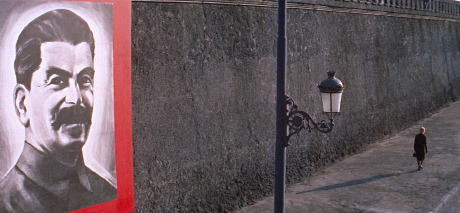
Within the trappings of its somewhat old-school, ’60s widescreen-epic realm, David Lean‘s Dr. Zhivago (’65) has always been a nice warm schmaltz-bath — eye-filling, movingly scored, nicely edited, decently written and for the most part very well acted (especially by Tom Courtenay, Rod Steiger and bit player Klaus Kinski). And it looked quite good when the November 2001 DVD came out — play it on your plasma or LCD flatscreen and it’s still handsome as hell.

The new Bluray Zhivago, of course, is more desirable. More detail, delicacy, vibrancy. Cleaner, sharper, etc. I could go on and on about how this or that scene looks decidedly better due to this or that enhancement, but we all know what a well-mastered Bluray delivers, and what exacting technicians the Warner Bros. home video guys (led by Ned Price) have always been.

Price was in Manhattan earlier this week for some Dr. Zhivago promotional activities (including a 4.28 screening at the Tribeca Film Festival). He spoke to me on the phone for a few minutes on Thursday, and explained some of the challenges and aplications that brought about the necessary upgrade in the basic Zhivago elements. But I didn’t speak with Ned as long or as thoroughly as Glenn Kenny did for his 4.30 piece for The Auteurs. Read it and get back to me in the morning.

I’ll always have problems with that shot of the rainbow over the dam at the very end. To me it’s an attempt to give a nice, bright happy ending to a film that didn’t need one. The story is fairly melancholy throughout, always about longing and sometimes about finding relief or brief serenity, but mostly about the brutal forces of early Bolshevism interfering and destroying time and again. I only know that a glowing rainbow at the end of such a tale feels wrong.

And Lean’s quick cut to an electric power-line spark when Omar Sharif‘s Zhivago and Julie Christie‘s Lara brush against each other on a Moscow subway car is way too on-the-nose. A similar strategy was used by Alfred Hitchcock when he cut to fireworks during a Cary GrantGrace Kelly love scene, but there the tone was strictly playful. On the other hand Lean, who’s telling a straightforward love story, appears to be offering a note of assurance. “Are these two are destined to fall in love or what?,” he seems to be saying. “I mean, my God, even the overhead subway wire can sense something’s up!”