Gandolfini, Stewart, Leo

This is an okay, down-to-business trailer for a very decent little character drama, which Samuel Goldywn & Destination are bringing out on 11.5. But why doesn’t the footage look a little more vivid? And I think it’s probably a good idea to never use the word “sometimes” in a trailer slogan, as in “sometimes it takes a stranger to help you see the world outside.” That may be true, but it hurts to hear that.

It would be nice, by the way, to forego commentary alluding to hormonal reactions of any kind. Thanks.

Don’t Wanna Hear It

Yesterday morning Salon‘s Matt Zoller Seitz posted a q & a with Matthew Wilder, director of the possibly forthcoming Inferno , a Linda Lovelace biopic that Lindsay Lohan has agreed to star in. My humble opinion is that his comments suggest the mind and values of a delusional, self-promoting, truth-denying weasel.

Not once does Wilder allow that Lohan might have even a mild substance-abuse problem, or that she might have caused her troubles by being reckless and ignoring court orders. With Iagos like Wilder giving support and comfort to Lohan, you can see why she might have trouble understanding or accepting the ways of the actual world.

Here’s the interview link but if you’re pressed for time here’s a translation of what Wilder says:

“I’m not only directing Lindsay’s next movie but I’m also her staunchest supporter, so don’t expect a fair-minded appraisal of her situation. I’m standing by my star, and I’m shilling. On top of which this poor pure-hearted girl, who is ready and willing to simulate extraordinary sexual humiliation in my film, did absolutely nothing to deserve 90 days in the pokey. Well, nothing I want to talk about. It’s just a ‘get Lindsay’ mentality out there, chiefly among the predatory press. If she were a guy she wouldn’t be hammered as much. But however you slice it she is who she is and she’s agreed to be in my film and thereby push along my career, and that’s all. So I don’t care about anything except portraying Lindsay as a victim, and…you know, sending out the message to others in the creative community that whatever I might really think, I sure as hell won’t share it with the likes of Matt Zoller Seitz.”

One of Wilder’s statements to Seitz was that “it’s important for people to understand…is that all the bile spewed [about Lohan] in the press here, and indeed the sentence itself, [is] based on a cooked-up narrative, one that bears no more or less relationship to reality than that of a reality TV show.”

Seitz replies by saying “it sounds like you’re saying it wasn’t Lindsay Lohan that was sentenced, but her image.”

And Wilder answers: “There is a weird ‘meta’ thing with our movie that is morphing into the real world. Lindsay, like Linda Lovelace, is a screen onto which people project their fantasies, anxieties and rages. And as with Linda, that can mean that person gets cookies and cake, or it can mean that person is subject to public shame and abuse.

“I think people idealize…and when someone doesn’t fit their fantasy, they are enraged. And the system, the entertainment press, is enraged too. And so a narrative is formed and that person is demonized.

“There are all these people out here whom the folks at home think are saints and walk on water. And you know as well as I that that couldn’t be further from the truth. It’s quite arbitrary who gets a halo and who gets horns. And in this case, I think the press wanted a tale of repentance, of humility, and they didn’t get it.

“The entertainment press wants the repentant story: I bought a house, here’s my boyfriend, here’s my dog, here’s my yoga class, see, I’m nice, now. And when they didn’t get that, they went into Annihilation Mode.

“I encounter people all the time — people in real life, fancy people with money — who say, “Oh, are you the guy doing that movie with Lindsay Lohan? God, I can’t stand her. I wish she’d drop dead.” What? Who ginned that up? Where do people feel that ease in saying that? And why, precisely, are people barking for her extinction instead of putting Tony Hayward or Lloyd Blankfein in their imaginary electric chair?”

Seitz reports Wilder’s assertion that Inferno is “fully financed” and “will start shooting when Lohan’s jail term is done and she’s ready to work again.”

Predators Club

Having seen Robert Rodriguez and Nimrod Antal‘s Predators, I was shocked this morning to see a Rotten Tomatoes riff-raff rating of 71%. Some film critics are just go-along whores. Anyone who tells his/her readers that Predators is some kind of rock-out popcorn thriller is just slacking off. All it is, at best, is a time-passer. No tension, no originality, no rooting factor. It’s a re-tread and a re-hash, which is what you always get when Rodriguez, who produced, is behind the curtain in any capacity.
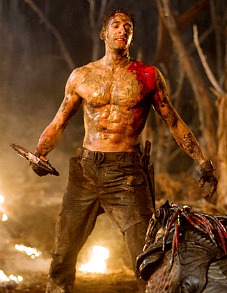

The opening shot is of Adrien Brody, playing a Max Max-ian mercenary, free-falling through the clouds. He’s a few thousand feet up, having been pushed out of a plane or something, and is writhing and groaning because he can’t open the chute. Now, the 2010 edition of The Bullshit Action Movie Manual states that the hero can never extricate himself from any tight situation until the last possible instant. So the question is whether or not Brody’s chute will open sooner than expected, or whether he’ll use a little ingenuity (like cutting open the chute packet with a knife) to release it, or whether something a little bit unexpected will occur. What happens? More writhing and groaning, no ingenuity with a knife, and the chute opens at the last possible second, or about 250 feet above ground.

As soon as this happened I knew this movie was basically dead meat, and I along with it. I knew it might throw in a twist or two, but that it would adhere to the usual cliches and expectations. That’s what it does, all right. I sat there in a trance, my mouth half open, slumping like a cancer patient with tubes in my arms.

The set-up involves a crew of violent types who’ve all been dumped onto some jungly Predator Planet as prey for the beasts. There’s no rooting factor for the characters because there’s no way off the planet (that’s for the sequel) so it’s basically a Ten Little Indians thing set in an outdoor prison, so who cares? It boils down to who’s going to get killed first, and how.

And there’s no particular thrill to the Predators because they’re just played by these tall muscle-bound guys with gray-skin makeup and Predator masks. (There are two Predator species in this film — the dominant wolves vs. the less-powerful dogs.) And I hate that stupid gurgly sound they all make. Hell, that all monsters make. King Kong throwing up, gargling with vomit, a pig getting his throat cut.

We all know that gradual group kill-offs are always determined by ethnicity, repellent characteristics and/or likability, and star power. The two biggest names (or the actors with the biggest roles) always survive to the end, although they usually come very close to dying during the last ten minutes, and are usually saved at the last second by a character who’s been a selfish prick all along but who decides to show the better angels of his/her nature just before the bell. Non-Anglos are usually the first to die followed by the morally repellent, although now and then an ethnic male will survive until fairly late in the game. (Not this time, Trejo.) Then it’s time to kill off the likable characters played by no-name actors. It works this way every damn time. And especially if the filmmakers are being led around by a genre-wallowing stooge.

Antal “directed” and the script is by Alex Litvak and Michael Finch, but Rodriguez was the spokesperson and pep-talker for Predators at the 2010 South by Southwest festival…okay? The guy made one cool and disciplined little movie, El Mariachi , in ’92 and has basically been Herschell Gordon Lewis ever since — a sloppy sex-and-blood freak. I mean, he saunters around Austin in his straw cowboy hat and his shitkicker boots and he cranks out genre cheese. To watch a Rodriguez film is to sink into warm and familiar quicksand. His films will always deliver a certain B-movie proficiency (i.e., slick values tempered by a modest budget) and plots that never stray too far from the path.

What gets you through are the performances. Especially Larry Fishburne‘s Act Two cameo. He plays some kind of eccentric commando who’s been hiding out inside a crashed space ship on Predator Planet for God knows how long. Fishburne flew into Austin, did two or three days at Troublemaker Studios, collected his check and flew back out. He’s like a cross between Marlon Brando in Apocalypse Now and Jon Voight’s nutjob in Anaconda, except he might weigh more than Brando and Voight put together. He was a skinny teen in Apocalypse Now and in reasonably good shape in the first Matrix movie…what happened?

Brody, all buffed up and covered with spray sweat and slinging a machine gun, handles the cryptic machismo thing pretty well. Alice Braga knows exactly how to make so-so lines sound better than they are, and more than holds her own. (On top of which she had a first-rate hair stylist standing by the ready, carefully misting her black hair and making it fall across her forehead and face in perfect curly tendrils.) Topher Grace , not playing a mercenary but a wimpy middle-class doctor with a secret, does his usual wise-ass yuppie thing.

Aaahh, this is more like it — a 50% Rotten Tomatoes elite rating. If you remove the blow-jobbers from the equation you’d have ratings that make more sense. Predators is passable to sit through if you don’t care about anything, but it’s a soul-sucker if you do. The Rodriguez virus will get you every time. Don’t expect the dopes to figure this out.

Best Hillcoat Ever

This is better than that grizzly western in which everyone was lathered with chicken grease, and more spiritually resonant than The Road. (Well, how could it not be?) The narration sounds Terrence Malicky, obviously. The music is what finally makes it. Where’s it from?

Stealth

A New York media guy who’s seen Phillip Noyce‘s Salt (Columbia, 7.23) says it “plays like gangbusters. It’s a thoroughly entertaining piece of popcorn that may very well launch a new franchise for Angelina Jolie (forget those horrible Tomb Raider abominations — this really is her Bourne).

“Clearly it’s more accessible than Inception and goes down a whole lot more easily (not to mention it’s at least 30 minutes shorter). That said if I had to guess both Sony and WB will be quite happy with what they get back on these. Inception will no doubt be the cool film to see this summer, but Salt might be the most fun.”

Well and good, but this guy has one of those spirited buoyant personalities. I’d like to find a Salt snitch with a brainy-but-gloomy thing going on. You know…a shlub who wears khakis and flannel shirts with a vaguely morose, Woody Allen-ish attitude. If a guy like that thinks Salt is the shit, then I’ll feel 100% comfortable.

Statement

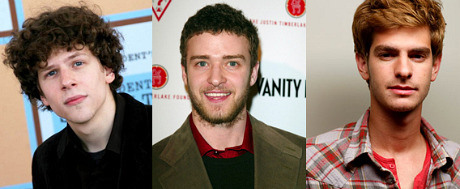
David Fincher‘s The Social Network (Columbia, 10.1) will be the 9.24 opening night attraction for the 48th New York Film Festival. I’ve said plenty about this film — I don’t think I need to repeat myself. Jesse Eisenberg, Justin Timberlake and Andrew Garfield costar. The NYFF runs from 8.24 through 10.10.

The Scott Rudin-produced drama, in other words, wont be playing at the Telluride, Venice or Toronto film festivals. So when’s the press screening? When should I definitely be home from Toronto, I mean?

Longer Avatar

A slightly longer version of Avatar with a bit more than eight minutes of added footage will be released in theaters on 8.27 in both Digital 3D and IMAX 3D. One presumes that the Jake-and-Neytriri sex scene will be included. In a statement Cameron only said that the footage will contain “new creatures and action scenes.”

Cameron told me at a Santa Barbara Film Festival gathering last February that he and 20th Century Fox believed that Avatar could have kept going and going if it hadn’t been for 3-D theatrical commitments made to Tim Burton‘s Alice in Wonderland.

Carson’s Hopper Doc

There’s a “Cinefamily” screening tomorrow night at L.A.’s Silent Movie theatre of L.M. Kit Carson and Lawrence Schiller‘s The American Dreamer, a 1971 doc about the late Dennis Hopper. The 90-minute feature, which hasn’t been seen in eons, will begin at 9:30 pm. (Following a 7:30 pm showing of Easy Rider.) It’s the kickoff attraction for Cinefamily’s Hopper tribute series.

Carson will regale with Hopper stories after the show ends, or roughly around 11 pm. I wrote Carson and asked for a sample. He wrote back with the following: “Hopper’s 50th birthday hit while we were shooting Texas Chainsaw Masaacre 2 in Texas in May ’86, and on the birthday party night Hopper insisted on cutting the cake with a chainsaw — laughing and shouting ‘gotcha 5-0!’ I don’t think Dennis ever thought he’d actually die.”

“The wild, unexpected success of Easy Rider ushered in what is now seen as one of the most significant turning points in film history, making pathologically rebellious Dennis Hopper an unlikely King Of Hollywood for a day,” the notes read. “Incredibly, that day was filmed — and not just filmed, but captured by two innovative and inventive filmmakers. Co-directed by L.M. Kit Carson and Lawrence Schiller, The American Dreamer is many things: an insightful document of a complex artist in the midst of his creative process, a self-reflective exploration and explosion of verite filmmaking tropes, and a playful and entertaining snapshot of the private life of one of Hollywood’s most eccentric stars at the peak of his newly found fame.

“Hopper boldly allowed access to his crazy life in all its aspects: firing his rifles off in the desert, editing The Last Movie, stripping naked and walking through downtown Taos, New Mexico, pontificating about art and life, and holding forth guru-like to a room full of naked women. Fortuitously timed, fantastically made, and virtually unseen, The American Dreamer is the great ’70s film doc you always wished existed.”

Handles


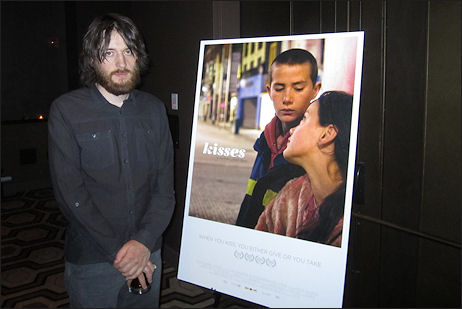
Kisses director Lance Daly after Tuesday night’s screening at the Tribeca Grand. Here again is my review.

I’ve been having problems with my left eye due to screen brightness. Hours and hours of writing each day is causing my left eye to get red and puffy. (The right eye is feeling left out.) So I’ve been (a) turning the screen brightness down and (b) wearing these green glasses while I write. It helps. It definitely feels less stressful.

One of the things that Brooklynites love about the L line is its tendency to run even slower than usual (and that’s saying something) when it’s really hot or really cold outside. This was taken at the height of rush hour yesterday morning. The cars were jammed tight and everyone was fuming because of the L line’s tardiness. It’s the worst subway line in the world. People offer vulgar gestures, corrrectly, to the driver as the train pulls in.

Dutch soccer fans on Soho’s Grand Street last Tuesday evening.

Poor Little Suddenly

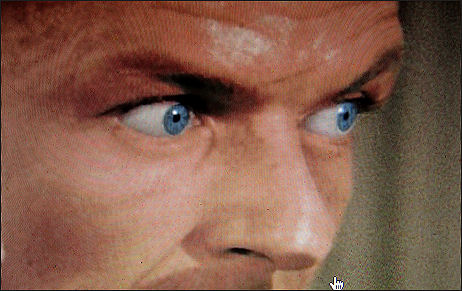
From a home-video perspective, Suddenly (’54) is one of the most shat-upon little movies of all time. A moderately decent political-assassination thriller with Frank Sinatra as a psycho bad guy, it’s been in the public domain for decades, and has always looked gray, hazy and diminished. Until a year ago, I mean, when Legend Films put out a slightly better looking b & w version. Now it has a bluish tint, and is more sharply defined.

The Legend guys also included a colorized version that corrected the legendary error made by the bozos at Hal Roach Studios when they put out a colorized VHS in which Sinatra’s eyes were brown.

“In 1959, five years after the release of Suddenly, a novel was published which had a remarkably similar ending,” the Wikipedia page says. “This was The Manchurian Candidate written by Richard Condon, a former Hollywood press agent recently turned novelist. His book also features a mentally troubled former war hero called Raymond Shaw who, at the climax, uses a rifle with scope to shoot at a presidential candidate. Because of such strong similarities, it is now thought that Suddenly was one inspiration for Condon’s Manchurian Candidate.”

In the late ’70s Suddenly costar Sterling Hayden (who lived in my home town of Wilton) told me that they made Suddenly before Sinatra’s big comeback in From Here to Eternity. (Hayden presumably meant before FHTE opened in August 1953, although he might have meant before Sinatra won his Best Supporting Actor Oscar in early ’54, since Suddenly opened in October 1954.) Even though Sinatra’s career was in a “down cycle,” as Hayden put it, he “still had the old kezazz.”

Each and everyone of us has to bring that old kezazz to our lives each and every day, and if we fail to do that on a consistent basis then we’re basically dead. I don’t have as much kezazz as I could right now, but at least I feel guilty about it and intend to rev up and get going later today.

Try, Try Again

One of the best analysis pieces I’ve ever posted to this column (and we’re talking literally thousands of items and stories since HE’s August 2004 launch) was my High Noon vs. Rio Bravo thing, which I wrote about three years ago. I’m very proud of having made it clear to God and Peter Bogdanovich and Quentin Tarantino and all the other Bravo cultists out there why I feel Howard Hawks‘ 1959 film has, okay, some merit (it’s a half-decent film) but doesn’t hold a candle to Fred Zinneman‘s 1952 classic.


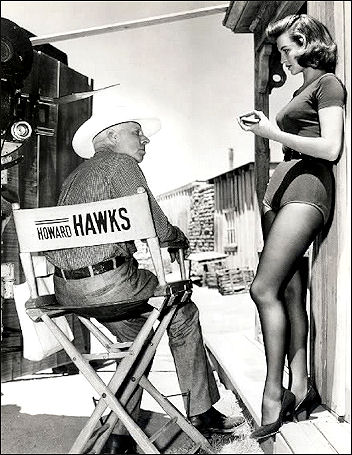
Howard Hawks had to know that making a romantic couple out of the hulking 51 year-old John Wayne and the doe-like, rail-thin 26 year-old Angie Dickinson was ludicrous, but I think he hired her anyway because of her great gams. And I think she knew this.

I just re-read the article and man, it really feels good when you discover that a semi-oldie reads clean and straight and true.

But in reading another well-written Rio Bravo analysis piece — actually a Rio Bravo vs. El Dorado thing, written a year ago by G.A. de Forest — it hit me that my ’07 article overlooked a huge aspect of Rio Bravo history, which is that Hawks more or less remade it twice — as El Dorado and Rio Lobo.

And so the obvious question: how good or classic or what-have-you can Rio Bravo be if the director not only decided five or six years later that he could improve upon it, but acted upon this notion not once but twice (with remakes #2 and #3 only four years apart), and using the same lead actor (John Wayne) in all three versions? And then admitting later on that the third version was shite?

Did Fred Zinneman feel the need to remake High Noon? Not as far as I know. We know for sure that he never did. Could it be that Zinneman felt it was good enough and didn’t need an upgrade? Uhm, probably. Does anyone think there might have been a reason why Hawks felt a need to remake Rio Bravo twice? I’m just spitballing, but the obvious conclusion is that he simply didn’t think Rio Bravo was “good enough,” to borrow from the Hawks lexicon.

Rio Bravo, for ill-defined reasons, is the more generally admired by critics,” de Forest wrote. “Hawks specifically remade it because he believed he could improve on the first version, and then believed he had. I too, maybe because [I’m] a child of the Sixties, have always preferred El Dorado, though having just seen Rio Bravo again and giving it proper attention, I appreciate its niceties more than before.

“Hawks knew what he was doing in remaking it…[and] by most measures El Dorado is a less compromised piece of filmmaking. Maybe simply to give the ensemble cast more on-screen time, there is a conscious insert in Rio Bravo where singing stars Dean Martin and Ricky Nelson get to do their thing — Dean crooning a cowboy song — ‘My Rifle, My Pony, and Me’ — with less C & W feel than anyone since Roy Rogers. Ricky bats his thick eyelashes and heavy lids for the girls rather irritatingly throughout, and almost pouts his more-generous-than-Elvis lips. Walter Brennan comes close to self-parody with his incessant cackling.

“On top of this, the original is far too wordy, especially for a western — courtesy of the screenplay by highly cultured Hawks favorites Jules Furthman and Leigh Brackett.”

I really think this settles it once and for all. All those Bravo groupies need to stand up, man up and explain clearly and concisely how a film that its own director felt a need to remake twice is somehow superior to a single, stand-alone western that its co-creator (the other being Carl Foreman) never re-thought or re-made. Because it can’t be done. I knew about the remakes all along, of course, but now that I’ve re-thought everything and re-read the ’07 article and jumbled it all around, I now feel — in my own mind, at least — that the High Noon vs. Rio Bravo debate is over and done with, and the bitches have scattered.