
Stacked Deck

I’m front-paging a response that I wrote this morning to a reader about Mark Romanek‘s Never Let Me Go (and the Kazuo Isiguro book that the film is based upon). The film opens on 9.15, less than three weeks hence, so it’s time to start kicking things around.
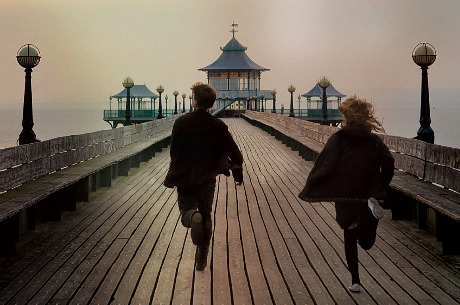
It’s not a very well-kept secret that the book and the film deal with a grim-fate dynamic — an oppressive, locked-down situation in which “a long and happy life” doesn’t appear to be in the cards for the main characters. In response a guy named The Perils of Thinking brought up the notion that facing the fact that you’re going to die is a bracing and clarifying experience.

“The clarity that comes from recognizing where one is heading,” he said, “can allow one to prioritize and make the most of one’s most brutally limited resource.”

Yes, I replied. As in that famous saying about how “the clarity of mind that comes to a man standing on the gallows is wonderful.” As in face facts, sharpen your mind and prioritize.

I’ve always been one, however, to take it a step further and not just prioritize and all that, but to first and foremost revel and rejoice in the immediacy of the symphony. Death is something to be accepted, okay, but primarily fought and strategized against, frequently laughed at, lampooned and pooh-poohed, acknowledged but simultaneously “ignored” (in a manner of speaking), dismissed, despised and raged against (in Dylan Thomas‘s words) right to the end.

There is only life, only the continuance, only the fuel and the fire…only the next step, the next breath, the next meal, the next sip of water, the next hill to climb, the next perfect pair of courdoruy pants, the next adventure, the next hypnotizing woman, the next splash of salt spray in your face, the next staircase to run down two or three steps at a time, the next rental car and the next winding road to concentrate on and carefully negotiate, etc.

Knowing your time on earth is limited and that the clock is pressing down leads one to value the time left and to treat each day as if it’s your last…of course. But The Perils of Thinking also said that “as far as I’m concerned, resignation to (or, to use a less negative connotation, acceptance of) one’s ultimate fate is one of the more rewarding and true experiences any human can experience.”

Resignation and acceptance? I know what he means but somehow those terms sound more like what a person with terminal cancer has to come to terms with than a person living a robust life.

The basic premise of Ernest Becker‘s “The Denial of Death” (1973) is, to go by one summary, “that human civilization is ultimately an elaborate, symbolic defense mechanism against the knowledge of our mortality, which in turn acts as the emotional and intellectual response to our basic survival mechanism.

“Becker argues that …man is able to transcend the dilemma of mortality through heroism, a concept involving his symbolic half. By embarking on what Becker refers to as an “immortality project” (or causa sui), in which he creates or becomes part of something which he feels will last forever, man feels he has “become” heroic and, henceforth, part of something eternal; something that will never die, compared to his physical body that will die one day.

“This, in turn, gives man the feeling that his life has meaning; a purpose; significance in the grand scheme of things.”

All to say that from one what I can gather, not having read the book but having read a couple of reviews and a couple of summaries, is that there doesn’t seem to be a great deal of dynamic go-for-it activity along these general lines in Never Let Me Go. Nobody seems to protest, creatively deny, fight against, counter-attack, escape from or anything like that. The young people in the book have been created to donate, and donate they do, and then they die. Great.

A friend who’s seen Never Let Me Go says, “If the film is difficult for some people, it’s not because of the movie’s quality, but simply because it deals with issues that most people are uncomfortable with. The performances are all fine. And the direction is subtle. It has a modesty. It’s all handled with humanity. The point isn’t to wallow in their tragedy, but to relate their experiences to our own. If you understand that, the film slowly builds its power as it progresses.”

Terrific

In a piece explaining how there’s no actual economic recovery going on and that we’re actually sinking toward a possible douple-dip recession, NY Times columnist Paul Krugman admits that “it’s arguable that even in early 2009, when President Obama was at the peak of his popularity, he couldn’t have gotten a bigger plan through the Senate. And he certainly couldn’t pass a supplemental stimulus now.

“So [administration] officials could, with considerable justification, place the onus for the non-recovery on Republican obstructionism. But they’ve chosen, instead, to draw smiley faces on a grim picture, convincing nobody. And the likely result in November — big gains for the obstructionists — will paralyze policy for years to come.”

Triple Dip

Yesterday The Oregonian‘s Mike Russell published a James Cameron interview in which the Avatar director revealed that a version running 16 minutes longer that the original theatrical cut — including a whole new opening on a polluted, befouled and Blade Runner-ish earth — will be sold in an Avatar box set out in November.

The extended 3D Avatar opening in theatres today is eight and 1/2 minutes longer than the version that opened last December.

Russell: I’ve read the Avatar screenplay that Fox posted online around Oscar season, and I’ll admit the thing I want to see re-inserted into the film are the opening scenes set on the polluted, dystopian Earth — the shots of lead character Jake in a sports bar — the polluted, crowded cityscapes. You shot this sequence, correct? Any chance we’ll be seeing that?

Cameron: Well, if you buy the box set in November, you can sit down, and in a continuous screening of the film, watch it with the Earth opening.

Q: Oh, really?

A: Yeah. It works very well. It just takes a long time to get the movie started. You have to be sort of predisposed to like the movie like a fan, you know what I mean? And then you can sit and you can have a great ride — a different telling of Avatar. Not inconsistent — it’s just the stuff that happened off-camera.

We call it ‘the Earth opening.’ It’s about 4 1/2 minutes of stuff. And it was in for the longest time. It was very late in the day that we took it out. I walked in one day and said to my two editors, ‘Guys, I want each of you to cut a new version of the start of the film, Reel 1, that doesn’t have any Earth in it at all.’ And they looked at me like I was out of my mind. And I said, ‘No — it’s gonna work.’ They had to figure out the details. I said, ‘Just grab a couple of things to use as flashbacks, and start it in space when Jake opens his eyes.’

Q: So wait – does [today’s] re-release start on Earth?

A: No. The re-release opening [today] starts the same way. But in November, you can buy a box set with all the bells and whistles. Plus it’s got like 45 minutes of unfinished deleted scenes that exist in a supplement where you can just play the scenes individually.

“But it’s all a big negotiation with the studios; how much money do they want to spend on these sort of revisionist versions of the movie? Because on the whole Earth opening, the visual effects weren’t done, and we had to go back and spend a million bucks or whatever to get those shots done. So there’s a price-tag dangling from anything that gets re-inserted.

“It’s not like Apocalypse Now, where they blow up a Vietnamese village and the footage is done – there are no visual effects after the fact. We’ve got to go back, and it’s our time and our energy and the studio’s money to re-create this stuff.

“But (in November) you’ll be able to watch a 16-minute-longer version of the film that’s a nice, flowing, cohesive version of the movie. If you just want to wallow in Avatar for three hours, I can get that for you.”

Sofia Ducking Toronto

I’ve watched this Somewhere clip three times now, and all I’m getting from it is one thing — the brunette isn’t especially taken with Stephen Dorff, her costar. They have a history and she’s over it. And everyone in the room is pretending to ignore this. And yet Dorff, for some reason, seems surprised. Which doesn’t figure. No guy is ever surprised by a woman’s disdain. He always senses it before it’s expressed, usually shrugs it off, projects “whatever.”

And by the way, I’m not seeing Somewhere (Focus Features, 12.22) on the list for the Toronto Film Festival. Why would Somewhere play Venice — journalists and critics galore — but not Toronto? If you’re going to be reviewed and talked about in Italy, what’s the advantage in ducking Phase Two (or Phase Three, if you’re counting Telluride)? This obviously sends a signal that Coppola and/or Focus Features are…well, concerned about something. Or that she and Focus are sensing on some level that Somewhere will get a friendlier reception in Venice.

When was the last time that a film by a major-league director bypassed Toronto after going to Venice? There are precedents, I’m assuming.

Game Is Rigged

I have a feeling (and no more than that) that I’m not going to be all that wild about seeing Mark Romanek‘s Never Let Me Go a second time. Because, as the Wiki page for Kazuo Ishiguro‘s book makes clear, once the layers have been peeled back and the situation is laid bare, it becomes a piece, essentially, about resignation and doom.

Not so, says a friend who’s seen it. There’s more to it than what has been summarized in this or that forum. It’s not some kind of “aha!” giveaway that comes at the end of the third act.

“If the film is difficult for some people, it’s not because of the movie’s quality, but simply because it deals with issues that most people are uncomfortable with,” he says. “The performances are all fine. And the direction is subtle. It has a modesty. It’s all handled with humanity. The point isn’t to wallow in their tragedy, but to relate their experiences to our own. If you understand that, the film slowly builds its power as it progresses.”
Stunner

On the Amazon.com page for the upcoming Apocalypse Now Bluray “Full Disclosure” edition (which I clicked on from the Bluray’s official website), it is stated that the package includes (and this is a direct copy/paste) (a) “Hearts of DarknessEleanor Coppola‘s documentary on the making of Apocalypse Now” and (b) “Hearts of Darkness audio commentary with Eleanor and Francis Ford Coppola.”

The first statement is a baldfaced lie. Hearts of Darkness was co-directed by George Hickenlooper and Fax Bahr with footage and audio tapes supplied by Eleanor Coppola, who had nothing to do with the interviews done for the doc and little to do with the cutting of it. This may be an Amazon error or (don’t want to leap to conclusions) deliberate misinformation forwarded by Lionsgate, Paramount Home Video and/or Zoetrope, but HE readers are referred to a piece I wrote this morning about a related Hearts of Darkness issue.

M.I.A.

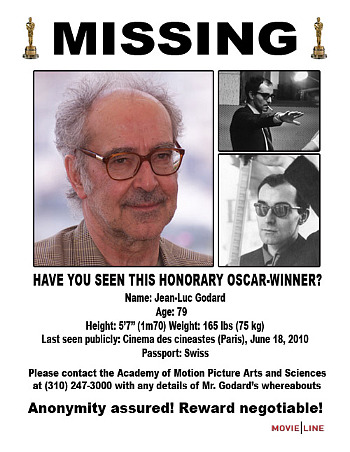
A Hollywood Reporter story by Stephen Galloway announced yesterday that Academy reps can’t find Jean Luc Godard in order to give him the good news that he’s been chosen to receive an honorary Oscar next February. And so Movieline‘s Stu Van Airsdale has created a Jean-Luc Godard “‘missing” poster. Hilarious. I’m guessing Godard is just ducking them — he doesn’t want the damn award and doesn’t want to get into a whole dialogue dispute and have to listen to endless cajolings.

More Toilet Swirl

On 8.24 Slate‘s Bill Engvell took another look at the 3D revenue situation. A somewhat harsher view, that is, than the one presented by TheWrap‘s Daniel Frankel on 7.20, which basically said that 3D revenues are going south. Actually, says Engvell, “It looks to me that the revival is even worse off than we thought. Not only has the profitability of 3-D fallen in the past few months; it’s in a slide that goes back years.”

Disdain

The posting of this just-released Apocalypse Now Bluray trailer affords an opportunity to bitch about a clear lack of interest on the part of Francis Coppola‘s Zoetrope as well as Paramount Home Video (which sub-licensed the AN elements to Lionsgate for the Bluray) in presenting George Hickenlooper and Fax Bahr‘s Hearts of Darkness, an award-winning 1991 documentary about the making of Apocalypse Now, in a respectful fashion within the three-disc AN “Full Disclosure” package.

It’s great that HOD is being included, mind, but it’s not going to look all that terrific, apparently, because it appears — emphasis on that word — that Paramount Home Video provided the same one-inch tape master that was used for the 2007 DVD, which looked so-so at best but could have looked better if the HOD negative had been digitally scanned.

It’s allegedly stated on the Apocalypse Now Bluray website that “original elements” were used in creating an HD master of Hearts of Darkness. The wording of this term seems needlessly vague and is probably misleading. I haven’t been able to persuade anyone from Lionsgate, American Zoetrope or Paramount Home Video to be more specific.

It makes basic visual sense to use higher-grade elements for a Bluray rendering, but apparently nobody wanted to spend the $10 grand (more?) it would have cost to scan the HOD negative. This is understandable from a nickel-and-dime perspective, but disrespectful to perhaps the best making-of documentary ever made. It is certainly the most intimate look at the travails of an anguished big-budget filmmaker ever seen. What’s right is right. Hearts of Darkness isn’t an EPK reel — it’s a highly revered film with its own legend.

It’s already been discussed how Paramount and/or Lionsgate had no interest in including a commentary track from Hickenlooper/Bahr on the HOD Bluray. Hickenlooper told me this morning he’s planning to record a commentary but lacks the geek expertise to do it correctly himself. If anyone in Los Angeles can lend a hand (i.e., provide a recording opportunity, edit the commentary, upload the master), please get in touch.

Late last month I spent too many hours emailing and calling people at Zoetrope, Lionsgate and Paramount Home Video to ask about if better HOD materials had been used for the Bluray, or not. I got totally stonewalled and shilly-shallied by everyone I wrote and spoke to. To this day nobody has ever confirmed or denied that the one-inch tape used for the 2007 DVD was used or not. Despite repeated requests Zoetrope attorney George Hayum wouldn’t even tell me if access to the HOD negative had been requested by Paramount Home Video. It was ridiculous.

It seems to me that this lack of interest and respect originates with Coppola, who owns the Hearts of Darkness elements. Hickenlooper has long believed that Coppola is fundamentally uncomfortable with the doc. “I think it makes him feel as if somebody had rummaged through his underwear drawer,” Hickenlooper says.

Coppola was willing to permit the release of the 2007 HOD DVD, yes, but that, Hickenlooper believes, was primarily a ruse to get promotional materials sent out for his then-upcoming Youth Without Youth and a doc that Eleanor Coppola, his wife, made about the filming of YWY, called Coda.

Gold Watch/Last Hurrah

If I was a name-brand filmmaker in the last act of my life, I would politely refuse the Academy’s offer of an Irving Thalberg or Governor’s Award. If your career hasn’t been going great guns, accepting these honors at the Oscar awards, I feel, is a kind of admission to the world that you’re over.

These awardings are always a warm and emotional tribute, yes, and a profound moment of glory. Who could fail to be moved by the Academy saying “we’ve loved your work all these decades, and we want to show our appreciation even though you’ve been winding down for a while…we love you”?

But if you accept this honor, you’re basically saying, “Yeah, you’re right…I’ve had a great career but I’m now officially finished.” If people haven’t been returning some of your calls prior to accepting an honorary career Oscar, they won’t return any of them the morning after. No matter what your “friends” may tell you at parties, you’ll strictly be seen as a retirement village guy from then on. I would rather dream the foolish dream while writing my latest script or meeting with financiers or talking with directors about my next part, etc. Fuck the Gold Watch. Never say die.

This year’s honorees are directors Francis Ford Coppola (i.e., the Irving Thalberg recipient) and Jean-Luc Godard (Governor’s Award) and actor Eli Wallach. Okay, I’d accept it if I was Wallach because he’s…what, in his early 90s? He’s untouchable and un-diminishable. But if I were Godard and Coppola I’d respectfully tell the The Academy fathers “thanks but no thanks.”

Arabian Nights

I’ve been invited to attend and cover the Doha Tribeca Film Festival (10.26 to 10.30), which is way the hell over in Qatar, adjacent to Saudi Arabia. We’re talking south of Kuwait, across the Gulf of Oman from Iran. I’ve never been east of Croatia so why not, right? Thanks to the Doha Film Institute for the invitation. I’m presuming it’ll be pure Vegas for the most part, but I’m looking very much forward to the exotic aspects.

Bray

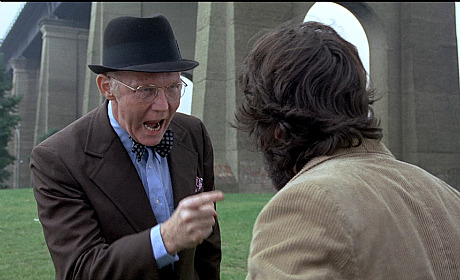
This frame capture is from a DVD Beaver review of a new French Bluray of Sidney Lumet‘s Serpico. I don’t know the yeller, but the guy taking the heat is Al Pacino. I’m trying to think of the last time I’ve been howled and pointed at like this, but it’s been a while. Possibly decades, I mean. It’s really hard to think when emotions are cranked up to this level.

Below is a N.Y. Times video essay about a visit with the real Frank Serpico, who wandered around Europe after his NYPD experience (’60 to ’71), returned to New York in 1980 and finally wound up in a small town in upstate New York. His Wiki bio says he “studies and lectures on occasion to students at universities and police academies and sharing experiences with police officers who are currently in similar situations.

Also from the Wiki bio: “When it was decided to make the movie about his life called Serpico, Al Pacino invited Serpico to stay with him at a house that Pacino had rented in Montauk, New York. When Pacino asked why he had stepped forward, Serpico replied: “Well, Al, I don’t know. I guess I would have to say it would be because…if I didn’t, who would I be when I listened to a piece of music?”