Rabbit Hole in Tribeca

I caught John Cameron Mitchell‘s Rabbit Hole (Lionsgate, 12.17) for the second time this evening. It hasn’t diminished a bit since I last saw it at the Toronto Film Festival; if anything, it’s gained. It’s a sad, honest and fully engaged thing, and never the least bit boring. It has no weak scenes — each is gamey, steady and true, and adds another layer to a whole that becomes more and more intriguing as it goes along. Really — this is not Oscar bloggie blather.

Every actor in the cast nails it with verve and snap, but especially Nicole Kidman, Dianne Wiest, Aaron Eckhart and (in his motion picture debut) Miles Teller.

I take it back about Rabbit Hole being an A-minus — I’m now calling it a solid A, and I still have no doubt about its ability to penetrate as a Best Picture contender. I’m not just “saying” this. It really is a keeper; it holds itself together and deepens the game and spreads out and sinks in a step-by-step basis.

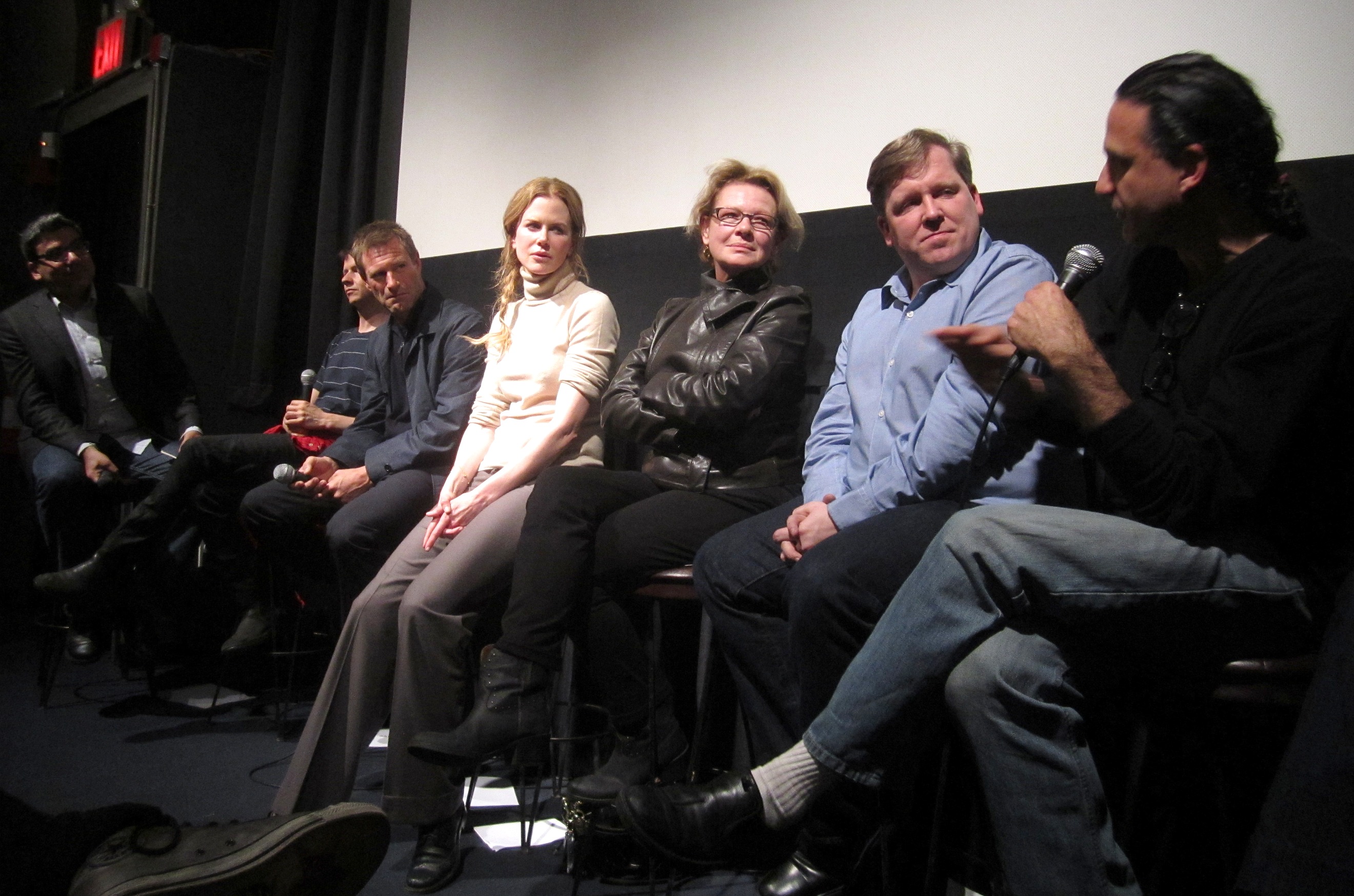
Kidman, Weist, Eckhart and Teller joined Mitchell and moderator Eugene Hernandez for a chat following tonight’s screening at the Tribeca Cinemas. Also participating were production designer Kalina Ivanov and a gentleman who may have been cinematographer Frank G. DeMarco. (I’ll confirm Wednesday morning — sorry.)

Rabbit Hole is a restrained/contained middle-class grief drama in the vein of Ordinary People and In The Bedroom (i.e., dead son). David Lindsay-Abaire‘s screenplay (based on his play) never lays it on too thick, but doesn’t hold back too much either. It’s a process drama about keeping the trauma buried or at least suppressed, and about how it comes out anyway — a little hostility here and there, odd alliances and connections, a little hash smoking (a la American Beauty), stabs at organized grief therapy, questions of whether to keep or get rid of the son’s toys.

It finally explodes in a bracing argument scene between Kidman and Eckhart, and then it subsides again and comes back and loop-dee-loops and finally settles down into a kind of acceptance between them. Not a peace treaty as much as an understanding that overt hostilities will cease.

A few people applauded at the end of the TIFF press screening that I attended. They also applauded big-time this evening. This is a very well honed, entirely respectable, honestly affecting drama. There’s no doubting and disengaging from any of it.

The Rabbit Hole gang during post-screening discussion at Tribeca Cinemas — Tuesday, 11.16, 9:35 pm — (l. to r.) moderator Eugene Hernandez, director John Cameron Mitchell, Aaron Eckhart, Nicole Kidman, Dianne Wiest, screenwriter David Lindsay-Abaire.
Fast Read

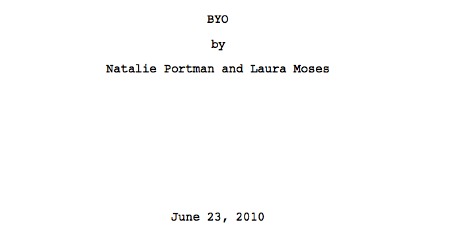
Unlike myself, a friend has found the time to finish a 6.23.10 draft of Natalie Portman and Laura MosesBYO, which I was sent yesterday. L.A. Times reporter Stephen Zeitchik recently described it as a “raunchy, female-themed Superbad comedy.” But “it doesn’t have any serious Jonah Hill-like vulgarity,” my colleague says. “Just lots of Michael Cera snarkiness and McLovin dopey-ness.”

The two main characters are Lucy and “Al” (short for Alice) — Lucy is the wild sex fiend and Al is the more or less level-headed one. There’s a scene on page five in which Lucy is caught blowing a 15 year-old by the teen’s mother. (I read about ten pages so even I got that far.) “There is one other sex scene,” my friend says, “but who knows what it’ll be. Let’s just say it doesn’t get any dirtier than the page-five BJ.”

“I can see it being funnier acted out,” he adds. “It just seems lurid because it’s about chicks acting like horny dudes.”

Good God

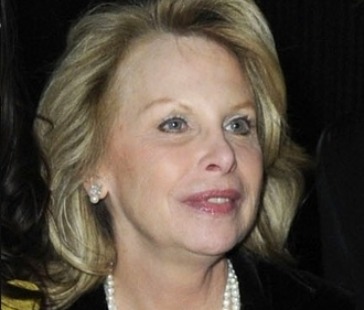
Longtime Hollywood publicist Ronni Chasen was found shot to death in her car early this morning with — I can’t believe I’m reading this — multiple gunshot wounds to the chest, according to TheWrap‘s Brent Lang. Beverly Hills police “would not confirm that the victim was Chasen, but did tell TheWrap that a woman was found in her car early Tuesday with multiple gunshot wounds to the chest,” Lang wrote.

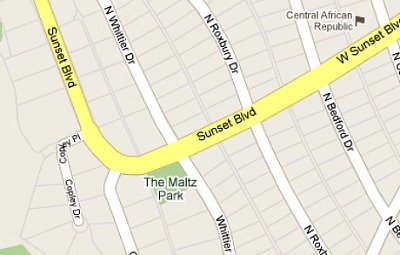
Chasen “had apparently crashed her car into a lightpole around 12:28 a.m. near Sunset and Whittier. Beverly Hills police said that there were no suspects, no known motive and that the investigation was under way. Chasen was believed to be returning from the world premiere of Burlesque, the Cher movie. The Hollywood publicity machine was in shock over the news.”

HE offers hugs and condolences to Chasen’s family (including director Larry Cohen, her brother) and coworkers/associates. I’ve known and worked with Ronni for years and always found her tough, sharp and fair. This is more than tragic — it’s surreal. What could have happened? All I can think is that one or two shots is a gunman looking to kill someone, but five in the chest is rage.

O'Neil and Pond

The King’s Speech looks like a perfect Oscar movie, but it’s not any more. I’m not confident in that. Even though it plays much funnier and lighter and not so stuffy as you might think, It doesn’t seem like a movie of the moment, whereas The Social Network does.” — TheWrap columnist Steve Pond speaking to Gold Derby‘s Tom O’Neil.

And yet, Pond adds, “Is The Social Network the movie of the moment for most Academy members, or is it the movie of the moment for people who are younger?

Deadly

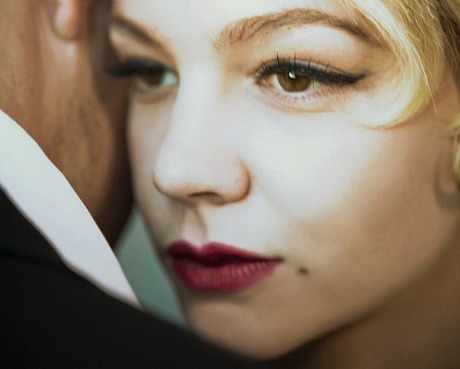
Missing in Mike Fleming‘s Deadline report about Carey Mulligan landing the part of Daisy Buchanan in Baz Luhrman‘s adaptation of The Great Gatsby is any sense of what an absolute stiff the 1974 Robert Redford-Mia Farrow-Bruce Dern version was, and what may happen when Luhrman begins to wrestle with the ghost of F. Scott Fitzgerald.


Pic of Carey Mulligan taken by Lurhman during a recent audition, and then supplied to Fleming for his exclusive announcement story.

Fleming is a shoe-leather guy who just writes it down and double-checks and types it out, but if he were so inclined he might also voice suspicion about the oil-and-water mixture of Luhrman’s hyperkinetic style and Fitzgerald’s elegiac 1925 novel.

I’m guessing that Gatsby‘s wistful tone — it’s a book about socially desperate people in states of dreamy-boozy lament — will almost certainly encourage Luhrman to turn up the intensity and the bombast even more than he did with Australia, which seemed to many like a tragedy of overstatement.

With Leonardo DiCaprio cast as Gatsby and Tobey Maguire as Nick Carraway (the narrator figure played by Sam Waterston in Jack Clayton‘s version), this project has “disaster” stamped all over its forehead. Perhaps if it was modernized in the manner of Luhrman’s Romeo + Juliet ? Maybe. Otherwise this feels like a train wreck in the making, a train wreck in the making, a train wreck in the making.

But agreeing to play Jay Gatsby (“old sport”) and also J. Edgar Hoover for Clint Eastwood, DiCaprio, no offense, has been on a roll in terms of taking the wrong roles for mystifying reasons.

In his review of the Clayton version, N.Y. Times critic Vincent Canby wrote that it “moves spaniel-like through F. Scott Fitzgerald’s text, sniffing and staring at events and objects very close up with wide, mopey eyes, seeing almost everything and comprehending practically nothing.

“The language is right, even the chunks of exposition that have sometimes been turned into dialogue. The sets and costumes and most of the performances are exceptionally good, but the movie itself is as lifeless as a body that’s been too long at the bottom of a swimming pool.”

Why Of It

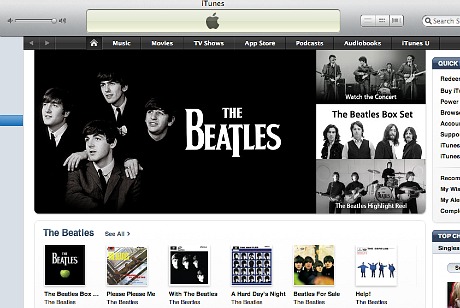
The vast majority of reports about the Beatles arrival on iTunes, which was announced this morning, have offered no explanations about what’s been holding this deal up for so many years. However, an article posted last night by the Wall Street Journal‘s Ethan Smith (with additional reporting from Nick Wingfield and Dana Cimilluca) provides a through-sounding history.

Pop-out #1: “People who have done business with [the Beatles] and its corporate entity, Apple Corps Ltd., describe a very slow-moving process in which the two surviving members, and the heirs of the other two, can take a long time to reach consensus.”

Pop-out #2: “The Beatles deal with iTunes was delayed in part by ongoing trademark litigation, the most recent round of which was resolved in 2007. The Beatles and iTunes have traded lawsuits since 1978, when the Beatles alleged that the computer maker, incorporated as Apple Computer in 1977, infringed on the band’s trademark in the name and logo of Apple Corps. The lawsuit was settled in 1981 for an undisclosed sum, plus an agreement that the Cupertino, Calif., computer maker wouldn’t compete in the music business.”

Pop-out #3: “The Beatles’ record label, EMI Group Ltd., has been under financial strain following an ill-timed leveraged buyout by Terra Firma Capital Partners LP in 2007. If the iTunes tie-up generates significant cash advances or sales, it could delay breaches in the company’s loan covenants. Terra Firma borrowed ¬£2.74 billion (US $4.4 billion) from Citigroup Inc. to finance the deal, but has fallen into breach of those covenants, forcing it to add millions more to its equity position last year.

Pop-out #4: “Even as recorded-music sales have plummeted, the Beatles have remained one of the most reliable franchises in the business. In 2009, 39 years after breaking up, they sold the third-highest number of albums of any act in the U.S., according to Nielsen SoundScan, with 3.3 million copies sold.”

Avoid "The" Whenever Possible

I didn’t read this 11.13 Drew McWeeny/Darren Aronofsky conversation piece until last night. Aronofsky told McWeeny that his Wolverine flick will be a “one-off” and shouldn’t be regarded as a sequel or prequel or related in any way to the X-Men franchise or Gavin Hood or anything. Aronofsky also told DW it’ll be called The Wolverine.

Right away I recoiled. I don’t like seeing “The” in any title, especially one citing the name of a superhero. I recognize that one of Heath Ledger‘s signature lines in The Dark Knight is “kill the Batman,” but a superhero is not an article like a table or a refrigerator or a car. A superhero is a myth, a force field, an icon, a tower. And most of them own their names for eternity. I’m obviously aware of The Shadow and The Green Hornet, but the use of the word “the” is generally superfluous and bothersome.

The fact that villains are agitating anti-socials allows them on some level to be called, fittingly, the Joker, the Riddler and so on. But imagine paying to see a film called The Superman or The Batman. It’s not right, not cool…stupid-sounding. So please — jettison The Wolverine.

Japan-phobia

I have two minor issues with the Drew McWeeny/Darren Aronofsky/Hitfix riff that was posted last weekend. Okay, one minor one and another that I could almost call major in a fundamental/cultural sense.


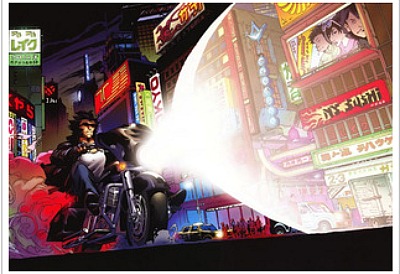
Adam Kubert illustration from 11.13 Hitfix article about a discussion between Drew McWeeny and Darren Aronofsky. Kubert “is just one of the many artists who have sent Wolverine to Japan over the years,” it says, “and now Darren Aronofsky is set to do the same.”

An illustration caption in the McWeeny article suggests that The Wolverine, which will be dp’ed by Matthew Libatique (Black Swan, The Fountain, Cowboys and Aliens), will be locationed in Japan. That scares me a bit. Go to Japan and your movie becomes a flamboyant acrobatic action-flash samurai-yakuza cartoon. I’ve loved Ichi the Killer and High and Low and dozens of Japanese-shot thrillers and action films over the decades, but visiting American filmmakers have this tendency to objectify and sanctify Japanese culture in a big-budgety, broad-stroke ways.

I’m sure there are U.S.-shot, Japan-based action thrillers that I’ve really enjoyed besides Ridley Scott‘s Black Rain and Sydney Pollack ‘s The Yakuza, but they’re not coming to mind. I know that quiet and meditation and small-scale simplicity don’t seem to factor in very much. Don’t even mention Kill Bill‘s Japanese section, which I found more or less ridiculous.

On top of which I’ve been developing this idea for years about Japan being a profoundly depressing place. Gaspar Noe‘s Enter the Void may have finally convinced me of this. Japan seems like one big Los Angeles strip mall these days. A strip mall with nicely landscaped gardens. I’m totally fine with the idea of never visiting there. I’ve never wanted to, really. Too crowded, too commercial, too expensive, and too sprawling. Plus they kill dolphins and eat them.

I also have a problem with McWeeny calling Libatique “Matty.” That feels like forced familiarity. I’m obviously not one to talk with my having adopted Bennett Miller‘s “Philly” in references to Phillip Seymour Hoffman, but Matty is somehow different. To me it’s in the same realm as Danny and Frankie.

Just so we’re straight: Mattie is bad, Danny is bad, and Frankie is bad…but Philly is somehow okay.