Wink Wink Sell-Out

Morgan Spurlock‘s The Greatest Movie Ever Sold (Sony Classics, 4.22) is a divided experience. 50% of it…make that 66% is a possibly audacious, mildly amusing, totally transparent hall-of-mirrors doc about Spurlock humorously “selling out,” which is to say trying to fund a doc about product placement (i.e., this one) entirely with product placement deals while — this is fundamental — winking at the audience and therefore not “really” selling out but commenting on it and delivering if you will the irony of it all.

The other 33% is about Spurlock and his film taking it up the ass for real, selling the shit out of every sponsor’s product (including Pom Wonderful), smiling like hell, turning on the charm and going “are you getting what we’re up to here? This is a kind of black comedy because the sell-out idea has been our intention from the get-go. You get that, right?” Yeah, I get it, I get it. But I wonder what it adds up to.

The fact is that The Greatest Movie Ever Sold isn’t angry or accusatory enough to mean anything in a conventional Michael Moore “this is bad and you should be mad!” sense, and it’s so friggin’ stuffed with ads and product lines and advertisements and marketing meetings and statistics that after a half-hour or so it makes you feel like it’s related on some genetic level to Don Siegel‘s The Invasion of the Body Snatchers (1956). Hundreds of thousands of flat-bed trucks carryng large seed pods have been delivering for decades, and free-spirit types like Kevin McCarthy and Dana Wynter…well, how very quaint.

During one of the very few non-ironic “instructive” points in the doc Spurlock visits Sao Paolo, Brazil, and learns about the government’s policy to completely ban all outdoor ads. The reason, says one official, is that with ads blanketing everything “we were losing our city” (or something close to that). The Sao Paolo section was a good idea, but Spurlock doesn’t want to lecture so when he returns to the US he goes right back to hustling and winking and rolling around in cross-promotional opportunity.

It’s not a boring film and is a very intelligent and thoughtful exercise all in all, but it’s somewhat tiring to sit through — I must say that because it’s true. Spurlock’s is “saying” something here, and at the same time not really saying anything…and yet he is. His best film is still Super-Size Me.

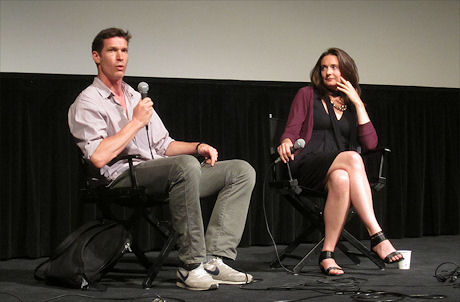
I saw The Greatest Movie Ever Sold last night at Pete Hammond‘s KCET class at the TV Academy theatre in Burbank, and then stayed for a q & a between Hammond and Spurlock.

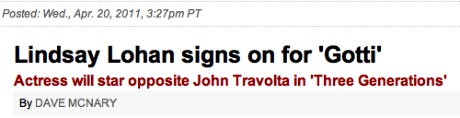
Lohan/Gotti Saga: Kim, Not Victoria

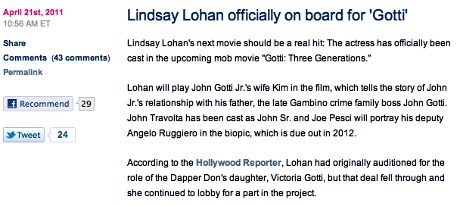
At 1 pm on Wednesday, 4.20, People‘s Liz McNeil posted the following: “Lindsay Lohan can fuggedabout playing Victoria Gotti on film. ‘We are not talking any further about Lindsay playing Victoria,’ says Marc Fiore, producer of Gotti: Three Generations. “She is no longer being considered. The talks have stopped. We are going to meet with other people [for the role].”

Two hours and 27 minutes later on the same day, Variety‘s Dave McNary posted the following: “Lindsay Lohan has signed to portray Kim Gotti opposite John Travolta in Fiore Films’ drama Gotti: Three Generations. Fiore Films announced the signing Wednesday as part of a two-picture deal with Lohan. The company also said Lohan has agreed to act in its upcoming production of Mob Street, based on a screenplay by Chazz Palminteri.”

The next morning (i.e., Thursday) at 10:56 am, CNN’s Marquee blog, quoting a Hollywood Reporter story, reported that Lohan “had originally auditioned for the role of the Dapper Don’s daughter, Victoria Gotti, but that deal fell through and she continued to lobby for a part in the project.”

Stand-In

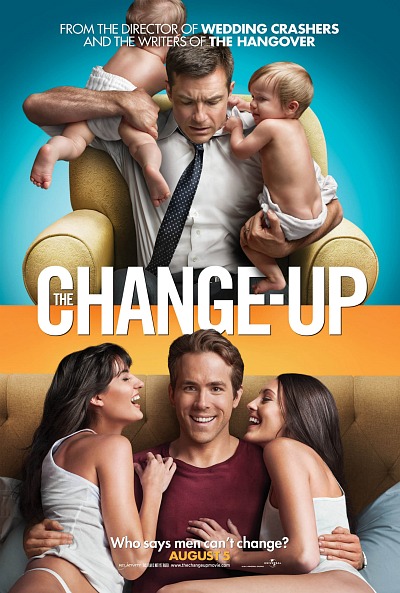
There’s a brief segment in Woody Allen‘s Husbands and Wives in which Allen’s character reads a short story about a champagne-sipping womanizer envying the married guy who lives down the hallway, and vice versa. David Dobkin‘s The Change-Up is a feature-length riff on this idea, goaded by a supernatural premise.

I used to ask myself if Ryan Reynolds will ever topline a really well-made commercial mainstream movie. Not a pretty good one like The Proposal or an interesting but unsatisfying indie-exercise pic like Buried, but a sharp, snappy, laugh-out-loud exception on the level of Dobkin’s The Wedding Crashers. Will it ever happen?

Jason Bateman costars in The Change-Up along with Leslie Mann, Olivia Wilde and Alan Arkin. The screenplay is by Jon Lucas & Scott Moore (The Hangover…ih-oh) and producer Neal Moritz (Fast & Furious, Click)….beware of Moritz! The film’s scheduled 8.5 opening could be another slight uh-oh…or not.

Religious Discrimination!

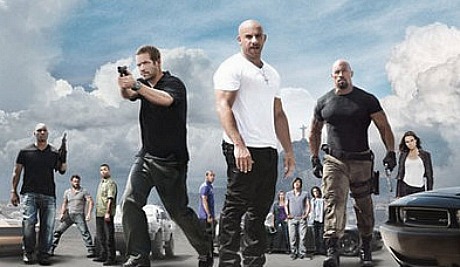
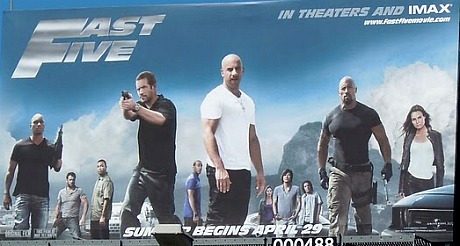
A screenwriter-editor friend “got an email from the Consulate General of Brazil in Los Angeles promoting Brazilian-shot films,” he says, “and I noticed their version of the Fast Five poster includes a small image of that giant Christ the Redeemer statue that stands on a Rio de Janiero mountaintop. But in Fast billboards around LA the Jesus statue has been erased.


Crop of Brazilian Fast Five poster includes the famous Rio de Jainero Jesus -on-mountaintop statue.

Jesus statue has been painted over or otherwise removed in LA billboards

A good portion of Fast Five was shot in Brazil, so it makes sense that the Brazilian billboards would include the Jesus statue, etc. But it’s obviously a very small element in the poster photograph (I didn’t even see it the first time Iooked at it) so why would Universal marketing guys go to the trouble of painting it over? Who cares? Why would it be a negative to indicate to US audiences that it was shot in Rio?

Once Upon A Time

Most of my life I’ve been somewhat interested in seeing Robert Frank‘s Cocksucker Blues (’72), a 93-minute doc about the Rolling StonesExile on Main Street tour in ’72. But it’s never been a burning obsession and I’ve never quite gotten around to it. This morning, however, I discovered that it’s on YouTube, and in what looks like fairly good quality.

My first aesthetic reaction? Franks’ camerawork is sloppy, scattershot and raggedy-assed. I hate it when photographers are always going for the jumpy-antsy closeup and seem indifferent to even trying to deliver formal, Eisenstein-like framings.

This, in any event, is a note of gratitude to Bill Wyman, whose 4.19 Slate article about unlimited access to music (“Lester Bangs’ Basement”), for tipping me off.

Death in Libya

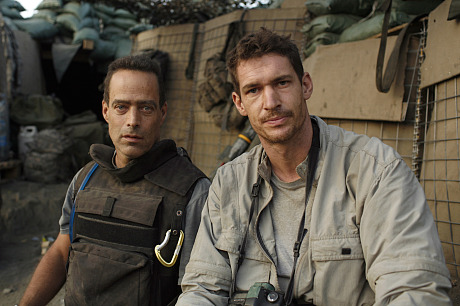
Restrepo co-director and Vanity Fair contributor Tim Hetherington, whom I met and questioned during a Lincoln Center q & a last June, has reportedly been killed in Misrata, Libya, while covering the fighting there. I suspect that if given an either-or choice, Hetherington would have opted for this while in his 60s or 70s rather than dying warm in his bed at age 87. He was a war junkie. But it’s a deeply sad thing, of course, and I’m very sorry. Sincere condolences to his friends and colleagues.


(l.) Tim Hetherington, Rachel Reid during 6.19.10 q & a at Manhattan’s Walter Reade theatre.

The initial report came from a Facebook posting by photographer Andre Liohn. Hetherington and three colleagues were hit by mortar fire.

4:29p pm Update: CNN has reported that Hetherington’s colleague Chris Hondros has died.

Previous Update: A NY Times story by C.J. Chivers reports that Hetherington’s colleague Chris Hondros, “an American working for the Getty photo agency, suffered a severe brain injury and was in extremely critical condition, according to Mr. Liohn. He had been revived and was clinging to life in the evening. A later update from Mr. Liohn said that Mr. Hondros was in a coma at the medical center, which is located near the front lines.”

Hetherington reportedly tweeted from Misrata shortly before he was killed, and described heavy fighting taking place outside the city, to wit: “In besieged Libyan city of Misrata. Indiscriminate shelling by Qaddafi forces. No sign of NATO.”


(l.) (l.) Sebastian Junger, (r.) Tim Hetherington during filming of Restrepo.

Silly Overlap

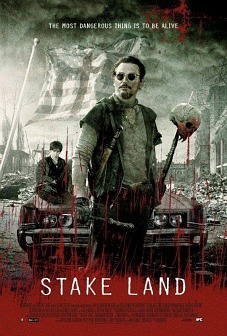
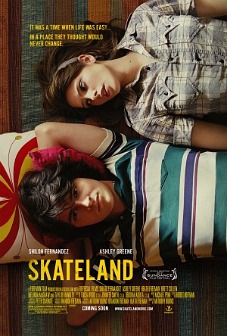
What are the odds that a Texas skating-rink movie set in the ’80s called Skateland (Freestyle, 5.13) would open within three weeks of a somewhat well-regarded dystopian horror flm called Stake Land (IFC Films/Midnight, 4.22)? I’ve known about them both for weeks and have been marvelling at the idiocy of the timing. You can’t make this stuff up.

Producers of both films presumably eyeballed each other and figured it wouldn’t matter if they opened this close to each other…amazing. They actually decided that moviegoers wouldn’t feel the least bit confused or uncertain? Any idiot, you’d think, would calculate that one of these films should delay or move up their release date so they’d be six or nine months removed from the other.

Anthony BurnsSkateland wlll probably suffer a bit due to following Jim Mickle‘s Stake Land by three weeks, but maybe not. They’re obviously appealing to different demographics. Skateland is apparently the more nostalgic, wholesome and emotionally winning of the two, etc. But it still seems weird.

And what about those two African lion docs — Dereck Joubert‘s The Last Lions (National Geographic, 2.18) and African Cats (Disney, 4.22) — opening two months apart? How many African lion docs have opened theatrically over the last half-century? And suddenly two open within eight weeks of each other?

Filmmakers Urging VOD Reversal

TheWrap‘s Brent Lang is reporting today that over twenty big-name directors and producers — including James Cameron, Michael Mann, Peter Jackson, Guillermo del Toro, Gale Ann Hurd, Michael Bay, Brett Ratner and Hangover director Todd Phillips — have signed a letter urging studios to reverse their much-debated VOD plan that would release films on DirectTV 60 days after their theatrical release.

The argument for the plan is that anyone with a pulse is going to catch any new film worth seeing in a theatre within three to four weeks, or more likely within one to three weeks, and what does it matter if it hits VOD after eight weeks? Most films are completely over at the box-office after five or six weeks. The argument against is that moviegoers outside the hardcore urban areas will now be more likely to skip theatrical exhibition altogether, knowing it will only be two months before a given film will be available on demand.

People in the hinterlands have long argued that smaller, highly recommended films never even show up at their local theatre, and that early VOD windows would therefore be very welcome and a life-saver of sorts. I can understand that. I’ve heard this complaint over and over among HE readers.

Discouraging moviegoers from patronizing films at theatres could indeed by disastrous for exhibitors. The filmmakers are probably right when it comes to major-league, well-reviewed, high-interest features like the ones that Mann and Del Toro and Cameron make — they shouldn’t be VOD’ed 60 days after release. But what about the not-so-great mezzo-mezzo films?

Theatre owners have arguably done much to already discourage attendance by failing to compete with the high-quality viewing experience available to anyone with a 50″ high-def screen, a Blurayplayer and a sound system of some kind. It seems to me that if smaller, cooler, more interesting films like Super are available day-and-date (or close to that) by IFC Films and Magnolia and others, it might not be fatal for lower-rated movies that most of us wouldn’t see in theatres anyway to be viewable on home screens after 60 days.

Lang summarizes that studios “have privately maintained that premium VOD is the best way to stabilize the home entertainment market and reestablish a price point that’s been depressed by dollar rental kiosks and subscription rental services such as Netflix.”

The filmmakers’ letter reads in part, “As a crucial part of a business that last year grossed close to $32 billion in worldwide theatrical ticket sales, we in the creative community feel that now is the time for studios and cable companies to acknowledge that a release pattern for premium video-on-demand that invades the current theatrical window could irrevocably harm the financial model of our film industry.”

As Lang reports, “The premium VOD platform kicks off on Thursday with the release of Just Go With It. For $30, DirecTV customers can rent the title for 48 hours. Four studios — Fox, Sony, Warner Brothers, and Universal — are making their films available through the new windows.”

Return of Villechaize

Yesterday The Playlist‘s Kevin Jagernauth reported about Sacha Gervasi‘s My Dinner With Herve, a drama about a 1993 interview Gervasi did with Herve Villechaize (“The plane! the plane!”) days before the dwarf-sized Fantasy Island actor killed himself. The director of Anvil! The Story of Anvil is looking to snag James McAvoy as the journalist; Peter Dinklage will play Villechaize.

This story gives me an excuse to post a clip of Villechaize’s gay cowboy scene in Robert Downey, Sr.‘s Greaser’s Palace (’72). I saw this film in its entirety once sometime in the early ’80s, and I’ve never forgotten the silly sexual current in this scene. Stanley Gottlieb‘s performance as Villechaize’s cabin-partner “Spitunia” is a classic. Villechaize was 28 or 29 when this scene was shot; he killed himself at age 51.

Sidenote: The Greaser’s Palace Wiki page claims that Robert Downey, Jr., “the son of the writer-director of the film, has an uncredited role as a Quasimodo-like child.”