Social Diagnosis

In a recent interview to promote The Conspirator (American, 4.15), director Robert Redford said that “the country is made up of three categories.” And yet his description of same differs from HE’s preferred Planet of the Apes breakdown — gorillas (i.e., skilled labor, working-class, K-Mart employees, Tea Party), chimps (educated professional class) and orangutans (governmental-financial ruling elite).

The three categories, says Redford, are “traditionalists, cultural creative people and the moderns. The moderns are the hi-tech Silicon Valley people. The traditionalists on the lower end of it are the people who don’t want change. They’re afraid of change therefore they have anger. The fear card is a very big powerful card and when you have people afraid of change. They’ll do anything to prevent it. They’re doing it because they’re limited, frightened of people who are not as limited. I think Sarah Palin…part of her strength is how limited she is.”

The “cultural creative class” (of which Redford is a part) is another term for genuine creatives, X-factor urbans and property-owning elite living in photogenic, selectively developed backwaters.

No Choice

From Huffington Post contributor Steven Weber: “The Right’s relentless and confounding opposition to President Obama can be explained by paraphrasing Arthur Conan Doyle‘s famous detective: when you have eliminated the impossible, whatever remains, however improbable, must be the truth.

What explains “the Right’s almost carnal embrace of apocalyptic rhetoric and unprecedented displays of nonsensical and stunningly counter intuitive/hypocritical/contradictory behavior since his inauguration?

What explains “the suddenly awakened consciences of the conspicuously caucasian Tea Baggers who, rather than easily grasp that the causes they trumpet are actually empirically proven to be detrimental to their own interests, opt instead to bleat banal credos which sound superficially like rousing cries for ‘smaller government’ and ‘accountability’ but what are in truth thinly veiled, virulent, recidivistic expressions of deep-seated racism?

What explains “the constant howl of birthers, death panelers, gun fetishists, Islamophobes and other vendors of dystopic delusions, all of which happen to have a boogie man at the core of their night terrors?”

You need to ask?

I Waited and Waited

3:29 pm Update: James Rocchi‘s 2011 Guilty Summer Pleasures piece has finally been posted by MSN Movies! Cue cheering, loud exhales, sound of soggy tomatoes hitting the wall, etc.

Earlier today: The night before last (i.e., the evening of 4.11) MSN’s James Rocchi asked his online pallies to submit guilty pleasure pics opening between now and August. I asked when the piece would appear so I could post a link + excerpt. Rocchi figured it would go up sometime yesterday…but it didn’t. And it hasn’t gone up today either.

I’m sorry but in this era of instant worldwide expression the idea of writing something and having it gestate and cool its heels off-screen for 48 or more hours seems ridiculous to me. Online articles are like fresh fruit — once they’ve been picked off the tree they need to be eaten. An un-posted story gets a little bit weaker with each passing hour. Savoring the robust flavor is all.

So the hell with it. Rocchi’s MSN editors have taken too long. Consider this an advance taste of Rocchi’s forthcoming article to come (i.e., the real thing), when and if the MSN team gets around to posting it. Here’s what I sent along:

“My #1 guiltiest anticipated pleasure of the April-to-August period is JJ AbramsSuper 8 (6.10) because I’d like to re-experience the pleasure of those old feelings I had 30 years ago when Steven Spielberg held mountains in his hands and I was a loyal devotee who really admired him….unlike today.

“My other biggie is Bad Teacher (6.24) because I’ve been nursing fantasies about secretly slutty, ill-mannered teachers (not to mention secretly slutty nurses and pre-vow nuns) since I was ten years old, and this looks somewhat fulfilling in that regard. Why oh why didn’t a teacher try to take advantage of me when I was 14 or 15? Why do today’s teenagers have all the fun?”

HE theories about Rocchi’s editors: (a) They’re holding on to institutional editing patterns that are left over from the ’90s; (b) The editors have suddenly decided to fly to Hawaii together for a corporate get-together and outdoor picnic; and (c) a cat belonging to a top copy editor has disappeared, and he’s been spending a lot of time walking around his neighborhood going “here, kitty-kitty!” and putting up flyers and telling his neighbors that she’s missing.

Woody Doc + Rome-Pic Cast

Being a huge fan of Robert Weide‘s Lenny Bruce and Mort Sahl docs, I’m delighted that he’s assembled a three-hour “American Masters” Woody Allen doc that will air this fall on PBS.

Cynthia Littleton‘s 4.13 Variety story says that Woody Allen: A Documentary will cover the whole magilla (childhood, early career as a TV writer and standup comic, What’s Up, Tiger Lily?, Louise Lasser, What’s New, Pussycat?, the stage play of Play It Again Sam) through his most recent pic, Midnight in Paris, which will open the Cannes fest next month.

“The prolific nature of Woody’s output has provided me with an embarrassment of riches,” Weide told Littleton. “Even with three hours at my disposal I feel the heartbreak of all the things I have to leave out. In fact, Woody will have made three features just in the time it’s taken me to make this one documentary.”

Things he’s going to leave out? Like what? He’s got three hours to fiddle with.

Allen, meanwhile, has locked down a cast for the Rome-based feature that he’ll shoot this summer — Jesse Eisenberg, Ellen Page, Penelope Cruz and Alec Baldwin. (The Eisenberg casting is hilarious — on his own steam JE is the GenY embodiment of Allen’s attitude, personality and philosophy.) I’m just hoping that the untitled film will at least try to use backdrops like the Foro Romano, the Colliseum, Campo di Fiori, Vatican City, Trastevere, etc. in an atypical way.

Fault

What are you supposed to do with horrible parental guilt that you can’t deny or ignore? Dramatically, I mean? All you can hope to do is…what, do or create something that will somehow counter-balance the bad thing? That’s as far as my thinking takes me.

Ghost Pal

Mia Wasikowska is obviously a highly skilled and communicative actress — a young Meryl Streep-y type — but she’s never really gotten to me on a deep-down level because she’s rather plain-looking and her acting, while honest and captivating, is, I feel, probably a little too inward and technique-y. She was as direct and solemn and soulful as she could have been in Jane Eyre, but…it’s hard to express but she wasn’t enough for me.

I greatly admired/enjoyed Wasikowska’s performances in HBO’s In Treatment and in The Kids Are All Right, but otherwise it’s been one low-flame encounter after another. But the indie-upscale end of the film industry is completely sold on her, and that’s that. And you’ll never hear me say she’s not a very high-grade actress.

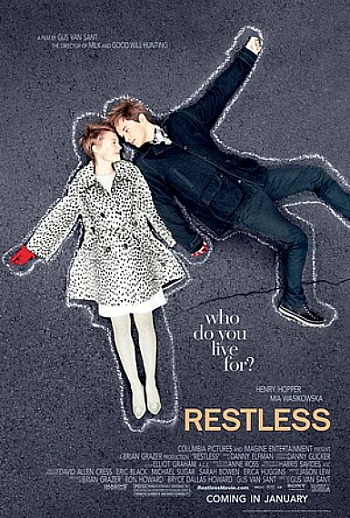
In any event, the Cannes Film Festival guys announced this morning that Gus Van Sant‘s Restless, in which Wasikowska costars with Henry Hopper, will open the Un Certain Regard section on 5.12.

Restless is about a girl with a serious illness (Wasikowska) who becomes friendly with a oddball kid who has an Asian ghost friend. It was originally going to play Sundance2011 and come out in late January, and then it was yanked because of some marketing hunch. It’ll be released by Sony Pictures Classics sometime in the fall.

Give Me A Brake

Rob Cohen‘s The Fast and the Furious (’01) was a moderately satisfying car-chase film with an unusually fine ending — i.e., Paul Walker, an undercover cop, making good on a promise by allowing the felonious Vin Diesel to skip at the end by giving him keys to a muscle car. It was a finale about character, friendship, guy-to-guy values and faith.

And then it was down, down, down into the toilet-bowl remake cycle with a trilogy of Fast films that downplayed character in favor of exhaust pipes, roaring engines and stunt-driving razmatazz — 2 Fast 2 Furious (’03), The Fast and the Furious: Tokyo Drift (’06), Fast & Furious (’09).

And now we’ve got Fast Five (Universal, 4.29), the fifth in the series and the third Fast film directed by Justin Lin, whose last truly decent film, Better Luck Tomorrow, came out nine years ago. The Sundance version, I mean, with the dark-but-honest amoral ending. Lin copped out on that and re-cut it under pressure from Paramount Pictures before Tomorrow was released.

Set in Brazil and using one of those “edge-junkie felons need to pull off an impossible job in order to win their freedom from criminal prosecution” plots (i.e., similar to Diesel’s xXx), Fast Five will almost certainly do the usual-usual and then probably end with DSS agent Dwayne Johnson showing respect and allegiance to Diesel, Walker and their crew.

Key question: To what degree will Jordana Bewster disrobe, if at all? This is a guy film, after all, so it’s not unreasonable of me to ask.

Why is it that the increasingly insane car-chase sequences in all of these films have never quite turned me on the way Peter Yates‘ car-chase-in-San Francisco scene in Bullitt does? I’ll tell you why. Because the driving and shooting in the Bullitt scene looks and feels “real.” Because the Bullitt chase is not some cyborg CG video-game bullshit fantasia. Because it isn’t edited to death and you can hear the shock absorbers collapsing and the chassis aching and groaning when the cars come crashing down on the street, and because on some level the cars look as human and vulnerable as the drivers, and because the metal hubcaps (which no longer exist except on classic old-time muscle cars) go flying off and into the street from time to time. It’s so effing beautiful, that scene.

My favorite car movie after Bullitt is still Dominic Sena and Jerry Bruckheimer‘s Gone in 60 Seconds.

Hand-Drawn

Just for the record, I saw Certified Copy at last year’s Cannes Film Festival and took a couple of hours to review it, and then I took another hour to respond to a putdown written by Glenn Kenny.

Plot Octopus

Take five minutes and read Lea Shafer‘s Amazon.com review of David Mitchell‘s “Cloud Atlas,” which will be co-directed by Andy and Lana Wachowski and Tom Tykwer for Warner Bros, with Tom Hanks playing one of the lead roles.

The book tells six stories about six connected characters in different places and eras, so obviously the Wachowskis and Tykwer are going to divvy them up. Will they go 3 for each or 4 for the Wachowskis and 2 for Tykwer? But consider the entire package and tell me this movie isn’t going to be one fascinating six-legged grizzly bear of a movie.

“‘Cloud Atlas’ has aspects of the dystopian future scenarios that I so loved in The ‘Handmaid’s Tale’, ‘Dune’ and ‘The Sparrow’ coupled with recent past and long-past stories,” Shafer writes. “It addresses basic questions of where we are going as a species, following one soul reincarnated through six lives. That soul is on a trajectory that traces the basic human desire for domination, the often-myopic thinking of the powerful, and the fate of the powerless. It is on a grand scale, beautifully told, and quite enthralling.

“The structure is what had me hooked to start — it is a mirror of itself. Rough breakdown: The first and twelfth chapters are ‘The Pacific Journal of Adam Ewing,’ a story of subterfuge, gullibility, and poison on a ship bound from the South Seas to London.

“Second and tenth chapters are epistolary, taking place in 1939 through the correspondence of Frobisher — a bit of a cad and scammer — to his friend Sixsmith. Frobisher is a brilliant musician but the family shame, in the process of writing his great masterpiece while apprenticing under a syphilitic genius composer.

“Third and ninth chapters follow the efforts of investigative journalist Luisa Rey to uncover serious evil at a soon-to-be opened nuclear facility in the mid-70s. One of her primary sources in the mystery is Sixsmith, Frobisher’s correspondent from the last chapter, but now 35 years older.

“Fourth and eighth chapters are the disturbing and frequently funny tales of Timothy Cavendish, a bumbling, arrogant, failure of a publisher in London during roughly our current times, maybe a little later.

“Fifth and seventh chapter are my favorites — here Mitchell hits the sci-fi, dystopian future part with full gusto. Sonmi-451 is a human clone of sorts, grown in a womb tank (like all ‘fabricants,’ as they are called) and born into service to Papa Song Company. The world as we read about it is governed and shaped around corporate structures and the economy is based on the slave labor of these fabricants.

“This chapter is her testimony about her ascension from fabricant to full human thinking and feeling. She observes the world outside Papa Song restaurant and ventures into the broader culture (a scary place, indeed).

“I don’t do these chapters justice. Sonmi~451 weaves a wonderful tale about this future world, using neologisms and appropriated words that make perfect sense based on how we are using language now. The links and connections to life in the 21st century make it compelling.

“The peak chapter, ‘Sloosha’s Crossin’ an’ Ev’rythin’ After,” describes a fallen world, one that has collapsed in on itself leaving the vast majority of humans in a new Dark Age where violence and predatory actions are the way of those who want to live very long. The strong dominate and destroy the weak. The protagonist, a goat herder, refers to the ‘civ’lized days before the fall when people was ler’nd.’ It’s written in this dialect and he tells a hard-wrought tale of lawless times.

“But it’s all believable. Mitchell never stretches his story in any part of the book beyond what we can imagine. He begins with a tale of dishonesty in the 1800s and spins it into the future, following some of our baser instincts to their logical, if stunning and frightening, conclusion.

“This book is complicated and ambitious–it’s a little over 500 pages of teeny, tiny print and plot lines that crisscross over chapters, lives, and hundreds, maybe thousands, of years.

“The reincarnation theme is only hinted at in the vaguest of terms. It’s not even a central part of the book, but it does weave the narrative thread from character to character. I can’t begin to fathom how many Post-it notes and spreadsheets it took Mitchell to keep track of all this.

“‘Cloud Atlas’ was the most thought-provoking novel I’ve read in years and I found myself meditating on the lives of the characters long after I’d put it down and moved onto something else. [An] extraordinary work.”

Figure It Out

Fact #1: Joe Wright‘s Hanna came in second last weekend behind Hop, but it was the most popular new film with $12.4 million, edging out out third-place Arthur by $200,000.

Fact #2: CinemaScore polling gave Hanna a C-plus (which is a fairly shitty grade as CinemaScore respondents tend to err on the side of politeness and noblesse oblige) and Arthur a B.

Fact #3: Hanna‘s Saturday-to-Sunday earnings dropped 37% for a $3.2 million haul while Arthur fell 46% over the same two-day period, bringing in $2.7 million on Sunday.

How does that work exactly? What kind of Harvard Law School graduate do you have to be to give the obviously high-throttle, high-style and super-confident Hanna a C-plus (or roughly a grade in the mid to high 70s, to go by high-school testing standards) while giving the tepid Arthur a mid-range B (which means about an 87)? And how do those sentiments turn around and result in Hanna earning $500,000 more than Arthur on Sunday?

What is it exactly that people are finding offensive about Hanna? Obviously a significant number of moviegoers have a problem with it. But regarding what?

Snow White in Quotes

I meant to comment about Sunday’s duelling Snow White movie ‘Power Grid” posting by TheWrap‘s Josh Weinstein, but I’m only just getting around to it now. If I was Hollywood’s moral-aesthetic emperor with absolute power and a terrible swift sword with no responsibility to deliver profits, I would shut both of these projects down immediately without the slightest hesitation, and I would order the supporters and financiers of these projects at Universal and Relativity to take two-year nature sabbaticals in Africa or Antarctica, or go to Japan and help with the radioactive clean-up.

Why? Because the idea of not one but two Snow White movies with big stars coming out in 2012 is completely sickening. Because they’re only being made because adaptations of games and comic books and fairy tales (plus sequels) are pretty much the only things that families and under-30s are willing to pay to see on opening weekends, and are therefore the only things being green-lighted by the studios these days. Because they’re the latest metaphors for the all-but-total-collapse of courage and imagination and creative pizazz in Hollywood production circles. Because they’re both going to be movie-movies that will carpet-bomb viewers with over-acting “in quotes” (a la Johnny Depp‘s Mad Hatter in Alice in Wonderland). And, I’m guessing, because they’re going to be made without the slightest trace of emotional sincerity. Air quotes, air quotes, air quotes all the way.