Respectable But Minor

Jean Pierre and Luc Dardenne‘s The Kid With The Bike, which I saw early Saturday evening, is being reflexively praised here and there because (a) it’s a low-key but entirely competent teenaged kid-desperate-for-paternal-support film, but (b) mainly because the Dardennes are highly respected big wheels within the Cannes journalistic community.
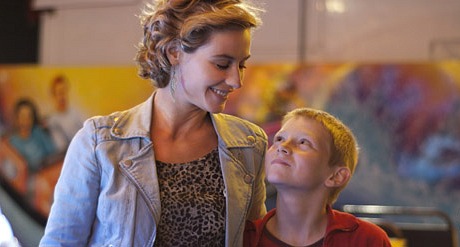
If The Kid With The Bike had been made by an unknown younger director and shown under Un Certain Regard or Semaine des Critiques, positive reviews would result — it’s an honest, well-made film — but it wouldn’t cause much of a stir.

Believe me, The Kid With The Bike is nothing to do mad cartwheels over. Yes, the Dardennes are first-rate scenarists and straight shooters; they know exactly what they’re doing every time. And their film ends well. But Cannes critics are, I feel, kneeling forward and kissing the proverbial ring. There’s nothing wrong with that in a general sense as long as there’s perspective.

Yes, I took an instant dislike to Thomas Doret, the red-haired lead character called Cyrill, when I first saw the trailer. This feeling deepened when I saw the film. I disliked his obstinate-woodpecker personality and the dogged, loon-like tone in his voice. If I ran into a kid like this in real life I would excuse myself fairly quickly, you bet.

Honestly? While the decision of his youngish kitchen-chef dad to abandon Cyrill and go his own way because he has very little money is reprehensible and pathetic, on a certain level I sympathized. Some men are just weak or selfish or naturally un-gifted at parenting (like my own dad), and some kids are just irksome. My heart goes out to any kid dealing with parental neglect and/or abuse, but on the other hand life is hard and sometimes cruel. Some of us are dealt shitty cards, but we have to play them as best we can.

Cyrill, it’s clear, is emotionally damaged and heading for some kind of downward swirl, perhaps into crime or becoming an abuser on his own. So on one level it’s admirable when a kind-hearted, fair-minded hairdresser named Samantha (Cecile de France) agrees to become Cyrill’s weekend care-giver, but on another level it’s a bit…puzzling?

She’s expressing a standard maternal instinct, but I found it curious that a youngish, attractive woman’s life would be so otherwise bereft of passion and commitment that she would leap into this kind of relationship. And I found her willingness to suddenly dump her somewhat selfish-minded, not-especially-bright boyfriend when he says “it’s him or me” too abrupt.

I felt that the whole film was a bit too simplistic and on-the-nose. I went with it, but I also felt that I was being fed a plate of honest but under-cooked contrivances by a couple of talented but (this time around) under-inspired chefs.
Great Creepy Art

There isn’t much time with the Dardennes brothersThe Kid With The Bike starting at 7:30 (i.e., 85 minutes from now) but the absolute best film I’ve seen at the 2011 Cannes Film Festival is a somewhat chilly, jewel-precise study of an Austrian child molester. Markus Schleinzer‘s Michael (pronounced “miKAYel”) isn’t “pleasant” to watch, but it’s briliiant — emotionally suppressed in a correct way that blends with the protagonist, aesthetically disciplined and close to spellbinding.

Because the titular character, a 30something office worker (Michael Fuith) is an absolute fiend and because the film acquaints the audience with the behavior and mentality of a child molester in ways that are up-close uncomfortable, a fair-sized portion of the crowd in the Lumiere theatre was booing when it ended. Those were the chumps in the cheap seats — the moralists. The people who know from film and especially a powerhouse flick when they see one were clapping, of course.

Michael is easily the most gripping and cunning film I’ve seen here. It operates way above and beyond the raw brushstrokes and the imprecise, at times florid manner of Lynne Ramsay‘s over-praised We Need To Talk About Kevin. Don’t even talk about Ramsey’s film at this stage.

The story is basically about how and when Michael’s evil behavior will reach out and take him down. That’s where the story tension is, and why it holds you in its grip. This guy is going to suffer some payback sooner or later. You can sense that early on.

A milquetoast fellow in nearly every respect, Michael has a regular dull office job where he’s liked (from a certain distance) and respected. But in his modest home he keeps a young blonde boy (David Rauchenberger) prisoner in a basement room and uses him on occasion. The film never pushes your face in the ugliness of this crime, but it let’s you know exactly what’s going on. And every person whom Michael knows at the office and those in his grown-up family…nobody knows who and what he is. He’s very careful, of course. Fastidious, cautious.

That’s all I have time to say except that Michael, so far, is it for me — the cream of the crop.


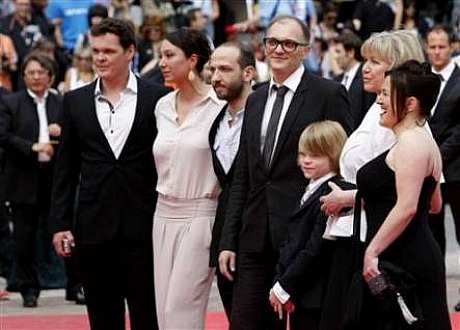
Michael director Markus Schleinzer, center, with cast (l. to. r.) Viktor Tremmel, Ursula Strauss, Michael Fuith, David Rauchenberger, Christine Kain and Gisella Salcher –Saturday, 5.14.11 in Cannes.

Foot Traffic

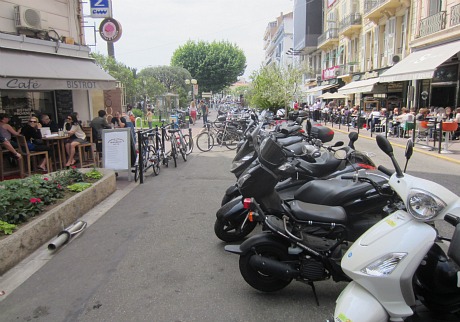
Approaching the Debussy theatre, the second largest within the Grand Palais, along rue Jean de Riouffe. I stumbled over something or someone at the very end. There’s a nice little cafe on this street that I pass by every morning; I’ll sometimes stop in from a quick cappucino before an 8:30 screening.

Noddy

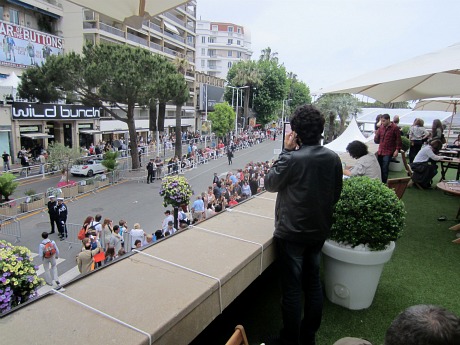
I’ve been feeling completely adjusted to European time, so I was surprised a few minutes ago to find myself suddenly waking from a nap while sitting on the outdoor balcony of the Grand Palais. Okay, I was slumping but more or less in an upright position in a chair with my Macbook Pro and camera in my lap, and my open black tote bag at my feet. (I’m not presuming that any journalist would take advantage but you never know.) It’s a very strange feeling to wake up from a dream in the sunlight, sitting, dressed, surrounded by others…”what?”

Stranger Things Have Happened

I hate frivolity. I despise escapist “fun.” I loathe corporate-supplied nothingness. And I abhor CG movies in which anything can and does happen and no rules apply and people fly through the air like winged squirrels and everything is meaningless eye syrup. I agree somewhat that Rob Marshall‘s Pirates of the Caribbean: On Stranger Tides, which I caught this morning, is a little more like the first one and therefore more tolerable, etc. But I mostly hated the first one, you see.


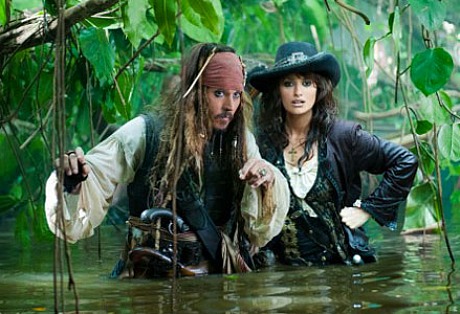
Johnny Depp, Penelope Cruz

So how did I get through the damn thing (i.e., all two hours and 17 minutes ‘ worth)? Through selective concentration on aspects I found appealing.

(1) The incessantly rich, razzle-dazzle composition of the photography. Everything you see in each and every shot has been lit within an inch of its life, finessed to a fare-thee-well, sprayed and misted and gone over with a fine tooth comb. No visual element has been left to chance or under-utilized. The problem, of course, is that it’s all in the service of cancerous swill.

(2) I realized early on that in the realm of fountain-of-youth action-adventures, this inch-deep hodgepodge makes Steven Spielberg‘s Indiana Jones and the Last Crusade look like a masterwork, an art film, a movie with a near-soul, an Alexander Korda 1940s classic.

(3) The verdant and altogether splendorful Hawaiian locations (Kaua’i, Oahu).

(4) Some of the 3D shots are appealing, but mostly the 3D element is just okay. None of it staggers. Honestly? I could’ve rolled with a flat version.

(5) The only 100% sincere performance is given by Sam Claflin, playing a missionary (Sam Claflin). The mermaid he falls in love with (played by Astrid Berges-Frisbey) is pseudo-topless in much of the film, which is to say impressionistically. She’s carefully covered in old-style ’50s fashion, like Maureen O’Hara‘s big scene in Lady Godiva. Why would a Disney film include a topless mermaid in the first place? What’s the point?

(6) I spent a lot of time thinking about all the hundreds of millions that have been pointlessly spent making these films and even more pointlessly earned in theatres worldwide, and about what Johnny Depp and Jerry Bruckheimer made (and will earn back-end) on this one, and what they paid Penelope Cruz and how much Geoffrey Rush pulls down, etc. And what kind of food was served on the set and where everyone stayed when they shot in Hawaii, England and Puerto Rico. What kind of per diems did they receive?

(7) Ian McShane‘s performance as Edward “Blackbeard” teach is an eye-level, steady-as-she-goes, only slightly japey turn. I relaxed somewhat when he was on-screen. McShane seems to actually sink into the role to some degree; he’s goofing along with everyone else, of course, but in a somewhat restrained, steely-McShane sort of way.

(8) The CG evocations of old London are nicely done. I just wish the camera could’ve held still for four or five seconds so I could’ve absorbed a bit more detail.

(9) The absense of Orlando Bloom and Keira Knightley isn’t a problem. At all.