Not To Be

Tonight I finally watched the pilot for Tilda, the might-have-been cable series about a Nikki Finke-like online columnist (very nicely played by Diane Keaton) that HBO declined to pick up last February. Too bad because Hollywood Elsewhere has a brief insert-shot appearance near the beginning when Ellen Page, playing a studio employee who feeds dirt to Keaton, glances at a list of Hollywood websites before settling on Tilda’s The Daily Circus.

You know what’s funny? The “H” logo that sits to the left of Hollywood Elsewhere’s URL in actuality is sitting to the left of the URL for New York‘s “Vulture.”

13 Years Ago

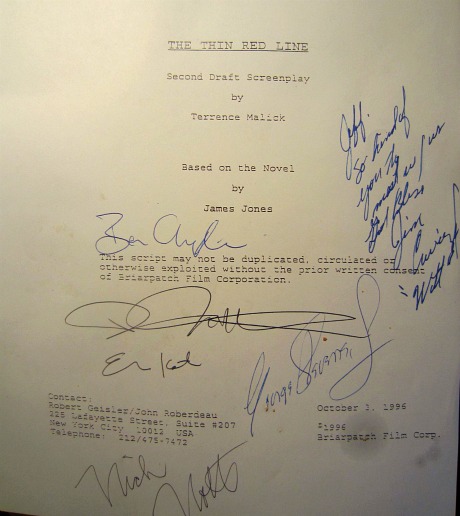
Terrence Malick‘s 10.1.96 draft of The Thin Red Line was tight and true and straight to the point, and it had no alligators sinking into swamps or shots of tree branches or pretty leaves or that South Sea native AWOL section or any of that languid and meditative “why is there such strife in our hearts?” stuff. During the junket round-tables I got Jim Caviezel, George Clooney, Nick Nolte, Elias Koteas, Mike Medavoy and Ben Chaplin to autograph my copy.

Glide Path

Larry Crowne makes no bones about its attempt to tell an upbeat story,” writes Marshall Fine. “Undoubtedly, at a time when unemployment is soaring and lives are collapsing as a result, some may fault it for taking a sour subject – losing a job in a down economy – and turning it into a feel-good story. But Hanks’ script – cowritten with Nia Vardalos of My Big Fat Greek Wedding fame – is about a guy with a positive attitude, with the will and resources to move forward.

“No doubt Larry Crowne will be criticized for all of the things it doesn’t do. It doesn’t address the economic tragedy that Larry’s situation means for so many people. It doesn’t build to a life-and-death climax. It is, instead, a stealth comedy, low-key but consistently satisfying, a movie that focuses on the power of positivity without getting melodramatic about it.”

Thief

This is an amazing video. It was posted five or six days ago, and I’ve watched it four times today. It isn’t simulated. A seagull really did scoop up a tiny lightweight video camera and fly away with it. It happened in Cannes. (Initially posted by Awards Daily‘s Ryan Adams on 6.27.)

Cowflop and Gag-All

“Chicago is the great American city. New York is one of the capitals of the world and Los Angeles is a constellation of plastic, San Francisco is a lady, Boston has become Urban Renewal, Philadelphia and Baltimore and Washington wink like dull diamonds in the smog of Eastern Megalopolis, and New Orleans is unremarkable past the French Quarter. Detroit is a one-trade town, Pittsburgh has lost its golden triangle, St. Louis has become the golden arch of the corporation, and nights in Kansas City close early. The oil depletion allowance makes Houston and Dallas naught but checkerboards for this sort of game. But Chicago is a great American city. Perhaps it is the last of the great American cities.” — from “Miami and the Siege of Chicago: An Informal History of the Republican and Democratic Conventions of 1968” by Norman Mailer.

I’m trying to find online the entire opening passage of the Chicago section of Mailer’s book. I don’t mind buying the book again but I’d like to re-read right now the section in which he describes in great detail the killing of steers in the Chicago stockyards and how the aroma from this slaughter used to rise up and make its way up into the city and to some extent affect the town’s psychology. Or something like that. It was out of date when he wrote it (more reflective of the way things were done in the ’50s and before than in 1968) but it’s still lovely writing, and I was looking to read it once again. Alas…

Grand-Slam Blitzkrieg

No question about it: the 45-minute Chicago finale of Transformers 3: Dark of the Moon (Paramount, now playing) is absolutely jump-off-a-skyscraper insane. It’s astonishing, exhilarating, relentless, pulverizing…and yes, finally exhausting. Even if you’re a confirmed Michael Bay hater you have to give the guy credit for shooting this stunningly energized and visually giddy CG symphony of madness out of a shotgun and right through your 3D glasses. And none of it amounts to anything more than motion and chaos and fury designed entirely to sell tickets.

I didn’t even see the extra-bright Platinum version (which I’m going to try and see later today) and my mouth was hanging open. I’ve never seen a battle scene that went on this long and with this level of sustained blow-it-to-pieces energy, and in 3D yet…it’s furious, crazybeautiful and a little diseased. And stupefyingly superficial. No thought whatsoever has been put into this film other than Bay saying to his crew, “Push it, faster, crazier …c’mon!” He’s delivering levels of destruction to downtown Chicago that are like 100 9/11 attacks rolled into one. (His cameras naturally ignore the hundreds if not thousands of civilian deaths that would inevitably result from this level of mayhem.) Either way the Chicago finale is one for the books and surely worth the price in itself.

What does the sequence mean? Nothing. It means that Bay had the money to shoot it. What does it tell us about ourselves? That we’re a shallow culture that enjoys seeing shit destroyed and blown up and shattered and splattered all to hell. What emotions does it arouse? None, unless you consider Magic Mountain-level excitement to be an emotion.

That said, some observations and complaints:

(a) The 155-minute Transformers 3 is basically two movies — 100 to 110 minutes of set-up, dialogue, character conflict, action-fortified exposition and blah-dee-blah, much of which is too busy or emphatic and in any case plowed right through me (or around me or over-my-head or whatever) without sticking to my brain or my ribs, and then the 45-minute Chicago payoff. I didn’t care about the first 110 minutes. The movie should have been shorter. 60 or 70 minutes to cover Part One plus Chicago, which would be 105 to 115 minutes, tops.

(b) The dialogue for the various Autobots and Decepticons has always been dreadful; ditto the voice-acting of this. The movie stops dead with every line these guys say to humans and to each other.

(c) John Turturro gives the best supporting performance. That is to say, he seems to be genuinely enjoying himself as opposed to just collecting a paycheck.

(d) Rosie Huntington-Whiteley (i.e., Megan Fox‘s replacement) is relatively okay, but she wears tall heels all through the film. Running like hell and climbing and falling down the side of a teetering glass building and scrambling for dear life over rock and rubble…in heels! Bay production assistant: “Michael, I know you like actresses to wear heels but c’mon, this is absurd, man…having Rosie wear heels through all this actionis like making her wear a formal gown with a diamond tiara. Why not make her wear a bikini while you’re at it?” Bay: “You wanna get fired? I like her in heels, she’s an incredibly hot ass-babe and she’s not wearing footwear that doesn’t look hot…end of discussion.”

(e) On top of which Huntington-Whiteley towers over Shia LaBeouf with her big heels on, and that…oh, that’s right, I’m not supposed to say that women standing taller than their boyfriends doesn’t work as well as being the same height or being slightly shorter.


Ford on LaBeouf: "Effing Idiot"

Harrison Ford has allegedly told a Details inteviewer that Shia LaBeouf was a “fucking idiot” for publicly criticizing Indiana Jones And The Kingdom Of The Crystal Skull in a May 2010 interview with L.A. Times writer Steven Zeitchik.

Nope, wrong. LaBeouf was being refreshingly honest about what everyone and his cousin believes was probably the worst of the Indiana Jones films, and he waited two years to say what he thought so what’s the problem?

Ford has a bit of an old-school attitude about this stuff, but let’s clarify that he hasn’t called LaBeouf an overall walking-around idiot. He’s saying — incorrectly and unfairly, I feel — that LaBeouf acted like one when he shared his true feelings about Crystal Skull. Most of us would agree that trashing the film during the promotional lead-up to the opening would have been stupid on LaBeouf’s part. But he spoke to Zeitchik two years after the film opened in May 2008 so who cares?

Power of Persuasion

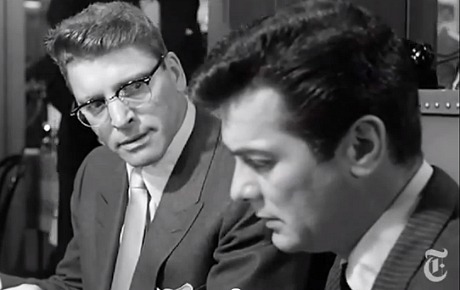
Two minor corrections for A.O. Scott‘s “Critics’ Pickscommentary about the 1957 classic Sweet Smell of Success: (a) Scott adds a nonexistent “The” to the title; and (b) Clifford Odets‘ screenplay is not “based on a novel by Ernest Lehman” but a Lehman novella called “Tell Me About It Tomorrow,” which originally appeared as a 1950 short story in Cosmopolitan magazine.

If the novella was ever sold in perfect-bound book form it’s not purchasable or even referenced online. Newark Star-Ledger critic Stephen J. Whitty informs, however, that it was published “as a Signet tie-in paperback in June of ’57 with a collage of photos on the front and back cover and an 8-page movie-still insert. It was called ‘Sweet Smell of Success and Other Stories’ by Ernest Lehman, which sold for thirty-five cents. I found mine for a couple of bucks years ago at a used bookstore.”

For my money the best account of the making of this classic film appeared in an April 2000 Vanity Fair article written by Sam Kashner. It was later included in Graydon Carter‘s “Vanity Fair‘s Tales of Hollywood: Rebels, Reds, and Graduates and the Wild Stories Behind the Making of 13 Iconic Films” (Penguin), which came out in ’08.

I love Scott’s description of Martin Milner‘s Steve Dallas character as “perhaps the whitest and squarest jazz musician in the history of cinema.”

The Times tech team continue to irk and infuriate. They refuse to play ball like everyone else in two ways. One, they don’t allow you to embed the code of this particular “Critics Picks” selection on YouTube, and two, the embed code for their own Times page version is constructed with all kinds of needless white acreage and copy below the video image. Please allow the image to be posted as a stand-alone rectangle without any of the doo-dads.