Driven To Tears

Comedies aren’t funny unless they contain at least some of the respect for genuine human experience that dramas do. Sorry to be a scold, but comedy writers need to represent the way it actually is out there. If they don’t do that and just make up exaggerated farcical crap, intelligent audiences can’t and won’t recognize anything they’ve written as life-like, and therefore won’t laugh.
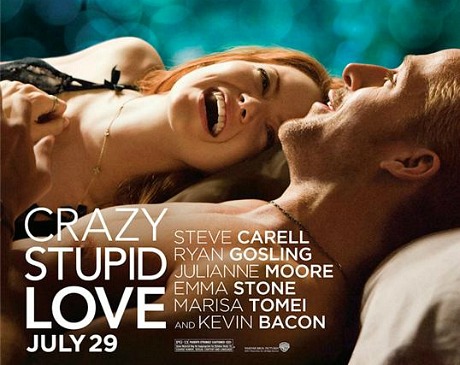
A failure to do this on the part of top-dollar cyborg-screenwriter Dan Fogelman is the main reason why Glenn Ficarra and John Fuqua‘s Crazy, Stupid, Love (Warner Bros., 7.29) is one of the most revoltingly phony, profoundly sickening “romantic comedies” I’ve ever seen.

I hated Crazy with a passion because it has no respect for real-world human behavior. Nothing about it feels the least bit true or reflective of modern life as most of us (with the exception of certain filmmakers) know it. Wafer-thin characters, ludicrous sitcom plotting, outrageous fakery of all kinds, absurd over-emoting, ghastly dialogue, etc. What were Ficarra and Fuqua and Fogelman trying to do? Establish a new high-water mark in synthetic “humor”? I was okay with Ryan Gosling‘s performance as far as it went (he plays a super-slick, somewhat robotic pickup artist) but otherwise I didn’t believe a single word, bit, moment or emotion in this film. Nothing.

How can a flagrantly square, middle-class, big-studio comedy misrepresent straight life (middle-aged marriages, single women, teenagers, the mentality and patter of hounds, the behavior of attorneys) this badly? Crazy is so off-the-charts fakey-crazy that it’s breathtaking. It was so bad that I cried. Any episode of Curb Your EnthusiasmLarry David‘s landmark-level, wonderfully acidic comedy series — is Eugene O’Neil compared to this.

I was initially intrigued when I read Peter Debruge‘s recent rave of Crazy, Stupid, Love in Variety. But right after I posted it I heard from a critic friend who called it “phony fucking bullshit of the highest order, an utter wad of falsehood shot through with behavior no human being would actually engage in.” How could two indisputably bright fellows disagree so strongly?

I figured it out pretty quickly once Crazy, Stupid, Love began playing earlier this evening. Debruge, I realized, has a very, very different sensibility than mine. That’s a polite way of putting it, I think. Ditto David Edelstein, Pete Hammond, Caryn James, Mary F. Pols, Emmanuel Levy and all the rest of the Rotten Tomatoes supporters.

Crazy, Stupid, Love is about a middle-aged couple (Steve Carell, Julianne Moore) breaking up due to Moore wanting a divorce, and then both of them trying things out as singles, and…you know the rest. Carrell pals up with Gosling-the-ladykiller at this one effing bar (which they keep returning to over and over and over and over). Gosling mentors the insecure, dipshitty, relentlessly dull Carell on the art of seducing women, etc. New wardrobe, new haircut, pickup lines, blah blah blah blah blah.
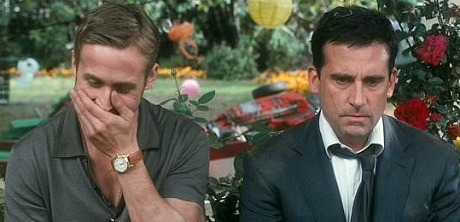

Ryan Gosling, Steve Carell.

Eventually Carrell gets pretty good at it, but of course, being one of those guys who needs his soul-mate (one of the most loathsome, hoodwinky terms in the English language), he can’t settle into singlehood and neither can Moore and yaddah-yaddah, etc.

I’m taking this opportunity right now to say screw the concept of soul-mates in movies. Good for you if you’ve found one in real life but movies about them are utterly dreadful to sit through.

Emma Stone plays Hannah, a young attorney whose connection to Carell-Moore seems nonexistent at first. She gets hit on by Gosling and turns him down, and then realizes that a law-firm hotshot she’s in love with doesn’t feel the same way about her, which prompts Stone to all-but-destroy her professional prospects at this firm (brilliant!), and then leads her to return Gosling’s advances, etc.

You don’t care. I didn’t care. Only Anne Thompson (whom I spoke to in the Arclight lobby after it was over) and people from her aesthetic corner of the woods care. “What romantic movies do you like?,” I was asked. “The Year of Living Dangerously,” I replied. “Notorious. The Visitor. Witness.”

There’s also Carell’s 13 year-old kid (Jonah Bobo) and the babysitter he’s in love with (Analeigh Tipton), and the acutely uncomfortable fact that Tipton has the hots for Carrell.

The way Moore tells Carell that she wants a divorce in scene #1 is forced and phony. A scene in which Carell’s pal (John Carroll Lynch) tells him they have to break up because his wife told him they have to choose between being friends with either Moore or Carell but not both is truly sickening. A scene in which Marisa Tomei, a schoolteacher who happens to have been Carell’s first post-marital conquest, totally risks her job and professional reputation during a parent-teacher meeting is completely ridiculous, unfunny and also sickening. A scene in which Bobo tells Tipton that he’ll resemble his father when he gets older is bullshit as he’s clearly no spawn of Carell or Moore — he looks like the son of a Lithuanian coal miner. I could go on and on and on.

Nearly every scene in this film blows in one way or another. A scene of intimacy between Gosling and Stone is one of the few that work. That’s the most supportive thing I can say.

By all means join the simpleton party this weekend and pay to see Crazy, Stupid, Love and have a good time chuckling. I’m presuming it’s going to make a fair amount of money. Let’s see what develops. But understand this above all: Crazy Stupid Love is a burn.
Felson's Law

Some people have been making cheap cracks about my “air and ether” remark earlier today about being able to read delicate radio signals and atmospheric data about where actors and filmmakers are coming from and what they’re facing and thinking and sorting through with their partners and agents. “It’s in the air, in the ether,” I wrote. “You just have to know how to feel or read it.”

I meant that when you’ve gathered enough experience and learned how to fine-tune your insect antennae and olfactory glands and you can’t write a column like this while running around with a note pad like Clark Kent, then you just have to trust what you’ve learned and absorbed and divined. It would be better, agreed, to do the Clark Kent plus the air-and-ether thing, but the latter works on its own. All you have to do is turn on the dish and just start processing and translating.

I’m not taking about the same thing that Paul Newman spoke of when he delivered his big speech in The Hustler (1961), but there are similarities. Because I honestly believe that I’ve reached a certain Eddie Felson-like proficiency in this racket or realm or whatever-you-want-to-call-it.

“If a guy knows….if he knows what he’s doing and why [then] he can make it come off,” Newman/Felson said 50 years ago. “When I’m goin’, I mean, when I’m really goin’ I feel like a…like a jockey must feel. He’s sittin’ on his horse, he’s got all that speed and that power underneath him…he’s comin’ into the stretch, the pressure’s on him, and he knows…he just feels when to let it go and how much. Cause he’s got everything workin’ for him. Timing, touch. It’s a great feeling, boy, it’s a real great feeling when you’re right and you know you’re right. You don’t have to look, you just know.”

Or as Lawrence Tierney‘s Joe Cabot said after fingering Mr. Orange in Reservoir Dogs, “You don’t need proof when you’ve got instinct.”

Don't Talk Much

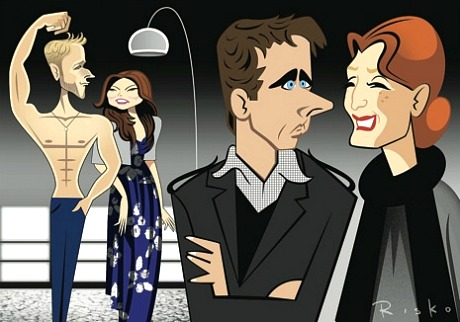
New Yorker critic David Denby sharply disagrees with Peter Debruge‘s recent Variety rave of Crazy Stupid Love, which has its all-media screening tonight at the Arclight. I’m telling you right now tonight may be a defining moment for Debruge. If I decide he’s a little too far off the mark on this film, his trustworthiness will have to be reconsidered.


Illustration by The New Yorker‘s Robert Risko.

Denby’s main beef is that it doesn’t seem to matter that much if Steve Carrell‘s Cal and Julianne Moore‘s Emily decide to cancel their planned divorce or not. Denby then makes a good point about how couples who seem to well-matched tend to speak to each other.

“In the remarriage classics (The Awful Truth, The Philadelphia Story, His Girl Friday), the former partners have a way of talking and being with each other that they don’t have — and couldn’t possibly have — with anyone else. That sophisticated metaphor for sexual compatibility made for uniquely satisfying romantic comedy.” But Cal and Emily “met when they were in high school,” he notes, “and, apart from reminiscing about that time, they don’t have much to say to each other.

Crazy, Stupid, Love regrettably “holds to the boring modern convention that good people are inarticulate, and Cal and Emily mainly stumble around trying to fill the silence.

“Moore may be too earnest an actress for rigidly structured commercial comedy. She tries to find some hard truths in the role, and she makes Emily angry, vague, and even a little dim. The character is parched and not very likable.

Carrell “always conveys the sense that he’s a rational man trying to keep his integrity,” and he “seems more comfortable acting with Ryan Gosling than with Moore. Cal has his mishaps and his successes, but the filmmakers believe in soul mates forever, and that kind of thing, and the audience may not want to think about the aftermath of the movie, in which Cal and Emily discuss, again and again, that magical year they met in high school.”

Venice Roster

Remember my 7.16 story about Ami Canaan Mann‘s Texas Killing Fields, an Anchor Bay crime drama that has no website or trailer and is looking “a little wobbly? Well, Variety‘s Nick Vivarelli is reporting that it’ll play in competition at the 2011 Venice Film Festival (8.31 through 9.10), which means it’ll also probably play Toronto.

From low-rent Anchor Bay limbo to Venice Lido lah-lah — that’s a pretty good rebound. Congrats to producer Michael Mann or whomever arranged this one.

The official Venice Film Festival lineup will be unveiled Thursday, but Vivarelli says

the following are apparently locked: William Friedkin‘s Killer Joe, Abel Ferrara‘s Last Day on Earth, Tomas Alfredson‘s Tinker, Tailor, Soldier, Spy, Andrea Arnold‘s Wuthering Heights, Steve McQueen‘s Shame, Roman Polanski‘s Carnage, Philippe Garrel‘s A Burning Hot Summer (a remake of sorts of Jean-Luc Godard‘s Contempt), Chantal Akerman‘s La folie Almayer, Yorgos LanthimosAlps, Eran Kolirin‘s The Exchange, Jonathan Demme‘s I’m Carolyn Parker: The Good, the Mad and the Beautiful, James Franco‘s Sal (another one of Franco’s gay films), George Clooney‘s The Ides of March, David Cronenberg‘s A Dangerous Method, Todd Solondz‘s Dark Horse, Steven Soderbergh‘s Contagion, Mary Harron‘s The Moth Diaries and Madonna‘s W.E.

Die Young, Avoid Complications

The gist of Scott Feinberg‘s 7.25 piece (“The Art of Dying Young‘) about the death of Amy Winehouse is that it’s not such a terrible thing to check out early if your legend is going downhill anyway. Biological shutdowns will always be traumatic to friends, fans and loved ones, but it’s arguably worse, Feinberg is saying, to hang on past your peak point.

But how do you know when you’ve peaked? Answer: Nobody ever does. Everyone goes through life saying, “I’ll find a way to turn things around…after all, tomorrow is another day.”

“Most [performing survivors] overstay their welcome,” says Feinberg, “and simply begin to evaporate from the public’s consciousness, either because they find themselves (a) unable to maintain the performance-level that first garnered them fame, (b) creatively limited by the public’s limited perception of them, (c) distracted and/or deterred by fame and its trappings, (d) no longer able or willing to compete with ‘fresher’ faces.”

Truman Capote certainly fell prey to (c). I remember to this day what Gore Vidal said when Capote committed suicide: “A very wise career move.”

If I could re-orchestrate my life from a free-for-all cosmic perspective, I’d like to live about 250 years but get no older than, say, 42 years. I’d arrange to be born in 1800 .with my 2011 consciousness intact, and then explore the unsullied American frontier and become an inventor and buy up all the patents for everything and become stinking rich. And then tour the world and become friends with everyone worth knowing — young Abe Lincoln, Leo Tolstoy, Chief Sitting Bull, Herman Melville, young Katherine Hepburn, Frederick C. Douglas, Karl Marx, Charles Dickens, Douglas Fairbanks, Sr., Isodora Duncan, D.W. Griffith, Theodore Roosevelt. Jack Reed, Jack London, young Cary Grant, young JFK, young John Lennon, etc. And then wind things down around 2050, give or take.

El Guard-o

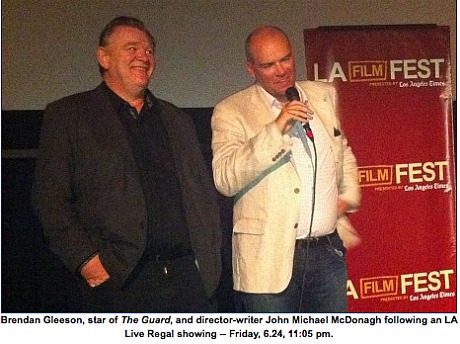
During the L.A. Film Festival I spoke to John Michael McDonagh, the witty and easy-rolling director-writer of The Guard (Sony Classics, 7.29). And now I can’t find the effing transcript. But you don’t actually need to speak with McDonagh (although he’s pleasure to chat with and I’d love to raise a glass with him some day) because The Guard says it all.

McDonagh (the brother of playwright and In Bruges screenwriter Martin McDonagh) is operating here in a sort of Quentin Tarantino-ish realm. The difference is mainly one of regional idioms. Tarantino is a dispenser of American criminal-class attitude, and McDonagh is a master of Irish ramble-on digression.

Set in County Galway, The Guard is nominally about a charmingly corrupt small-town cop (Brendan Gleeson) and an American FBI agent (Don Cheadle) becoming unlikely allies on a case involving a dead constable and a team of drug-runners (Mark Strong, Liam Cunningham, Rory Keenan).

But it’s really about the art of inspired chit-chat and hardly ever sticking to the point. It’s basically a movie that says “Look, we have to do this sort-of cops and bad guys thing because you need a story of some kind, right? But let’s mainly have a little fun with some spitballs and in-betweeners and side-pocket shots. Because that’s where the elevation is.”

It’s a bit early to calling Best Actor shots, but Gleeson’s performance as Sergeant Gerry Boyle ought to be lock for one. It’s the best role of his career, hands down.

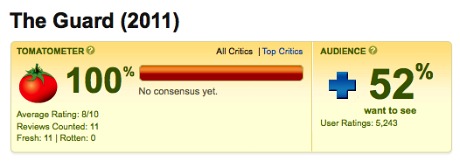
It really should mean something to the online movie community when a film has a 100% Rotten Tomatoes rating, as The Guard does now. Very, very few films achieve that number.

What will this mean box-office-wise? Perhaps not much because Walmart crowd doesn’t read reviews and probably feels a little funny about paying to see a movie about an whimsical Irish fat guy and a deadly earnest, somewhat testy-mannered FBI guy. The determinations of the Walmart crowd can be breathtaking at times. They’ll face a firing squad before paying to see one of the most entertaining films of the year, hands down.

Last month I wrote that “when the kids were toddlers they’d call a film like The Guard ‘a talking movie.’ People sitting indoors and playing verbal ping-pong, etc. But what talk! What delicious Irish ping-pong!

The Guard is a loose-shoe, Guiness-slurping thing that’s simultaneously digressive and twinkle-eyed, and one of the best ‘cops and bad guys batting the ball around’ movies in ages. I don’t know if this indie Irish production will be eligible for a Best Original Screenplay Oscar, but it ought to be. It’s all dessert.

“I had a little bit of trouble hearing all the dialogue when I first saw The Guard at Sony Studios (Jimmy Stewart, room #24). Irish-speak has a certain gliding, looping, burry sound that can you can lose the ear for if you’re not careful. It’s a little like Shakespeare — once you find it you can hear it, but you can fall off the track if you’re not careful. In any event I heard every syllable during [an LAFF] screening at the LA LIVE Regal. I think it was because the sound sounded a bit sharper and cleaner.”

Fear of Cliff-Jumping

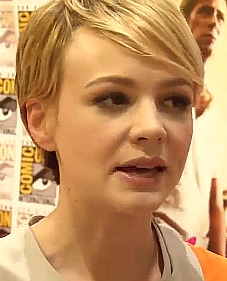
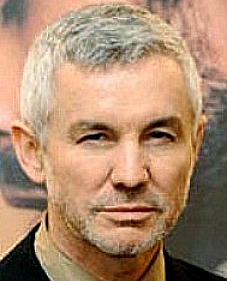
In Contention‘s Guy Lodge has taken issue with yesterday’s riff about Baz Luhrmann‘s forthcoming 3D version of The Great Gatsby, which alluded to one or two concerns about what Luhrmann might do to F. Scott Fitzgerald‘s classic novel, and how costar Carey Mulligan, as I put it, is probably “too diplomatic to voice fears along these lines.”


(l.) Carey Mulligan during a video interview last weekend at ComicCon; (r.) Great Gatsby director Baz Luhrmann.

“I love how you’ve completely fabricated this certainty that Carey Mulligan is secretly on your side in all of this,” Lodge wrote. “If she had such misgivings, would she really have committed to the project?”

Here’s how I responded this morning in the comment thread:

Wells to Lodge: If you’re a gifted, A-list actress and you’ve been offered a shot at working with an impassioned brand-name director (i.e., one who isn’t necessarily on his aesthetic game the way he was 10 or 15 or 20 years ago but who’s still cooking with gas and full of beans) on an ambitious and/or nervy sort of project based on a greatly admired book by one of the great names of 20th Century literature, you may well decide that you owe it to yourself to take a risk and jump off the cliff and see what happens, etc.

“An artist who can’t think or act boldly or perhaps even recklessly from time to time isn’t an artist. Mulligan is obviously not stupid. If she’s seen Australia she knows what could possibly happen here. But she doesn’t want to play it timidly and safely. ‘Art isn’t easy’ plus she’s in the company of Leonardo DiCaprio and Tobey Maguire and Isla Ischer, etc. She’s figuring even if it’s a fiasco nobody will blame her for doing everything she can to breathe fresh life into Daisy Buchanan.

“Plus it’s…I was going to say it’s a great part but Mia Farrow‘s performance as Daisy Buchanan in Jack Clayton‘s 1974 film was so irksome that I wrote her off for years after that. But it’s certainly a part that allows for a performance by Mulligan that could work out nicely in this or that respect. At least theoretically.

“Honestly? I don’t know that I want to see Mulligan playing a flamboyantly unstable Zelda Fitzgerald-type airhead. I love C.M. for her class and sass and the aesthetic focus that led her to do that Manhattan stage adaptation of Through A Glass Darkly (and okay, her sexiness), but as Daisy she’ll have to suppress a good deal of what she seems to be basically about.

“I wrote that she’s ‘too diplomatic to voice fears along these lines’ because YOU AND I KNOW, GUY, that despite whatever particular enthusiasm she’s feeling about the role and this film that she’s almost certainly nursing fears about the whole thing going wrong in some horrifically miscalculated way (as Australia did).

“What if Luhrmann had managed to shoot his own Alexander the Great movie as a competitor to Oliver Stone‘s version? Can you imagine what that might have been? In terms of the potential excess, I mean? The mind cartwheels.

“I mean, c’mon, a Great Gatsby movie in 3D…? To what possible end?

“The idea of transforming the Capulets and Montagues into warring, swaggering, gun-toting gangsta clans in flashy urban threads and driving around in hot cars …that was cool. But you know that no good can come of doing Gatsby in 3D unless Baz just shoots it plain and simple and straight in a Masterpiece Theatre way (which you KNOW he’s incapable of doing), in which case the 3D would just ‘be there,’ so to speak — it wouldn’t stand in the way or block the path or vulgarize whatever remnant of Fitzgerald’s novel that might still work in this day and age. If Baz cooled his jets and just shot it in 3D (which, again, WILL NOT HAPPEN) the technology might not muck things up in any sort of coarse or obnoxious way. It would just ‘be in 3-D’…which might be okay.

“But you KNOW Baz can’t leave well enough alone, and that’s why Mulligan is almost certainly scared. She’s a brave enough artist to go for it regardless and who among us doesn’t respect her for that? But don’t tell me she hasn’t awoken at 4:30 in the morning once or twice since signing to do this thing & asked herself, ‘My God, what have I done?’ I’m not saying she’s ‘on my side’, but she’s a highly alert and perceptive artist of the first order, and she knows or has sensed or at least considered everything I’ve written here….c’mon.

“Fear is a natural component of creativity. And the right kind of fear feeds the fire.”

Earthy, Fragrant, Calming

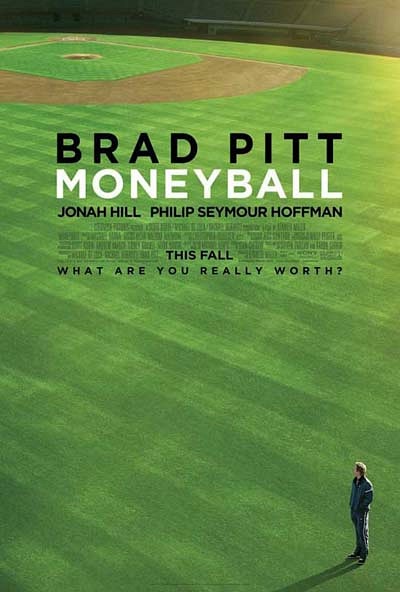
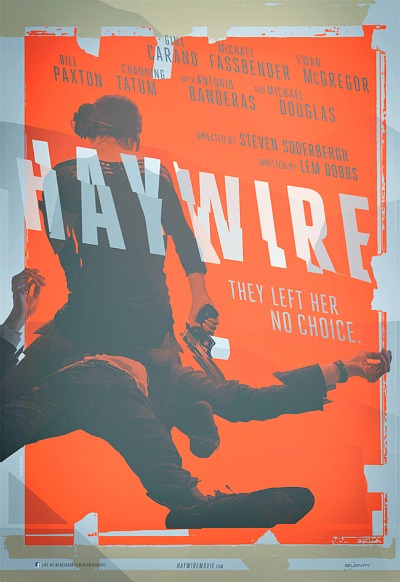
God, the green is such a relief after staring at that horrible orange Haywire poster for the last three hours! It’s like a nice misty rainshower on my eyeballs. Why don’t they just say “September” instead of “Fall”? Bennett Miller‘s biz-minded baseball drama opens on 9.23. Why be opaque about it?

I love the smell of moist earth and grass when I sit along (or close to) the first or third-base line in a major-league stadium.

Scrap This

I’ve explained two or three times that orange is a bad color to use in ads, movie posters and/or DVD/Bluray covers. I mentioned this in a recent riff about a British Touch of Evil Bluray. And I wrote last August that “any emphatic use of orange feels a bit oppressive” because “it’s a safety color when you’re hunting or working construction or standing on a busy traffic road in the evening, but it’s also a control color — a symbol used to enforce rules and segregate prisoners and make people stay within boundaries.”

Orange doesn’t say “life can occasionally be beautiful or transporting.” It says “do this,” “watch out,” “don’t go there,” “slow down,” etc.

Bazzed-Up Gatsby

I for one am tremulous with concern about what Baz Luhrman is going to do with (and to) F. Scott Fitzgerald‘s The Great Gatsby when he begins shooting it in 3D later this year. Carey Mulligan is too diplomatic to voice fears along these lines, but she surely knows that Baz would sooner slit his throat than simply “film the book”.

My guess is that Luhrman’s conjuring of 1920s Long Island will be as authentic as his recreation of “belle epoque” Paris in Moulin Rouge, or maybe Zack Snyder‘s ancient Greece in 300.

The upside is that no matter how eccentric Luhrman’s version turns out to be, it’ll have more of a pulse than Jack Clayton’s 1974 version, widely regarded as one of the stiffest adaptations in Hollywood history. The downside is that Baz has been indulging his exuberant instincts more and more as he grows older. The Baz who made Strictly Ballroom or Romeo + Juliet, even, has pretty much disappeared.

The lineup, once more, will be Mulligan as Daisy Buchanan, Leonardo DiCaprio as Jay Gatsby, Tobey Maguire as Nick Carraway; Joel Edgerton as Tom Buchanan, Isla Fisher as Myrtle Wilson; and Elizabeth Debicki as Jordan Baker.

Pink Ladies

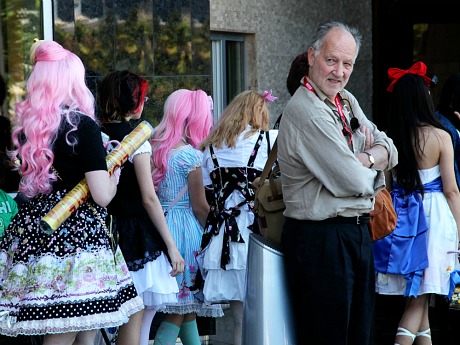
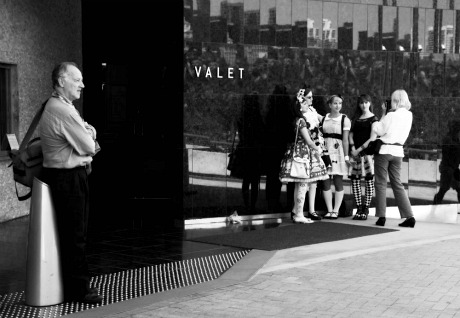
Yesterday evening N.Y. Times reporter Michael Cieply wrote about catching up with Werner Herzog, of all people, at ComicCon. The legendary 68 year-old filmmaker “was absorbing the Breughel-like atmospherics” while taking a break from a death-row documentary that he’s making with Erik Nelson.


Photo by Awards Daily‘s Sasha Stone.

Also taken by Ms. Stone.

Worse Than Most Cancers

For my money, CNN’s Dr. Drew Pinsky has delivered the likeliest explanation of why Amy Winehouse is dead. “Opiate addiction takes months to years of treatment,” he explained yesterday. “And one of the most serous risks in my experience of that recovery for celebrities and particularly musicians is that they return to their career, they return to the road far too prematurely, and it’s absolutely predictable what will happen.

“People look at these stories and go, ‘Oh, addiction treatment doesn’t work.’ The crazy thing about addiction is that part of the disease is a disturbance of thinking [in which] addict tell themselves they don’t need to listen to what they’re being told to do.

“But just as with the diabetic, if they don’t take their insulin [and] the addict doesn’t do their recovery program, they inevitably in all cases will relapse, and if it’s opiate addiction, it’s a progrssion to fatality. The prognosis for an opiate addict is worse than the vast majority of cancers.”