Sword and Sandal


The formidable Toby Wyler, great-grandson of Ben-Hur director William Wyler, during this morning’s pre-Ben-Hur screening breakfast across the street from Alice Tully Hall. The sword he had in his sheath had dull edges, but was made of serious metal.

Wyler on-set with kids during making of BenHur some 53 years ago. Yes, same outfit.

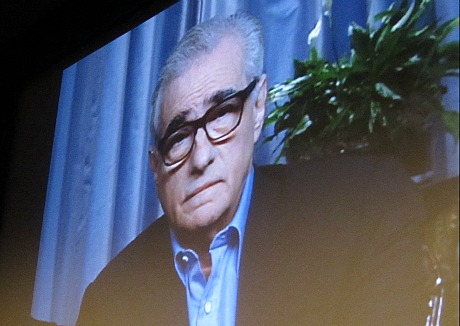
Currently London-based Martin Scorsese during Skype interview following today’s screening of George Harrison: Living in the Material World. (I captured two video clips of this event; being converted and uploaded.

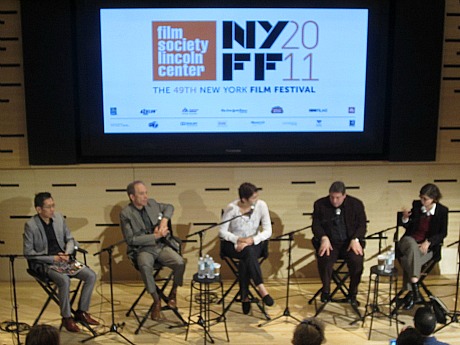
A New York Film festival panel that occured earlier today. Moderated by Indiewire’s Dana Harris.

Time of Life

“The man who gives Moneyball its soul as well as, at times, its drive and exuberant energy is Brad Pitt, which surprises me, since I had written him off as a good-looking guy without much temperament,” writes New Yorker critic David Denby in his 10.3 review of Moneyball.

“Pitt was fun in such films as Snatch, in which, playing an Irish bare-knuckle boxer, he throws himself around the set and speaks in a brogue thicker than the head on a pint of Guinness, and he was exciting as the unpredictable, mock-fascist underground leader in Fight Club. But when he stopped moving and the camera bore in on him (in Meet Joe Black, for instance) his eyes were empty. He couldn’t convey thinking, which is not a sign of stupidity, just a failure of technique.

“But recently something has been happening inside Pitt. In Babel he showed hints of fire and a fallible rage. And in Terrence Malick’s Tree of Life, in which he plays a father who takes out his disappointments on his sons, his anger is self-wounding and tragic. It’s a performance that deserves an Academy Award.

In Moneyball, Pitt has the air of a former athlete who never quite grew up. His round-cheeked face, like Mickey Mantle‘s, has the congealed look of a picture on a baseball card. A restless man, Pitt’s Beane abruptly overturns anyone who disagrees or can’t keep up with him. Swapping players with other general managers on the telephone, Pitt is almost as quick as Cary Grant‘s manic newspaper editor in His Girl Friday.”

50/50 Reactions?

Is there general agreement with my view that Jonathan Levine‘s 50/50 is an affecting, honestly configured drama ribbed or seasoned with occasional Rogen laughs (which you really need to call “yuks”) but is hardly a comedy, or do some feel that the term “comedy” actually, literally applies? What did the room feel like as it played? How old did the audience seem to be?

Magazines for Umbrellas

Last night’s New York Film Festival opener for Roman Polanski‘s Carnage went nicely, I thought. But it began raining fairly hard before the film began at 9 pm and was still coming down when the film ended just shy of 10:40 pm. There were no cabs in the rain, of course, so everyone took the IRT down to Times Square then walked four blocks over to the Harvard Club — slightly crouching, no umbrellas, somewhat exasperated expressions. My back felt as if someone had poured a glass of water onto my sport jacket. The party was great. The bull elephant head on the wall (the one allegedly shot by Teddy Roosevelt) looked green, for some reason.

Holding Action

Last night’s numbers (as reported by Deadline‘s Nikki Finke) had Moneyball in the #1 slot on its second weekend with a projected $12 million by Sunday night and a grand cume of $38 million. These days a 45% drop is considered a reasonably good second-weekend hold, but a mid 30% decline would have been more to my liking.

Dolphin Tale, which nobody in my sphere cares about, might wind up on top with an estimated $13 million…maybe. Courageous is being projected to come in third…blah.

If 50/50, which did $3.5 million last night, ends up with $9.5 million in 2458 situations, the per-screen average will be $3864. So by no means is it tanking, but audiences are being a little standoffish.

Nobody cares about Lion King 3D being expected to rake in $12 million by Sunday night with an estimated grand cume of $80.6 million. I mean, people “care” in the sense that they can’t ignore the huge success of this re-issue, but…fine, whatever, later.

Jim Sheridan‘s debuting Dream House, which wasn’t press-screened, did $2.7 million last night for an estimated weekend haul of $7.5 million. If that number holds it’ll have a per-screen average of $2817 in 2,661 situations. That’s bad.

Nobody cares about the seventh-ranked What’s Your Number? or ninth-place Abduction, but it’s moderately cool that Steven Soderbergh‘s low-key Contagion, beginning its fourth week of play, is still duking it out with an estimated $4.7 million of weekend income and an estimated cume of $64.4 million.