Kael 1968

All the bullies and ignoramuses who tried to beat me up yesterday for using the satirical term “flying negro”, or more particularly “negro”, which they believe is and was a racist term…they all need to listen to this KPFK recording of a speech given to Berkeley film buffs in 1968 by New Yorker critic Pauline Kael.

Asked about the prospects for black filmmakers, she used the term “negro” three times in her response. Because that was the term to use back then. As it was during World War II.

I Died A Thousand Times

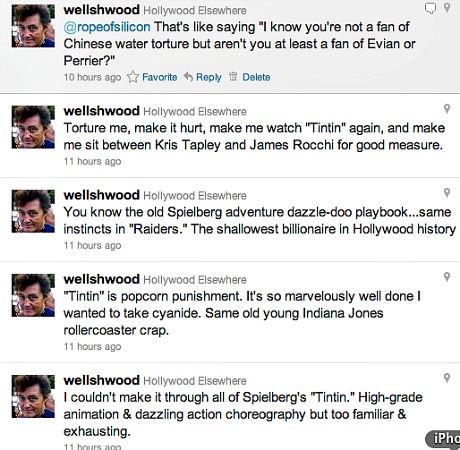
If you have a place in your moviegoing heart for an empty synthetic entertainment that will delight your inner nine-year-old, Steven Spielberg‘s Tintin will rush in and twinkle your toes. A motion-capture adventure thriller in the vein of Raiders of the Lost Ark and the four Pirates of the Caribbean films, it showed last night at the Chinese, and I almost made it to the end. I just couldn’t stand all that technical skill and pizazz and exactitude in the service of absolutely nothing, you see. It was just too much of a rousing, highly disciplined, relentlessly energetic kids movie for me to take, given my personality and tolerance levels.

All I know is that I never, ever want to sit through Tintin again. Because, as I said last night, it is popcorn punishment. I felt like I was being whoopee-cushioned and thrill-ridden to death, or like a virus was being injected into my system. Such amazing filmmaking, and it was making me sick.

As with all Spielberg films, which are always superficially diverting without the slightest hint of subtext, Tintin is about nothing but light and colorful characters and swirling camera movement and high adrenaline and technology. It is about Spielberg wanting to excite easily excitable minds and sell tickets and popcorn and make himself and producing partner Peter Jackson a little bit richer.

Did I say it was utterly without context? That’s not entirely true. Tintin‘s second-billed character, after Jamie Bell‘s Tintin, is Andy Serkis‘s Captain Haddock, who is fond of spirits. This is a minor side issue, I realize, but the fact that Bell’s Tintin seems to regard Haddock’s boozing as a tolerable eccentricity is, of course, a reflection of Spielberg’s attitude about same, which strikes me as curiously divorced from our 2011 reality.

In the 1940s, ’50s and ’60s, supporting characters with alcohol problems (Walter Brennan‘s seagoing rummy in To Have and Have Not, Arthur O’Connell‘s boozy attorney in Anatomy of a Murder, Edmond O’Brien‘s alcoholic Senator in Seven Days in May) were often portrayed as marginally charming and, oddly, men of character. They needed to cut down on the drinking, of course, but they were loyal and colorful and fun to have around. In today’s social context this would be a misguided or pathetic attitude, to put it mildly, which is why the last truly entertaining drunk — Dudley Moore‘s Arthur — came along 30 years ago. But Spielberg is oblivious to this.

Why am I even talking about alcohol issues? Spielbergland is Neverland. I’m wasting my time.

Goodfellas

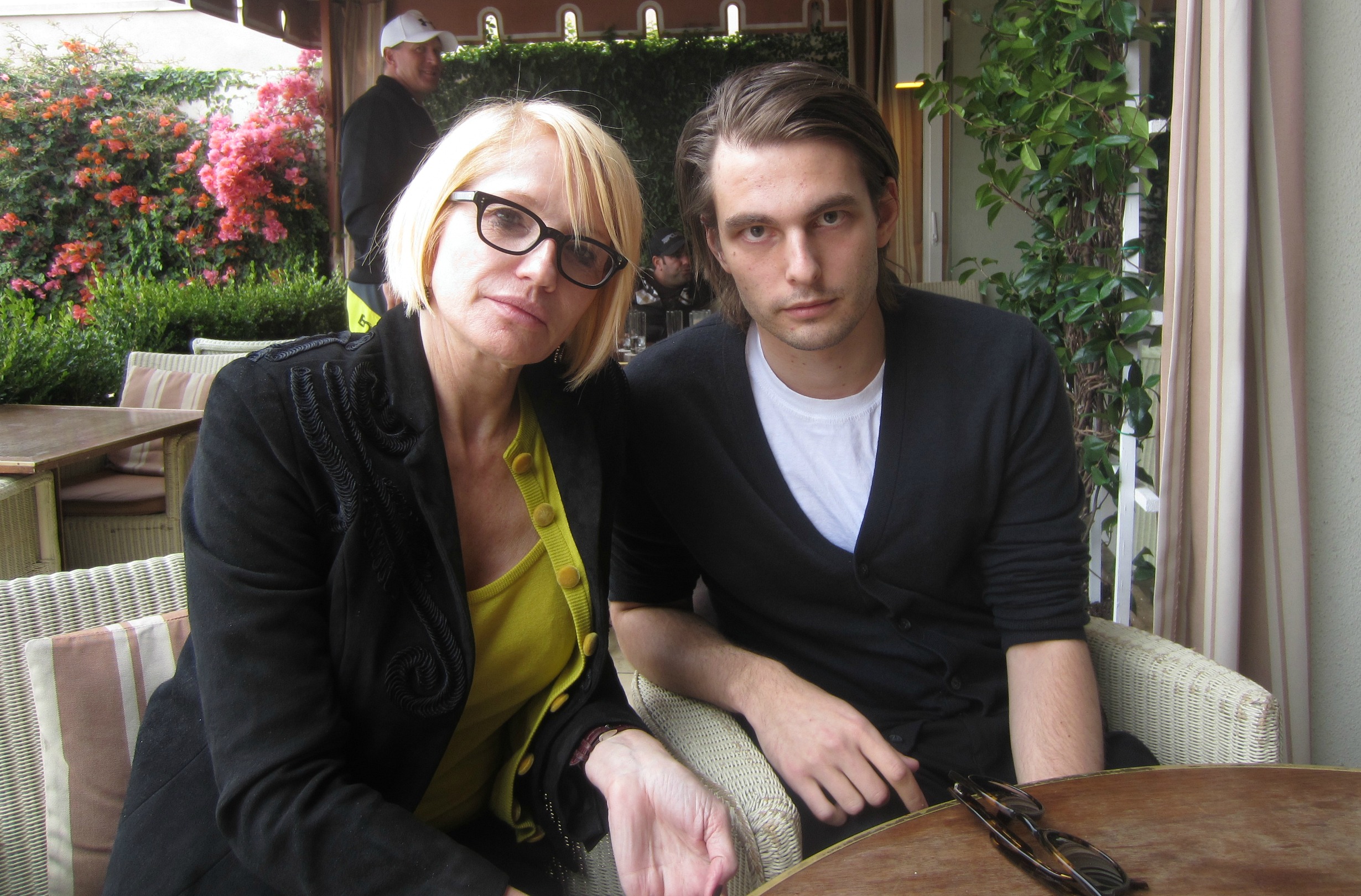
I don’t have the time now to write anything about my talk earlier this afternoon with Another Happy Day star-producer Ellen Barkin and director-screenwriter Sam Levinson, or even to post an mp3…later. But the time just flew. The conversation was mostly on-point but digressions happened from time to time. Barkin and I reminisced about early ’80s Manhattan, sharing anecdotes in particular about the Hellfire Club and the old Edlich Pharmacy on 1st Avenue. Don’t ask.


Another Happy Day star-producer Ellen Barkin, director-writer Sam Levinson — Thursday, 11.10, 2:55 pm, Sunset Tower hotel.

“Just Call Me Shame”

What if Michael Fassbender‘s sex-addict character in Steve McQueen‘s Shame was called “Shame”? And if everyone called him that — all the girls he picks up, his sister (Carey Mulligan), his charmless boss at the office and so on? And what he if struck up a relationship with a 10 year-old kid who lives in his building, and what if the kid found out he was a sex addict and said, “I’m ashamed of you, Shame!”


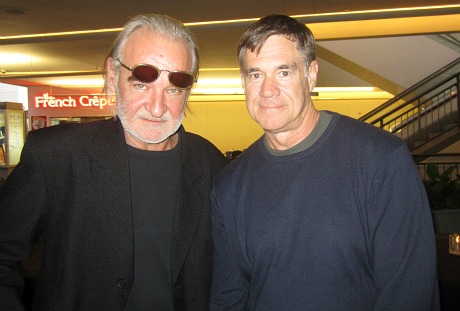
The Turin Horse director Bela Tarr, director Gus Van Sant at yesterday afternoon’s gathering (organized by MPRM) for Tarr and his film at The Grill on Hollywood Blvd. — Wednesday, 11.9, 4:50 pm.

Read more

Still Mahvelous?

I was interviewing Another Happy Day star Ellen Barkin and director-writer Sam Levinson at the Sunset Tower from 1:15 pm to 3 pm or thereabouts, and then we said our goodbyes and I was walking down to my car and I pulled out the phone and learned that Billy Crystal will be hosting the Oscars…wham.

My first thought was “okay, I get it…safe choice.” Producer Brian Grazer had to land an experienced pro who knew the lay of the land and who would hit the ground running. My second thought was “what happened to reaching out to younger Genx and GenY?” Crystal is a boomer whose movie career peaked in the late ’80s and ’90s. But he’ll be funny and rascally. I guess the youth reach-out will have to wait until the 2013 show.

The only concern I have is that Crystal has gained a little…actually more than a little weight over the last decade or so. All movie stars have big heads, but Crystal’s is the size of a medicine…I mean, a basketball.

Encouraging

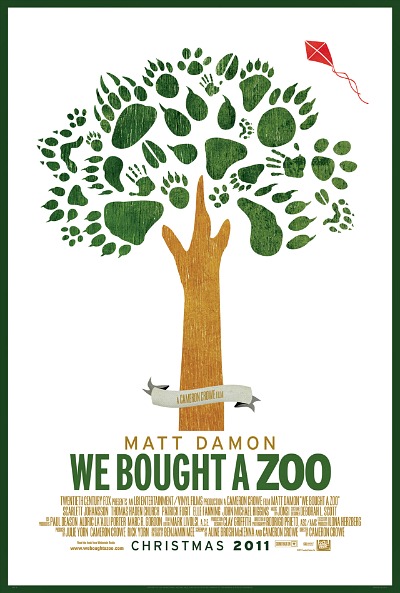
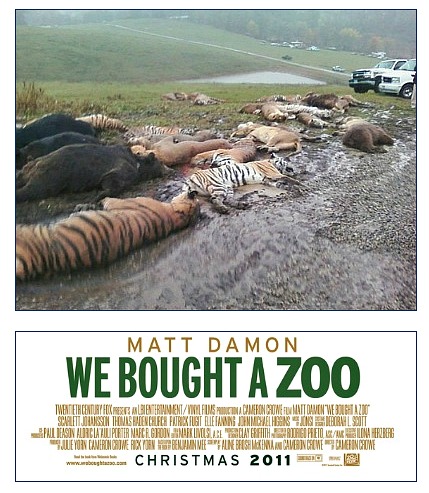
This is an agreeably low-key, on-target poster. It doesn’t quite erase my memory of that saccharine trailer (which I just re-watched) or that nightmarish association I have in my head with last month’s Ohio wild-animal massacre or that subsequent PETA letter urging director Cameron Crowe to post a warning on the closing credits about the danger of keeping exotic animals as pets. But the poster works — it’s the first positive spin that We Bought A Zoo has had in a long while.

“I’m Finished!”

“If only he’d prepared!,” N.Y. Times columnist Gail Collins wrote this morning. “I can see him now, jogging in the morning, his coyote-killing pistol tucked precariously into his sweatpants, chanting: ‘President Perry knocks off three: Commerce! Education! Energy!’ all the way down the trail. Really, it would have made all the difference. Rick Perry, we hardly knew ye. Farewell.”

Stiller-Wilson-Vaughn

Memo to Brian Grazer: Nearly six years years ago I suggested a moderately nervy Oscar-hosting idea. “What offbeat comic team has performed the most consistently funny and inventive bits on previous Oscar telecasts and generally been the most out-there and in-front-of-the-crowd? Ben Stiller and Owen Wilson. Now let’s go one better…make the Oscars into a three-way gig between Stiller, Wilson and Wilson’s Wedding Crashers partner Vince Vaughn. Are you kidding me? These guys would kill, and again they’d get the younger viewers. Think of the level of the writing! Think of the nerve element!” Think of Stiller’s Na’vi bit, the ’09 Joaquin Phoenix parody, that great bit he did years ago with Wilson…he gets it, he’s cool, they all do.

“Without A Killing There Is No Feast”

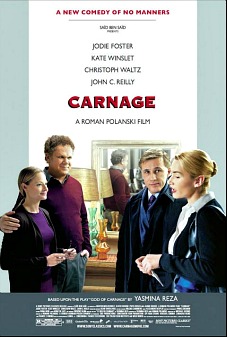
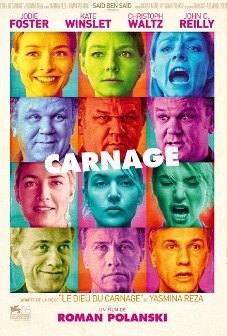
De-ball, soften, sand it down. Last April Sony Classics, director Roman Polanski and producer Said Ben Said decided to remove “God of” and just call their film Carnage. Now the Sony Classics marketing team has apparently decided that selling Polanski’s (and playwright Yasmina Reza‘s) dark comedy (opening on 12.16) as a chaotic or discordant experience will be bad for business. Could they have presented this film in blander terms? They’re clearly trying to soothe prospective viewers, but to what end?


(l.) Sony Classics’ new domestic-market poster for Carnage; (r.) French poster.

It seems to me that this poster argues with everything that Reza’s play — a piece about the thin line between good manners and animal aggression — ever was or hoped to be.

“As Freud tells us in ‘Civilization and Its Discontents,’ we have to repress our infantile aggression in order for civilization to survive,” New Yorker critic John Lahr wrote in March 2009. “But it’s worth paying top dollar to see those feelings acted out by an expert ensemble. And no bleating about the cruelty of farce, please. As [playwright Yasmina] Reza knows and so gleefully shows, without a killing there is no feast. ”

That’s precisely what this poster does. In a roundabout way it bleats about the cruelty of farce by suggesting that the film contains no cruelty or farce or ferocious jungle behavior whatsoever.

Six weeks ago I called Carnage “wonderfully tight and concise, and acted to perfection…not just a film about bile and self-loathing and lacerating words and puke, [but] about artful chiseling and razor-sharp precision…beautifully timed and cut (congrats to Herve de Luze), exquisitely framed within a widescreen aspect ratio…and no jiggly hand-held shots! Everything shot is captured from a tripod or a super-smooth steadycam.”

Mistah Hoovah

Deadline‘s Nikke Finke is calling J. Edgar‘s opening-day, five-city gross of $59,000 “strong” and “good enough.” Boxoffice.com’s Phil Contrino doesn’t disagree, but feels “the negative reviews are really going to hurt. J. Edgar is aimed at moviegoers looking for an Oscar juggernaut — and they’ll find plenty of reasons to believe that it’s not. It also looks like a downer. There’s no emotional uplift to this historical biopic, and, let’s face it, you need that to make the big bucks. That’s why Moneyball hit $70 million and not $100 million. We’re going with a $12.5 million opening weekend — good by Clint’s standards, weak for Leo.”