Leo Gaining Ground?

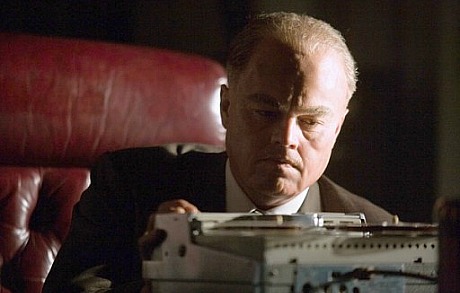
Late this morning Indiewire‘s Anne Thompson and In Contention‘s Kris Tapley discussed their reaction to Clint Eastwood‘s J. Edgar, which they saw last night at the AFIFest, on Oscar Talk. I have a chance to see it tonight, and I may do that rather than wait for Monday’s “caboose” screening.
Tapley also talks about last Tuesday’s screening of Young Adult (“I think it plays to a niche crowd”), which Thompson missed.

Here’s Tapley’s J. Edgar review on Hitfix/In Contention.

“I think DiCaprio could win [the Best Actor Oscar],” says Tapley, and Thompson agrees. Neither of them think it’s a Best Picture contender. Thompson says she wasn’t sure about Armie Hammer after his Social Network performance, but after seeing him play Clyde Tolson in J. Edgar she feels “he’s a keeper now.”

Thompson: “I liked it a lot more than I expected…a lotta flashbacks…an old guy looking back…the casting is really good and the actors are really great…I feel a great deal of affection for Leo [giving] a great movie-star performance….one of those movie-star alchemy things happen in which you’re looking at J. Edgar and you’re looking at Leo…there’s a lot of resemblance to Brokeback Mountain…tragic love story…..I was surprised by how much I was pulled in to the narrative and pulled into caring. Not a perfect movie, not a great movie…but Clint does it again.”

Tapley: “The greatest hits biopic approach…oddly clunky, abitrary structure, zipping around in time…..unmotivated…didn’t seem to have a reason to go back and forth…but probably my favorite Clint pic since Letters From Iwo Jima….Mystic River is a lot more boring that I recall…I just think that…uhm, I like the movie on one hand [but] I don’t like latter-day Eastwood.”

Eastwood “peaked with Mystic River and Million Dollar Baby,” says Thompson, “and mostly the later ones don’t measure up.”

From a NY critic friend: “You can cross this one off the Oscar-contender list. Not sure who anyone thinks the audience is. The movie it most reminded me of was that Jack Nicholson‘s Hoffa. Unfocused movie built around strong central performance or performances. Armie Hammer is pretty great, though. Very even-handed and Leo is also strong. The problem is the script, which can’t seem to figure out what it’s about. Addresses the gay issue obliquely by suggesting that Hoover was a closet case who wouldn’t admit to himself what was going on with Tolson.”


Chintzy Pinkness

I was somewhat excited about attending Summit Entertainment’s shindig last night at the Bel-Air Hotel because I wanted to see what the $100 million renovation looks like. It was a nice party but the makeover is a letdown. At least in terms of those 12 newly built canyon-view suites up on the hillside. The exteriors and staircases, I mean, which have an uncultivated, hard-edged, nouveau-riche appearance, like something you might find in Riyadh or Qatar or Cancun.


The hard sharp lines that define the Hotel Bel Air hillside exteriors are icky. What person with taste decorates a stairway with little white porthole lights?

And the chandeliers in the Vegas-styled ballroom where the Summit party took place have “a Long Island bar mitzvah quality,” as a publicist friend put it.

I haven’t inspected the entire hotel. A lot of sections seemed very nice. The gardens and the restaurant-bar are still beautiful. So I’m not putting the whole place down, just some of it.

The Bel-Air hotel, which was originally built in 1946, has never been a bastion of Spanish architectural tradition, certainly not along the lines of the Four Seasons Biltmore hotel, which does it exactly right. But there’s no way to go if you’re renovating a 1940s-or-older Southern California hotel except to honor Spanish-style architecture. You need to restore (and if necessary, recreate) this atmosphere as best you can. Ali Baba and the 40 Thieves-style architecture is frightful in this context.

The Bel-Air hotel used to be half-Spanish and half-California comfortable with a kind of soothing, ladies-who-do-lunch Nancy Reagan vibe. Now the place feels half-Spanish and vaguely Middle Eastern.

Oh, wait….there’s a reason for that. The nouveau-riche types who’ve come into money since the flush times of the ’90s and early aughts have no taste to speak of so they love anything brash and sparkly and showoffy — they eat that shit up. So if you want to attract this crowd, you don’t want to generate an atmospheric vibe that’s too classy or reserved.

Plus the Bel-Air hotel is owned by the Sultan of Brunei. It is never a good thing when some loaded big-shot from India or Asia or the Middle East buys an old-WASPy-establishment hotel because one way or the other he will always chintz it up. For whatever reason genuine taste is hard to come by if you’re from the entrepenurial or inherited-wealth classes within those regions.


One of the areas in the new Bel-Air hotel that I found to my liking.

The architect behind the Bel-Air renovation is Alexandra Champalimaud of the Rockwell Group. She also renovated Manhattan’s Pierre hotel, and if you ask me she made that one feel a little too Middle-Eastern also…too bright and sparkly, too much gold paint.

This isn’t the first time I’ve complained of Middle-Eastern architecture influences upon old white-people establishments. Last year I complained about the design styles of Isaac Tshuva, the Israeli billionaire who bought and re-designed the Plaza seven years ago.

“The Plaza used to be a haven of old-world Anglo-Saxon class,” I wrote. “Now it reeks of Middle-Eastern cluelessness. The only thing missing are bellmen standing around with pointy-toed Ali Baba shoes.”

In 2007 I reported the shock that I felt when I realized that Boston’s former Ritz Carlton — the Plaza Hotel of Boston, operating since the mid 1920s — is now called The Taj, and “has been transformed with a name and a design scheme that’s right out of Las Vegas or Cancun.” The Ritz Carlton waa sold in ’06 to Taj Hotels Resorts and Palaces, a swanky hotel chain based in Mumbai, India.

Getting To Be A Habit

Eighteen months after abruptly departing Apparition, Bob and Jeanne Berney are abruptly leaving FilmDistrict, the GK-partnered company that was launched 13 or 14 months ago. The stated reason is that the company wants to abandon its New York City offices and move the whole kit ‘n’ kaboodle to Los Angeles, and the Berneys are hardcore New Yorkers and don’t want to relocate.

According to math provided by Deadline‘s Mike Fleming, the company has generated about $163 million in revenues from five Film District releases — Insidious, Don’t Be Afraid of the Dark, Soul Surfer, Drive and Rum Diary. I don’t know what FD’s cut of this amount boils down to, but it sounds like they had a fairly decent year. But it apparently wasn’t enough because the basic idea behind any consolidation is to cut costs.

The Berneys will keep the New York office running for another months, or roughly until 3.1.12, largely to attend to the release of Angelina Jolie‘s In The Land Of Blood and Honey.

Stockyard

This morning I placed a call to a New York-based company (never mind the particulars) called Reprise something-or-other. I got the usual voice message explaining the usual options. The speaker had what sounded to me like a somewhat educated New York borough or northern New Jersey accent. What got me was his pronunciaton of Reprise, which he called RE-prize — a variation on the standard football-game prounciation of the word “defense” as DE-fense.

The second I heard RE-prize I thought of those hillbillies in Deliverance telling Jon Voight and Ned Beatty that “well, we, uh, RE-quire that you both get your asses into them woods.” I was once again channeling Jose Ferrer ‘s Turkish Bey in Lawrence of Arabia: “I am surrounded by cattle.”

Frank Sinatra‘s old record label was called Reprise, but it was pronounced the elegant way — reh-PREEZ. Commoners, I remember, would say reh-PRIZE and others would correct them by saying, “Uhm, I think you’re supposed to say reh-PREEZ.” But now we’ve sunk even further. Now we have guys who sound like Port Authority bus drivers greeting callers with “thank you for calling RE-prize.” Welcome to Jersey Shore.

Old-School, “Kid Gloves”, Lacks Voltage

J. Edgar Hoover‘s mystique lies in the fact that while he kept meticulous files with compromising details on some of America’s most powerful figures, nobody knew the man’s own secrets,” writes Variety‘s Peter Debruge. “Therefore, any movie in which the longtime FBI honcho features as the central character must supply some insight into what made him tick, or suffer from the reality that the Bureau’s exploits were far more interesting than the bureaucrat who ran it — a dilemma J. Edgar never rises above.”

Scam Artist

Updated: Brett Ratner‘s Tower Heist (which opens tomorrow, and which I’m finally seeing this evening) isn’t doing all that well on Rotten Tomatoes so far. 67% isn’t awful, when I got a grade like that on a high-school exam it meant that I’d failed. A film has to get 70% or better to be called “critically approved,” I think.

“There are heist pictures that offer careful and detailed accounts of criminal procedure, generating suspense by focusing on the precise arrangements necessary to bring a brazen and improbable crime to fruition,” writes N.Y. Times critic A.O. Scott. “Tower Heist is emphatically not one of those movies.

“Important plot points seem to have been edited away — or never bothered with in the first place — and credulity is strained at nearly every point.

“If this is a Robin Hood story, it is more in the manner of Daffy Duck than Errol Flynn (or, heaven help us, Russell Crowe). Which is great — or would be if Mr. Ratner were daring or disciplined enough to unleash the full farcical anarchy that Tower Heist occasionally promises but rarely delivers.

“Mediocre entertainment is not a crime — this is still America, dammit! — but Tower Heist could and should have been much more. Mr. Ratner goes for the safe bet and the easy score, which means that, for all his shows of solidarity with the working stiffs, he has more in common with the wealthy scam artist who took their hard-earned money.”

Pain-In-The-Ass Hippies

Middle-class husband loses job and convinces his wife they need to leave the big city and start a simpler life elsewhere — that’s Lost in America. Middle-class people are thrown for a loop by hippie manners and appetites (like hallucinogen-taking) — that’s the last act of Flirting With Disaster. Throw those together and remove the exceptional, whip-smart writing and you’ve almost certainly got Wanderlust, a Paul Rudd-Jennifer Aniston comedy due in February.

Contrarian

A person of substance and experience has seen War Horse and isn’t eating the oats like the others. He got in touch this morning. Here’s his report:

“I have a fairly high tolerance for schmaltz and sentiment. I bought into The Blind Side heart and soul. And as someone who dearly wishes that Steven Spielberg would get back on his game and deliver a winner, I was rooting for War Horse, especially as a potentially high-quality family film.

“But dear Lordy…

“My guard was up immediately when the film opened with the hoariest of cliches — a smitten lad beckoning a testy steed with an apple. When the mustachioed landlord came after the poor family for their back rent, he did everything but twirl his whiskers. By the time the comic-relief goose started squawking, it was clear that Spielberg not only wasn’t raising his bar, he was settling for the trite and true and nothing new.

“He does get probably the most important elements pretty much right: The horses are the best actors on the screen even if one flashes a Barrymore-esque profile shot that would be ridiculous in a silent movie. And the battlefield sequences, especially a cavalry charge massacre and encounters in the trenches, are duly rousing, harrowing and authentic — though not enough to top Paths of Glory or All Quiet on the Western Front.

“But tonally, War Horse is at odds with itself. It seems to be trying for almost a folk-tale feel, somewhat mythic, and then asks us to flinch at the horrors of war. The single most egregious shot is when a spinning windmill coyly hides an act of violence unnecessarily, perhaps protecting the family-friendly rating.

“Even a top-of-the-line cast can’t enliven the material when what they are asked to do is so predictable. That said, for some reason I never felt its length. But I think I was mostly eager to see just what Spielberg was going to try to get away with next.

“I don’t know what’s happened, but the man who made Saving Private Ryan didn’t make this.”

The New Jack Torrance?

I don’t want to go into this all half-cocked….actually, no, that’s okay…I’ll readily admit that this is a half-cocked notion. It’s just that two initial reactions I had to Charlize Theron‘s Young Adult character — that she’s a cautionary metaphor for “a kind of egoistic Kardashian-like malignancy afoot in the culture right now” as well as a kind of monster in her own right — have been somewhat refined.

We’re talking about an emotionally predatory Jason Voorhees here, and yet armed with a lot of sassy, funny, outrageous-deadpan dialogue. And I’m now starting to think of Theron being closer to Jack Torrance in The Shining than Jack Nicholson‘s other similar-type character, Bobby Dupea in Five Easy Pieces, whom I mentioned the other night.

The key component is that Theron’s Mavis Gary, an alcoholic writer of young-adult fiction who visits her hometown to nab an old boyfriend (Patrick Wilson) who’s now married with a kid, is unrepentant, and if anything is deeper into her mudhole at the end than at the beginning. That’s certainly Jack Torrance, all right. The other factor is a kind of balls-to-the-wall acting style that isn’t looking for empathy or sympathy. Either you embrace the fact that Mavis is a noxious wreck and that there’s nothing about her that is comforting or relatable…or you don’t.

It was clear from the get-go that Nicholson wasn’t playing a normal, average, relatable, ah-shucksian guy in The Shining. That moment when they’re driving up to the Overlook in that yellow VW and talking about the Donner party and Nicholson goes “See?…it’s okay…he saw it on the television!” with that goofy demonic look in his eye, you knew he was coming from a grand guignol place. On some level this is what Theron is doing also, I think. She’s not playing “one of us.” She’s playing a myopia-afflicted freak…but sharing dark cryptic laughs as she goes along, or at least for the first three-quarters of the film.

You know she’s neurotic right away, and you start to see the obsession early on, and then she gets into it a bit more, and then she gets worse and worse. I think if you go into this film knowing the old third-act redemption routine simply isn’t in the cards and the only way to go is to roll with crazy Mavis while getting your bedrock reality fix from Patton Oswalt‘s half-crippled guy, the film will work for you. And you may find, as I have, that Theron’s “arc” (if you want to call it an arc) is a little bit like Jack Torrance’s gradual descent into lunacy.

Compare The Shining‘s staircase-and-baseball-bat scene with the front-yard freakout, wine-on-the-dress scene in Young Adult, and you’ll notice a vague similarity or two.

Patrick Wilson’s vaguely wimpy Buddy Slade isn’t exactly Wendy swinging the bat and whimpering “I just want to go back to my room and think this over!”..but he is a bit of a softie and a pudgehead. But Charlize/Mavis saying “Look, you’re miserable here…this town is awful…I’m here to save you and I’m furious that you’re not hearing me!” isn’t all that far from Jack saying “You’ve had your whole fucking life to think things over! What good is a few more minutes gonna do you now?”

Stand-Up Girl

I hate to admit it, but “Nordling”‘s War Horse rave on AICN, which was posted early this morning, deserves respect and consideration. He’s a fool for that sappy, sweeping Spielberg stuff, but he knows how to write, and that implies he may know (or at least picked up some knowledge of) other things besides.

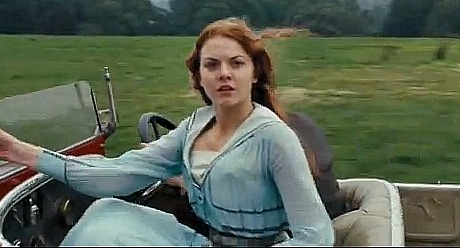
The only thing I’m kinda half-wondering is why doesn’t Nordling mention the pretty young girl (seemingly played by Celine Buckens) we’ve seen in the trailer with the sad, soulful eyes and a tear streaming down her cheek?

Update: I’m told that it’s a separate girl in that “Albert and Joey galloping alongside a moving convertible” scene. I’m speaking of the girl who feels moved to stand up in said convertible to better appreciate the sight of Albert (Jeremy Irvine) and Joey keeping pace. (I for one certainly know this feeling. I’ve been there. If I see something that touches or moves me, I almost always stand up in order intensify the connection, even if I’m in a moving car.)

War Horse is old fashioned, and I mean that in the best possible sense,” Nordling begins. “It wears its emotions on its sleeve, and there is no place for cynicism in that world. It has obvious films like All Quiet On The Western Front and the films of John Ford and David Lean in its DNA, but the end result is all Steven Spielberg. War Horse is an epic that has Spielberg doing what he does best. He takes the audience on an emotional journey through World War I and out the other side, and the film very much feels like Spielberg paying tribute to the filmmakers he loved as a young man.

War Horse is what you’d call an ‘old soul.’ It’s a film that could have been made — perhaps not with the technology but definitely with the heart — in Hollywood’s heyday. David Selznick would have adored War Horse.

“And then there are those scenes where Spielberg puts his classic touch on them and those scenes burn themselves indelibly into my mind. The way all the horses react when a companion is put down. The horrors of trench warfare, and the terror of mustard gas. A cavalry charge that’s straight out of Lawrence of Arabia‘s assault on Aqaba.” [Wells interjection: now this is the scene I’m anxious to see!] The beautiful cinematography. War Horse is most definitely a Steven Spielberg work, and he pulls out all the stops to bring the audience into a time that hasn’t been on film very much recently, and he does it with an elegance and a passion that can only come from him.

“It’s not a perfect film” — no! — “but anyone who loves movies and Spielberg’s work in particular really cannot miss this. War Horse is what movies are all about — transporting the audience into a world that will never exist again. As for myself, I loved every moment. For me, War Horse is magnificent.”