Posted earlier today by Slant‘s Ari Arikan…enjoy.
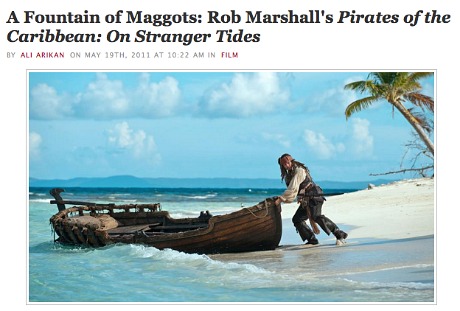

Posted earlier today by Slant‘s Ari Arikan…enjoy.
I’ve only just gotten around to watching this Tintin teaser, which appeared yesterday. It isn’t much — teasers never are.. I could share my opinion but I have to bolt now for a screening. If anyone has a view — an honest, non-invested view — I’d love to hear it.
According to N.Y. Times reporter Michael Cieply, Arnold Schwarzenegger’s next film, Cry Macho, in which he’ll have his first starring role since setting aside his Hollywood career to become California’s Governor, contains echoes of his current Mexican maid paternity scandal.
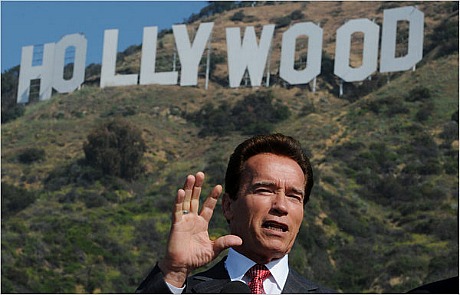
Boiled down, Cieply states, Schwarzenegger’s character will portray a man “working out a complicated relationship with an 11-year-old who unexpectedly turned up in his life,” and who “falls in love with a Mexican woman.”
Cry Macho “was written as a novel decades ago by the playwright N. Richard Nash, who died in December 2000 at 87,” Cieply writes. “It tells the story of Mike Milo, a washed-up horse trainer — he was a rodeo cowboy until Mr. Schwarzenegger entered the picture — who schemes to make $50,000 by snatching a streetwise Mexican boy from his mother in Mexico City and delivering him to his father, Milo’s ex-boss, in Texas.
“As Milo and the boy, Rafo, get to know each other, the plan changes. The boy actually wants to connect with his father, a ne’er-do-well who is trying to have him kidnapped for leverage in a business deal. Mr. Schwarzenegger’s character falls in love with a Mexican woman. A rooster named Macho provides comic relief.
“But mostly, Cry Macho is written as a morality tale about two characters who help each other through tough transitions.”
No journalist has tried to organize a Lars Von Trier Cannes-banning protest petition so I guess I’ll have to do it, dammit. Or at least I can propose the wording of the statement:
Date: Thursday, 5.19.11
To: Cannes Film Festival Board of Directors
From: Cannes-attending Journalists & Filmmakers
Subject: Decision to Declare Lars Von Trier “Persona Non Grata” In Wake of Inflammatory Statements at 5.18.11 Press Conference
We, the undersigned, recognize the the Board’s responsibility to respond forcefully and unequivocally to the offensive statements made on Wednesday, 5.18, by Melancholia director Lars von Trier. You are a political body as well as a team dedicated to drawing annual worldwide attention to the most exciting and artful films, and in this context you were obliged to verbally admonish Mr. Von Trier, even though he sincerely apologized for these statements on the same day he made them.
We feel, however, that declaring an artist of his accomplishments and magnitude “persona non grata” is an over-reaction. We ask that you reconsider.
You no doubt understand that Mr. Von Trier is a bit of a rascal and a provocateur. He loves to poke at the hornet’s nest. We recognize, of course, that he went too far with Wednesday’s statements (although we believe they were made in jest) and that he committed a grave political error in doing so.
But Lars Von Trier is one of your own — a longtime friend of the festival — and it seems harsh and even rash to throw him under the bus in this manner. Your decision seems particularly inappropriate since he is the director of one of this year’s most emphatically praised competition entries, one which, until late yesterday morning, stood a reasonable if not better-than-decent chance of winning the Palme d’Or.
Lars von Trier is a serious and compassionate artist who has time and again made films that have, with the possible exception of Antichrist, lent immeasurable dignity and stature to your festival. His films have shown time and again that he is full of nothing if not artistic bravery. As with all artists, his films are surely a truer, deeper representation of who he is and what he feels and believes than any words he might carelessly speak at a press conference. Never trust the artist — trust the tale.
Due respect, but respect needs to be paid. Lars Von Trier, an imperfect human being like all of us, needs to be offered charity and clemency. Admonish by all means, but don’t excommunicate.
Thank you.
I’m naturally presuming that James Cameron‘s 3D re-do of Titanic, which will hit theatres in April 2012, will look significantly better than all those cheapo conversions we’ve been seeing in theatres for the last couple of years. Ask which ones were the worst and everyone defaults to Clash of the Titans, but what were the other lamentables? 2D conversions are a tacky idea to begin with, so this will have to done exactly right. If Cameron can’t deliver, no one can.

You know what I’d like to see converted into 3D with the same needlepoint care? George Stevens‘ Gunga Din (’39). Seriously.
Where’s the Titanic Bluray, by the way? I could see owning that.
Even in the backwash of The Skin That I Live In and Lars Von Trier’s banning by the Cannes Film Festival, I’m drawn to a banal observation. When I was a kid my mom would hang the family wash on an outdoor clothesline, and the super-crisp way this made my jeans and T-shirts feel was pure pleasure. Two days ago, after not knowing this wondrous sensation for decades, I re-experienced it after hanging my wash off the patio of my Old Town Cannes abode. Delightful.

The Cannes Film Festival Board of Directors has just issued a statement that not only condemns Melancholia director Lars von Trier for his put-on “I’m a Nazi” comment at yesterday’s press conference, but declares that he’s officially been shunned.
“The Festival de Cannes provides artists from around the world with an exceptional forum to present their works and defend freedom of expression and creation,” the statement reads. “The Festival’s Board of Directors, which held an extraordinary meeting this Thursday, 19 May 2011, profoundly regrets that this forum has been used by Lars Von Trier to express comments that are unacceptable, intolerable, and contrary to the ideals of humanity and generosity that preside over the very existence of the festival.
“The Board of Directors firmly condemns these comments and declares Lars Von Trier a persona non grata at the Festival de Cannes, with effect immediately.”
Well, Von Trier obviously touched a highly explosive nerve, and the Cannes team is politically obliged to say something admonishing. But this is such an over-reaction I don’t know where to begin.
Lars von Trier has, press conference-wise, often played the role of a provocateur, a kidder — he loves to poke and agitate and whip the press into a lather. Nazi-winking, even in jest, in a huge no-no, of course, but we all know that Von Trier is a serious artist and a humanitarian who, despite his impishness, has time and again made films that see through to the sad soul of things. Due respect to the Cannes team, but this is excessive. They’re swatting a fly with a double-barrelled shotgun.
Von Trier apologized for his remark yesterday, saying that “if I have hurt someone this morning by the words I said at the press conference, I sincerely apologize. I am not antisemitic or racially prejudiced in any way, nor am I a Nazi.” What more can he say?
I’m not presuming that the Cannes Board of Directors intend to ban Von Trier from the festival indefinitely, but it seems a safe bet that Melancholia hasn’t a chance of winning the Palme d’Or now. Unless the jury feels as I do and gives it to him anyway. Not likely, I’m guessing.
If any journalists and filmmakers want to sign a petition saying this whole simple-brained scandal has been inflated past the point of reason and perception and make it public, I’ll sign it and post it.
Glenn Kenny tweet: “So I assume today it’s gonna be May ’68 all over again, with Kohn and Longworth and various unnameables manning the barricades? Oui, non?”
JHoffman6 tweet: “BREAKING: Cannes organizers ban Von Trier for sympathizing with Hitler. Also, they ban their grandparents.”
At this morning’s The Skin That I Live In press conference, Pedro Almodovar explained that his creepy comic melodrama is a result of his being “in a thriller mode.” He’s also called it “a horror story without screams or frights.” Well, okay, but I wouldn’t go to this film expecting to be thrilled or scared. It’s more of a wicked-camp thing. More than a few times the crowd I saw it with erupted in giddy chuckles. And yet Skin, after a fashion, is played more-or-less straight. Always the best way to go with a wink-winker.

So…whatever, see it at a midnight screening with a hip gay crowd and prepare for doses of exceedingly dry humor and strange-itude in the general vein of David Cronenberg‘s Dead Ringers and Georges Franju‘s Eyes Without A Face. In a just-up tweet MSN’s James Rocchi has invoked Vertigo…yeah, that works.
For this is a highly perverse and, typical for Pedro, lusciously sensuous film about a mad plastic surgeon (Antonio Banderas) who goes to great lengths to…how to put this? A one-line synopsis I’ve found says it’s about a surgeon “who tries to save the life of his wife by creating a new skin.” Nope, wrong. It’s about Banderas, playing a brilliant Dr. Frankenstein-like sociopath with wealth and elegance to burn, recreating his dead wife and daughter with…well, let’s not say.
But the story is also about rape-payback and revenge and a selfish young hound getting a taste of his own medicine and having the tables turned. That’s vague enough, I think.
Let’s take a wild guess and suppose that straight, hamburger-eating, ESPN-watching guys are not going to beat down the doors to see this. But I like burgers and I had a enjoyable, better-than-okay time with it. It’s a first-class effort, beautifully shot by Jose Luis Alcaine (Volver, Bad Education) and assured and technically spot-on, etc. I’m a devout Pedro guy from way back, but I prefer his more soulful, deep-well stuff.
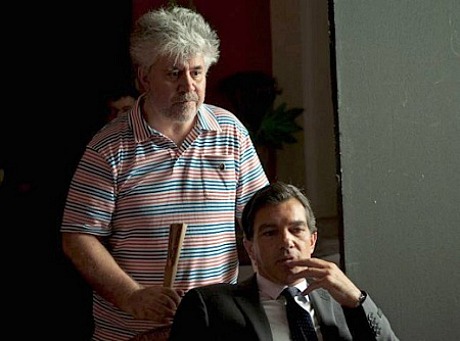
Almodovar also said during the press conference that he “was thinking about Fritz Lang” when he wrote the screenplay (which is based upon a book called “Tarantula” by
Thierry Jonquet). He also said he “considered” shooting it as a silent black-and-white film. That probably would have been too on-the-nose.
I had a slight issue about to what degree a person of a certain gender could become as thoroughly transformed as shown in the film, but it’s not worth picking at.
As Robert Ledgard, Banderas has delivered his most striking star-turn performance since “Che” in Evita (which I loved him in) and before that Philadelphia. In the second-lead originally intended for Penelope Cruz, Elena Anaya (Habla con Ella, Sex and Lucia) is fierce and focused as Vera, Banderas’s reconstructed guinea pig and object of desire. Costars Marisa Paredes and Jan Cornet also burn through.
An engaging sum-up of the last two or three days at the Cannes Film Festival from L.A. Weekly critic Karina Longworth and Indiewire critic Eric Kohn, moderated by Film Society of Lincoln Center’s Eugene Hernandez.
FilmLinc: Karina Longworth and Eric Kohn Talk About Cannes by FilmLinc
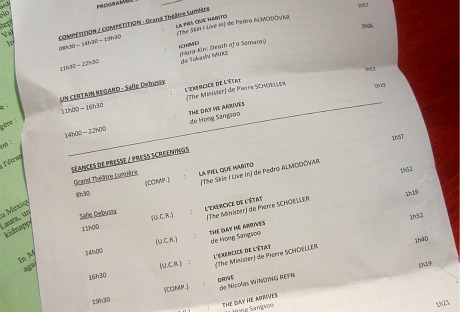
One final full day left before packing it in and flying to Paris. Up at 6:30 am, Pedro Almodovar‘s The Skin That I Live In at 8:30 am, the Pedro press conference at 11 am, writing time, Hogn Sangsoo‘s The Day He Arrives at 2pm, more writing time, back home to pack and write, Nicholas Winding Refn‘s Drive at 7:30 pm and then final composing and clean-up. It’s 12:15 am right now.
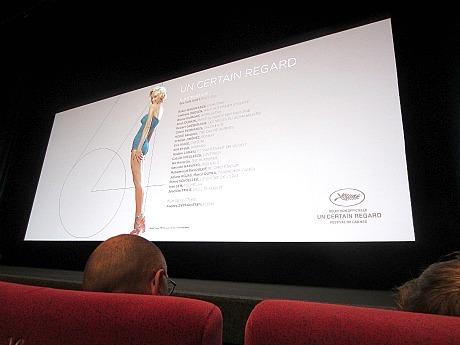


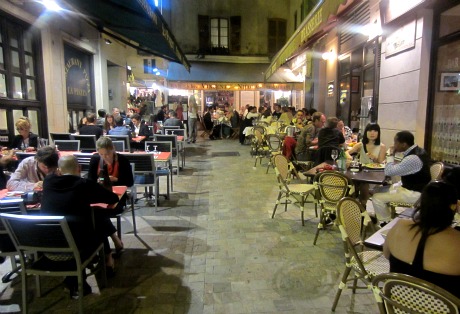
A couple of hours ago Drive director Nicholas Winding Refn described his film, which costars Ryan Gosling and Carey Mulligan, as a “kind of fantasy” thing that was partly inspired, he said, by the vibe of driving around and listening to great music on the car stereo. He also said that in one sense it’s “almost a John Hughes film.”
That scared the hell out of me. My initial impression had been that Drive is a lean ’70s flick in the vein of Michael Mann‘s Thief featuring a quiet hero in the mold of Steve McQueen, etc. (This was fortified by moderator Trevor Groth, who said he’s seen it, during the discussion.) So I asked Refn what he meant exactly by the dreaded term “John Hughes.”
He basically meant, he said, that Drive, which will have its first Cannes press screening tomorrow night, is a somewhat lighter thing during the first half and then turns into something darker in the second half when Gosling’s character, a stunt driver, “goes a little crazy.” Refn mentioned, I think, Pretty in Pink , but I couldn’t tolerate that notion. (Not Ringwald…no!) So I asked if Drive might perhaps be analogous to Jonathan Demme‘s Something Wild, which definitely does the light-goes-into-darkness thing, and he said yeah, that wasn’t a half-bad analogy.
Refn also said he doesn’t drive, doesn’t have a license, is “car-ophobic” and is terrified of going on Magic Mountain rides. And yet “I like speed,” he said. Go figure.
