Albino Eyebrows

I don’t recall a single moment in any of the three Danish-made Girl movies in which Noomi Rapace conveyed this level of vulnerabiity. And I don’t know if this kind of emotionality is in Rooney Mara‘s performance in David Fincher‘s The Girl With The Dragon Tattoo either. The pic was shot by Jean-Baptiste Mondino for Le Monde.

What’s that white-gray stuff on her face and hair? Volcanic ash?

Hugo “Made For Cineastes”

A guy who read my earlier Hugo post and who definitely writes well has conveyed the following: “I saw Martin Scorsese‘s Hugo at a Chicago test screening in mid-September. Some comments on your posted expectations”:

1. “Scorsese’s 3D work will be ’50s-style, I’m expecting. Lots of House of Wax-y pop-out shots.”

Chicago comment: “Not at all. Lots of wide-angle and tracking shots. In fact, there’s one tracking shot in the opening 10 minutes that outdoes the Copa shot in Goodfellas in terms of sheer technical razzle-dazzle — it follows Hugo across and around catwalks, down a ladder, around a spiral slide, through walls, etc. ¬†It doesn’t have the same narrative effect as the Copa shot, but it left my jaw the floor.

“The most consistently impressive aspect of the 3D is actually the particulate matter Scorsese adds to all the shots in the train station — amber-hued dust, snow, seta, etc.

“Also, much of the aesthetic is rooted in the wide proscenium framings of silent cinema. This makes a lot of narrative sense once the ‘secret’ of the film is revealed.

2. “And it may be a highly satisfying film in this or that way, but this is one of Scorsese’s experiments.”

Chicago comment: “Nope. I actually think it may be his most ‘personal’ film since…I don’t know, Goodfellas? Without spoiling too much, all the people who know Scorsese are going to be writing about how this is really about him and Thelma Schoonmacher rediscovering Michael Powell in the ’70s and their efforts to restore his reputation. I shit you not — the last act is all about the importance of film preservation.

“And that’s before you throw in all the stuff about an outcast kid who watches the world from his window (i.e., Scorsese growing up), trying to avoid getting hit by the local enforcement (Sasha Baron Cohen = the mob, etc.)

“Does it work? To a point. Before I saw it, I was willing to write this off as an experiment as well, but it’s obvious Scorsese put some heart and soul into this. But you’re right — ‘heart’ isn’t really in Scorsese’s wheelhouse.
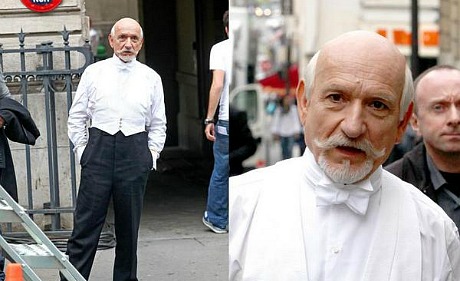

Ben Kingsley as he appears in Hugo.

3, “Scorsese doesn’t do kid-friendly or family-friendly.”

Chicago comment: “You’re right. But contrary to the trailer’s portrayal, this isn’t really a kid movie. Frankly, I think kids’ll be bored with it. It’s a movie made for cineastes.

“The kids are fine (Asa Butterfield is a little stilted), but the showcase performance here is Ben Kingsley‘s.

“It makes sense that they’re screening this early. If they try to sell this directly to families, it’s going to tank. They really need to get the erudite snobs talking about this one. Unfortunately, The Artist may have the stolen the old-school cineaste cache this might have had.”

Note: Obviously those stupid A’s are contained in the characters of the original e-mail, but damned if I can figure how to get rid of them short of re-typing the whole thing.


Not So Bad

I’ve been 80% to 85% persuaded by an unnamed source that Monday’s New York Film Festival screening of “a work-in-progress from a master filmmaker” will be Martin Scorsese‘s Hugo (Paramount, 11.23). I won’t attend due to travel plans that can’t be changed, but if my source is correct, I can live with missing this screening. I’ll see it soon enough. It’s okay.

I’ll feel shattered if the sneak turns out to be The Girl With The Dragon Tattoo or J. Edgar even, but…we’ll obviously know soon enough.

Scorsese’s 3D work will be ’50s-style, I’m expecting. Lots of House of Wax-y pop-out shots. And it may be a highly satisfying film in this or that way, but this is one of his experiments. He doesn’t do kid-friendly or family-friendly. When did he last deal with a really young character or two? Alice Doesn’t Live Here Anymore? Not his wheelhouse.

Krugman Lauds Occupy-ers

In his 10.7 column, N.Y. Times columnist Paul Krugman has offered some of the most sensible thoughts I’ve heard from a boomer-aged pundit about the various Occupy happenings: “There’s something happening here. What it is ain’t exactly clear, but we may, at long last, be seeing the rise of a popular movement that, unlike the Tea Party, is angry at the right people.

“When the Occupy Wall Street protests began three weeks ago, most news organizations were derisive if they deigned to mention the events at all. For example, nine days into the protests, National Public Radio had provided no coverage whatsoever.

“It is, therefore, a testament to the passion of those involved that the protests not only continued but grew, eventually becoming too big to ignore. With unions and a growing number of Democrats now expressing at least qualified support for the protesters, Occupy Wall Street is starting to look like an important event that might even eventually be seen as a turning point.

“What can we say about the protests? First things first: The protesters’ indictment of Wall Street as a destructive force, economically and politically, is completely right.

“A weary cynicism, a belief that justice will never get served, has taken over much of our political debate — and, yes, I myself have sometimes succumbed. In the process, it has been easy to forget just how outrageous the story of our economic woes really is. So, in case you’ve forgotten, it was a play in three acts.

“In the first act, bankers took advantage of deregulation to run wild (and pay themselves princely sums), inflating huge bubbles through reckless lending. In the second act, the bubbles burst — but bankers were bailed out by taxpayers, with remarkably few strings attached, even as ordinary workers continued to suffer the consequences of the bankers’ sins. And, in the third act, bankers showed their gratitude by turning on the people who had saved them, throwing their support — and the wealth they still possessed thanks to the bailouts — behind politicians who promised to keep their taxes low and dismantle the mild regulations erected in the aftermath of the crisis.

“Given this history, how can you not applaud the protesters for finally taking a stand?

“Now, it’s true that some of the protesters are oddly dressed or have silly-sounding slogans, which is inevitable given the open character of the events. But so what? I, at least, am a lot more offended by the sight of exquisitely tailored plutocrats, who owe their continued wealth to government guarantees, whining that President Obama has said mean things about them than I am by the sight of ragtag young people denouncing consumerism.”

Sharp Tongue, Incisive Mind

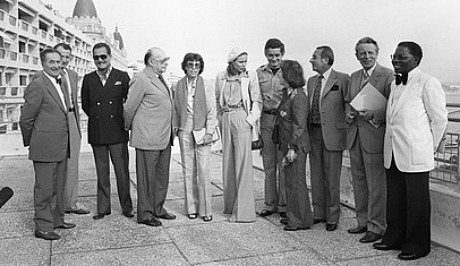
Before reading Todd McCarthy‘s 10.6 review of Brian Kellow‘s “Pauline Kael: A Life in the Dark“, I’d never heard about the legendary New Yorker film critic having allegedly hastened the death of director Roberto Rossellini by inflicting stress on the poor man. During their mutual service on the 1977 Cannes Film Festival jury, McCarthy writes, Kael “argued so relentlessly with the aging and ailing Rossellini for two weeks that the uncharitable accused her of killing the revered director, who died the following week.”


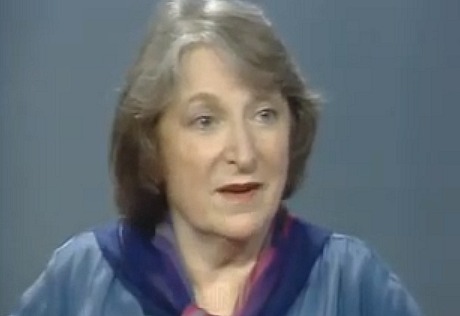
New Yorker critic Pauline Kael during a 1982 interview, when she was 62 or 63.

On the other hand McCarthy recounts a passage in Kellow’s book in which Kael and director George Roy Hill, “both terribly debilitated by Parkinson’s disease, met by chance in a small-town Massachusetts restaurant. Their previous personal contact had been some 30 years earlier when the director, responding to her unkind and, in one respect, uninformed review of Butch Cassidy and the Sundance Kid, had begun with the salutation, ‘Listen, you miserable bitch.’ Ignoring this, ‘Pauline clutched his hand warmly and gave him the name of her massage therapist, promising him that the therapy would do him a world of good.'”

McCarthy also notes that Kael “was always surprised when ‘friends’ she went on to attack in print — Woody Allen, for example — took offense at her criticism, as she somehow imagined they would understand it wasn’t personal, that she had to be completely honest in her reviews.”

Hah! From the filmmakers’ point of view, a critic or columnist they personally know is their friend and supporter no matter what, a writer who will always be generous or at least cut them a break whenever possible, or they’re some kind of enemy or betrayer or backbiter if they write something even moderately critical, especially if it strikes the filmmaker as dismissive.


The 1977 Cannes Film Festival jury (i.e., Kael is the shortest, fourth from right)

Nevermore

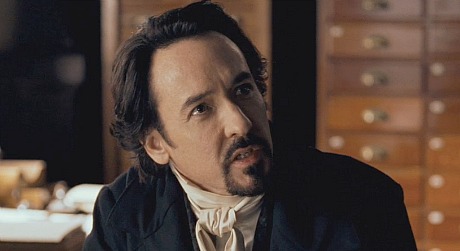
In 1840s Baltimore Edgar Allen Poe (John Cusack) joins forces with a stalwart detective (Luke Evans) to catch a serial killer who’s apparently been inspired by Poe’s writings, and whose next victim may be Emily (Alice Eve), whom Poe is in love with…Jesus! A movie can’t be funded until it’s ground down into genre mulch and made to closely resemble other films of its type (i.e. Sherlock Holmes, From Hell, Sleepy Hollow). 19th Century arterial splatter with lots of fog.

It’s called The Raven, and it comes out of 3.9.12. Here’s the Apple trailer.

Pedroworld

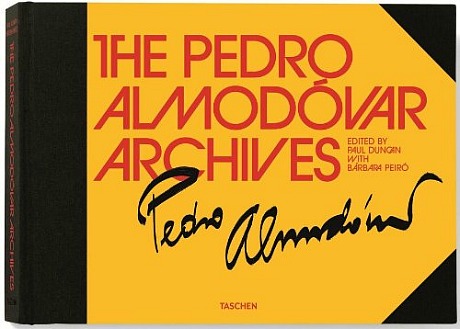
The images in Pedro Almodovar‘s films are always luscious, sensuous, refined to perfection. Paying $200 to own 600 of them (including some never-before-published personal photos) to have and hold seems like a good deal to me. Taschen’s “The Pedro Almodovar Archives“, edited by Paul Duncan and Barbara Peiro, will hit stores on the same day that The Skin That I Live In (Sony Classics, 10.14) opens.

Separate Planets

Yesterday media theorist and cultural pulse-taker Douglas Rushkoff posted a piece on CNN.com called “Think Occupy Wall St. is a phase? You don’t get it.” He was subsequently interviewed by an obviously skeptical, not-getting-it CNN anchorperson.

Rushkoff’s points are that (a) mainstream media types are having a hard time understanding the groundbreaking nature of the protests because they’re thinking in 20th Century street-protest terms while Occupy Wall Street is a “patient” internet phenomenon and (b) the discussions heard in Liberty Park about the 1% vs. 99% economic inequities have been, he feels, “more profoundly intelligent” than anything heard on network talk shows or in the halls of Congress addressing same.

Unfortunate

My decision to fly back to Los Angeles on Saturday morning now seems like a major miscalculation. Not only will I miss seeing My Week With Marilyn at the Sunday press screening, but the just-announced “work in progress from a master filmmaker” that will screen on Monday night at 7pm. “The film is due to be released in theaters this year,” says the official announcement.

Darkness Soothes


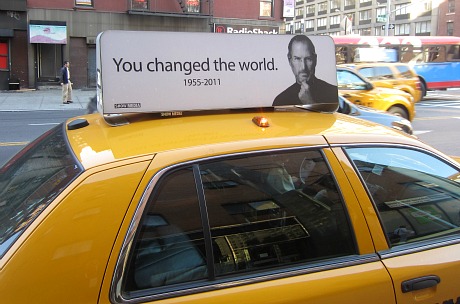
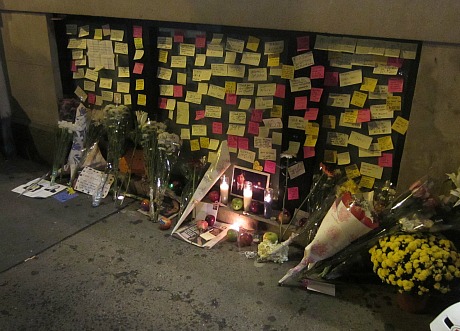
Steve Jobs flowers, candles and post-its in front of Prince Street Apple store — Thursday, 10.6, 8:15 pm.

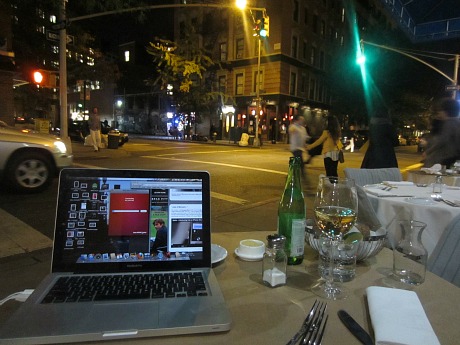
Doing some work on an outdoor table at Savore, corner of Spring and Thompson — Thursday, 10.6, 9:05 pm.

Read more

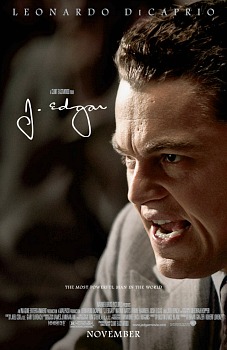
DiCaprio Hoover

Not the “scariest, snarliest bulldog in the pen” but “the most powerful man in the world”? When Clint Eastwood‘s Harry Callahan called the .357 Magnum “the most powerful handgun in the world”, I believed him. But the Hoover description seems grandiose.