The Howling

Joe Carnahan‘s The Grey doesn’t open for another 12 days, but I’ll be up to my ears in Sundance starting on Wednesday…okay, it actually begins Thursday…and I’m figuring it can’t hurt to say a few things, at least, because it’s quite a surprise for a Carnahan film. I had him pegged as “over” after the one-two punch of Smokin’ Aces and The A-Team. But The Grey is a complete departure. It’s a good tough film that’s going to sell tickets, I’m guessing, but it’s almost too pure and unsparing to be a big hit.

The Grey is a Jack London survivalist thing. Liam Neeson, Dermot Mulroney, Frank Grillo and four other guys vs. hungry CG wolves. I was thinking about the hard terms of London’s “To Build A Fire“. It ends, in a way, like “To Build A Fire”. It doesn’t fool around. This makes it a very significant film for a January release, given that January films tend to be dumpers. Which this is not.

The CG wolves got in the way for me. All CG animals do. Especially one that looked to be the size of one of the Twilight werewolves — i.e., almost as big as a lion. That kind of stuff rips me out of a film. But otherwise it’s solid (well, fairly sold) and hard and honorable. I’m trying to think of a previous instance in which a director started out with a strong, admirable film (i.e., Narc) and then seemed to cash in (if not sell out) and wham…he does a total 180 with a hardcase men-against-the-elements film that no one could accuse of being overtly commercial. And yet it is commercial, if quality means anything to anyone.

That’s all I’m going to say for now. I can post another Grey piece next week sometime.

Reckoning

Deadline‘s Pete Hammond reminds that next Saturday’s Producers’s Guild Awards — the first 2011-2012 awards ceremony that isn’t press-and-media-driven (including the Golden Globes) — is the last chance to stop The Artist . “If someone — anyone — can stop The Artist we have a race,” he wrote this morning at 2:14 am. “But if the latter sails to a win among those all-important and predictive guild’s members, it could be all over even before Oscar nominations are announced January 24.”

I think it’s been over since early December. As sold as many of us are on The Descendants, it has generated more in the way of admiration and respect than heartfelt rocket-fuel passion — let’s face it. But let’s see.

Memory Motel

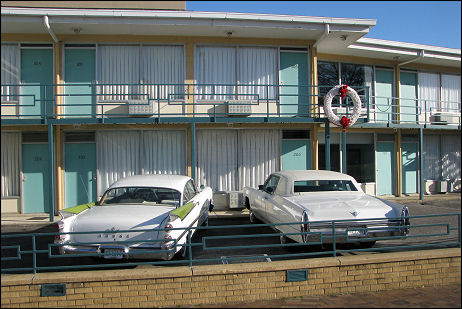
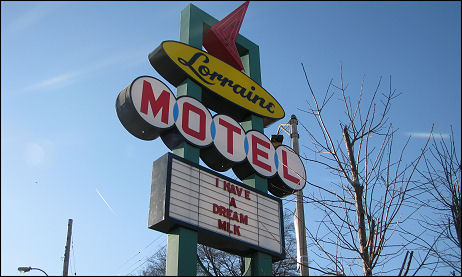
The snaps I took on 2.5.09 of the Lorraine Motel, site of the April 4, 1968 murder of Dr. Martin Luther King, speak for themselves. “The strongest impression I got was that it’s quiet — dead quiet,” I wrote during my Memphis visit three years ago. “The Lorraine stopped being a working motel in ’82 and was soon after bought by the Martin Luther King Jr. Memorial Foundation and eventually became part of a small network of buildings called the National Civil Rights Museum.

“It’s a queer sensation to suddenly be eyeballing with great concentration a place as famous/infamous as this, and to just…I don’t know, just stroll around and take it all in. I was assessing the distance between the motel’s upper balcony (where King stood just before being shot) and the rear window of a former down-at-the-heels rooming-house from which James Earl Ray fired. Over and over I’ve watched black-and-white photos and newsreel film film (and lately, since the 40th anniversary last year, color video) of this sad place, and it’s just weird to see it live.”

Don’t Glare Me Down

I feel, in a sense, like a West Virginia coal miner trying to fend off black lung disease. For the last two or three years my left eye has been suffering from computer glare — redness, puffiness, watering, pink eye — due to prolonged computer-screen exposure. I’m in front of screens for a good 10 hours a day, and that’s a lot of eye-blasting — 70 hours a week, 280 to 300 hours each month.

My initial remedy was to (a) turn down the brightness levels to one-third and (b) wear sunglasses while working, but it’s hard to find ones that don’t make things look too dark. Then I started being extra-careful about keeping the screen as far away from my eyes as possible. Two days ago I ordered two screen-glare filters. Maybe that’ll work. My right eye, oddly, hasn’t had any difficulty.

That’s It?

I wholeheartedly agree that the best CG fakery is the modest, non-showy kind that you never notice until you see it pointed out in a piece like this. But c’mon…two minutes devoted to how CG bookshelves and other architectural archive elements were created? Plus some train tracks and a slit throat and one or two other bits? The work was done by Stockholm’s The Chimney Pot.

Oscar Poker #64

Yesterday’s Oscar Poker was a four-way between Awards Daily‘s Sasha Stone, Gold Derby‘s Tom O’Neil, Coming Soon‘s Ed Douglas and myself. We recorded on an outdoor balcony on the third floor of Barnes and Noble at The Grove, with planes droning overhead and three or four kids chattering nearby. It happened about four hours before the Golden Globes began.

The energy never flagged, and a good scuffle between Ed and Sasha materialized about halfway through. Ed was predicting a Meryl Streep Best Actress win and Sasha was pooh-poohing this and saying it was Viola Davis‘s time. Douglas was on the money, it turned out.

Here’s a stand-alone mp3.

Bloom Was Off

There was probably no way, I suppose, for Ricky Gervais to aggressively lambast and offend the way he did during his 2011 Golden Globes hosting gig. Last night’s opening monologue plays slightly better than the second time, for whatever that’s worth. It seemed to me that people laughed a bit more last night — in 2011 a lot of them scowled or looked a bit stunned. The only person Gervais seemed to really piss off was Elton John.

Globes Tick-Off

7:54: All hail The Descendants for winning the Golden Globe for Best Drama-yamma-mamma! The cheer inside the Fox Searchlight party was deafening. Good thing for FS, for HE and for all Hawaiians, honorary and otherwise. A counter-surge against The Artist or just a good night in and of itself? Hugged Judy Greer, who was of course delighted.

7:47 pm: The DescendantsGeorge Clooney wins for Best Dramatic Actor. Good one! Gracious speech, kudos to Pitt, Fassbender, etc. Classy guy, as always.

7:37 pm: The Artist wins, naturally, for Best Comedy or Musical, but Meryl Streep‘s Best Actress win is a bit of a shocker, as most of the know-it-alls had Viola Davis pegged. I know that Awards Daily‘s Sasha Stone was stunned by this.

7:26 pm : Jean Dujardin wins for Best Actor, Comedy or Musical. Charming fellow, good jawline, nice speech…piffle.

7:18 pm : I drove down to the Beverly Hilton on the scooter, got through security, and am now drinking champagne. No, champagne cocktails! With the jovial Fox Searchlight gang.

7:13 pm: Shocker! Good shocker! Hugo‘s Martin Scorsese wins the Golden Globe for Best Director! What if anything does this signify?

6:47 pm: The Best Supporting Actress Golden Globe goes to Octavia Spencer for her performance in The Help. Which means that Viola Davis is definitely, absolutely winning for Best Actress. Right? They’re both on a roll. Blah speech by Spencer though. She just read names, names, names…nothing from the heart.

6:41 pm: All right, I’m heading down to the Bev Hilton…leaving now. A part of me would rather stay here and just watch & tweet. Eff it.

6:32 pm: The Golden Globe for Best Foreign Language film goes to — yes! — Asghar Farhadi‘s A Separation. The film’s male lead, Peyman Moadi, accompanies Farhadi to the stage for acceptance, but nobody points him out. Farhadi thanks Sony Classics co-presidents Michael Barker and Tom Bernard, calls Iranian people “truly loving”…and lets it go at that.

6:21 pm: Woody Allen‘s Midnight in Paris beats Aaron Sorkin and Steve Zallian‘s Moneyball screenplay? Really? Okay, whatever. I’m not going to put down Allen’s clever screenplay, but it really doesn’t have the spirit or freshness or emotional current of the Moneyball screenplay. Yes, I’m talking about what was written down.

6:18 pm: N.Y. Times reporter Brian Stelter is tweeting that Jon Huntsman is bailing out and “poised to endorse Romney.” The second part is predictable but not very admirable, I must say.

6:14 pm: I agree — the Best Animated Feature Golden Globe going to Tintin is the HFPA saying “sorry, man, but this is the best we can do” to Steven Spielberg in lieu of their inability to raise high the War Horse roof beam,

Tim Robbins‘ silvery gray hair looks really nice with his lean, tanned face against the midnight tux.

6:01 pm: Golden Globe for Best Actress in a Musical or Comedy has gone to Michelle Williams for “that hysterical comedy” My Week With Marilyn. (Seth Rogen provided the description.) A mother first, eh?

5:51 pm: Ricky Garvais‘ decision to wear a maroon-and-black tuxedo is, to my eyes, a huge miscalculation. A sartorial nightmare. Maroon jackets, sweaters, socks, scarves, capes…all bad.

5:48 pm: The Artist composer Ludovic Bource has won a Golden Globe for Best Score. And there’s your tipoff about general HFPA Artist sentiments.

5:37 pm: I realize it’s not nice to go where I’m about to go, but…actually, I can’t. I’ve wimped out. The thought concerned Melissa McCarthy. The thought is fairly evident. Sorry but c’mon.

5:22 pm: Nobody in my sphere cares very much about Golden Globe TV awards…sorry. Tens of thousands are paying attention, and that’s fine. No disrespect intended. Wait…Kate Winslet won for Todd HaynesMildred Pierce? I care about that. Excellent work.

5:09 pm: To no one’s surprise and everyone’s approval (except for the hardcore Drive geeks), Christopher Plummer has won the Best Supporting Actor award for his performance in Beginners. And incidentally, the NBC cameras have so far delivered two shots of the Sony Classics table, and I didn’t see Corey Stoll.

Sluggish

The day has so far included a little writing and researching, and then a four hour hang-out at West Hollywood’s The Grove with Awards Daily‘s Sasha Stone , Gold Derby‘s Tom O’Neil and Coming Soon‘s Ed Douglas (including a recording of a one-hour Oscar Poker), and then back to the pad to bang out two articles before preparing to hit the Fox Searchlight Golden Globes viewing party at the Beverly Hilton.

Except now it’s 4:29 pm and the show starts at 5 pm so maybe I’ll hang here and watch Ricky Gervais‘s opening monologue and then head over to the party. Everything always takes more time than you figure it will…every time.

Nugent Got It, Said It, Told It

Frank S. Nugent was the reigning New York Times film critic from 1936 to 1940, and a fairly young one — 28 when he landed the job and 32 when he left it. He gradually segued into screenwriting and wrote 21 film scripts until his death in 1965 at age 57. (Obviously something befell him.) 11 of those scripts were for director John Ford, including The Quiet Man, Mister Roberts and, most notably, The Searchers.

Last night I turned to Nugent’s March 1940 review of Rebecca to get the Tooze effect out of my head, and it hit me all over again that Nugent could write like Joe DiMaggio could hit, and that he really knew the world that he lived in, and was as knowledgable about the language of film and the nature of powerful, talented types and the ins and outs of Hollywood poltics as anyone else, Manny Farber or Andre Bazin or anyone in that high-falutin’ realm included.

Savor this, and note how Nugent felt obliged to define the word “cineaste”:

“Before getting into a review of Rebecca, we must say a word about the old empire spirit. Hitch has it — Alfred Hitchcock that is, the English master of movie melodramas, rounder than John Bull, twice as fond of beef, just now (with Rebecca) accounting for his first six months on movie-colonial work in Hollywood. The question being batted around by the cineastes (hybrid for cinema-esthetes) was whether his peculiarly British, yet peculiarly personal, style could survive Hollywood, the David O. Selznick of Gone with the Wind the tropio palms, the minimum requirements of the Screen Writers Guild and the fact that a good steak is hard to come by in Hollywood.

“But depend on the native Britisher’s empire spirit, the policy of doing in Rome not what the Romans do, but what the Romans jolly well ought to be civilized into doing. Hitch in Hollywood, on the basis of the Selznick Rebecca at the Music Hall, is pretty much the Hitch of London’s The Lady Vanishes and The Thirty-nine Steps, except that his famous and widely-publicized ‘touch’ seems to have developed into a firm, enveloping grasp of Daphne du Maurier‘s popular novel. His directorial style is less individualized, but it is as facile and penetrating as ever; he hews more to the original story line than to the lines of a Hitch original; he is a bit more respectful of his cast, though not to the degree of close-up worship exacted by Charles Laughton in Jamaica Inn.

“What seems to have happened, in brief, is that Mr. Hitchcock, the famous soloist, suddenly has recognized that, in this engagement, he is working with an all-star troupe. He makes no concession to it and, fortunately, vice versa.

“So Rebecca — to come to it finally — is an altogether brilliant film, haunting, suspenseful, handsome and handsomely played. Miss du Maurier’s tale of the second mistress of Manderley, a simple and modest and self-effacing girl who seemed to have no chance against every one’s — even her husband’s — memories of the first, tragically deceased Mrs. de Winter, was one that demanded a film treatment evocative of a menacing mood, fraught with all manner of hidden meaning, gaited to the pace of an executioner approaching the fatal block. That, as you need not be told, is Hitchcock’s meat and brandy.

“In Rebecca his cameras murmur ‘Beware!’ when a black spaniel raises his head and lowers it between his paws again; a smashed china cupid takes on all the dark significance of a bloodstained dagger; a closed door taunts, mocks and terrifies; a monogrammed address book becomes as accusative as a district attorney.

“Miss du Maurier’s novel was an ‘I’ book, its story told by the second, hapless Mrs. de Winter. Through Mr. Hitchcock’s method, the film is first-personal too, so that its frail young heroine’s diffident blunders, her fears, her tears are silly only at first, and then are silly no longer, but torture us too. Rebecca’s ghost and the Bluebeard room in Manderley become very real horrors as Mr. Hitchcock and his players unfold their macabre tale, and the English countryside is demon-ridden for all the brightness of the sun through its trees and the Gothic serenity of its manor house.

“But here we have been giving Mr. Hitchcock and Miss du Maurier all the credit when so much of it belongs to Robert Sherwood, Philip MacDonald, Michael Hogan and Joan Harrison who adapted the novel so skillfully, and to the players who have re-created it so beautifully. Laurence Olivier‘s brooding Maxim de Winter is a performance that almost needs not to be commented upon, for Mr. Olivier last year played Heathcliffe, who also was a study in dark melancholy, broken fitfully by gleams of sunny laughter. Maxim is the Heathcliffe kind of man and Mr. Olivier seems that too. The real surprise, and the greatest delight of them all, is Joan Fontaine‘s second Mrs. de Winter, who deserves her own paragraph, so here it is:

Rebecca stands or falls on the ability of the book’s ‘I’ to escape caricature. She was humiliatingly, embarrassingly, mortifyingly shy, a bit on the dowdy side, socially unaccomplished, a little dull; sweet, of course, and very much in love with — and in awe of — the lord of the manor who took her for his second lady. Miss du Maurier never really convinced me any one could behave quite as the second Mrs. de Winter behaved and still be sweet, modest, attractive and alive. But Miss Fontaine does it — and does it not simply with her eyes, her mouth, her hands and her words, but with her spine. Possibly it’s unethical to criticize performance anatomically. Still we insist Miss Fontaine has the most expressive spine — and shoulders! — we’ve bothered to notice this season.

“The others, without reference to their spines — except that of Judith Anderson’s housekeeper, Mrs. Danvers, which is most menacingly rigid — are splendidly in character: George Sanders as the blackguard, Nigel Bruce and Gladys Cooper as the blunt relatives, Reginald Denny as the dutiful estate manager, Edward Fielding as the butler and — of course — Florence Bates as a magnificent specimen of the ill-bred, moneyed, resort-infesting, servant-abusing dowager.

“Hitch was fortunate to find himself in such good company but we feel they were doubly so in finding themselves in his.”

Grain Freak

I couldn’t help but chuckle at Gary W. Tooze‘s just-posted DVD Beaver review of MGM’s Rebecca Bluray (out 1.24). I respect and value the capability of Bluray to capture and deliver celluloid texture, and I know that grain is a natural component of this. But you’d have to search far and wide to find a more obsessed grain fetishist than Tooze. You can almost feel a certain erotic tumescence as he writes about grain, grain, glorious grain.


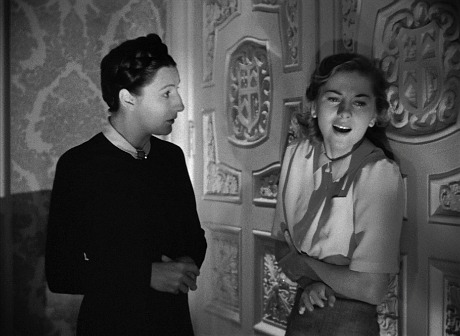
Judith Anderson, Joan Fontaine in Alfred Hitchcock’s Rebecca.

I don’t want to see Rebecca DNR’ed, Gor forbid, but I’m not queer for grain either. I can guarantee you that Rebecca producer David O. Selznick and director Alfred Hitchcock never once spoke to each other excitedly about the delightful graininess of the footage they were capturing. No golden-age Hollywood cinematographer or director or producer ever did…not once. Because there was nothing to say. Grain was simply a technical, professional fact of life, and they accepted it the way Londoners accept fog and rainshowers and polar bears accept ice and snow.

I’m very much looking forward to the film-like appearance of the Rebecca Bluray — terrific. And I know that grain is what that movie is “made of”, in a very true and particular sense. But if there was some magical way to capture every last detail in Rebecca and at the same time reduce the grain somewhat, at least to the extent that the Bluray viewer wouldn’t be reminded of the fact that Joan Fontaine, Laurence Olivier, Judith Anderson and George Sanders are smothered in a swarm of billions of silver mosquitoes…well, that would be a preferable way to go. Because Selznick and Hitchcock weren’t aware of said mosquitoes — only Bluray viewers are. Because Bluray makes these critters seem vivid and pronounced like they never did in the old days. And I, apparently, am the only one who laments or even acknowledges this.

Respect The Man

If either Woody Allen or Sony Classics co-presidents Michael Barker and Tom Bernard are reading this, please do the right thing and get Midnight in Paris costar Corey Stoll a seat at tomorrow night’s Golden Globes awards. At today’s Spirit Awards luncheon Stoll told N.Y. Times “Carpetbagger” columnist Melena Ryzik that he’s been excluded from the Sony Classics table inside the Beverly Hilton ballroom.


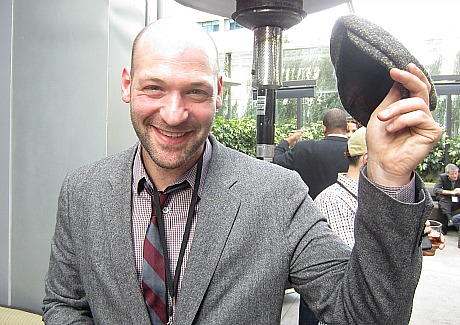
Midnight in Paris costar and Ernest Hemingway inhabitor par excellence at today’s Spirit Awards luncheon at BOA Steakhouse. I interviewed Stoll in Manhattan a little more than three months ago.

Guys…really? Stoll is the standout supporting performer in this, one of the most successful films in the history of Sony Classics and a hallmark in Woody’s career. His Ernest Hemingway is perfect and succinct and beautiful in a way — one of the main reasons for the personal charisma and magnetism in this film. If I had anything to say about it Stoll would be one of the Best Supporting Actor nominees at the Globes and the Oscars. Ryzik, myself and dozens of others have interviewed him and praised his work. This isn’t right….c’mon.