Refresher

Michael Cieply has tapped out a 4.18 N.Y. Times article (which will appear in Sunday’s print edition) about Paul Thomas Anderson‘s The Master (Weinstein Co., 10.12). The piece is titled “Filmmaker’s Newest Work Is About…Something” and is subtitled “Paul Thomas Anderson Film May Be About Scientology.” The basic “tell” is that PTA’s film is partly about a figure who could be L. Ron Hubbard (played by Phillip Seymour Hoffman) and is largely about the beginnings of Scientology, at least in broad historical spitball terms.
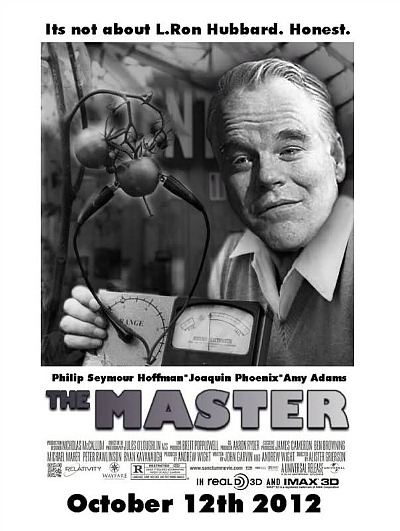
So the article, no offense, doesn’t exactly advance the narrative since people have been batting around the Scientology connection angle for quite some time.

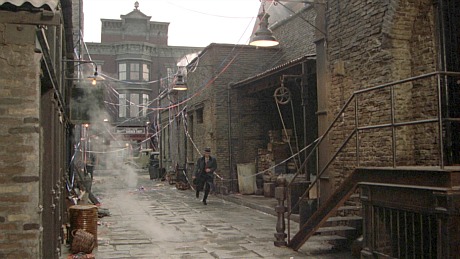
Anderson wouldn’t talk to Cieply but Cieply spoke to a Scientology spokesperson, and he quotes from a short piece I wrote last September when I spoke to Hoffman at a party for The Ides of March. Plus the article has some cool black-and-white location photos of actors hired to perform in a period scene from the film.

Key passage #1: “Anderson has declined to speak publicly about the movie…but the details suggest a story inspired by the founding of Scientology, and that has provoked industry whispers. With that church’s complicated Hollywood ties and high-profile adherents like Tom Cruise, a film even loosely based on it will guarantee discussion upon its release.”

Key passage #2: “With The Master Mr. Anderson will tell a dual tale. The first is that of a boozy Navy veteran, played by Joacquin Phoenix, who shares what Mr. Anderson’s associates say are accidental similarities with the filmmaker’s father, who died in 1997. The elder Anderson was a Navy vet who served in the Pacific during World War II, and, like [Pheonix’s character], was born about 90 years ago.

“The second story is that of Lancaster Dodd, who is eerily referred to in a screenplay Mr. Anderson initially wrote for Universal Pictures only as ‘The Master’ or ‘Master of Ceremonies.’ Played by Mr. Hoffman, he is the red-haired, round-faced, charismatic founder of that most Californian of phenomena, a psychologically sophisticated, and manipulative, cult.

“Dodd was inspired by — though not entirely modeled on — Scientology’s L. Ron Hubbard,” Cieply writes.

Here’s what I wrote about my chat with Hoffman last September:

“At last night’s Ides of March party Phillip Seymour Hoffman — a.k.a. ‘Philly’ — insisted that Paul Thomas Anderson’s The Master, which he just finished filming, is ‘not a Scientology film.’ But I’ve read an early draft and it seems to be about a Scientology-like cult, I said to him. And I’ve read about the parallels. “I don’t know what you’ve heard and what script you’ve read,” Hoffman replied. “Trust me, it’s not about Scientology.”

“Maybe not specifically or literally, but there are just too many proofs and indications that The Master (or whatever it’s eventually going to be called) is at least about a cult with a charismatic L. Ron Hubbard-type leader that could be seen as a metaphor for Scientology. At least that.”
Long Haul

There’s a 4.18 Variety story from Nick Vivarelli in Rome about a new “redux” version of Sergio Leone‘s Once Upon A Time in America (’84) that will screen next month in Cannes. Halfway through the piece is the following: “Redux adds 40 minutes of original footage to the 229-minute running time.” In other words, it will run 269 minutes, or a minute shy of four and a half hours.

So why didn’t Vivarelli or his editors simply say that? Declaring that Once Upon A Time Redux adds 40 minutes of footage to the 229-minute running time is like describing the 44 year-old Judd Apatow as a guy who’s kept a grip on mortality for 12 years since turning 32.

No journalist covering Cannes 2012 is going to sit through a 269-minute time machine zone-out…nobody except for fringe Leone fanatics and sentimentalists who go to older films to weep about their lost youth. There’s too much to cover at Cannes and too little time as it is. That said, I would love to see the Redux version some other time. Maybe it’ll play at the American Cinematheque or LACMA later this year.

Excerpts from OUATIA‘s Wikipage: (a) “The original shooting-script, completed in October 1981 after many delays and a writers’ strike that happened between April and July of that year, was 317 pages in length” (b) “At the end of filming, Leone had about 8 to 10 hours‘ worth of footage. With his editor, Nino Baragli, Leone trimmed this down to about almost 6 hours, and he originally wanted to release the film in two movies with three-hour parts” (c) “The producers refused (partly due to the commercial and critical failure ofBertolucci’s two-part Novecento) and Leone was forced to further shorten the length of his film, resulting in a completed (i.e. scored, dubbed, edited, etc.) film of 229 minutes.” And then the Ladd Co. ogres cut it down even further to 139 minutes, and it was this version that went out to theatres in the initial general release.

So there are now three versions of the film: the 269-minute Redux version, the 229-minute version and the all-but-disappeared 139-minute version, which Encore reportedly aired in 2009.

Giant Among Comedians

It’s long been my opinion that Gerritt Graham is one of the greatest under-used comic actors in motion picture history. I believe this because of two performances he gave eons ago — the drugged-up rock star “Beef” in Phantom of the Paradise (’73) and Jeff, the wildly superstitious guy who’s terrified of driving a red car in Robert Zemeckis‘s legendary Used Cars (’80). Anyone who’s seen the latter remembers Graham’s hilarious “too fuckin’ high!” scene…a classic.

And don’t forget the madness of Frank McCrea (i.e., the high prices monster) either.

Phantom Guy Passes

I failed earlier today to remember William Finley, the anguished central figure in Brian DePalma‘s Phantom of the Paradise (’73) who died four days ago in Manhattan, at age 71. It would appear that Finley was a fine fellow but face it — the world took note of his acting career mainly because of his roles in DePalma films (Sisters, The Wedding Party, The Black Dahlia).

Finley hit the mark in Phantom, portraying Winslow Leach and pouring his heart out for Jessica Harper, etc. But the stand-out performance in that flamboyant glamrock satire came from the brilliant Gerritt Graham as “Beef”…no?

Alcoholic Sunday

My memory of John Frankenheimer‘s Black Sunday (’77) was that it wasn’t a great thriller but a relatively decent one with a few exceptional action sequences. Not true. I saw it Sunday night at the TCM Classic Film Festival, and everything about it felt off-balance, strained, unconvincing and generally second-rate. Sometimes it’s better to leave well enough alone and not revisit an older film.

There’s a hospital scene in which Robert Shaw‘s character, an Israeli Mossad-type agent called Major David Kabakov, is laid up with injuries. His partner and best friend, Robert Moshevsky, is played by Steven Keats. The scene begins with Marthe Keller‘s Dahlia Iyad, a Black September terrorist, dressed as a nurse and slipping into the hospital (located somewhere in Los Angeles) to kill Shaw. Keats spots her about to go into his room and asks who she is, and tells her they need to go downstairs and check with security to make sure she’s okay.

The fact that Keller speaks with a thick German accent should be a huge red warning light for Keats, but he doesn’t seem overly concerned. Then he goes into an elevator with Keller and turns his back, looking at the floor-indicator panel while Keller stands behind him. When the doors open on the bottom floor Keats is lying dead from a lethal hypodermic that Keller has shoved into his neck artery. Repeat after me: a Mossad agent is going to turn his back on a suspicious nurse with a German accent inside an elevator?

Black Sunday is peppered with ridiculous scenes like this, or with aspects that don’t work or which seem shoddy, or with bad acting or dialogue that strains credulity.

Black Sunday came right after Frankenheimer’s relatively decent French Connection II, but I’ve always believed it was the first significant manifestation of his alcoholic downswirl period. His Wiki page says the following: “Black Sunday tested very highly, and Paramount and Frankenheimer had high expectations for it. When it failed to become the hit that was expected, Frankenheimer admitted he developed a serious problem with alcohol. He is quoted in Charles Champlin‘s biography as saying that his alcohol problem caused him to do work that was below his own standards, such as Prophecy (1979), an ecological monster movie about a mutant grizzly bear terrorizing a forest in Maine.”

“Playing Like Dicks”

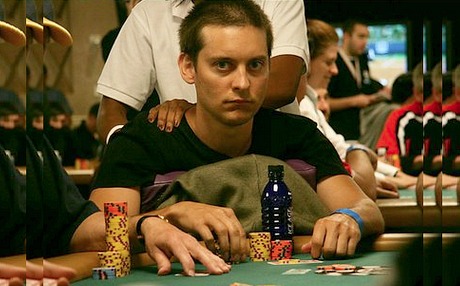
Hollywood Interrupted‘s Mark Ebner has written a good, well-sourced article about the egoistic, reckless mentality propelling some Hollywood hotshot poker games, particularly that infamous Tobey Maguire game that Leonardo DiCaprio, Ben Affleck and Matt Damon occasionally attended before it all went kablooey after that lawsuit, etc.

“Actor and lifelong poker player Kevin Pollak never played in Maguire’s game — so named because he is among its highest-profile participants and most faithful attendees. But he did play briefly with some of its mainstays, including Nick Cassavetes, former nightclub impresario Chuck Pacheco (now Cassavetes’ producing partner) and Rick ‘Scum’ Salomon, a featured player on Fox TV’s PokerStars Big Game, who once cleared Pamela Anderson‘s quarter-million-dollar gambling debt in exchange for matrimonial favors. And he’s got the scars to prove it.

“‘Cassavetes is one of the most dangerous players I’ve ever seen at a table,’ Pollak recounts. ‘You have to have a certain level of fearlessness along with savvy. If you add in a reputation and deep pockets – that makes someone dangerous.’

“Playing in a regular game that suddenly went from a thousand-dollar buy-in to $5000 virtually overnight, he found himself across the felt from Cassavetes and the others in what was now a full-contact sport.

“‘It was like being surrounded in the Old West by the best gunslingers in town, and I’m the Sheriff or something,’ says Pollak, who was the original host of the long-running Celebrity Poker Showdown on Bravo. ‘I was like, ‘We’re gonna need a bigger boat to get out of this.’ I only played with them for three weeks — three games — and then I said, ‘I’m done kidding myself…you guys are insane.’

“To them, it’s all relative. They play in their regular game [Tobey’s], and this is how they play. It’s a tactic — an investment in the future.

“Nick actually pulled me aside — I got up to go to the restroom, and when I came out, he was waiting for me. He took me into a side room and said, ‘Dude, you’ve got to lighten up. You could kill this game if you stopped being so upset about everyone playing like dicks. This is how we play, and you could be killing these guys, because half of them don’t know what the fuck they’re doing. They just know how to play like a dick. You actually know how the game works, so stop being so pissed off at everyone for over-betting 3-2 off, and take their money.'”

“Great Gift of Ignorance’

Orson Welles talking sometime in the early to mid ’60s (to judge by his appearance) about legendary cinematographer Gregg Toland, and discussing in particular Toland’s willingness to go along with whatever brazen ideas Welles had during the filming of Citizen Kane , and how Welles wasn’t innovative as much as unaware of what the rules were. Toland died of a heart attack at age 44 — what could that have been about?

No Last Hurrahs

I don’t like movies that say “look at these older graying guys doing this!” or “look at these older graying guys doing that!” I’d rather just watch a movie about older guys doing whatever minus the pigeonholing. I also don’t like synopses like this: “A pair of aging con men try to get the old gang back together for one last hurrah before one of the guys takes his last assignment — to kill his comrade.” That’s a bullshit plot from the ’80s.


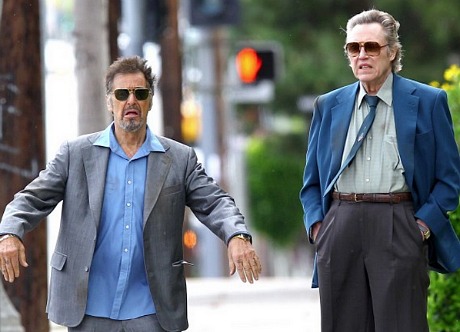
Al Pacino, Chris Walken during filming of Stand-Up Guys.

In real life there’s no “last” anything. There’s just the next thing, and the next thing after that. “People always ask me what my favorite is of all the films I’ve made,” John Ford once said, “and I always say, ‘The next!'”

Heavyosity

The instant I pulled my new Oppo 93 out of the box I knew I’d made the right decision. Not just because it comes in a black faux-cloth bag with an Oppo logo on it, but because it’s fairly heavy and in my head that means it’s a sturdy, high-quality thing. I’ve never liked buying hardware of any kind that feels proportionally too light. I don’t care if the manufacturer has inserted lead bars so it’ll feel heavier — people like me associate high-end performance and reliability with molecular density.

From the Oppo 93 web page: “Built around a steel chassis, aluminum faceplate, and center-mounted tray, the BDP-93 is designed to impress as well as to provide a stable base for the highest quality reproduction of your favorite media.

The Oppo 93 is the Macbook Pro of Bluray players — I know it’ll drive like a Beemer for as long as I own it. I haven’t even looked into the various capabilities, but I love the wifi flash drive that you plug into the back.

“…Like You’re Being Murdered”

Girls is refreshing not just because it exposes girl talk in all of its raw glory, but the way the characters speak comes so naturally you really feel like you’re sitting in the room with them. It sent me back to my NYU dorm room days and how great it felt just to be hanging in the balance of who I was and who I might become, and with a whole long road laid out in front of me.

“Like taking a shower or sleeping in the car on a long drive, it didn’t matter that you were where you had to be — it mattered that you weren’t there yet. That kind of limbo comes usually once in a lifetime. Ten more years of that kind of thing and these characters [will] all become a sitcom about losers on the Fox network. But they’re still young enough, their futures are still bright enough, [so] we can forgive them their confusion.

“Still, what bothered me about Girls was what bothered me about Tiny Furniture. I know that Lena Dunham in the movie, and maybe in real life, is discovering her sexuality slowly — maybe slower because of her ‘body issues.’ But I hope at some point her character realizes that being the object of some dude sticking his dick in her and getting off is not the way any girl, or woman, should have sex. Maybe she doesn’t yet feel she can demand pleasure in her own right but hopefully she’ll get there. Hopefully she’ll meet that one guy where they won’t get out of bed for two weeks straight and she’ll know the glory of superior, hardcore, stripped-down loving.

“Right now, all I wanted to do was march into that room and throw that dude against the wall for doing her like that. She is 24, not 16. She’s old enough to know better. Or is she?” — from Sasha Stone‘s 4.17 Awards Daily piece on Lena Dunham‘s show.

I agree — that guy Lena was having it off with was one of the most odious and animalistic Uriah Heeps I’ve ever seen live or on a screen or on a stage or in an art gallery. Where did they find this fucking troglodyte? After watching he and Lena together I decided to stop thinking about sex, much less having it, for at least the next 90 days.

Jett on Girls

“I totally agree with what you wrote about Girls,” Jett wrote this morning. “And I’m curious what you think about people hating on it because it only focuses on privileged middle-class white girls. People are too fucking sensitive. Lighten up.”

My reply: “You agree about the girl-on-girl dialogue being really good? Can you write something? Just bang it out in your lunch hour. Obviously you have a generational perspective, etc.”

To which Jett replied: “I mostly relate to the story lines and context. When it was on one of my roommates even said she couldn’t watch the show because she talks to these people everyday, and it’s frustrating. I think that says a lot about how spot-on it is. The dialogue itself has a Diablo Cody quirky sharpness to it, pre-Jennifer’s Body.

“That moment when Lena’s boss says she should take over the company’s Twitter account because she has the voice for it? That really sunk in with me. It was patronizing in a way because I’ve heard that kind of thing and it demeans my line of work but it’s so true, and that’s a sign of good writing.

Lena Dunham did this exact same role with Tiny Furniture, and she feels so real all the time, especially when she’s delusional about everything. Kara, my other roommate, is basically Lena Dunham, so that probably helps too. Really smart, but snarky in a subversively sad way.”