
“Dumb Whore Award of 1974”

From a 7.12.09 piece called “The Art of Paycheck Acting”: “The Towering Inferno was entertaining crap when it opened 35 years ago, and the exact same deal applies now that it’s on Bluray. But Paul Newman and Steve McQueen are honorable and oak-solid in their starring roles. This is impressive given the fact that neither actor has a real part to play — they were just paid to show up and go through the Irwin Allen paces. They knew it then and we know it now, but they deliver the goods anyway. That’s professionalism and star power.

“There are four ways that brand-name actors deliver straight-paycheck performances in mediocre big-studio films. One, they do it straight and plain and cruise by on chops and charisma, like McQueen and Newman. Two, they do it straight and plain and don’t cruise by on chops and charisma — they sink into the movie like quicksand and then suffocate. Three, they behave in an extremely mannered and actorish way as a way of telegraphing to the audience that they’re totally aware that they’re in a crap film. And four, they go beyond mannered and waaay over the top (like Jon Voight in Anaconda) and turn their performances into inspired farce.”
Read more

Wilder at 80, 92Y, Three Years Ago

Born in 1933, Gene Wilder didn’t begin making films until 1966 when he played the giggly, anxious undertaker in Bonnie and Clyde (’67), at which time he was 33. No spring chicken. He had just turned 40 when he began filming Young Frankenstein in ’73 or early ’74. (Whenever.) He was 46 or thereabouts when he began working on Stir Crazy (’80). And then he quit acting after making Funny About Love (’90), at which point he was 56 or 57. he must have been coping with early Alzheimer’s disease when he did this interview with Robert Osborne at Manhattan’s 92Y in 2013.

Milkblood

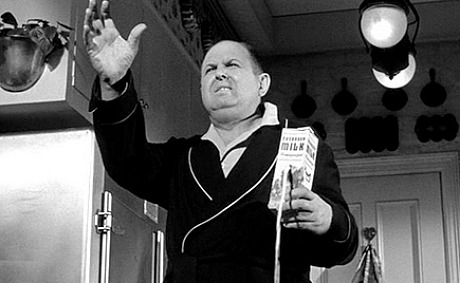
All along Jonathan Nolan and Lisa Joy‘s Westworld (HBO miniseries beginning on 10.2) has seemed heavier, gloomier and creepier than Michael Crichton’s 1973 original, which had a lighthearted tone until the final act. Everyone in the current version seems to be bothered or haunted or pervy or a combination of all three. The most distinctive visual bit in the trailer is when a milk-like liquid bleeds out of a bullet hole in a robot’s stomach. Which reminds us, of course, of that moment in The Manchurian Candidate (’62) when John McGiver, playing a liberal U.S. Senator, is shot by Laurence Harvey with the bullet puncturing a milk container, etc.

Things I Hate About The Great Escape

I got into a brief back-and-forth last night with Farran Nehme (a.k.a. Self Styled Siren) about’60s-World War II movies and particularly John SturgesThe Great Escape (’63), which I loved as a teenager and 20something but which has been irritating me more and more as I get older.

My basic beef is that the American and British prisoners are so casually enterprising, so smooth and cool and smug, that most of the camp scenes feel more or less like Hogan’s Heroes — i.e., doses of light attitude + mild slapstick comedy mixed with Sgt. Bilko with Germans. Stalag 17 feels much more realistic. The prisoners swagger around like cock of the walks, smirking and dispensing insults and just getting away with every stunt in the book.

The only bad thing that happens during the entire camp portion (or about 65% to 70% of the film) is when one of the three tunnels is discovered by the Germans. That’s it! No other mishaps or mistakes except for the shooting of Angus Lennie‘s Archibald Ives, except in my book that’s a good thing.

Five random irritants: (1) The German camp commanders are far too lenient with the prisoners, who after all have been put into this super-camp because they’re all disobedient bad apples with a high likelihood of trying to escape;

(2) Why oh why don’t the Germans simply post two guards inside each of the barracks so as to spot any possible digging going on?;

(3) I despise Richard Attenborough‘s Roger/”Big X” character, such that I always feel a slight pang of pleasure when he gets machine-gunned to death near the end (not that I’m happy that the other 49 other prisoners are killed but at least Attenborough has been shut up for good);

(4) I hate the Brigadoon-like Scottish accent and cute-little-guy mannerisms used by Lennie, and so I always find it gratifying when Ives gets machine-gunned to death on the camp wire;

(5) That scene when McQueen and Ives explain to their superiors how they intend to dig their way out under the fence like moles is completely absurd and not even vaguely funny, and McQueen’s delivery of his dialogue is straight out of The Honeymoon Machine.

Read more

Replies to Thoughts, Quotes from Buchanan’s Oscar-Season Piece

Kyle Buchanan‘s Vulture article about the about-to-launch Oscar season (“The Unsettled, Unsettling Oscars“) riffs every which way but basically posts the following ten intuitions or suspicions:

(1) “It’s a weird year…not that much I’m looking forward to…no one movie that I feel certain is going to get a Best Picture nomination”; 

(2) The Birth of a Nation is Best Picture toast (“It was good enough for the narrative it had at Sundance, but it’s not good enough to withstand what’s happening now”); 

(3) But given the general compulsion among Academy and guild members to “get their black on,” Fences and Moonlight will almost certainly benefit from Nate Parker‘s fall from the pedestal; 

(4) Manchester By The Sea is “a downer for sure”…an unfounded slur as there’s a distinct difference between downer and sad (and keep in mind that Buchanan himself wasn’t a huge fan when he tweeted about Manchester last January); 

(5) Buchanan believes that “if voters crave a fizzy counterbalance to Manchester, I think they’ll flock to Florence Foster Jenkins“…wrong! Except for a possible knee-jerk Best Actress nomination for Meryl Streep and a supporting actor nom for Hugh Grant, Florence doesn’t have the weight or the edge.

Read more

Wilder’s Peak Performance: Howling, Bug-Eyed, Electric-Haired, Droll, Perfect

Gene Wilder, an absolutely genius-level comic actor who fully understood the angst and anxiety of 20th Century existence and the bullshit within and who ruled and revelled for a glorious 13-year period (’67 to ’80), has left the planet. I’m very sorry but the poor guy was grappling with Al Z. Heimer. Hugs and condolences for his friends, loved ones, family, fans. Wilder was 83.

Brilliant and crackling as he was in several films during his hot streak, Wilder never quite matched his exquisitely delivered performance as Dr. Fredrick Frankenstein in Mel BrooksYoung Frankenstein (’74) — a film that I’ve watched at least 20 times and could easily watch another 20 for Wilder’s performance alone. Incandescent, precise, fall on the floor.

For me his career boiled down to seven key performances — the kidnapped undertaker in Arthur Penn‘s Bonnie and Clyde (67), Leo Bloom in Brooks’ The Producers (’68 — “Max, he’s wearing a dress”), the doctor who has an affair with a sheep in Woody Allen‘s Everything You Always Wanted to Know About Sex (But Were Afraid to Ask) (’72), Fredrick Frankenstein, The Waco Kid in Blazing Saddles (’74), George Caldwell in Arthur Hiller‘s Silver Streak and Skip Donahue in Sidney Poitier‘s Stir Crazy (’80).

Read more

Respect for Max Rose

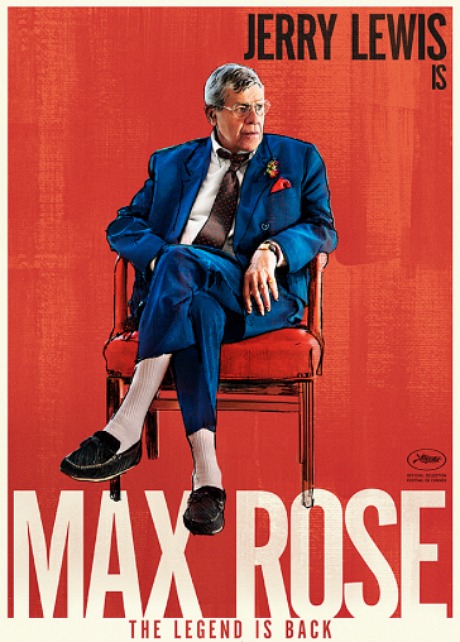
As I wrote last night, Daniel Noah‘s Max Rose (Paladin, 9.2) is solemn, well honed and salutable. I love that Noah had the decency not to try to charm or tickle me into submission. It’s a melancholy film in some…okay, most respects, but not a downer because Lewis is so interesting to watch. His performance isn’t “performed” — he just divvies out a series of straight, no-bullshit, take-it-or-leave-it cards. These cards create a vibe, an aroma of hurt that doesn’t want to be sniffed or shared. But there it is nonetheless.

The trailers have told us that Max Rose is about the titular character, an elderly but mostly unbowed jazz pianist (Jerry Lewis), coping with a realization that his recently deceased wife Eva (Claire Bloom) had been unfaithful to him since the ’50s.

But Max has already digested this news before the film begins (thank God!), and so we’re spared the heartache scenes. Max, who’s been written as a riff on Lewis as well as The King of Comedy‘s Jerry Langford in his dotage, just sits there and more or less takes it like a man. He keeps to himself for the most part, meditating, scowling a bit. For me Lewis’s silences are a master stroke. He lets you sense what he’s thinking and feeling, and in so doing is spared the verbal effort, and the payoff is that much more than if Noah had written him pages and pages of dialogue.

As I watched I was muttering to myself to and particularly to Noah, “Thank you, thank you, thank you for not trying to make Max Rose into some irrepressible old codger with a cute little twinkle in his eye.”

Event-wise two things happen. Max’s frailty prompts his son (Kevin Pollak) and granddaughter (Kerry Bishe) to move him into a pricey assisted-living facility, and then sell his Los Angeles home to pay for this. But before moving out Max has found a gift (a snap-shut locket with a romantic inscription) that Eva’s boyfriend gave her in 1959. The guy’s name is Ben Tracey (Dean Stockwell), we’re eventually told. The climax comes when Max finds Tracey’s home and pays him a visit. I won’t spoil any further, but that’s what happens.

Read more

Huma Has Had Enough

In the wake of Anthony Weiner‘s latest texting scandal, his solemn-faced wife Huma Abedin — otherwise known as Hillary Clinton‘s top aide — has announced a separation. There was no other option for her. The man is a fool. Brilliant and impassioned in the political rhetoric realm, but a dude who’s unable to covertly channel his libidinal longings is an embarassment all around.

Somebody wrote this morning that if Weiner had been busted for merely having an affair with a fellow legislator or a campaign worker, he’d probably still be a New York Congressman.

The general response since the news broke is that Weiner, John Kriegman and Elyse Steinberg‘s much-praised doc about Weiner’s political implosion due to his absurdly self-destructive sexting, would have been more interesting if it had been more focused on Huma. Possibly but Huma would’ve never granted the access.

Does Huma’s decision to leave Weiner increase the chances of Weiner being nominated for Best Feature Documentary Oscar? Of course it does.

From my 1.23.16 Sundance Film Festival review:

“And poor, put-upon Huma Abedin, Weiner’s wife and Hillary’s top aide who endured a form of spousal abuse during these two scandals that has rarely been equaled in any area. The looks she gives her husband throughout the film are indescribable.

“All I felt was sympathy for Huma, just as most people felt sympathy for Hillary during the Monica Lewinsky scandal of ’98 and ’99. Almost all politicians have the same ravenous appetites, and almost all men are dogs. All the public asks is that they keep their canine urges private and discreet and consensual. Is that really so hard?”

Read more