Throw Huma Under The Bus?

Reported yesterday by CBS News: “In another twist to the investigative saga over Hillary Clinton’s private emails, CBS News has learned that Huma Abedin, a top Clinton aide and longtime confidant, says she has no knowledge of any of her emails being on the electronic device belonging to her estranged husband, disgraced ex-congressman Anthony Weiner.

“A source familiar with the investigation told CBS News that the computer where FBI investigators found the latest trove of emails belonged to Weiner, not Abedin. The two separated earlier this year, following news of Weiner’s continued sexting practices. Abedin, according to law enforcement sources, was cooperating with officials and ‘seemed surprised that the emails were there.’

Like Hillary, Huma is presumably skilled at plotting, scheming, concealing and conniving with the best of them. But it doesn’t sound right for her to be “surprised” about some of her correspondence with Clinton being found on her estranged husband’s computer. One way or another Hillary has to surgically remove herself from this mucky-muck, and one way to symbolically do this will be to cut Huma loose. You tell me.

What Am I MIssing?

The saga of Tippi Hedren having been harassed (emotionally, obsessively, to some extent sexually) by Alfred Hitchcock during the filming of The Birds and to a lesser extent Marnie was revealed 33 years ago in Donald Spoto‘s “The Dark Side of Genius.” That controversial 1983 book includes a story about Hitchcock having attempted “to grab and violently kiss Hedren in the back of a car as they drove on to the set.”


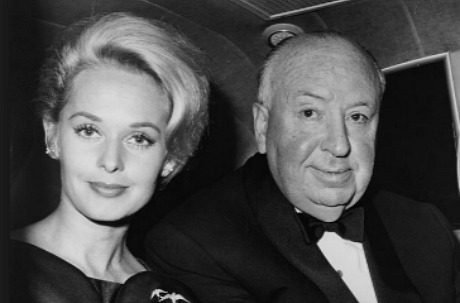
Tippi Hedren, Alfred Hitchcock during promotion of The Birds in ’63.

In Spoto’s “Spellbound by Beauty” (’08), his third book about the directing legend, Hedren revealed that Hitchcock made offensive demands on her. “He stared at me and simply said, as if it was the most natural thing in the world, that from this time on, he expected me to make myself sexually available and accessible to him, however and whenever and wherever he wanted…he made these demands on me, and no way could I acquiesce to them.”

This predatory pattern was also depicted in The Girl, a 2012 HBO movie that was based upon “Spellbound by Beauty.”

So I guess I’m not quite understanding what the big hoo-hah is about Hedren’s memoir “Tippi,” which includes a portion that recounts the same sordid saga. A Daily Beast summary mentions Hitchcock having “talked with Hedren about getting erections, and [that he] would ask her to touch him.” In short he wanted an occasional handjob. Which Hitch, an extremely rich and powerful man, could have easily gotten from a high-class professional any day of the week. So bizarre, so unhinged.

What Moviemaking Manual States That Under-Educated, Struggling-Class Women Have To Smoke?

All We Had (Gravitas, 12.9), a drama about a homeless single mom (Katie Holmes) and her teenaged daughter (Stefania LaVie Owen), is Holmes’ directorial debut. The Hollywood Reporter‘s Frank Scheck, reviewing during the ’16 Tribeca Film Festival, said it “packs in enough hot-button social issues to have fueled an entire season of The Oprah Winfrey Show — the ’09 financial crisis, subprime housing loans, alcoholism, homelessness, teen drug abuse, tolerance of the transgender community.” Plus this adaptation of Annie Weatherwax’s 2014 novel “also provides Holmes with her meatiest role since 2003’s Pieces of April. Unfortunately, All We Had is less edifying for the viewer. Somehow managing to feel rushed and plodding at the same time, it’s the sort of film in which the main characters display their resiliency by standing joyfully in a pouring rain…it reeks of well-intentioned indie movie cliches.”

If Marlene Dietrich’s Perfect Legs Could Talk

It’s been seven years since Hollywood Elsewhere riffed on the issue of hairy female legs. It was during the late ’09 (or early ’10) Oscar season when Precious costar Mo’Nique showed red-carpet photographers that she was down with noticable leg follicles, and then claimed that her husband was a fan of this grooming decision. (Which no one believed.) Now comes Adele telling Vanity Fair‘s Lisa Robinson that she recently didn’t shave her legs for a month. When Robinson asks if Simon Konecki, the father of their four-year-old son, minds her unshaven legs, Adele says “he has no choice…I’ll have no man telling me to shave my fuckin’ legs…shave yours.”

I’m sorry but what’s next, women with beards? Hairy female legs are profoundly unattractive — the female equivalent of a naked man with large sloping breasts or a schlong the size of a cashew nut. I very much doubt if I’m alone on this.

I noticed a dark-haired woman in shorts on the G train earlier this month, and her legs were as hairy as Omar Sharif‘s, and right away I inaudibly moaned. I did everything I could to avoid looking in their general direction, but I couldn’t think of anything else. Then I began ordering myself to stop thinking like an old fart and get with the program and accept that hairy female legs are the next barrier to fall. Marlene Dietrich would be appalled, of course, but she’s dead.

Read more

Finally Neruda

I finally saw Pablo Larrain‘s Neruda (The Orchard, 12.16) yesterday. It played at Santa Barbara’s storied Riviera theatre, under the auspices of Santa Barbara Film Festival honcho Roger Durling (and with Larrain taking bows and doing a post-screening q & a.) I wasn’t head over heels in love with this late ’40s period drama, but I gradually warmed to the dream saga of a renowned poet, politician and libertine. The film knows itself, and unfolds at its own pace. Which is to say leisurely, thoughtfully. It has an undercurrent.

Neruda is not a film about intrigue and twists, or even about a chase. It’s about different approaches to living — a meditative, sensual and humanist-compassionate way of being (Luis Gnecco‘s Pablo Neruda) vs. a small subservient man (Bernal’s government cop, Oscar Peluchoneau) determined to capture and suppress a perceived enemy of the state.


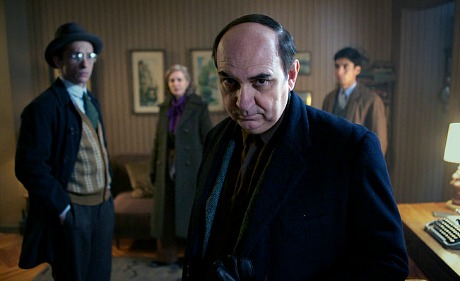
Luis Gnecco as Pablo Neruda.

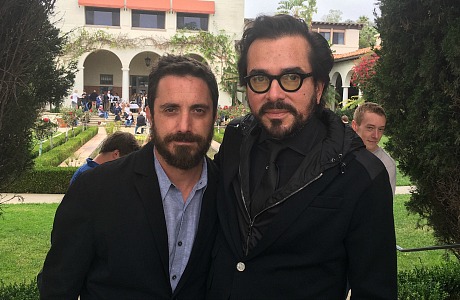
Neruda director Pablo Larrain, Santa Barbara Film Festival director Roger Durling during a midday lunch between screenings of Neurda and Jackie.

I liked the textures, the culture, the glimpses of this and that part of Chile. And I liked the ending quite a bit. I expected something glum and resigned, but no. And then Neruda, who lived until 1973, is shown living with a measure of comfort in Paris, which is partly indicated by a scene of a naked Neruda cavorting with naked women. (The fact that Neruda is fat is not presented as a problem or even an issue.  But if I was as fat as this guy I would never take my clothes off, not even to shower.)

I’ll always remember the line “where is that fat Communist?”

But there’s no mention of Neruda‘s return to Chile, and how he became part of Salvador Allende‘s government. And how he may have been poisoned to death by a Pinochet loyalist in ’73, and right around the time Pinochet and the military overthrew the Allende government in a coup.

This is the pattern of nearly all historical films these days. You see the partial, incomplete version of a real-life event or a man’s life that the filmmaker has presented, and then you go to Wikipedia and other online sources and read the whole story, warts and all.

Read more

Note From A Friend

“I saw Tom Ford‘s Nocturnal Animals last night,” the email begins. “A BAFTA and British Oscar voters event. Ford, Amy Adams, Jake Gyllenhal and Aaron Taylor-Johnson were all there. Great group of talent. The film was well received and I liked it a lot, but Ford’s handling of the material makes it feel more emotional in retrospect than it was on the screen.

“By making a story about a woman so cold that she’s lost touch with everything in her life, we end up with a cold movie. The music, cinematography and actors, however, elevate it to a level of fascination that kept me in. I hope Michael Shannon gets some award attention. He was amazing as always.


Amy Adams in Nocturnal Amnials

“I asked you about an Arrival screening. Anything coming up?”

My reply: The only really interesting thing about Nocturnal Animals, which may strike a chord with this or that industry person but is going to more or less die when Joe Popcorn enters the equation, is the ending when [redacted but it involves something that happens between Gyllenhaal and Adams]. That’s it. That’s the only thing that grabbed me. Okay, that and Shannon’s cancer-ridden sheriff. But then Shannon is always good so it’s almost de rigeur when he scores yet again.

Again, my initial Toronto review.

Read more