Jenkins vs. Cameron with HE Referee

James Cameron‘s argument with Wonder Woman, as explained in an 8.24 Guardian interview, was basically that Gal Gadot looked too dishy, too made up, too objectified. Which was basically a shot at director Patty Jenkins for catering to traditional male-appetite Hollywood fantasies. Cameron would have preferred a butchier, more bad-ass Wonder Woman in a kind of mid-’90s Linda Hamilton mode.

Jenkins’s Twitter reply: “Cameron’s inability to understand what Wonder Woman is, or stands for, to women all over the world is unsurprising as, though he is a great filmmaker, he is not a woman. Strong women are great, [but] if women have to always be hard, tough and troubled to be strong, and we aren’t free to be multidimensional or celebrate an icon of women everywhere because she is attractive and loving, then we haven’t come very far, have we?”

HE verdict: Cameron is right — Jenkins was catering to traditional Hollywood standards by making Gadot’s Amazon warrior a super fox as well as loving and maternal. But that’s cool. As I was watching it in a Paris plex last June I told myself, “This is different, this is good…Wonder Woman has a fuller, more caring heart than her male counterparts in the Marvel or D.C realm. And therefore she has her own identify, her own piece of superhero turf. Plus she has great eyes, hot legs and a really warm smile. I don’t have a problem with that.”

Can’t Help But Feel Badly About It

N.Y. Times critics A.O. Scott and Manohla Dargis were recently asked to choose the five best New York movies for a special project called “One Film, One New York.” The winners were Spike Lee‘s Crooklyn, Gene Kelly and Stanley Donen‘s On the Town, Susan Seidelman‘s Desperately Seeking Susan, Ang Lee‘s The Wedding Banquet and Martin Scorsese‘s New York, New York.

Scott and Dargis were somewhat restricted by having to choose films that are more or less family-friendly or, you know, not too coarse or graphic or profane. Which is sorta like being asked to choose the best westerns in which gunslingers don’t wear six-shooter holsters around their waist.

On top of which New York, New York was regarded at the time of its release as a notorious cocaine movie. A whole lotta tootin’ goin’ on, and yet 40 years later a pair of top-tier critics…forget it.

I haven’t re-watched any of their picks since their original release, and that goes double for New York, New York. I caught it a little more than 40 years ago, and only once at that. It’s basically a ’40s and ’50s period piece about a singer and a saxophone player (Liza Minelli, Robert DeNiro) who discover that they’re incompatible after getting hitched in a hurry and having a kid, largely because the sax player has a temperamental nature.

I’ve written a couple of times that it has one terrific scene — i.e., when De Niro is thrown out of a club that Minelli is performing in, and he kicks out several light bulbs adorning the entrance way as he’s manhandled out by the manager and a bouncer. If I could only find that scene on YouTube, but there’s no trace of it.

You still can’t stream New York, New York, and for people with limited search abilities (like myself) the only way to catch a high-def version is to buy a 2013 English import Bluray.  

Stiller, For Sure, But Austin Abrams Is A Find

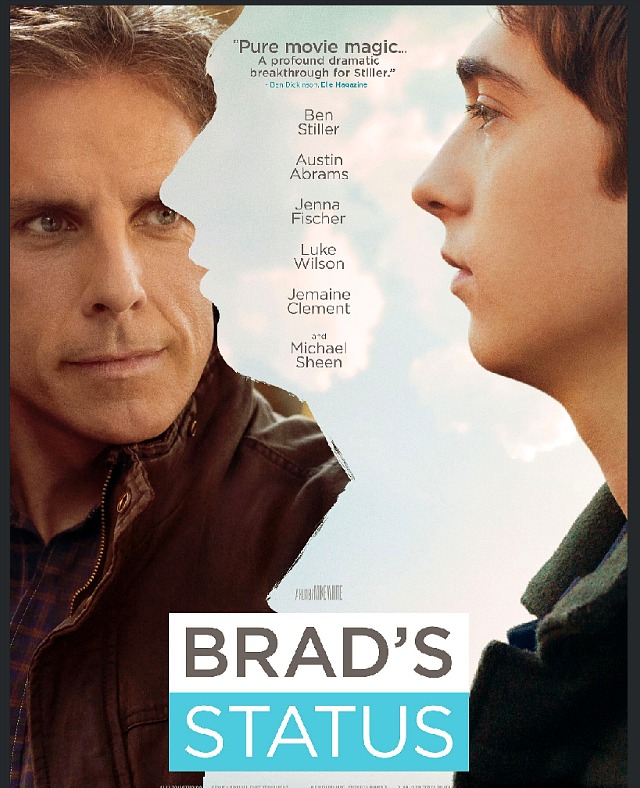
On 7.31 I wrote that Ben Stiller‘s lead performance in Brad’s Status (Amazon/Annapurna, 9.15) is easily his best-written role and finest performance since Greenberg. But the second-best thing in Mike White‘s father-son dramedy is Austin Abrams, who plays Stiller’s college-bound son. Abrams had small parts in Gangster Squad, The Kings of Summer and We Don’t Belong Here, but I never noticed him until Brad’s Status. He’ll turn 21 next weekend, and I swear he’s got some kind of dead-center, no-bullshit essence that seeps out with every line, looks and gesture. I said in my review that Abrams has this young Bob Dylan quality. One of these days he’ll land the right role.

Read more

Please Redefine “Loser”

Newsday‘s Lewis Beale has posted a piece about the biggest winners and losers of the summer movie season, which ends on Labor Day. Two of his losers are Sofia Coppola and Steven Soderbergh, so named because their respective films, The Beguiled and Logan Lucky, whiffed at the box-office. After 49 days The Beguiled has earned a lousy $10,576,669 domestic (maximum theatre count: 941) and $16,656,888 worldwide, and over the last 7 days Logan Lucky has generated a meager box-office of $9,316,933, albeit in three times as many theatres (3,031).

The problem with Beale’s verdict is that The Beguiled was a reasonably decent period drama (I called it a better film than Don Siegel‘s 1971 version with Clint Eastwood), and Logan Lucky is a bone dry, brilliantly fine-tuned redneck caper flick. Both films proved that Coppola and Soderbergh are pros who know their stuff, and it hardly makes them “losers” simply because ticket buyers decided they weren’t interested. If you ask me it’s the ticket buyers who lost.

Was it commercially savvy to re-make a gothic Civil War-era melodrama involving sex and dismemberment but with most of the sex taken out? Perhaps not. Did it make sense to re-make Ocean’s 11 in a bumblefuck milieu, minus the big stars and a Las Vegas setting? Okay, maybe Logan Lucky couldn’t have become a hit no matter what. But Soderbergh and Coppola did their jobs well. They made a pair of engaging, first-rate films. They brought honor upon themselves.

Beale’s other losers: 1. Universal Pictures for the wipe-out of Tom Cruise‘s The Mummy (HE agrees). 2. Michael Bay‘s Transformers: The Last Knight (ditto — HE only saw Cinemacon product reel, decided against attending). 3. Pirates of the Caribbean: Dead Men Tell No Tales (shitty reviews, $166 million gross vs. $230 production cost). 4. Baywatch (crappy reviews, audiences weren’t sold). 5. Will Ferrell for the embarassing failure of The House. 6. French comic books — i.e., the complete cratering of Luc Besson‘s Valerian and the City of a Thousand Planets. 7. Kathryn Bigelow and Mark Boal‘s Detroit. 8. Halle Berry for the barely noticed failure of Kidnap.

Likable, Affecting, Poignant

Unless this trailer is highly deceptive, I’m half-convinced that Richard Linklater‘s Last Flag Flying (Amazon/Lionsgate, 11.8) is going to work with both critics and ticket-buyers. It’s a “Last Detail sequel” but with different characters.  (Yeah, I know — go figure.). Bryan Cranston is playing his own Badass Buddusky, it seems, but with his own name — Sal Nealon. (Somewhere up in the hills Jack Nicholson is scratching his head, wondering if Nealon is somehow related.). Larry Fishburne seems to be channeling Otis Young‘s Mulhall (i.e., “Mule”), except his name is Mueller. Steve Carell has retained the quiet sensitivity of Randy Quaid‘s Larry Meadows, but with a different name — Larry “Doc” Shepherd. Directed and co-written by Linklater with Darryl Ponicsan, author of the 2005 source novel as well as the 1971 novel that led to Hal Ashby‘s The Last Detail. All eyes on the 9.28.17 premiere at the New York Film Festival.

Back Pages

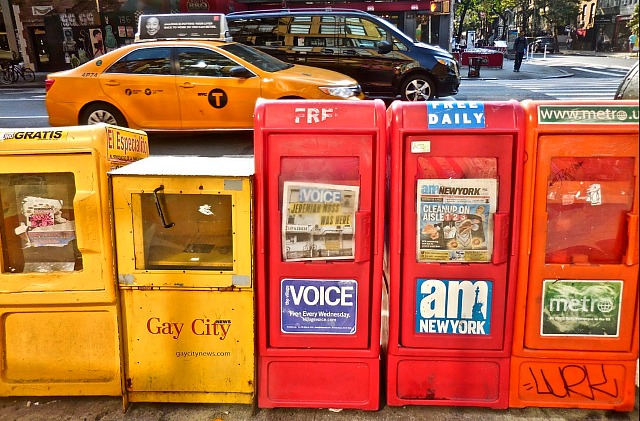
It’s sad that the print edition of Village Voice is going away, sure, but I can’t honestly say I’m devastated. I never pick up a newspaper. Nobody does. But I’ve always liked — hell, cherished — the fact that the Voice is there. If I could guarantee that the print edition would survive by snapping my fingers three times, I would do that. Who wouldn’t? I’m just as sentimental as the next guy.

The newsprint Voice is an atmospheric artifact — a tangible remnant of the Manhattan that I lived and struggled and sometimes barely survived in from late ’77 to mid ’83. When I think of the effort and feeling and discipline that have gone into each Voice issue, even recently, even with me living in West Hollywood, and what its absence will do to downtown culture, etc. Not that anyone under 40 will notice all that much.

I was a New Yorker when the Voice definitely mattered. Reading the new issues of it and the Soho Weekly News at the Village Bowl (a little diner on West 13th near 8th) back then — what an affinity that was. I would take the issues home, leave them at my Sullivan or Bank Street apartments, carry them with me for something to read on the subway.

But I almost never pick up print these days, and when I do it’s only for a fast skim. My reaction would be the same if the L.A. Weekly, which has been printing since ’78, were to turn into an online-only publication. I picked up a copy at Amoeba last week, and that’s saying something. But I’m not saying anything nervy here. The printed Voice launched almost 62 years ago, on 10.26.55. I’m sorry.

Read more