Give Wonder A Chance?

Earlier this week a friend saw Stephen Chbosky‘s Wonder (Lionsgate, 11.17), the little-kid-with-a-disfigured-face movie with Julia Roberts, Owen Wilson and Jacob Tremblay.

“It was better than expected,” he says. “I was actually surprised at how likable it was. And it doesn’t just focus on the disfigured kid. At some point the film starts to shift toward other characters linked to the kid and tell their own stories, with each chapter being named after them. There must have been around three chapters dedicated to three separate characters.

“It seems as if critics are already shooting darts at it, mostly because of that misguided trailer, so who knows how the reviews will turn out? But all the child actors are really good in this, all of them delivering is a very believable way. I bought the story of the kid as well. It never felt maudlin or sugar-coated. Roberts was also excellent, probably her best work since…what, Duplicity?

“We shouldn’t be so surprised that Wonder has turned out to be a good movie. Chbosky, who brought a sensitive and delicate touch to The Perks of Being a Wallflower, is no slouch. The ending is a bit flat, but most of the movie works.”

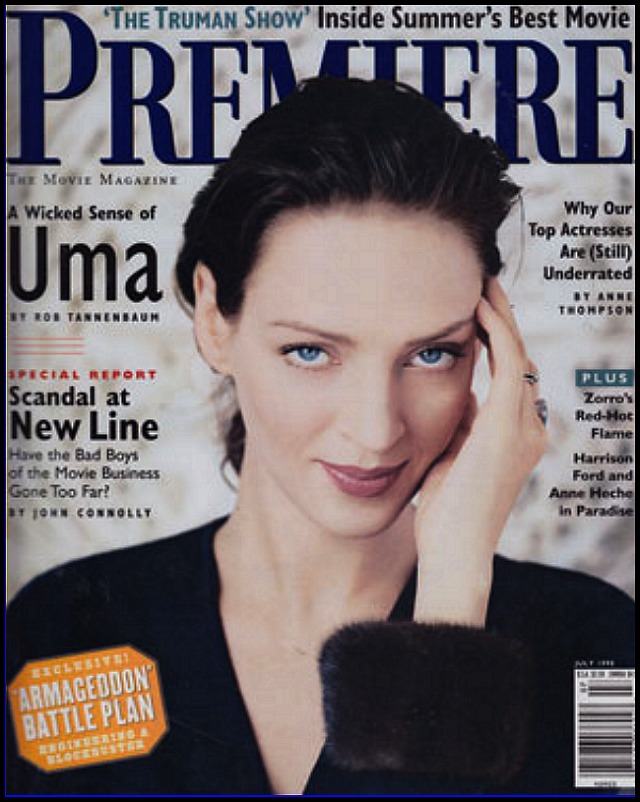
1998 Sexual Harassment Piece Comes Home To Roost

In an Indiewire piece posted earlier today, producer, industry consultant and former Fine Line production executive Liz Manne outed herself as a major anonymous source for a controversial, once-heavily-criticized 1998 Premiere story that described a culture of sexual harassment at New Line Cinema, which at the time was run by Bob Shaye and Michael Lynne.  

The article, written by John Connolly and fact-checked by Premiere staffers (including then-editor Jim Meigs and senior film editor Glenn Kenny), was called “Flirting With Disaster.”

The article asserted that all kinds of nasty shenanigans (drinking, drugs, sexual harassment) were happening at New Line, and that Shaye and Lynne ran the place “like a college dorm,” according to a producer who spoke anonymously to Connolly. The piece began with a story about a boozy New Line party that happened the year before (1992) at a lodge in Snowmass, Colorado, and about how Lynne made an aggressive sexual pass at an unnamed female executive

That executive, according to Manne’s Indiewire piece, was Manne herself. As noted, she flat-out admits to having been one of Connolly’s anonymous sources.

In hindsight, the Connolly piece can be appreciated as a tough expose that described a predatory climate that sounds all too familiar by today’s understandings. But because it depended on anonymous sources (when she left the company Manne signed an exit agreement that forbade her from talking to anyone about anything in any context) the article was strongly attacked as an example of reckless or irresponsible journalism.

Two of the attackers were Movie City News’ David Poland and Variety‘s Peter Bart. Coincidentally, there was also a “Reverse Angle” article on page 51 in that same issue of Premiere, written by Harvey Weinstein of all people, that complained about “the reckless use of unnamed sources.”

From Poland’s 6.17.98 MCN article: “Can you say ‘hatchet job?’ I know for sure that Premiere magazine can. It had to be the phrase of the day when it decided to print its story, ‘Flirting With Disaster’” on alleged sexual and drug-related misconduct at New Line Cinema. I am often disgusted with the state of entertainment journalism, but usually it’s because we throw softballs in exchange for access to the talent that sells magazines, newspapers and TV shows. (And yes, some Web sites.) This time, it’s the opposite

“What was Premiere thinking when it ran the results of John Connolly‘s eight-month ‘investigation’ which added up to little more than a handful of gossipy accusations by unnamed sources that any reporter working this beat on a regular basis could have come up with over a three-day weekend?”

Read more

Rob Reiner’s U-North

Hey, I know — let’s have George Clooney get blown up and burnt to death on the way back from Westchester to Manhattan in Michael Clayton. Forget the mystical moment with the horses. He’s a flawed guy anyway. A fixer, a janitor and a shortfaller so let’s kill him. Better that way. We can just insert a bit in which Clayton, before leaving for Westchester, mails that incriminating memo to the N.Y. Times. That way the audience will know that Tilda Swinton, Ken Howard and U-North will pay in the end.

U-North, for the film Michael Clayton from Victor Melton on Vimeo.

Just Due

Hollywood Elsewhere agrees with the AMPAS Board of Governors’ decision to give a special Oscar to Alejandro G. Inarritu’s Carne y Arena, the virtual reality installation that I submitted to on 5.18 in Cannes and again on 7.1 at the Los Angeles County Museum of Art. (I was told at the time the installation would be discontinued last month, but it’s still going.) The Carne y Arena experience is a six-and-a-half-minute virtual reality trip that simulates with all-encompassing realism what Mexican immigrants often go through while attempting to cross the United States border in the Southwestern desert region. It’s a collaboration between Inarritu, dp Emmanuel Lubezki, producer Mary Parent, Legendary Entertainment, Fondazione Prada, ILMxLAB and Emerson Collective. The Oscar will be presented to Inarritu, et. al. during the 9th Annual Governors Awards on Saturday, 11.11, at the Hollywood & Highland Center.

Mindhunter Finality

I finally finished watching Netflix’s Mindhunter last night. All ten episodes. Wow. Precise, patient, unnerving, character-rich, exacting dialogue, blissfully intelligent. By far the most engrossing Netflix thing I’ve sat through this year, and that includes Okja, First They Killed My Father, Mudbound and The Meyerowitz Stories. I’m really glad the second season has been approved as I couldn’t get enough of season #1. Really and truly riveted. A perfect thing to watch at the end of a long, vaguely depressing, anxiety-ridden day consumed by writing and researching and…you don’t want to know the rest.

Though Mindhunter I’ve come to know four…make that five actors I’ll never forget and want to engage with again — Jonathan Groff (Holden Ford), Holt McCallany (Bill Tench), Hannah Gross (Debbie Mitford), Anna Torv (Wendy Carr) and even Joe Tuttle, who plays God-fearing, goodie two-shoes FBI agent Gregg Smith, who rats out Groff when he sends a Richard Speck interrogation tape to a pair of FBI internal affairs investigators.

An HE salute to producers David Fincher (who directed episodes #1, #2, #9 and #10), Charlize Theron, Josh Donen and Cean Chaffin.

For whatever reason I didn’t do my research until a week or so ago, and hadn’t realized that Holden Ford is based on former special agent John Douglas, who co-authored the same-titled book about his 25 year career with the FBI’s Investigative Support Unit.

I loved the Holden and Debbie breakup scene in episode #10. [After the jump.] Or rather the “Holden breaks up with himself” scene. Debbie is radiating that silent hostility thing that women love to radiate when so inclined, signalling everything and saying nothing. Holden calmly adds up the signs and indicators and comes to a conclusion that “you’re breaking up with me?” Yup, that’s what she’s doing but she’s making you do the work.

Read more

Breakfast with Roman, Dan & Denzel

Nine days after Deadline‘s Michael Fleming reported that Dan Gilroy‘s Roman J. Israel, Esq. has been trimmed by 12 minutes and to some extent re-edited, elite L.A. journos have been invited to see the “new” Roman J. Israel a few days hence. And in the morning yet — bagels, coffee and scrambled eggs at 9 am, the movie at 10 am, and then Gilroy and star Denzel Washington sitting for a q & a around noon.

A month and a half ago I conveyed how much I loved the first 85% to 90% of of Roman J. Israel. I called it “a whipsmart, cunningly performed, immensely satisfying film in so many ways. Such a skillful job of character-building on Gilroy’s part, layer upon layer and bit upon bit, and such a finely contoured performance by the great Denzel Washington.

I loved the specificity of Denzel’s stuck-in-the-past attorney character (the old-fashioned earphones, the modest apartment, the odd ’70s dress style, the music he listens to, the Asperger’s social tics), and that I was really pulling for the guy, and that a feeling of comfort came over me when he bought a couple of nice suits and lost the ’70s Afro and started going out with Carmen Ejogo‘s Maya, in some ways a kindred spirit of Roman’s and vice versa.

Then the thing happened and I was saying “this is how it ends? I don’t want this. I don’t like this.” But I so loved the film right up to this point.

“Roman is a brilliant guy,” I explained to a friend this morning. “I understand that for dramatic purposes he needs to be in a difficult or desperate place at the end of Act 2, but Gilroy should have somehow figured a way out of this, some clever-ass, end-run gambit that involves Denzel’s amazing recall and generally phenomenal brain-power. He pulls something off, lucks out, fortune smiles, etc.”

I just think it’s a bad idea to create a complex guy with flaws and character ripples and attributes, and then show him going through a fairly profound life-change that feels good and calming all around, and then pull the rug out. That really didn’t work for me.

I understand that we need to wipe the Toronto slate clean and see how the new version works and then go from there. I get that. I’m ready to absorb and possibly adjust.

Read more