No Honor Among Thieves

Imagine if Gary Ross‘s Ocean’s 8 (Warner Bros., 6.8.18) was made like a modern-day Rififi. If eight shrewd women got together and successfully pulled off a big heist, but then one of them rats another out to the cops. Or a rival crew finds out about the job and kidnaps the child of Sarah Paulson, and so Paulson, Sandra Bullock and Cate Blanchett hunt down the kidnappers except Bullock gets shot in the stomach. Or after flashing too much money around Helena Bonham Carter gets busted by detectives and pressured to reveal who else pulled off the job, and Mindy Kaling panics and realizes HBC has to die or she’ll spill the beans on everyone. I would love an escapist film like that, one that promises the usual bullshit but then turns around and gets real. But of course, no one would be allowed to make a Rififi about ruthless women thieves as this would go against the narrative.

Incidentally: The MovieBox copy that accompanies this new trailer starts with the words “to steal a priceless neckless…”

Time-Machine, Missing-Ear Kidnap Thriller

I saw Ridley Scott‘s All The Money in the World (Sony, 12.25) for the second time last night at a big Academy premiere — talent, producers, actors, publicists, below-the-liners, people like me, etc. Scott and some of the cast attended (Mark Wahlberg, Christoper Plummer, Michelle Williams, Charlie Plummer, Timothy Hutton), and there was a big party afterward with loads of great-tasting food by Wolfgang Puck caterers.

All The Money is about a true-life event — the 1973 Rome kidnapping of John Paul Getty III and the laborious, months-long negotiations between the kidnappers and the young Getty’s tightwad grandfather, oil baron and billionaire J. Paul Getty, that followed. Scott doesn’t fool around with the story beats, and has made a stylish, well-finessed thing, jarring and intelligent and always believable.
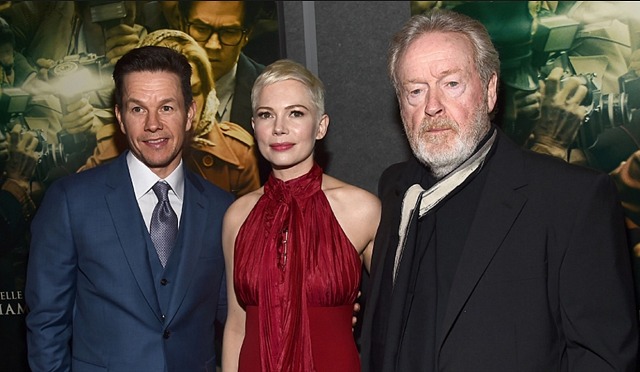

Prior to last night’s Academy screening of Ridley Scott’s All The Money In The World — Mark Wahlberg, Michelle Williams, Scott.

The film is actually about tycoon vs. people values — a rumination about the real price of meat in the market, about how cold things can get when a capitalist emperor like Getty Sr. (chillingly played by Plummer) has been told to cough up or else when it comes to life of one of his own (Charlie Plummer, no relation), and how thorny and malignant life can be when hard bargainers are sparring over the size of a ransom. It’s a film about icy, eyeball-to-eyeball behavior on all sides.

Except, that is, when it comes to Gail Harris (Williams), the mother of the kidnapped scion who, as you might expect, doesn’t see the situation in monetary as much as human terms. And also, come to think of it, when it comes to Cinquanta (Romain Duris), a member of the Red Brigade kidnapping gang who becomes the young Getty’s closest captor and “friend”, in a manner of speaking. At the end of the day Cinqunata is almost as much on the human side as Gail.

In the Scott canon, All The Money in the World isn’t as cruel and ruthless as The Counselor, the 2013 drug-dealing drama that is arguably Scott’s finest 21st Century film, but it operates in the same chilly ballpark. Scott isn’t commonly associated with straight-talking dramas about upfront realism, but when he decides to settle down and make films for adults (i.e., stories about how things really are out there), there’s no one better.

We’ve all been impressed, I think, by Scott’s recent herculean re-filming of all the J. Paul Getty scenes (re-performed by Plummer when it became apparent in early November that the disgraced Kevin Spacey had to be jettisoned) between 11.20 and 11.30. Scott was given a longish standing ovation when he took the stage before the show began.

Read more

Raise Your Glasses for Stuhlbarg

It’s been nearly 11 months since I first saw Call Me By Your Name at Sundance ’17. Like everyone else, I was floored by that quietly climactic father-son scene between Michael Stuhlbarg and Timothee Chalamet. Even before it ended I was dead certain that Stuhlbarg would become one of the five contenders for Best Supporting Actor Oscar, and perhaps even the likeliest winner.

But then, of course, The Florida Project premiered in Cannes four months later and then Willem Dafoe began to happen in the early fall, and now there’s not even an element of doubt about his winning, despite strong competition from Sam Rockwell‘s performance in Three Billboards outside Ebbing, Missouri. Stuhlbarg’s performance, jewel-perfect as it is, never lifted off the award-season runway. The unfairness of life amazes me, and it never stops.

From Brett Easton Ellis’s 12.18 Out piece: “In terms of plot nothing much happens on the surface of Call Me By Your Name, but of course something monumental is happening because what we are witnessing is the erasure of innocence — this affair will kill that. On a second viewing the gay vibe** from Elio’s father (Stuhlbarg) is clearer, and in a very moving scene near the end he gives a speech to Elio (Chalamet), devastated over the loss of Oliver and flooded with the pangs of first love’s disappointments.

“The speech is culled from the book where the father tells his son that he knew what was happening between him and Oliver and that he has nothing to be ashamed of and to cherish the pain he’s feeling and that he’ll always be there for him. This scene could have been nearly insufferable in its noble ‘progressive’ virtue-signaling: if only we all had fathers this wonderful and warm-hearted and accommodating, who can console their sons with lines like ‘When you least expect it nature has cunning ways of finding our weakest spot,’ and ‘Remember, I’m here.’

“And yet Stuhlberg sells it with a hushed technical virtuosity that makes every word land and vibrate, even though at times he overdoes the saintly Jewish-Daddy thing. Stuhlberg makes this the real climax of the movie — it becomes a primal scene — and in the packed theater I saw the movie you could hear the gay men (at least half the audience) barely holding back muffled sobs.

Read more

Bark of Despair

The initially dispiriting thing about Wes Anderson‘s Isle of Dogs (Fox Searchlight, 3.23) is that (a) it’s set in Japan, which Hollywood Elsewhere has never been a huge fan of, (b) it’s about a dystopian future and (c) it’s largely set on “trash island,” which seems to be all about grayish colors, rotting food and industrial waste. Which of course makes you feel sorry for the poor dogs who live there. One presumes (hopes) that the third-act involves some kind of escape and/or transformation.

Wiki boilerpplate: “Set in a dystopian future Japan in which dogs have been quarantined on the remote eponymous island due to a “canine flu”, Isle of Dogs follows five barkers — Chief (Bryan Cranston), Rex (Edward Norton), Boss (Bill Murray), Duke (Jeff Goldblum) and King (Bob Balaban). They’re fed up with their isolated existence until a boy named Atari Kobayashi (Koyu Rankin) ventures to the island to search for his dog, Spots (Liev Schreiber),” etc.

Read more