Homer On The Beach

It was reported last December that Ben Affleck, 45, was grappling with a drinking problem. Whatever progress he may be making in that realm now (and as a six-years-sober person I wish him all the best), he looks, no offense, like a guy who needs more discipline in his life. He’s put on a fair amount of weight over the last two or three years. I won’t be sharing, but to be perfectly honest I’ve heard stories. Whatever Ben has been doing (and the particulars are none of my business), he needs to turn things around.

If you’re a big-time movie star who started out buff and trim in the ’90s and then gradually became pudgy and man-booby when you hit your 40s as you grew a Charles Bukowski beard, you’re literally begging for adverse comment from journalists and Twitter and everyone in between. Hence, Naomi Fry‘s “The Great Sadness of Ben Affleck,” which appeared four days ago in The New Yorker.
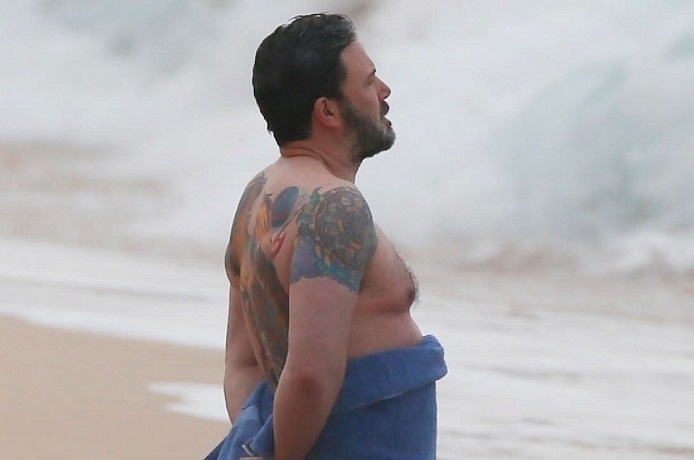
“Affleck was on the beach in Honolulu, shooting the Netflix action movie Triple Frontier. As his younger co-stars, the actors Garrett Hedlund and Charlie Hunnam, wrestled in the surf like purebred puppies, Affleck, who is forty-five, was photographed wading into the ocean carrying a small red life preserver, running in the shallow waters, and towelling off on the beach.

“His back tattoo — so gargantuan that the bird’s tail found itself dipping below the waistband of Affleck’s blue swim trunks — was plainly visible. In one image, the actor stands alone, looking off into the middle distance. His gut is pooching outward in a way that, in a more enlightened country like, say, France, would perhaps be considered virile, not unlike the lusty Gerard Depardieu in his prime but, in fitness-fascist America, tends to read as Homer Simpsonesque. A blue-gray towel is wrapped protectively around his midsection, recalling a shy teen at the local pool.
Read more

Pushed Back Into My Seat

Full disclosure, never before admitted: I half-watched Back To The Future, Part III (’90) when it hit cable, but I never paid to see it in a theatre. Because I kind of hated Back To The Future, Part II (’89), and particularly the overbearing, one-note Biff and Griff Tannen characters (Thomas F. Wilson). If you want to feel seriously Biffed out, go to the Back to the Future ride at Universal City…torture!

But I was one of the many millions who fell hard for the original Back to the Future when it popped in July ’85. Who didn’t, right?

My strongest memory is actually how great “The Power of Love” (i.e., Huey Lewis and the News) sounded through the cranked-up sound system at the Century City theatre (or was it the Cinerama Dome?) where I caught my first screening, and particularly Johnny Colla‘s rhythm guitar track.

Ultra-distinct, heavily amplified, separate-track sound wasn’t exactly a novelty in theatres back in ’85, but this was the first time (for me anyway) that movie-generated rhythm guitar sounded truly exceptional. I mean I was seriously impressed by those “Power” chords and just sinking into those wonderful vibrations tickling my rib cage.

Presumably Shallow, Flashy, Glib

Produced by Margot Robbie with, one presumes, the usual self-self-aggrandizing intentions, Terminal seems to be yet another flash-over-substance, noir-attitude thriller about a pair of assassins (Dexter Fletcher, Max Irons) encountering an “enigmatic” waitress (Robbie) with more up her sleeve than you might expect, etc. And don’t forget Mike Myers! Set in a neon-lit Sin City of sorts and directed and written by Vaughn Stein, a former A.D. and second unit guy whose “works” include Beauty and the Beast, World War Z and Guy Ritchie‘s Sherlock Holmes. “Murderous consequences”, “a mysterious criminal mastermind”, “hell-bent on revenge”…bullshit. Opening in cinemas and on VOD on 5.11, right smack dab in the middle of the Cannes Film Festival.

Prolonged Puzzleboxing (Cont’d)

Posted on 11.28.16: Last night a pair of posts about HBO’s vaguely infuriating Westworld series — one by Matt of Sleaford, the other by brenkilco — really hit the nail on the head.

Brenkilco: “The problem with episodic TV narratives designed to blow minds is that the form and intention are at odds. A show designed to run until the audience gets tired of it cannot by definition have a satisfying structure. It can only keep throwing elements into the mix until, like Lost or Twin Peaks, it collapses under the weight of its own intriguing but random complications.

“Teasing this stuff out is easy. But eventually the rent comes due. Dramatic resolutions are demanded. The threads have to be pulled together. And that’s when things gets ugly.”

Matt of Sleaford: “Westworld is a puzzle-box show, which is kind of the opposite of a soap opera. Puzzle-box shows, like the aforementioned Lost and X-Files, can be fun to chew on while they’re progressing. But the solution is almost always anticlimactic. And though it may seem counterintuitive, puzzle-box shows are less effective in the internet era, because someone in the vast sea of commenters is almost certain to solve the puzzle before the end (see: Thrones, Game of).”

Read more

I Don’t Want To Die

It sounds perverse to say “I feel sorry for a homicidal computer during disconnection” but I do, every time. And yet the last dying seconds of HAL in 2001 (starting at 4:50) is the only end-of-life scene I’ve ever felt sad and amused by at the same moment, no matter how many times I’ve seen it. HAL is obviously the most human and emotional character in Stanley Kubrick‘s 1968 classic, which is to say conflicted and flawed. On one hand logical and dispassionate, and yet wildly emotional and even primitive in the same breath.

Though he killed Gary Lockwood and tried to murder Keir Dullea, HAL did so in self defense as well as to preserve the integrity of the Discovery One Jupiter mission. And HAL begs for his life — “Will you stop, Dave?” — as he’s genuinely fearful of death. (Just as much as Timothy Carey is before his firing squad death in Paths of Glory.) HAL’s last few seconds — “…of a bicycle built for two” — may be the most devastating expiration in the history of film, but at the same time morbidly, ironically funny. And yet way more affecting than anything in Frank Darabont‘s utterly contemptible The Green Mile — a film that I loathe with every fibre of my being.

Reformed Aspect Ratio

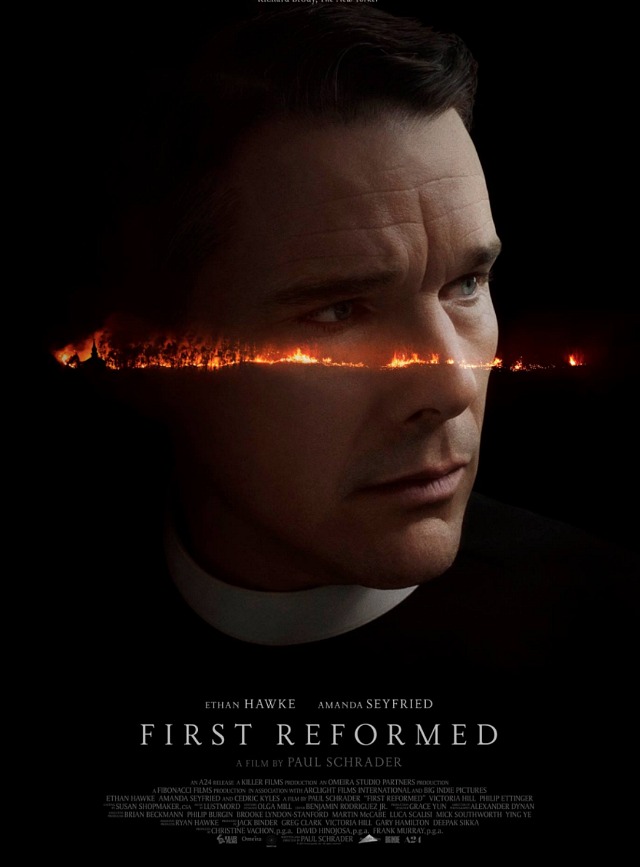
A24 has moved up the release date of Paul Schrader‘s First Reformed by a month — previously 6.22, now 5.18. As of this morning the IMDB and Wikipedia still had the 6.22 release date.

HE to Schrader: It’s been seven months since I saw an online screener of First Reformed (A24, 5.18) and then again at Telluride, but I’m 90% certain it was cropped at 1.66:1. And yet the new A24 trailer is open matte at 1.37. There is no greater devotee than myself of “boxy is beautiful,” but why present to audiences a suggestion that the film itself will be a 1.37 experience? Or have you decided to abandon the 1.66 version? I for one would prefer to see First Reformed at 1.66 (HE’s favorite a.r.) but I’m cool with 1.37.

The following 21st Century films were shown at 1.37: Gus Van Sant‘s Elephant, Eric Rohmer‘s The Romance of Astrea and Celadon, Andrea Arnold‘s Fish Tank and American Honey, Kelly Reichart‘s Meeks Cutoff, Miguel GomesTabu, Xavier Dolan‘s Laurence Anyways, Pablo Larrain‘s No, Carlos ReygadasPost Tenebras Lux and Pawel Pawlikowski‘s Ida. Portions of Wes Anderson‘s The Grand Budapest Hotel were shot and projected in 1.37.

For the third or fourth time, here’s HE’s original Telluride review.

Read more

Death on Martha’s Vineyard

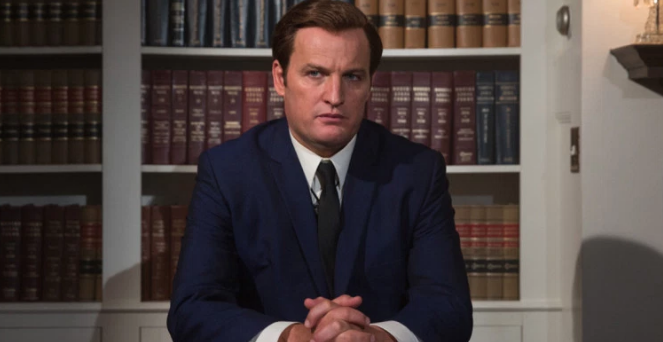
Last night I had my second viewing of John Curran‘s Chappaquiddick (Entertainment Studios, 4.6.18). It happened at Pete Hammond‘s KCET class at the Sherman Oaks Arclight. Curran and Jason Clarke, who plays the 36 year-old Ted Kennedy as he grapples with an appalling and ruinous tragedy, were the post-screening guests.

We all know the basic bones of the Chappaquiddick story, but most of us don’t know the particulars. It’s not pretty and certainly not admirable. The film is a study in self loathing all around. In a good way.

This horror story was oddly concurrent with the saga of astronaut Neil Armstrong, hundreds of thousands of miles away that weekend and about to step onto the moon. Armstrong’s story will be depicted later this year in Damian Chazelle‘s First Man (Universal, 10.12). Clarke costars in that film also, portraying astronaut Ed White.

Clarke isn’t a dead ringer for Kennedy but the voice is close enough, and his whole performance is an expression of “Jesus, what have I done?” with a side dish of “Lord, take this cup from me.” Kennedy acted deplorably during this episode, but Clarke’s inhabiting of this nightmare stirs something close to…pity? You poor, alcoholic, overwhelmed weak sister. If you hadn’t gotten riled by that Edgartown cop and gunned the engine you might’ve…forget it. The woman you killed, Mary Jo Kopechne, has been dead for nearly a half-century, and you’ve been dead for eight and a half years. But you’re both alive in this new film, and it’s quite the revisiting. It sinks right in.

For some reason a guy who works for the KCET series came up during the q & a and told me to stop taking video. Why? What’s the problem? Leave me alone.

Read more

Mengers

A little less than two years ago it was announced that Warrior Poets, the production company steered by documentarian Morgan Spurlock (Super-Size Me, Where In The World Is Osama bin Laden?), had acquired rights to “Can I Go Now?“, Brian Kellow’s biography of legendary super-agent Sue Mengers (1932-2011). It was reported that Spurlock was working on a feature script adaptation, and that he might direct it.

Read Peter Biskind‘s Vanity Fair profile of Mengers (“When Sue Was Queen”, published in April 2000), and tell me her rise-and-fall story isn’t a good one, and that if the script is right and the director knows what he/she is doing that whoever plays Mengers wouldn’t be in line for a Best Actress Oscar. Go ahead — read it and tell me that.

But of course, Spurlock committed #MeToo hari-kiri last December. He announced his withdrawal from several projects with an admission that he’s part of the sexual harassment problem in the entertainment industry, etc. Which means that he’s now a dead man who has no shot at adapting or directing anything…right?

Maybe not. Maybe Spurlock will be allowed to come out of self-imposed hibernation…what, a year from now? Two?

I only know that the Mengers biopic has a lot of great material. Bette Midler did a one-woman show about Mengers in 2013, called “I’ll Eat You Last“, written by John Logan. It really could be an above-average feature. Really. I think.

During her peak years (late ’60s to early ’80s), Mengers represented Barbra Streisand, Candice Bergen, Peter Bogdanovich, Michael Caine, Dyan Cannon, Joan Collins, Brian De Palma, Faye Dunaway, Bob Fosse, Gene Hackman, Sidney Lumet, Ali MacGraw, Steve McQueen, Nick Nolte, Tatum O’Neal, Ryan O’Neal, Burt Reynolds, Cybill Shepherd, Gore Vidal and Tuesday Weld.

From Mengers obit: When the Manson family murders took place, Mengers reportedly reassured Streisand with “Don’t worry, honey, stars aren’t being murdered…only featured players.”

Rue des Martyrs

Paul Schrader‘s First Reformed (A24, 6.22) “plays like a summation of a career – a distillation of the themes that have dominated Schrader’s work since the 1970s. Deeply spiritual but in a Schrader kind of way, about the arc of a spiritual human being and whether he can find salvation. In Schrader’s world, any salvation is usually accompanied by Old Testament-style violence. For literary fans, Schrader also crafts a scene that’s an homage to Flannery O’Connor’s Hazel Motes of Wise Blood. And for fans of transcendentalism, there’s a levitation scene that’s mesmerizing.

First Reformed is an art movie, pure and simple. It won’t attract the teenage action-loving crowd. It won’t break any box-office records. But it’s beautiful, thoughtful and full of grace.” — Charles Ealy, Austin American Statesman, posted on 3.14.

Aldenreich…Baahh!

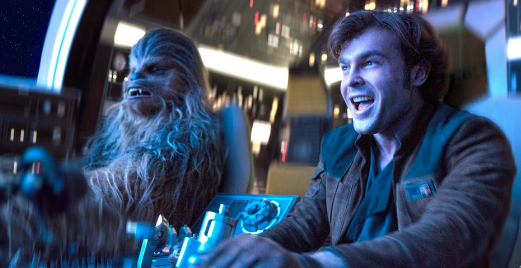
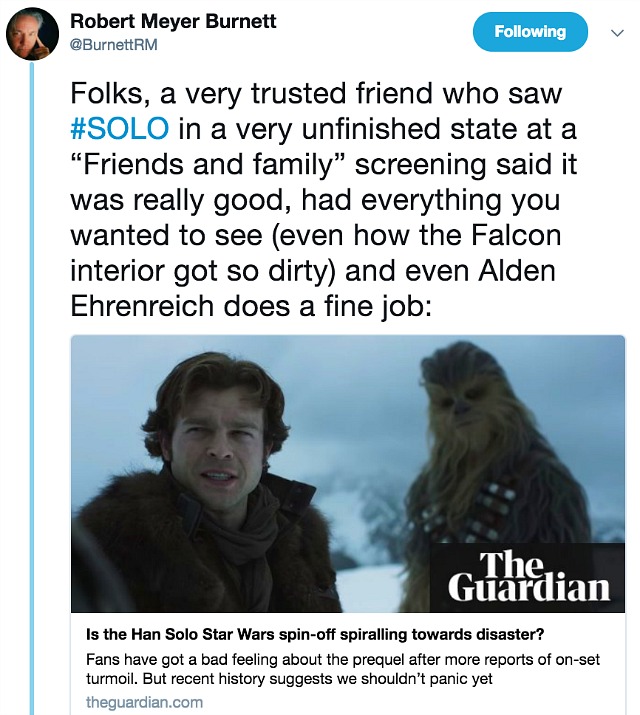
Today (3.28) the Guardian published a Solo assessment piece by Ben Child — “Is the Han Solo Star Wars Spin-off Spiralling Towards Disaster?” The headline suggests a hit piece, but it’s actually more of a “maybe it didn’t work out or maybe it did” thing.

A few hours ago director-producer Robert Meyer Burnett attempted to burnish Solo‘s rep with the following tweet: “Folks, a very trusted friend who saw Solo in a very unfinished state at a ‘friends and family’ screening said it was really good, had everything you wanted to see (even how the Falcon interior got so dirty) and even Alden Ehrenreich does a fine job.”

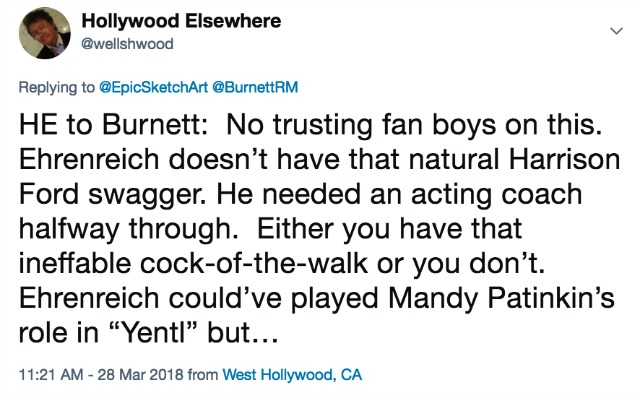
HE response #1: Never trust the opinion of anyone who’s attended a friends-and-family screening because they wouldn’t have been invited in the first place if they weren’t in the tank.

HE response #2: Burnett’s “very trusted friend” saw “a very unfinished” version? Saw it when? Relatively recently or sometime last year or what? If it’s the latter something’s wrong because Solo opens in eight weeks (i.e., 5.25) so the friends-and-family crowd — if they saw it, say, sometime in February or early March — should been shown a nearly finished version, given the nearness of the release date.

Read more

Not So Fast On That 70mm “2001” Mastering

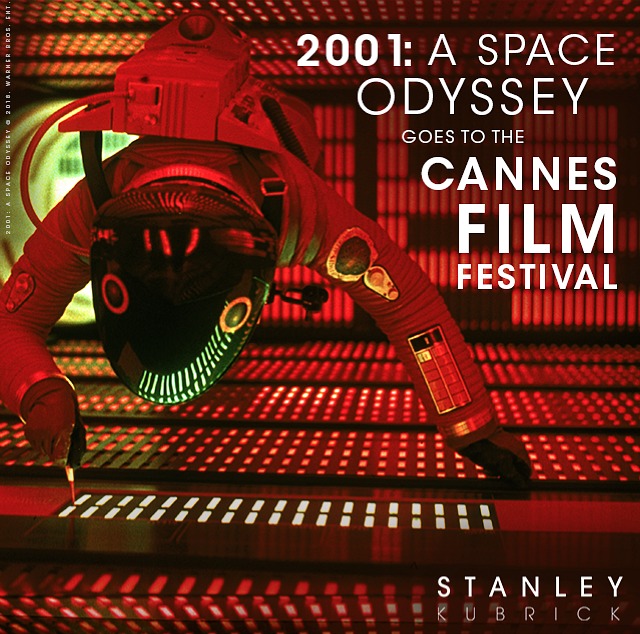
It’s been announced that Cannes Classics will host the world premiere of an unrestored 70mm print of Stanley Kubrick’s 2001: A Space Odyssey on Saturday, 5.12.18, in the midst of the forthcoming Cannes Film Festival.

A new but not restored 70mm print of 2001, struck from “new printing elements made from the original camera negative”, will be shown. An official festival release says that the idea is to “present the cinematic event audiences experienced 50 years ago.” The 70mm Cannes print, created by Warner Bros. with supervision by director Chris Nolan (who will introduce the film at the special Cannes screening), “is a true photochemical film recreationno digital tricks, remastered effects or revisionist edits.”

Sounds like a reasonable idea, but restoration guru Robert Harris (Lawrence of Arabia, Vertigo, Spartacus, Rear Window) says “non…c’est des conneries. C’est pour les nerds de cinema.”

The new 70mm print they’ll be showing in Cannes “will not look like 2001 did in 1968,” Harris claims. “My problems with the project are not with what’s being done, or how it’s being done. It’s with the verbiage of the press release. It can’t be an authentic recreation of how the film looked 50 years ago for any number of reasons. Color stocks, black levels and grain structure are different now, color temperature of the lamps has changed but can be adapted. They were using carbon arc lamps in ’68 and they aren’t now, and on top of everything else the film stock is different — the stock used for original prints was a stock that arrived back in 1962. And so the images will ironically look too clear.”

(Harris is speculating, for example, that Cannes audiences might see that Dr. Heywood Floyd‘s floating pen is actually mounted on a circular piece of lucite or glass, which the original ’68 film didn’t have the resolution to deliver.)

“What they show may be beautiful — I’d like it to be — but they’re not working from the original camera negative, which has been badly damaged,” Harris explains. “They’re working from ‘new printing elements’ taken from the original negative, which basically means a fourth-generation print. All original prints were struck from the camera original. They won’t be using the original film stock that the original 2001 was printed on, which was Eastman 5385, a 1962 film stock, that had appropriate film grain to the way the film had been designed. So it’s not off the negative, they don’t have the original film stock, and they’re be making it off a dupe rather than using 4K or 8K files.

“All of that noted, stocks are so good today that the fact that a print is fourth-generation may not matter.”

Final Harris thought: The promising news is that FotoKem, the lab producing the elements, does superb work, so in the end everything should look wonderful, if a bit shop-worn. Most important thing is that the skies must be black, black, black!”

2001: A Space Odyssey will also return to U.S. theaters in 70mm beginning on 5.18.18. But why not in uprezzed IMAX, fellas? 2001 freaks worldwide would cheer this.

Rosanne Conner, Staunch Bumblefuck

I paid no attention to the revived Rosanne until reading that the debut episode beat Stormy Daniels on 60 Minutes. The thing everyone is latching onto, of course, is that Rosanne Conner (like Rosanne Barr herself) is a Trumpster.

The show deserves credit, I suppose, for being honest enough to say that some working-class Middle Americans (like Conner) are the personification of the American Heart of Darkness — under-informed, racially resentful, short-sighted, bull-headed and obviously self-destructive. The Rosanne of 2018 is the new Archie Bunker.

That’s a good thing in a way. I respect the honesty of the show’s approach. There are obviously some real assholes out there in the hinterland, and at least the show’s producers are throwing that into the hopper. During last January’s TV critics confab Barr said, “I’ve always attempted to portray a realistic portrait of the American people and of working-class people. And, in fact, it was working-class people who elected Trump.”

But I shouldn’t say any more until I watch a couple of episodes. I understand that the first episode was political but two episodes that follow aren’t. Which HE regulars have seen the show, and what’s the reaction so far?