Curious Reverence

“It’s not a film that I like; it’s a film that I love. When I say I don’t like it, it’s that I don’t like the feel of the film. I don’t like its sterility. I like a film with a little more emotional balls, just as a movie, to get involved in. But as a work of art, I love it. It had an had an enormous, enormous impact on me, at a certain point.” — James Cameron speaking about 2001: A Space Odyssey in a 4.26 Toronto Star interview by Peter Howell.

What films do I greatly admire or highly respect, but which I don’t really like on a gut level? Because they lack emotional balls or have rubbed me the wrong way or whatever?

Michelangelo Antonioni‘s The Passenger. It’s a masterful film about being at the end of your rope, about ennui and futility and cul de sac alienation. I adore the final shot, of course, but it delivers a current of lethargy and bitterness that’s fairly unlikable. I tried to re-watch it on Bluray recently and gave up after a half-hour. It’s more than a little boring. But I know it’s a great or near-great film, and I’ll never call it dismissable or a shortfaller.

I recognize that Sergio Leone is a pantheon-level director who elevated ’60s spaghetti westerns by injecting a certain fuck-all nihilism and a degree of psychological complexity, and that his use of dynamic close-ups upped his rep as a kind of visual maestro. He’s a first-rate auteur, but I can’t think of a single one of his films that I actually like.

I worship Barry Lyndon, of course, but I really don’t like what I once called the “dead zone portion” — from the instant that Ryan O’Neal blows pipe smoke into Marisa Berenson‘s face until he shows up for that duel with Leon Vitali.

I’ll never trash Martin Scorsese‘s The King of Comedy — it’s a ballsy capturing of a certain American malaise, about third-raters and loneliness and a bottom-line feeling among millions that fame is the end-all and be-all, and that without it life would be a fairly miserable proposition. But apart from two or three scenes with Jerry Lewis (especially the “so was Hitler!” moment with Robert De Niro and Diahnne Abbott) I’ve never liked it. One serving after another of shamelessness, delusion, bile and idiocy. I remember my first viewing in ’82 and realizing about a half-hour in that it was going to play on this level all the way to the end. But I admire Scorsese for having made it, and I would never call it bad or even flawed. I just don’t care for the taste.

Oh, and 2001 is not my idea of sterile. Dry and dispassionate, yes, but the drollness and dark humor, not to mention the enraged, flipped-out behavior of a certain homicidal computer, are delicious.
Last-Minute Dropout

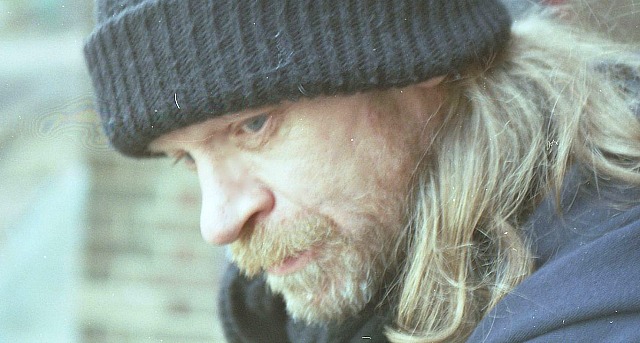
For seven or eight years Washington Post critic Ann Hornaday and I have shared a two-story, 19th-century apartment in the Old Town section of Cannes. (The address is 7 rue Jean Mero, four or five minutes from the Palais.) Ann can’t attend this year because her dad is ailing in Iowa, so half the place is suddenly sublettable. WaPo film reporter Steven Zeitchik is first in line but he hasn’t gotten approval yet, and maybe that won’t happen. If anyone’s interested it’ll be 925 euros — you’d have the downstairs, I have the up. Here’s a video I took back in 2011. Excellent wifi.

Brokaw Pushback

It seems highly significant that over 60 women have signed a letter of support for NBC News legend Tom Brokaw, who was slammed yesterday with sexual harassment accusations from former NBC news reporter Linda Vester.

Vester contended that Brokaw acted in a boorish and icky manner while allegedly attempting to ignite a romantic involvement back in the mid 1990s, when Brokaw was in his mid 50s and Vester, born in ’65, was nudging 30.

With frontline news professionals like Rachel Maddow, Andrea Mitchell, Maria Shriver and Kelly O’Donnell signing the letter, it shows that feelings of loyalty and affection for Brokaw are very strong. It also suggests that a consensus has been reached that Vester may not be cool on some level.

Brokaw “has given each of us opportunities for advancement and championed our successes throughout our careers,” the letter reads. “As we have advanced across industries — news, publishing, law, business and government — Tom has been a valued source of counsel and support. We know him to be a man of tremendous decency and integrity.”

Variety‘s Cynthia Littleton reports that the letter was written by Elizabeth Bowyer, who worked with Brokaw on his best-selling books “The Greatest Generation” and “Boom: Voices of the Sixties” and also produced the Tom Brokaw Reports documentary series.

Bowyer told Littleton that the response to the letter was “overwhelming” and she received many emails from women asking that their names be included, with responses still coming in as of Friday evening.

Invested, Devotional

From the p.r. copy: “Kevin Macdonald‘s Whitney uses rare archival footage and photos of the late Grammy-winning singer Whitney Houston for a portrait of the legendary singer’s life and career. The first documentary to be approved by the Whitney Houston Estate, pic will take a comprehensive and intimate look at the superstar’s triumphs and struggles during her 30-year career in the entertainment business.”

It seems significant that the teaser-trailer doesn’t mention singer-songwriter Bobby Brown, who was married to Houston for 14 years (’92 to ’06) and has long been regarded as a non-helpful influence in her life, particularly regarding her substance-abuse issues.

Everyone will need to compare MacDonald’s doc to Nick Broomfield‘s Whitney: Can I Be Me, a 2017 Showtime doc that was fairly candid about some things that I suspect MacDonald will skirt or pay little attention to. Whitney’s drug use, the Brown relationship, her hidden sexuality (which was reiterated by her father in a 2017 interview), and her daughter Bobbi Christina Brown, who died under regrettable circumstances at age 22.

Read more

Refreshments With Mr. Vitali

Two weeks hence Tony Zierra‘s Filmworker, a brilliant tale of the life and times of Leon Vitali, will open at Manhattan’s Metrograph, and then a week later at West L.A.’s Nuart. I’ve been insisting for months that this is an absolutely world-class doc, not to mention the best inside-the-beltway, what-it-was-really-like Stanley Kubrick doc ever made.

Yesterday I sat down with Vitali at a Starbucks in Culver City. We shot the shit for 40 minutes or so, the only problem being that we sat outside on a patio, and that meant contending with the rumble of L.A. traffic — cars, trucks, ambulances, fire engines — not to mention a Starbucks cleaning person who kept generating that awful “aaahhhggg!” sound when you drag metal tables and chairs across concrete. So it might be a bit of a struggle to listen to our chat, but by all means have a go.

Leon Vitali, former actor (Barry Lyndon, Eyes Wide Shut), longtime Stanley Kubrick assistant, Warner Bros. visual consultant and star of Filmworker (Kino Lorber, 5.11).
Given the traffic noise and the difficulty in hearing each and every syllable, I asked Leon whatever came into my head, chatting more than interviewing really.

Vitali: “I did the color timing on the 2001: A Space Odyssey 4K Bluray, and 4K is so beautiful…the details, the shadows…looking at it on these very high resolution monitors. It looks great, everybody loves it, and I’m not blowing my own trumpet. HE: “What would you say is the difference between the forthcoming unrestored Chris Nolan version and the spiffed-up 4K Bluray?” Vitali: “The difference is that the 4K has more clarity and sharpness and detail.” HE: “So people seeing the Nolan version in Cannes will say, ‘This is wonderful…not as sharp or as clear as the 4K but it looks very good.'”

Sidenote: For some reason I developed an idea years ago, perhaps after speaking with Dan Richter, the guy who played the bone-tossing “Moonwtacher” in 2001, that the “Dawn of Man” sequence was shot early in the schedule. Vitali told me yesterday that it was actually the last thing to be shot.

HE: “Your voice has a softer quality right now, but there are passages in Filmworker in which it has that deep, resonant, gravelly sound…the kind of great-sounding voice that can only result from years and years of cigarette smoking. Are you smoking now?” Vitali: “Not as much. I’ve cut down. At my height with Stanley I was smoking three packs a day. Stanley [himself] would have one every now and then.”

HE: “I always loved the sound of Stanley’s voice. The timbre and the accent. The voice of a cultured, well-educated New York cab driver. A guy who grew up in the Bronx and knew all the angles.” Vitali: “He never lost that.”

HE: “The special groove of Filmworker for me, is that when you’ve found something that really matters to you…that for all practical and aesthetic purposes has become a source of profound satisfaction, as your work with Stanley became…for me it makes Filmworker such a sublime film, because it understands and conveys that special devotion.” Vitali: “I went to drama school [when young] and I met this guy who taught me how to harness a certain inner energy…it made me realize, once you really get into something, something that really seeps in and opens you up…you’re in there and it’s no contest…you know?”

Read more

Upping Her Game

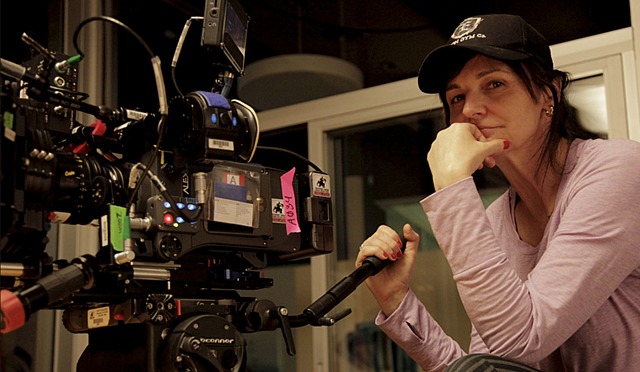
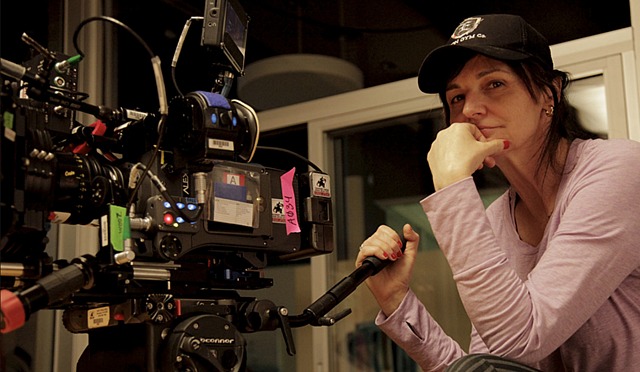
Cinematographer Svetlana Cvetko, whom I’ve been referring to as “HE’s own” for several years, has become a bona fide hyphenate — a director-dp. After making the festival rounds last year with her doc short, Yours Sincerely, Lois Weber, she began directing a self-penned feature. Produced by Nick Sarkisov and shot in black-and-white widescreen (2.39:1), it’s called My Crazy Nature.

It’s about a menage a trois relationship between two guys and a girl. The portions I’ve seen (and the silky monochrome capturings are truly magnificent) reminded me at times of Francois Truffaut‘s Jules and Jim (’62) with a dash of Coline Serreau‘s Pourquois Pas? (’77).

Alas, Svetlana has had to recently interrupt this passion project (which has been filming locally as well as in Europe) to direct an indie-financed drama called Foreign Exchange, costarring Meet The ParentsTeri Polo and Niptuck‘s Dylan Walsh.

Svet’s dp credits, working backwards: Stuntwomen: The Untold Hollywood Story (post-production), Jonathan Parker‘s The Architect and several docs (including partial cinematography) — Silicon Cowboys, Brand: A Second Coming, Red Army, Inequality for All, Miss Representation and Inside Job.

Firm Decision

Season #2 of Westworld has been airing for a few days now, but I’m pretty firm about not watching it. At all. Not this horse. Some other time.

Once again, the Brenkilco assessment: “The problem with episodic TV narratives designed to blow minds is that the form and intention are at odds. A show designed to run until the audience gets tired of it cannot by definition have a satisfying structure. It can only keep throwing elements into the mix until, like Lost or Twin Peaks, it collapses under the weight of its own intriguing but random complications.”

In short, my loathing for season #1 — that feeling of being fiddled and diddled without end, of several storylines unfolding and expanding for no purpose than to keep unfolding and expanding — is such that I’m determined to hate season #2 without watching it. I don’t care how that sounds or what it implies. Come hell or high water, I will not go there.

One question for those who saw the season #2 opener: Now that the host revolt is in full swing, it seems logical that the Westworld staffers, naturally concerned about their own survival as well as lawsuits and whatnot, would call in outside law enforcement. Perhaps even state militia. What’s preventing this? What am I missing?

From a 4.20 review by CNN’s Brian Lowry: “The first half of [season #2] repeats the show’s more impenetrable drawbacks — playing three-dimensional chess, while spending too much time sadistically blowing away pawns. The result is a show that’s easier to admire than consistently like.

“The push and pull of Westworld is that it grapples with deep intellectual conundrums while reveling in a kind of numbing pageant of death and destruction. Where the latter is organic to the world of HBO’s other huge genre hit, Game of Thrones, it doesn’t always feel integral to the story here, but rather a means of killing (and killing and killing) time.”

“For all its strengths, the series [is] a bit of a slog, at times, as the wheels turn along the dusty, blood-specked road to wherever this maze leads.”

Read more

Beyond The Unhinged

Stephen Colbert‘s riff on yesterday morning’s Donald Trump tirade (29 minutes and 25 seconds) on Fox and Friends is worth it for the 45-second satirical passage beginning at 6:20 and ending at 7:05 — the inner thoughts of co-hosts Steve Doocy, Ainsley Earhardt and Brian Kilmeade as they listen to the enraged Trump go on and on and on.

Watch the actual “Fox and Friends” video and study Kilmeade’s facial expressions starting around the 20-minute mark. The man is clearly concerned about Trump’s unhinged schpiel while struggling with himself about how to wind things down without sacrificing the required tone of respect and deference. Doocy is fairly glassy-eyed while Earhardt…is that a look of maternal concern or is she just concentrating for all she’s worth?

Read more

Nolan’s Yellowish, Teal-Tinted “2001” Obviously Sucks

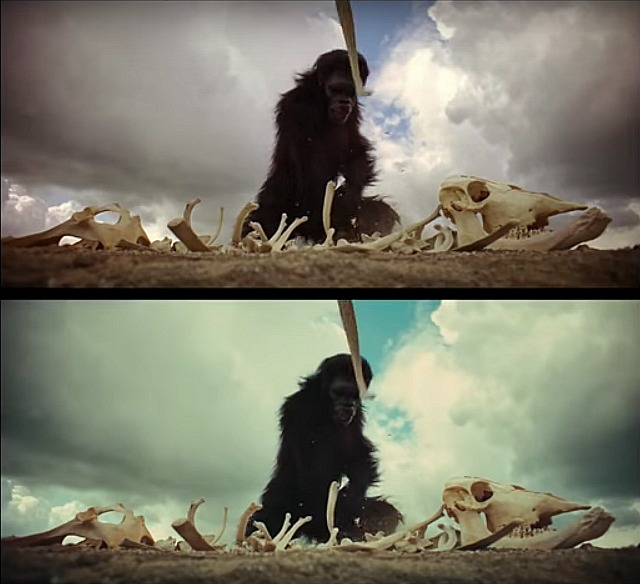
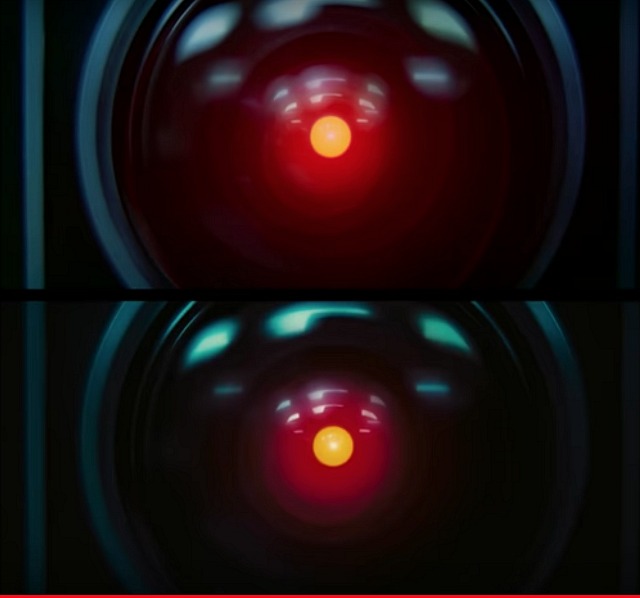
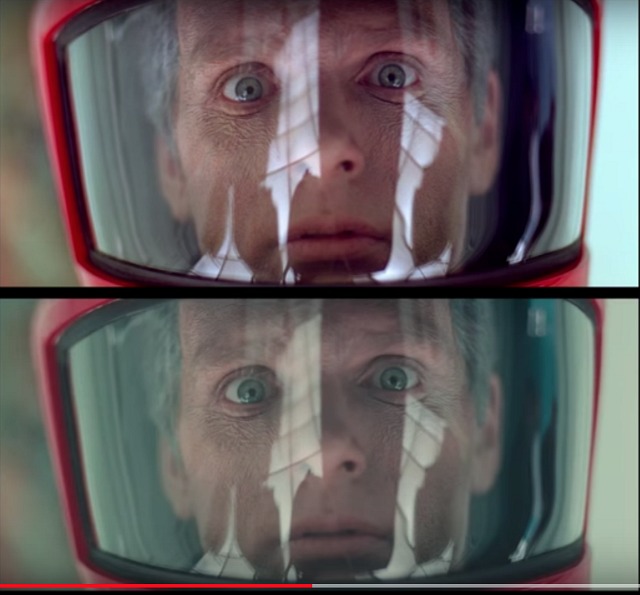
On 4.24 a guy named Krishna Ramesh Kumar posted a video essay that compares the forthcoming, Christoper Nolan-approved, unrestored 50th anniversary re-release of 2001: A Space Odyssey with corresponding images from the Warner Home Video 2007 Bluray. Please watch the essay but pay particular attention to three sets of comparison captures that I’ve posted below. The 2007 Bluray images are on top; the unrestored 70mm Nolan versions are below. The Nolan is obviously warmer, yellower and even teal-ish with weak contrasts and less detail. Plus it has no deep blacks or true whites. It looks weathered.

And this, the Nolan, is apparently what’s being re-released into theatres in May. The images rendered for the upcoming 4K Ultra HD version of 2001, which pops on May 8th, will be restricted to those with 4K Bluray players. It seems obvious to me that the colors in the Nolan aren’t as satisfying and the images are less precise than even Warner Home Video’s 11-year-old Bluray, much less whatever the new 4K version will deliver. This seems absolutely NUTS.

Examine the 2007 version of Dave Bowman‘s face through his red space helmet visor vs. the far less distinct Nolan version — anyone who says that the Nolan version is preferable needs to be hunted down by men in white coats RIGHT NOW and sent off to an insane asylum. Examine the “Dawn of Man” bone-bashing images — the sky in the 2007 version is true blue but a kind of greenish teal in the Nolan version. Examine the two close-up images of HAL — you can obviously see more red-glow detail in the 2007 version while the Nolan is darker and murkier. Who in their right mind would say “the Nolan versions are better”? This is FULL-ON INSANITY.


2007 Bluray capture above; unrestored Nolan verson below.

ditto

ditto

Read more