Way Down Below The Ocean

At the recent Los Angeles premiere for Chappaquiddick, Entertainment Studios honcho Byron Allen told Variety that “there are some very powerful people” — one of them being Chris Dodd? — “who tried to put pressure on me not to release this movie. They went out of their way to try and influence me in a negative way. I made it very clear that I’m not about the right, I’m not about the left. I’m about the truth.”

Chappaquiddick is truthful, all right. It could have been even more damning, in fact, but it conveys the necessary facts. It doesn’t slap you across the chops, but it delivers and lingers. There’s no forgetting it the next day.

It’s about how Sen. Edward M. Kennedy (Jason Clarke) suffocated his soul late at night on 7.18.69, and thereafter showed his family and colleagues (and eventually the world) what kind of person he was. About how he recklessly and probably drunkenly drove his Oldsmobile off a small wooden bridge around 11 pm that night, plunging into the black seawater, somehow climbing out of the vehicle but failing to save his passenger, a 28 year-old campaign worker named Mary Jo Kopechne (Kate Mara). And about how Mary Jo, stuck inside the submerged, upside-down vehicle, didn’t drown but almost certainly died of gradual suffocation in an air void.
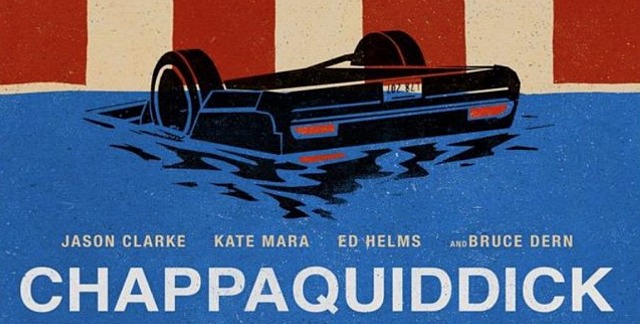
In my view (and probably in the view of those who see it this weekend), Chappaquiddick is about how irresponsible, well-connected rich guys call their friends and cover their tracks, and about how average bystanders sometimes stand by and shake their heads or shrug their shoulders and perhaps say to themselves “not mine to judge or condemn…I merely have my life to live, but the rich and powerful have their agendas to serve.”

In the late summer of ’16 I threw some praise at a 5.11.16 draft of Taylor Allen and Andrew Logan‘s Chappaquiddick script. I tore through it in no time. It’s the kind of well-finessed backroom melodrama that I love — no bullshit, subdued emotions, no tricks or games. It’s tense and well-honed, and, like I said on 8.18.16, a nightmare that had me shaking my head and muttering “Jesus H. Christ”.

Like the script, film is a damning, no-holds-barred account of the infamous July 1969 auto accident which nearly destroyed Ted Kennedy‘s political career save for some high-powered finagling and string-pulling that allowed the younger brother of JFK and RFK to wiggle out of serious trouble and more or less skate.

Just about every scene exudes the stench of an odious situation being suppressed and re-narrated by big-time fixers, many of whom are appalled at Ted’s behavior and character but who do what’s necessary regardless.

Read more

20 Years Have Taken Their Toll

Last weekend I watched a 4K streaming version of Steven Spielberg‘s Saving Private Ryan. There’s no question that this 1998 WWII drama is one of the most brutally realistic and emotionally affecting war films ever made, and is certainly among Beardo’s finest. And yet I found myself flinching at the occasionally forced or unlikely moments, at the too-broad “acting” and emotional button-pushings. It kept ringing my phony gong. “Jeez, I don’t know if I even like this movie any more,” I said to myself. “Even the Omaha Beach landing sequence is starting to bother me.”

I had the same kind of reaction when I rewatched Close Encounters of the Third Kind in ’07, or 30 years after it opened. The bottom line is that Spielberg’s sentimental or overly theatrical instincts aren’t aging any better than John Ford‘s similar tendencies.

The greatest offense comes from Harrison Young‘s awful over-acting as the 75-year-old Ryan. His face is stricken with guilt as he shuffles through the Omaha Beach cemetery, and he walks like a 90-year-old afflicted with rheumatism. In ’87 I visited this same cemetery with my father, who’d fought against the Japanese during WWII. He was quietly shaken, he later said, but he held it in because that’s what former Marines do under these circumstances. They show respect by behaving in a disciplined, soldier-like way. They don’t moan and weep and flail around like some acting-class student.

I almost lost it when the teary-eyed Young collapsed upon the grave of Cpt. Miller (Tom Hanks). “Oh, for God’s sake!” I said out loud. “Show a little dignity…be a man!” Kathleen Byron‘s performance as white-haired Mrs. Ryan is almost as bad. All she does is eyeball her doddering, bent-over husband. The whole family, in fact, is staring at the old coot like he’s about to keel over from a heart attack.

Then comes one of the most dishonest cuts in motion picture history, going from a close-up of Young’s eyes to the D-Day landing craft carrying the Ryan squad — Hanks, Tom Sizemore, Edward Burns, Barry Pepper, Adam Goldberg, Vin Diesel — as they approach Omaha beach. Matt Damon‘s Ryan (Young’s 21-year-old counterpart) won’t meet them for another couple of days, when they’re inland a few miles.

I don’t believe that loaded-down soldiers drowned after being dropped by landing craft into 15 feet of water. That might have occured in real life, but I didn’t believe this in Saving Private Ryan — it just seemed absurd. I didn’t believe that bullet wounds would cause the water off Omaha Beach to turn red with blood — in fact Spielberg’s crew poured 40 barrels of fake blood into the water to achieve this effect. The basic effect is one of Hollywood exaggeration blended with historical, real-life horror.

Then comes Hanks’ big zone-out moment when he hits the beach. He’s an Army captain in the thick of battle with machine-gun bullets whizzing by and guys getting drilled and blown apart, and he chooses this moment to go “Ohhh, I can’t think or move…it’s too much…I’m so upset by war and its carnage that I need to go catatonic for a couple of minutes…don’t mind me…I’ll come back to life after this sequence is over.” I’m sitting there going “get it together, man! You wouldn’t do this in a Samuel Fuller or Howard Hawks film…you’re only zoning out because Spielberg likes the idea of spacing out and turning the sound down.”

Read more

How Do You Feel

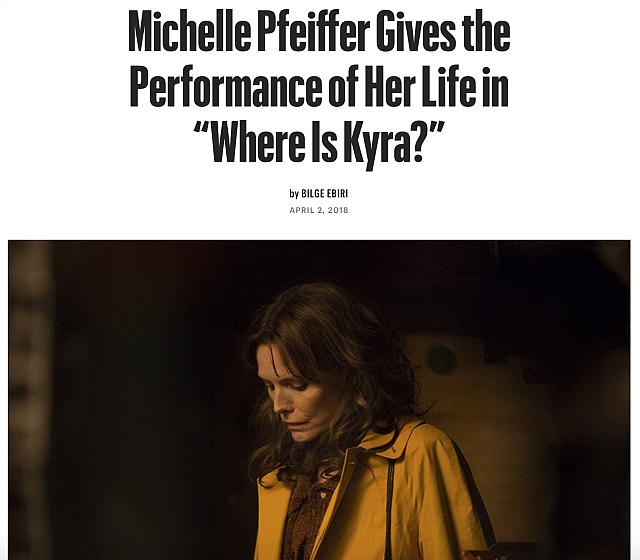
15 months after debuting at the 2017 Sundance Film Festival, Andrew Dosonmu‘s Where is Kyra? is opening this Friday (4.6). I’ve been saying all along that it’s “grade A within its realm” and that Michelle Pfeiffer‘s performance is quite the tour de force, but it’s the kind of film that will empty your soul and drain you of any will to live.

I’m not disagreeing with Village Voice critic Bilge Ebiri, whose just-posted article, “Michelle Pfeiffer Gives the Performance of Her Life in Where Is Kyra?“, teems with high praise; I’m saying “yeah, it’s very well made but don’t see it if you’re the type that occasionally thinks about suicide because it’ll push you into the abyss.”

I mentioned this impression to Ebiri this morning, and he replied “good…a movie that can convey the exhaustion and desperation of poverty to that degree is essential, and rare.” Yeah, it conveys that, all right, but I know if I consider this kind of creative deliverance to be “essential.”

Here’s how Ebiri puts it in his Voice piece: “[Dosunmu] and cinematographer Bradford Young sheathe Kyra in oppressive darkness, and they hold on her for extended periods, even when other characters are speaking or acting. Close-ups often show her half-concealed in the gloom, emerging from pitch-black corners of the screen. No lamp gives off enough light, no street scene is bright enough. A pall has descended over this woman’s life. Rarely on film has the sheer debilitating exhaustion of poverty been conveyed so clearly.”

Here‘s how I put it on 1.24.17: “A funereal quicksand piece about an unemployed middle-aged woman (Pfeiffer) in a terrible financial jam, and about a relationship she has with a fellow down-and-outer (Keifer Sutherland), Where Is Kyra? is a carefully calibrated, well-acted gloomhead flick that feels like it’s happening inside a coffin or crypt.

“This is Dosunmu’s deliberate strategy, of course, but the end-of-the-road, my-life-is-over vibe is primarily manifested by the inky, mineshaft palette of dp Bradford Young — HE’s least favorite cinematographer by a country mile.”

Read more

Sullivan Travels

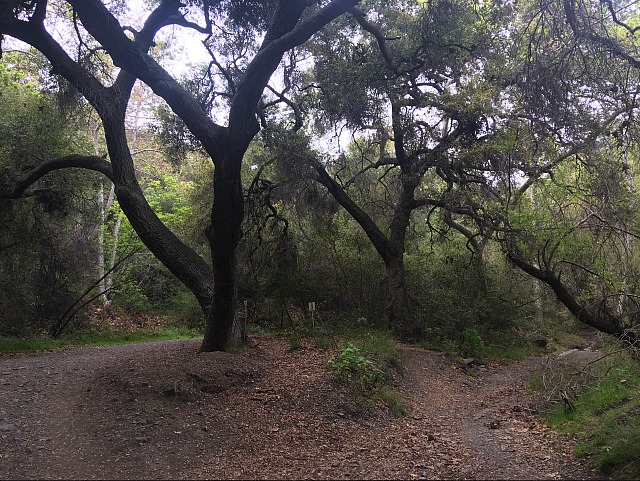
Most of yesterday afternoon was about hiking in Sullivan Canyon, a leafy, horse-trail community just west of Mandeville Canyon. We defied the posted warnings and parked on Old Ranch Road, about 1/2 mile north of Sunset. We walked up a horse trail to Sullivan Canyon trail, which goes on and on. By the time we were back to the junction of Sunset and Old Ranch we’d hiked five miles.

We also checked out Diane Keaton’s super-sized, industrial-chic home, which was written about last October in Architectural Digest. Keaton also published a book about it — “The House That Pinterest Built.”

We only scoped out the exterior, of course. It’s magnificent and exacting, so beautifully textured and all of a piece in so many ways, but at the same time (here it comes) so immaculate that it feels more like the workspace of an enlightened, forward-thinking company (it reminded me a bit of J.J. Abrams‘ Bad Robot headquarters) than what most of us would call a “home.”

Homes need to feel imperfect and lived in and just a little ramshackle — a tad sloppy and messy with the scent of white clam sauce and peanut butter and sliced lemons, and maybe a hint of cat poop. A good home always has magazines and books and vinyl LPs all over the place, not to mention flatscreens and blankets draped over couches and at least three or four cats and dogs hanging around. Keaton’s place might feel homier inside, but the exterior seems a bit too precise.

Oh, and there’s hardly any tree-shade in the front yard of Keaton’s place. Warren Beatty once said that great-looking hair constitutes 60% of a woman’s attractiveness; by the same token a great-looking home needs great trees (sycamores, jacaranda, lemon eucalyptus, pin oak) to drop a few thousand leaves and shade the place up.

6:15 pm update: I just ran into Warren Beatty and Annette Bening at Le Pain Quotidien on Melrose…honest! I told him I loved the quote about hair constituting 60% of a woman’s beauty or appeal, and he said, “I don’t think I ever said it.” Huh. “You read this somewhere?,” he asked. Yeah, I said. In an article about Diane Keaton or about her home, and just this morning. I definitely didn’t invent it, I emphasized, but I love the observation regardless.


Diane Keaton’s spacious, self-designed home, just around the corner from Old Ranch Road and exactingly designed like nothing you’ve ever seen.

Built in Sullivan Canyon in 1956, Mandalay (2200 Old Ranch Road) was a sprawling, one-story home designed by architect Cliff May, who is regarded as the creator of the California Ranch-style house (i.e., early 1930s). May died in 1989. The Mandalay property was bought, destroyed and redeveloped. The big gate looks like the entrance to Jurassic Park.

Read more

Sinclair Goon Squad

Self explanatory but for clarity’s sake, HBO’s John Oliver has summarized the situation as follows: “Nothing says ‘we value independent media’ like dozens of reporters forced to repeat the same message over and over again, like members of a brainwashed cult.”

The across-the-board Orwellian script was obtained and published by the Seattle Post Intelligencer last Thursday:

“Hi, I’m (A) ____________, and I’m (B) _________________…

(B) Our greatest responsibility is to serve our [local] communities. We are extremely proud of the quality, balanced journalism that KOMO News produces.

(A) But we’re concerned about the troubling trend of irresponsible, one-sided news stories plaguing our country. The sharing of biased and false news has become all too common on social media.

Read more

“They Hear, They Hunt”

From critic, documentarian and film series host Marshall Fine: “My favorite movie of the moment is A Quiet Place (Paramount, 4.6). Much more emotionally compelling than Don’t Breathe or any of your average thrillers. Showed it at my film club (had the producers there for a q & a), which is a suburban NY 60-plus crowd — they walked in not knowing what they were going to see (they never do). Three older women walked out an hour in (one said ‘it’s good but it’s too intense for me’); otherwise, a hit with my audience, which is quite a different thing than, say, a SXSW gathering.” John Krasinki‘s film premiered in Austin on 3.9.

“What’s Wrong?”

I’ve mentioned before that my first viewing of George Lucas‘s THX-1138 happened during a 24-hour FILMEX sci-fi marathon, which happened in ’74 or ’75. The screening began around 4 or 4:30 am. I remember getting up at 3 or 3:15 am and driving over to Century City Plitt theatres in the dark. There’s nothing quite as pulverizing as watching a sci-fi film at 4:30 am, your system just starting to feel revved with that first jolt of caffeine. I’ve never forgotten that computer greeting Robert Duvall hears with each and every log-on — “what’s wrong?” I say this to my cats when they want something. They look at me and I say “what’s wrong?”, in that exact same computer voice.

Son of Latvian Prince

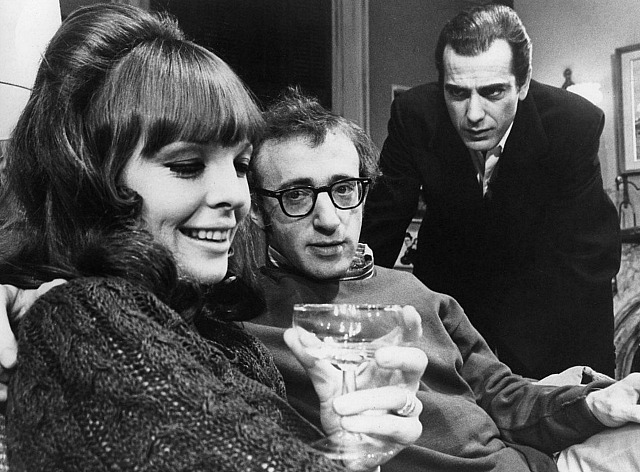
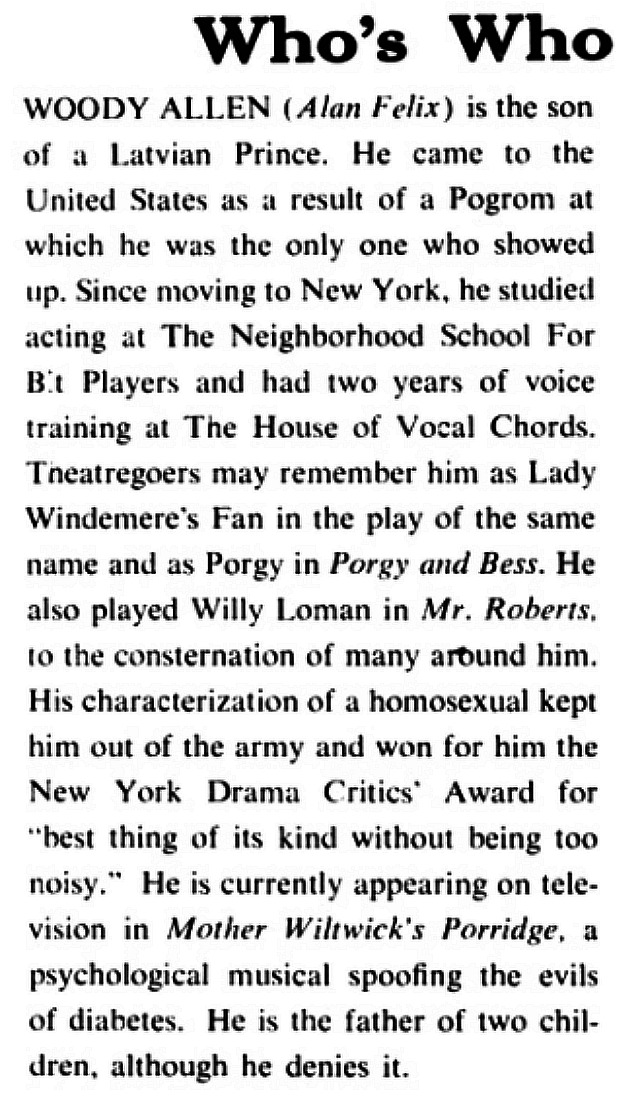
Woody Allen‘s Play It Again, Sam opened at the Broadhurst theatre on 2.12.69 and ran for just over a year, closing on 3.14.70. Directed by Joseph Hardy, the cast included Allen as Allan Felix, Diane Keaton as Linda Christie, Tony Roberts as Dick Christie and Jerry Lacy as the ghost of Humphrey Bogart. Allen left the show near the end of its run and was replaced by Bob Denver. It was while auditioning for the play that Keaton first met Allen; they became romantically involved but broke up after a year. The biography [below] is from the Play it Again, Sam copy of Playbill.


(l. to r.) Diane Keaton, Woody Allen, Jerry Lacy.

Read more

Quiet But Permanent Expulsion

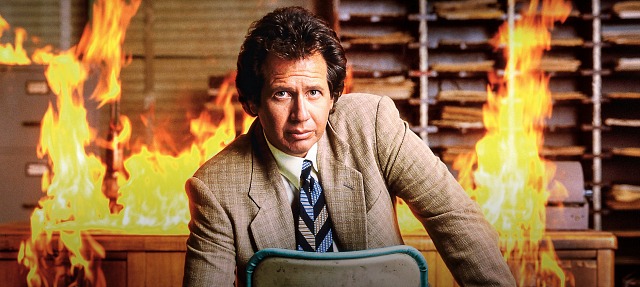
I regret to say that Garry Shandling told several penis jokes in his day, and every last one of them makes me cringe. Because of that godawful word, I mean. I’ve said this once or twice before but I really and truly want to see that icky and contemptible term retired, and that includes being removed from each and every English dictionary, dead-tree or online. I make a face each and every time I hear it because it assigns or associates the menial and moderately offensive task of waste disposal to an organ that is primarily about love and rapture and hormonal mountain-climbing, not to mention shouldering a metaphor for the primal love of life. The substitute terms are schlong, junk, Johnson or schtufenhaufer. I mean it. There are dozens if not hundreds of words that have become obsolete due to not being used — zounds, sweetmeats, smite, fourscore, etc. I’m merely talking about adding another to the list.

Reminder

Ex-wife: Did you watch the Garry Shandling HBO special [i.e., The Zen Diaries of Garry Shandling]?
Me: Been meaning to….the four and a half hour length has been giving me pause….why?
Ex-wife: Really moving.
Me: Okay, I’ll watch it tonight. Of half tonight and half tomorrow or something. Moving how? What was the big moment?
Ex-wife: He never recovered from the death of his brother when he was a kid.

Read more

Easter Blip on Radar Screen

Easter means nothing to me. Not since I turned 14 or 15. Okay, maybe when the kids were young in the early ’90s and we all went on a couple of easter egg hunts. But don’t even think of pulling that shit now.

If I’m so inclined there’s one way to bring it all back, to revisit that time in my life when Easter service at our local Episcopal church and Palm Sunday and chocolate rabbits were actually “things” of some value, and that’s listening to Miklos Rozsa‘s Biblical film scores. I’ve said this three or four times since HE launched, but when orgiastic, big-screen, reach-for-the-heavens emotion was called for, no one did it better. He may have been first and foremost a craftsman, but Rozsa really had soul.

Posted 15 years ago: “Listen to the overture and main title music of King of Kings, and all kinds of haunting associations and recollections about the life of Yeshua and his New Testament teachings (or at the least, grandiose Hollywood movies about same) start swirling around in your head. And then watch that Nicholas Ray‘s stiff, strangely constipated film (which Rozsa described in his autobiography as ‘nonsensical Biblical ghoulash’) and ask yourself if Rozsa didn’t capture the spiritual essence of Christ’s story better than what Ray, screenwriter Phillip Yordan and producer Samuel Bronston managed to throw together.

“I don’t know if it’s commonly known, but the “buhhhm-ba-dum-dum” theme from Jack Webb‘s Dragnet TV series was taken from Roza’s score for The Killers. Here’s Rozsa’s bum-da-dum-dum in the opening credits for that 1946 noir classic.

Read more