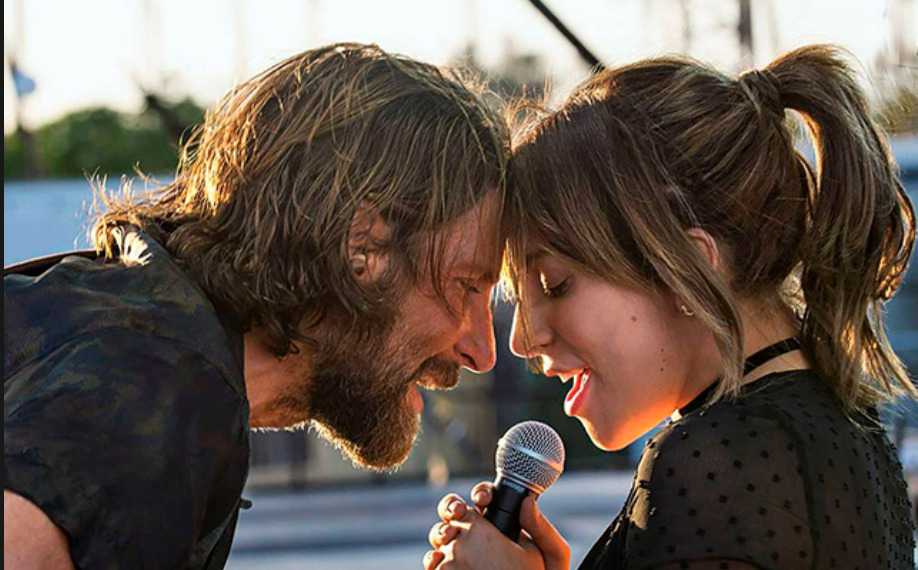
Everyone’s Shilling For Cooper’s “Star Is Born”

Not sure when Warner Bros. decided to hold special celebrity screenings of Bradley Cooper‘s A Star Is Born (Warner Bros., 10.5), but I’m guessing sometime in early to mid March. All I know is that three big names — Barbra Streisand, Sean Penn and Robert De Niro — have spoken highly of it.

First it was Streisand (“Oh, I can’t say too much…I haven’t seen too much, but it’s good…it’s very, very good.”). Then Penn (“One of the most beautiful, fantastic, it’s the best, and most importantly commercial film I have seen in so many years”). And now De Niro, speaking during a Tribeca Film Festival discussion with Cooper (“It’s terrific and Bradley is excellent in it…the movie is wonderful…I hope it gets the attention I feel it should when it opens…Bradley learned to sing…he really worked hard and it paid off…you see all the hard work he did, it’s special”).

Hollywood Elsewhere to other celebrities who’ve seen it: We get it. You liked the film and you’re happy that Cooper’s debut effort turned out well — great. But that’ll do for now.

We Are, We Are Morons

In a 4.9 New Republic piece called “Will Hollywood Ever Make Another Children of Men?,” the answer is a simple “no.” Why? Because the apes have decided that theatres are CG funhouses, and that smarthouse, soul-stirring flicks are for streaming, and never the twain small meet.

The article is actually a chat between Alex Shepard and Wall Street Journal reporter Ben Fritz, author of “The Big Picture.” The book basically explains how it’s all turning to CG shit in theatres, but we’re actually in a golden age if you focus on non-theatrical.

Shepard: “2017 was an outstanding year for movies but it does seem like Oscar-bait movies are working on a smaller scale, for a smaller audience, in part because Hollywood has stopped investing in big budget Oscar-bait movies that aspire to a mass audience. In The Big Picture, you argue that three of my favorite recent movies — Michael Clayton, Captain Phillips and Children of Men — would have a much hard time getting made right now.”

Fritz: “That specialty market will certainly survive. If you live in a big enough city you’ll be able to see the next Ladybird in a few years. But most people won’t. They’ll see it on streaming or whatever. And that will be fine. But Children of Men, that’s a great example. I don’t know what it’s budget was — $80 million maybe. It’s not cheap to make that film. You’re making a film that’s really worth seeing on a big screen.

“But there’s no Children of Men cinematic universe. There’s no franchising. There are no tie-ins. There are no sequel possibilities. That’s a one-off film and that’s the type of thing that won’t get made anymore. It’s also the kind of thing that’s tough to replicate for a streaming service. It’s the kind of movie we’re losing and that’s a bummer.”

Bummer? For those of us who’ve been watching aspirational, high-craft, spiritual-deliverance movies in theatres for the last 30 or 40 years, this is a major cultural tragedy. It’s enough to make you think about getting into opioids, brah.

In an 11.20.06 HE piece called “Children = Guernica,” I wrote the following:

“Many critics were impressed by Children of Men‘s virtuosity and bravado,” writes Hollywood Reporter/Risky Biz blogger columnist Anne Thompson, “while industry types were seeing a downer film that’s going to lose money.

“The movie is a brilliant exercise in style, but it’s another grim dystopian look at our future — like Blade Runner or Fahrenheit 451 — that simply cost too much money.”

Read more

Criterion’s Teal-Tint Insanity

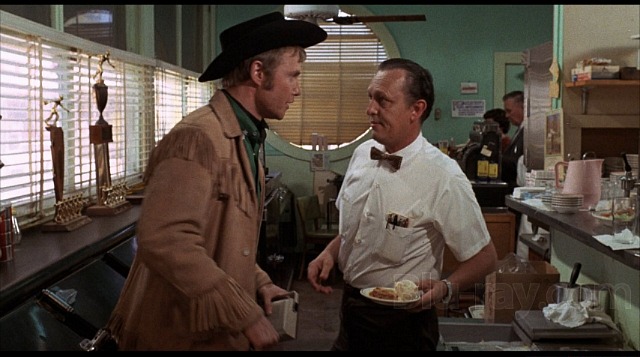
Last night I read some Bluray.com comments along with a review that made me gasp. Actually they made me fall out of my chair. The thread was about Criterion’s curiously re-colored, teal-tinted Midnight Cowboy Bluray (5.29), which I wrote about a couple of days ago.

The Criterion jacket says that the Midnight Cowboy Bluray is a “new 4K digital restoration, approved by cinematographer Adam Holender.”

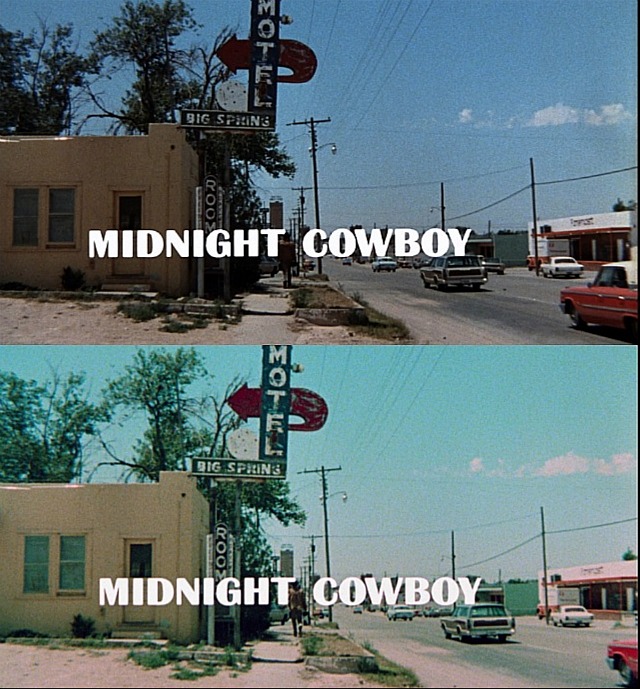
To go by recently posted comparison shots, this is easily Criterion’s biggest Bluray boondoggle** since the Dressed To Kill calamity of 2016, when Criterion went along with Brian DePalma‘s request that the images be narrowed (i.e., horizontally compressed) and the colors tinted yellow-green without much of a black layer. Criterion gradually admitted to error and released a corrected disc.

Natural-looking capture from 2012 MGM Bluray.
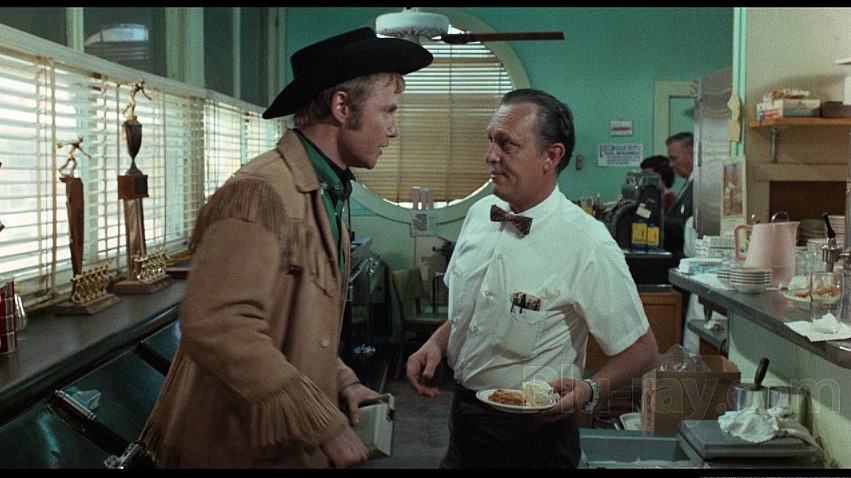
Same shot rendered by Criterion’s “teal team.”
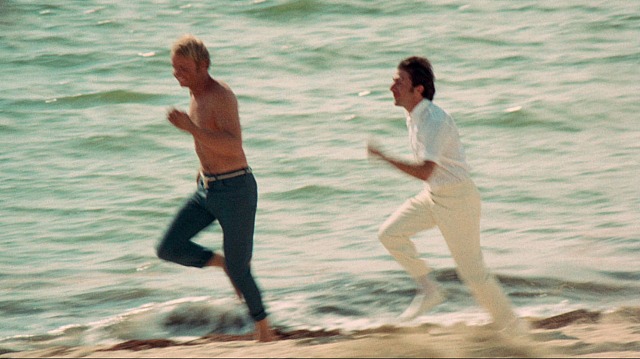
Many times I’ve gazed upon the green Atlantic Ocean while basking in the hot-sand warmth of Miami Beach.

In a 4.15 review, Bluray.com’s Dr. Svet Atanasov refuses to even acknowledge the teal-tint issue, which automatically makes you wonder what he’s up to. “The color palette [of Criterion’s Midnight Cowboy Bluray] is a lot more convincing,” he writes. “On the old release [the 2012 MGM Bluray] some of the primaries were not as stable and well saturated as they should have been and now the new 4K restoration makes this painfully obvious.”

What the hell is Atanasov talking about, “not as well saturated”? I own the six-year-old MGM Bluray and it’s totally fine, and it doesn’t have any space-alien tinting.

Please read this thread. It includes a few fair-minded, sensible-sounding remarks, but also comments from some real lunatics.

One of the latter is a guy who calls himself “RCRochester.” In a remarks about contrasting shots (Criterion vs. MGM) of a small-town Texas motel [see above], he claims that “the sky looks blue in both…it’s just that the Criterion cap looks brighter. The movie’s title in the same shot looks bright white, if the image was ‘tealed’ I would expect that to have a bluish tint to it as well.” The man has gone over the waterfall in a barrel — he actually maintains that the sky in the Criterion image is blue when it’s obviously an eerily bright blue-green.

A looney-tune named “The Green Owl” exclaims that “the screenshots look great to my eyes,” and that he’s ordering the Criterion as a result.

A guy named “Markgway” doesn’t like what he sees, but says he might go along regardless. “Unless someone can say for sure that the film was meant to look teal, I’m going to assume something is awry,” he says. “It happens too many times that older films are remastered to a modern grading standard and wind up looking suspiciously different to the way they had before.”

Read more

Took ‘Em Long Enough

A trailer for Tony Zierra‘s Filmworker, a brilliant doc about the life and times of Leon Vitali, has finally surfaced. It’s been kicking around in my head for a full year, this film, and now the crescendo. Easily the juiciest and dishiest capturing of Stanley Kubrick‘s backstage life and career ever assembled. It’s about Vitali’s life, of course, but by way of Kubrick’s. (Or is it the other way around?) 21 or 22 years of deep focus, late hours, nose to the grindstone, passion, obsession, total commitment and almost no days off, ever.

Vitali began working for The Great Stanley K. in various capacities a year before The Shining began shooting, and then stayed with him to the end (i.e., 3.7.99). Researcher, gopher, go-between, driver, casting assistant, print cataloguer and (after Kubrick’s death) restoration consultant. The film is a completely satisfying record and assessment of that servitude, that era, that history, that ongoing task. And that Vitali voice! A bassy creation made resonant by decades of cigarette-smoking, and really something to sink into.

The photos and behind-the-scenes film clips alone are worth the price, I can tell you. Great stuff. On top of which I was reminded that Vitali played not one but two roles in Kubrick films — Lord Bullington in Barry Lyndon (’75) and “Red Cloak” in Eyes Wide Shut (’99).

Vitali said to himself early on that he’d like to work for Kubrick. What he didn’t expect was that once that work began Kubrick would want Vitali at all hours, all the time…focus and submission without end. If the early sentiment was “I’d give my right arm to work for Stanley Kubrick.” Kubrick’s reply would be “why are you lowballing me? I want both arms, both legs, your trunk, your lungs, your spleen, your ass and of course your head, which includes your brain.”

Yes, Virginia — Stanley Kubrick was no day at the beach. Then again what highly driven, genius-level artist is?

Read more

All-Time Irritation

Posted on 1.19.18: “In the ambitious but mediocre Blindspotting, the sympathetic, Oakland-residing Colin (Daveed Diggs) is trying to stay out of trouble over the final three days of his parole status. Unfortunately, his longtime best friend is a violent, hair-trigger, gun-wielding asshole named Miles (Rafael Casal) so right away you’re wondering “is Colin as stupid as he seems, or is he just temporarily stupid?”

Even more unfortunately for the audience, Casal, a 32 year-old playwright and performance poet, relies on a broad caricature of Oakland street blackitude — machismo shit talk, constant strut, a mouthful of gold fillings, flashing pistols, drop-of-a-hat hostility, etc.

In the view of Hollywood Reporter critic Todd McCarthy “the volcanically emotive Miles” is “a character so brainlessly compulsive and violent that he becomes pretty hard to take after a while.”

White guys adopting the posture of angry, ready-to-rumble street brahs is an old bit. Hip white kids have been pretending to be urban desperados since at least the early ’90s. Gary Oldman as Dretzel in True Romance (’93). Josh Peck in Jonathan Levine‘s The Wackness (’08). The best comic reversal of this was Richard Pryor‘s imitation of dipshit white guys in Richard Pryor — Live in Concert (’78).

Casal’s Miles is easily the most irritating variation I’ve ever seen. I was hating on him 15 minutes into the film.

Arkansas Hick

I love Sarah Huckabee Sanders‘ pronunciation of Iran, which in cultivated circles sounds like “Ihrahn.” At 1:42, Sanders pronounces it “Eye-rayuhnn.” She also pronounces France as “Frayunce” (33-second mark). She probably pronounces Paris like a friend from Connecticut does — “Pairiss.” A deft sidestepper and frequent liar, Sanders is only 35 years old. If there is a hell, Sanders will definitely be taking the down elevator when her time comes.

Who Dies At 28?

Tim Bergling (a.k.a. Aviici or “Aveechee”), the Swedish D.J. and electronic dance music producer whose worldwide fame completely eluded my attention, was found dead today in Muscat, the capital of Oman. He was 28 years old, or the age of my younger son Dylan. He apparently drank himself to death. The Sun‘s Jacob Dirnhuber reports that Aviici “stopped touring and live performances in 2017 after being diagnosed with pancreatitis from excessive drinking. He was forced to have an emergency appendectomy and have his gallbladder removed.”

Pounding of Heels

If only we could get rid of people who walk heavy…boom! boom! boom! The kind of slam-heel walking that can make an older home vibrate and shudder. People who pound their heels like a weapon. My younger sister used to walk like this. When she used the stairway in our pre-war home you could hear those jackhammer heels ramming and thumping and giving pause to the main beams.

If you’re an elegant person (and by that I mean someone who also takes relatively short showers) you’ll walk around like you’re wearing hush-puppies. Like Swing Time Fred Astaire or Cary Grant over the Cannes rooftops in To Catch A Thief, or Marlon Brando shuffling across a sound stage in Guys and Dolls.

Remember Paul Newman describing Jackie Gleason as he was “shooting the eyes right off them balls” in The Hustler? “Look how he moves, he’s like a dancer!” It doesn’t matter if you’re big-boned or a Jabba; if you know how to walk you’ll always step softly.

There She Goes Again

The one-two punch of National Geographic‘s “Genius” series (Albert Einstein, Pablo Picasso, Mary Shelley) and Gabe Polsky‘s In Search of Greatness doc has made me irritable. Because I can’t stand that awful word, even though I use it from time to time. And not just the word but people who seem to say it a lot, or more frequently than once in a blue moon.

The first time I recoiled at the word “genius” was when a New York girlfriend was explaining that she was dropping me for a guy who had his own advertising agency, Geoffrey something-or-other, and that he was a “real genius.” Fuck that guy and fuck anyone who calls anyone else the g-word, I decided then and there.

Decades have passed but I’ve noticed time and again that people who say “genius” the most — sycophants, ass-kissers, headline writers, wives and girlfriends, employees, speechwriters, radio-talk-show hosts — have the same kind of obsequious attitude about X-factor people. That’s my preferred term, by the way. No allusions to any sort of God-given brilliance or incandescence, but definitely off in some other realm.

I first heard the term when I was six or seven, when my mother was telling me who Albert Einstein was, and that was long before he changed his name to Albert Brooks. All I know is that I decided a long time ago to throw a little stink-eye at anyone who says “genius” in conversation. It’s one thing to type it and be done with it, but saying it out loud is like chalk on a blackboard.

Swoosh of the Sword

A semi-historic, invitation-only screening of Black Panther occured in Riyadh the night before last (i.e., Wednesday, 4.18). The premiere happened at a new AMC plex in the King Abdullah financial district, the first in the country since a 35-year-old ban on cinemas was lifted last December.

Video messages from various film industry bigwigs (Tom Rothman, Jeff Shell, Jim Gianopulos, Alan Bergman, Kevin Tsujihara) were screened before the feature. A message from producer and former AMPAS president Hawk Koch: “I’m sure that Saudi Arabian filmmakers are now going to start making the kinds of films that will gain recognition all over the world. And I bet very soon, a film from Saudi Arabia will get nominated for an Oscar!”

HE reaction: In my estimation, Koch’s encouraging vision is unlikely if not illusory. There’s a current p.r. effort underway to sell Saudi Arabia as a more liberal nation (i.e., a Saudi Arabian pavilion will appear at next month’s Cannes Film Festival), but it’s still a medieval-minded autocracy, and governed by a very hardline approach to Sharia Law. A harshly punitive government mentality has never been conducive to creative ferment, at least not in my experience.

The only thing Saudi Arabia is really liberal about, it seems, is beheading people, and they still occasionally stone people to death. A Wiki page says you can lose your head in Saudi Arabia for murder, treason, rape, blasphemy, adultery, sexual misconduct (anything non-hetero), sorcery or waging war on God.

Guillermo Banters With Hurricane Billy

Guillermo del Toro on the sweet smell of success: “You have to remain a scrapper, [and] success palliates that spirit. Success tells you ‘you’re a good boy.’ If you give into that impulse you get disoriented because you get patted on the back. The artist has a certain degree of rage against the people [who] are inside the candlelight banquet…success tells you, ‘come on in, have a piece of chicken, have a glass of wine,’ and you shouldn’t. If you go into that banquet you lose some of that scrapper spirit.”

HE response: There’s nothing wrong with a friendly candlelit banquet if you don’t drink, and if you go easy on the chicken. Everyone needs to come in from the cold from time to time. Also: Every artist suffers the same anxiety attack every morning, and the name of that attack is “Have I peaked? Am I more or less done? Am I dead but don’t it?” The natural knee-jerk response is “Hell, no!…I’m just beginning, more mountains to climb,” etc. But there’s another voice from deep inside that says “you think?”

William Friedkin on his French Connection Oscar glory: “I feel like I kind of lost myself. Absolutely.”

HE response: The thing about success and power is that they goad people into revealing their dark sides. If a person has snarly tendencies embedded in his/her personality, success makes them rise to the surface. Also: For the 109th time, the Billy train hit a wall when Sorcerer flopped, but — BUT! — it’s a brilliant film. The mistake was having the mob assassins come for Roy Scheider at the very end. The poor guy had just made it through a terrible ordeal through sheer moxie and determination. He deserved a measure of peace, and perhaps even a ticket out of that South American hellhole. But Friedkin had him killed. When that happened, the audience went “fuck this movie.”

Friedkin and Del Toro got together under the banner of a Talk House podcast, posted by The Playlist‘s Rodrigo Perez.

Read more