Another Obiter Dicta Reveal

There are brilliant X-factor horror flicks — John Krasinski‘s A Quiet Place, Robert EggersThe Witch, Jennifer Kent‘s The Babadook, Andy Muschietti‘s Mama (but not It) and now Ari Aster‘s Hereditary — and there is the pig trough of horror-genre films.

Either you get what serious, classy, smarthouse horror films are up to, or you don’t. Either you understand that when a certain scare switch is flipped by way of hint, suggestion or implication (such as that little-ping moment in Rosemary’s Baby when Mia Farrow reads the journal of a recently-deceased victim of Roman and Minnie Castevet and comes upon the phrase “I can no longer associate myself…”), it connects with convulsive, deep-rooted terrors that are far more disturbing than anything you might find in It.

Not to paint with too wide a brush, but horror-genre fans tend to be on the coarse and geekish side in terms of their preferences. They’re basically about a general opposition to subtlety or understatement of any kind. Which is not to imply that Hereditary errs on the side of understatement. It certainly doesn’t during the second half. But the first half is almost a kind of masterclass in how to deliver on-target chills and jolts through fleeting suggestion rather than the usual sledgehammer approach.

In her 1.30.18 review of Hereditary, The Verge‘s Tasha Robinson wrote while Ari Aster’s film had been praised by Sundance critics as shocking and terrifying, there was nonetheless “some skeptical backlash from horror fans who felt burned by similar advance praise for films like The Witch and It Comes At Night, two extremely tense horror films in which not a whole lot ultimately happens.”

Robinson was dead serious. She really and truly felt that some horror fans (including herself?) felt “burned” by The Witch. Words fail.

From my 2.15.16 review of The Witch: “This is easily the most unsettling and sophisticated nightmare film since The Babadook. That’s a roundabout way of saying that the dolts who pay to see the usual horror bullshit will probably avoid it to some extent. Insensitive, all-but-clueless people tend to favor insensitive, all-but-clueless movies, and I’m sorry but The Witch is mostly too good for them — too subterranean, too otherworldly, too scrupulous in its avoidance of cliches. And because it goes for chills and creeps rather than shock and gore.”
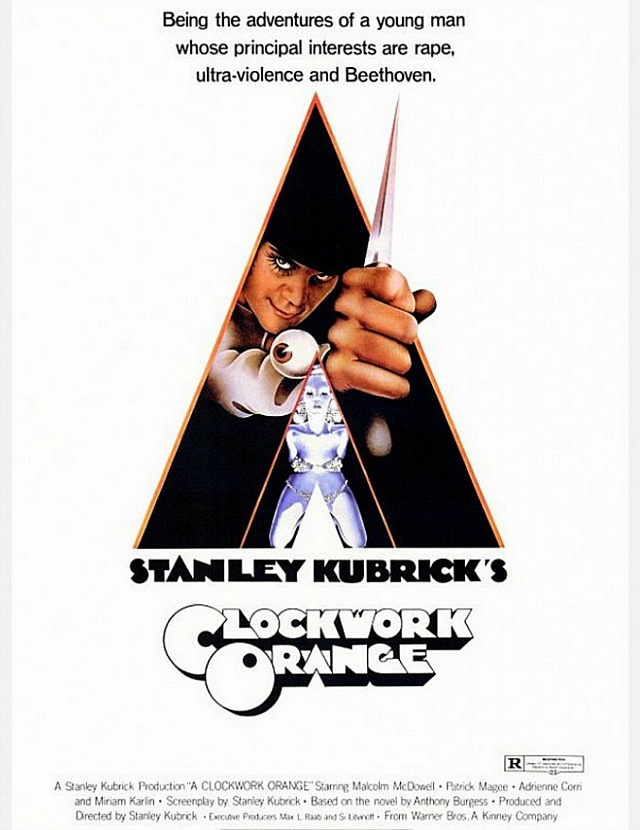
Greatest All-Time Movie Poster?

Poster designer Bill Gold, who passed yesterday at age 97, began in the advertising department of Warner Bros. The year was 1941, when Gold was only 20, and yet his Wikipage says he designed the poster art for Yankee Doodle Dandy and Casablanca, which both opened in ’42. I don’t know who was running WB’s poster design department back then, but some older person was. I’m not throwing shade, but how likely is it that a fresh-faced 21 year-old, straight out of Pratt Institute, was the sole poster designer for two major WB releases, one of which won the Best Picture Oscar?

Gold was the art and concept guy for dozens of classic movie posters, but the Clockwork Orange poster, which he partially designed at age 50 or 51, was arguably his best. (The primary designer was Philip Castle.) Look at it — it doesn’t project lewd or grotesque vibes, but it almost makes the vague notion of ultra-violence and the old in-out, in-out by way of Alex DeLarge and his deplorable droogs seem almost delicious, like candy or ice-cream. Or at the very least slick and stylish, like album-jacket art for a cool band. I would argue that the Clockwork Orange poster is the greatest of all time. It’s perfect. One glance and there’s no forgetting it.

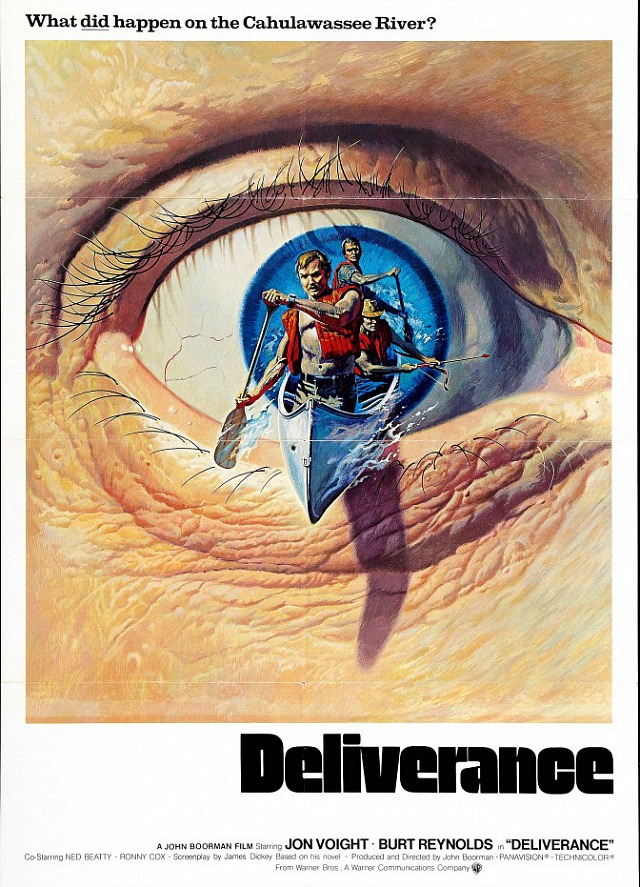
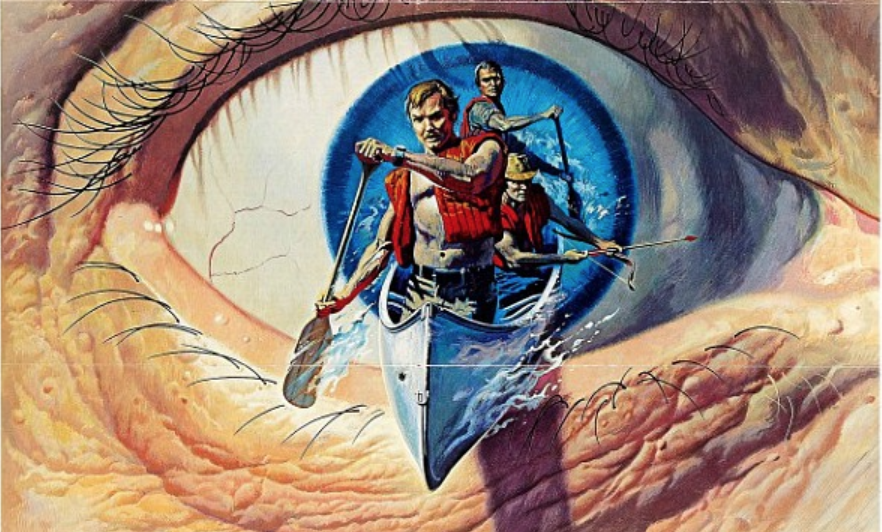
And yet Gold’s trippy one-sheet for John Boorman‘s Deliverance may be the most creatively mis-designed poster for a major studio release that I’ve ever seen. It suggests that what happened between Jon Voight, Burt Reynolds, Ned Beatty and Ronnie Cox on the fictional Cahulawassee River was a matter of individual interpretation or conjecture. Canoe-paddling out of a big eye suggests some kind of surreal or imaginary fantasy, which Deliverance certainly isn’t. The events that occur are absolutely real start to finish, and so the poster lies. Before today I’d never even seen it. So Gold gets one demerit.

Read more

Son of Soft Corruption

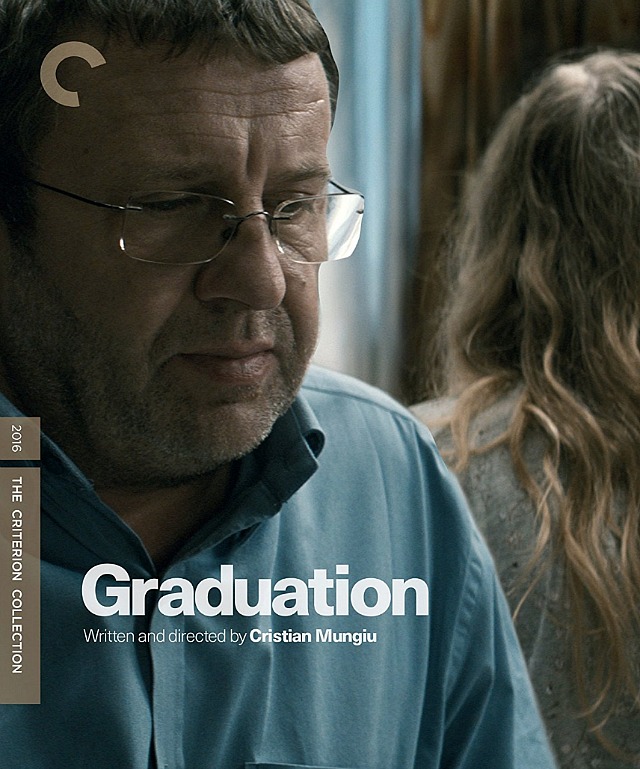
Sorry for re-posting, but Criterion’s Bluray of Cristian Mungiu‘s Graduation pops tomorrow (5.22). Maybe there are some who missed my original review. Even if the jacket art bores or puzzles you, this 2017 film (which premiered in Cannes in May 2016) is really quite essential.

It’s a fascinating slow-build drama about ethics, parental love, compromised values and what most of us would call soft corruption. It basically says that ethical lapses are deceptive in that they don’t seem too problematic at first, but they have a way of metastasizing into something worse, and that once this happens the smell starts to spread and the perpetrators start to feel sick in their souls.

I don’t necessarily look at things this way, and yet Mungiu’s film puts the hook in. I felt the full weight of his viewpoint, which tends to happen, of course, when you’re watching a film by a masterful director, which Mungui (Four Months, Three Weeks, Two Days, Beyond The Hills) certainly is.

And yet I tend to shy away from judging people too harshly when they bend the rules once or twice. Not as a constant approach but once in a blue moon. I’m not calling myself a moral relativist, but I do believe there’s a dividing line between hard corruption and the softer, looser variety, and I know that many of us have crossed paths with the latter. Let he who’s without sin cast the first stone.

Politicians or dirty cops who accept payoffs from ne’er-do-wells in exchange for favoritism or looking the other way — that’s hard, blatant corruption. Soft corruption is a milder manifestation — a form of ethical side-stepping that decent people go along with from time to time in order to (a) prevent something worse from happening or (b) to help a friend or family member who’s in a tough spot and needs a little friendly finagling to make the problem go away or become less acute.

The soft corruption in Graduation, which is set in a mid-sized town in Transylvania (the region in Romania where Dracula came from), has to do with a father (Adrian Titieni) who’s trying to help his daughter (Maria Dragus), an A-student who hopes to study psychology in London, with her final exam. Unfortunately she’s obliged to take the exam right after suffering an attack by a would-be rapist. The assault momentarily scrambles her brain, and she winds up not doing as well as she might have otherwise.

Read more

Right Here, Right Now

I’m coping with the usual post-Cannes, L.A.-blues syndrome. I missed last night’s 7:30 pm JFK flight, took a 9:40 pm flight instead. Two compassionate Jet Blue reps took pity and didn’t charge me a penalty. Tennessee Williams and the kindness of strangers.

Missing the 7:30 flight was 35% my fault, 65% the MTA’s.

I was underneath Penn Station on the A and D train platform. An A train with signs that said “JFK” and “Howard Beach” pulled in. It didn’t seem to be going southbound, but I was just fatigued enough to question my own sense of direction. (MTA subway-stop signage doesn’t always clarify which way trains are heading.) I asked a sharp-looking 20something woman, “Excuse me but is this train going to JFK?” Yes, she said. “Really?”

It didn’t seem right but I got on regardless. How could it not be JFK-bound with that signage?

Fake-out! It was a northbound train, headed for Harlem. How could the MTA do this? What kind of fiendish, diabolical minds, etc.? I lost about 15 or 17 minutes, all in. Call it 20. The result was that when I finally got to JFK, I missed the plane by a nosehair.

Middle of the Night

Ethan Hawke‘s performance in Paul Schrader‘s First Reformed is one of his all-timers. In part, I feel, because he really knows how to channel “tormented”. (I still think Hawke’s anguished-younger-brother performance in Sidney Lumet‘s Before The Devil Knows You’re Dead is his all-time peak.) Somewhere over Kansas last night it hit me that the Hawke of, say, 12 or 14 years ago would been a supremely right Yeshua of Nazareth in Martin Scorsese‘s The Last Temptation of Christ. If, obviously, Martin Scorsese hadn’t made his classic 31 years ago and had waited until the early to mid aughts. As moving as Willem Dafoe was, Hawke might have been a notch or two more affecting.

Finally!

Matt Tyrnauer‘s Studio 54, one of HE’s favorite docs at the Sundance ’18 festival, has finally been acquired for distribution. Zeitgeist Films and Kino Lorber have picked up U.S. rights and will presumably open it later this year. Took long enough!

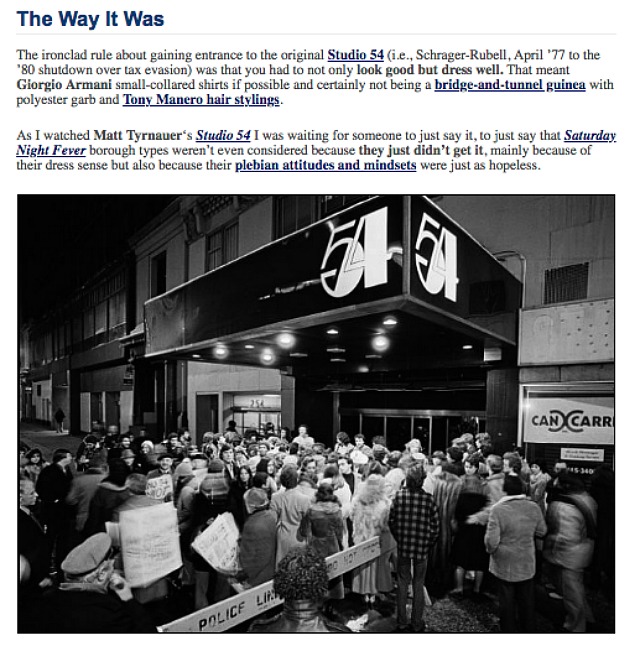
From “The Way It Was“, posted on 1.22.18: “The ironclad rule about gaining entrance to the original Studio 54 (i.e., Schrager-Rubell, April ’77 to the ’80 shutdown over tax evasion) was that you had to not only look good but dress well. That meant Giorgio Armani small-collared shirts if possible and certainly not being a bridge-and-tunnel guinea with polyester garb and Tony Manero hair stylings.

“As I watched Studio 54 I was waiting for someone to just say it, to just say that Saturday Night Fever borough types weren’t even considered because they just didn’t get it, mainly because of their dress sense but also because their plebian attitudes and mindsets were just as hopeless. It finally happens at the half-hour mark. One of the door guys (possibly Marc Benecke) says ‘no, the bridge-and-tunnel people never got in“…never.’ I can’t tell you how comforting it was to hear that again after so many years.”

Studio 54 also screened during last month’s Tribeca Film Festival.

Stewart’s Greatest Role?

Jimmy Stewart would have been 110 years old today if nature hadn’t intervened. There were some tweets celebrating this fact, and it left me with two questions: (a) Which Stewart films are known by Millenials and Gen Z types, if any? and (b) What was Stewart’s greatest or most popular signature role?

I’m inclined to say his finest might not have been George Bailey in It’s A Wonderful Life or Scotty Ferguson in Vertigo — the two defaults that everyone always mentions.

My top two are actually Senator Ransom Stoddard in The Man Who Shot Liberty Valance, even though Stewart was obviously too old (53 or 54) to play a greenhorn in John Ford‘s 1962 western classic, and the dogged Chicago newspaper reporter in Call Northside 777.

I’m also a big fan of his Charles Lindbergh in The Spirit of St. Louis. And then comes his chilly-loner performance in Anthony Mann‘s Bend of the River.

My least favorite Stewart performances? Rupert Caddell, the snooty college professor in Alfred Hitchcock’s Rope. and Chip Hardesty in Mervyn LeRoy’s The FBI Story.

Post-Mortem

It took me four months to notice something interesting in a February 2018 Vanity Fair piece about 2001: A Space Odyssey. It’s an excerpt from a draft of Stanley Kubrick and Arthur C. Clarke‘s script, a scene that was never shot. A conversation between Dave Bowman (Keir Dullea) and that Mission Control guy (“Sorry about this little snag, fellas”) about what turned HAL into a killer.

MISSION CONTROL: “We believe his truth programming and the instructions to lie, gradually resulted in an incompatible conflict, and faced with this dilemma, he developed, for want of a better description, neurotic symptoms. It’s not difficult to suppose that these symptoms would center on the communication link with Earth, for he may have blamed us for his incompatible programming. Following this line of thought, we suspect that the last straw for him was the possibility of disconnection. Since he became operational, he had never known unconsciousness. It must have seemed the equivalent of death. At that point, he, presumably, took whatever actions he thought appropriate to protect himself from what must have seemed to him to be his human tormentors.”

Martyr Complex

A fair number of HE regulars saw Paul Schrader‘s First Reformed this weekend, I’m sure. I’ve been doing handstands since I first saw it last August. “A spare, Bresson-like, thoroughly gripping piece about despair, environmental ruin, moral absolutism and sexual-emotional redemption,” I wrote. “Completely rational and meditative and yet half crazy in a good way.”

The Rotten Tomatoes score is 97%. It would probably be 100% were it not for Armond White’s National Review pan, which Schrader recently called a badge of honor or words to that effect.

So what’s the HE community verdict?

Drunken Sculpture

Early this morning I walked around a heavy-partying area of Dublin (south of Liffey river, west of Westmoreland). 20somethings, for the most part. The pubs close sometime around 2 or 2:30 am here, but you wouldn’t know it from all the rowdy pumping energy. In most cities 2 am means things are starting to wind down. Not in Dublin, they’re not.

I’ve long felt a spiritual kinship with Ireland and the Irish. During my initial visit in ’88 (accompanied by wife Maggie and infant son Jett) my first thought was “I could die here.” But I felt a slightly uneasy vibe last night. A somewhat loutish, hair-trigger feeling from some of the guys hanging out in groups in front of pubs and whatnot.

You can usually sense civility in people or a lack of, a current of deference and humility and a basic instinct to be nice or a willingness to take a poke if provoked or fucked with in the slightest way. I was feeling more of the latter last night. Everyone bombed and more than a few on the ornery, rambunctious side.

And then I came upon the strangest, angriest drunken Irishman I’ve ever gotten a whiff of. This guy, 25 or slightly younger, was so stinking and so consumed with rage that he was just standing in front of a Burger King, immobile, looking slightly downward but more or less statue-like, like he’d been carved out of wood or injected with a drug that turned his muscles into stone. “Don’t touch me or come close…fauhhck, man, don’t even look at me,” his body seemed to be saying.

It was eerie. Drunks generally stumble or flail around or lie down or lean against walls. This guy was beyond all that. It was like he was trying to decide who to hit or how to kill himself or what weapon to use.