Scotty in Santa Monica

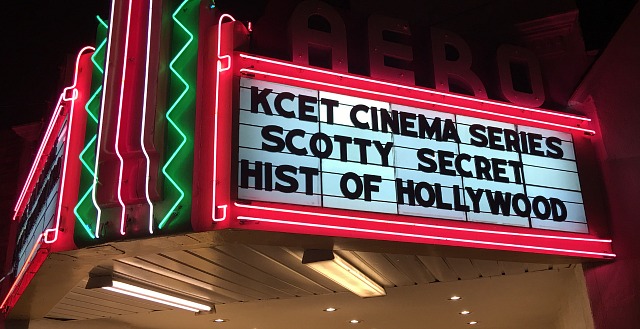
Last night at the Aero I caught my second viewing of Matt Tyrnauer‘s Scotty and the Secret History of Hollywood (Greenwich, 7.27). Tyrnauer and the film’s subject, the legendary Scotty Bowers, sat for a post-screening q & a with Deadline‘s Pete Hammond. Like the film, the discussion delivered charm, candor and much laughter.

I noted a few days ago that this 98-minute doc is an honest, believable portrait of the life (present and past) of a 90something guy who was a sexual go-between for gay or bisexual Hollywood stars in the 1940s, ’50s, ’60s and ’70s. The film is partly based upon Bowers’ six-year-old memoir, “Full Service: My Adventures in Hollywood and the Secret Sex Lives of the Stars.” Tyrnauer’s film is well-assembled, well-narrated, intimate and often touching.

There’s one aspect of the doc that the politically correct brigade won’t like, and that’s Scotty’s declaration that he was happily and homosexually active when he was 11 or 12. And with several priests even! He wasn’t coerced or manipulated or taken advantage of, he says — he knew exactly what he was doing and was entirely the captain of his own ship.

A certain marquee-brand director told me the same thing back in the mid ’90s, that he was having sex with older guys when he was roughly the same age. I related because I was leafing through nudie mags when I was eight or nine. I wasn’t sexually active until my late teens, but if a pretty older woman had invited me indoors when I was 12 or 13 or 14, I would have been delighted.

Responsible adults don’t like to hear this stuff, and as a rule I realize that sexual activity at a tender age can be highly traumatic for many if not most. But certain people start earlier than others.
Read more

All Kennedy Had to Do Was Wait Seven Months

Supreme Court Justice Anthony M. Kennedy announced today that he’ll retire as of 7.31. The 81 year-old jurist, a conservative moderate who often performed a swing-vote function, is well aware that this decision will allow President Trump an opportunity to fundamentally tilt the Supreme Court in a hard-right, corporate-favoring, Gorsuch-like direction. Thanks, brah…history will remember you for this.

Kennedy presumably understands what an existential threat to democracy Trump is, and that his replacement nominee will almost certainly be a rabid-dog rightie. Kennedy knows, of course, that the considerate thing (as far as the country is concerned) would have been to wait until early ’19, by which time the midterm elections might give liberals a majority in the House and/or Senate. But naahh.

Is Kennedy ill or something? Even if he’s suffering from late-stage cancer he should hang on until the very end. The judicial and legal character of the U.S. of A. hangs in the balance.

Today’s N.Y. Times report states the obvious. “A Trump appointee would very likely create a solid five-member conservative majority that could imperil abortion rights and expand gun rights.”

“Das Boot” Meets “Close Encounters”

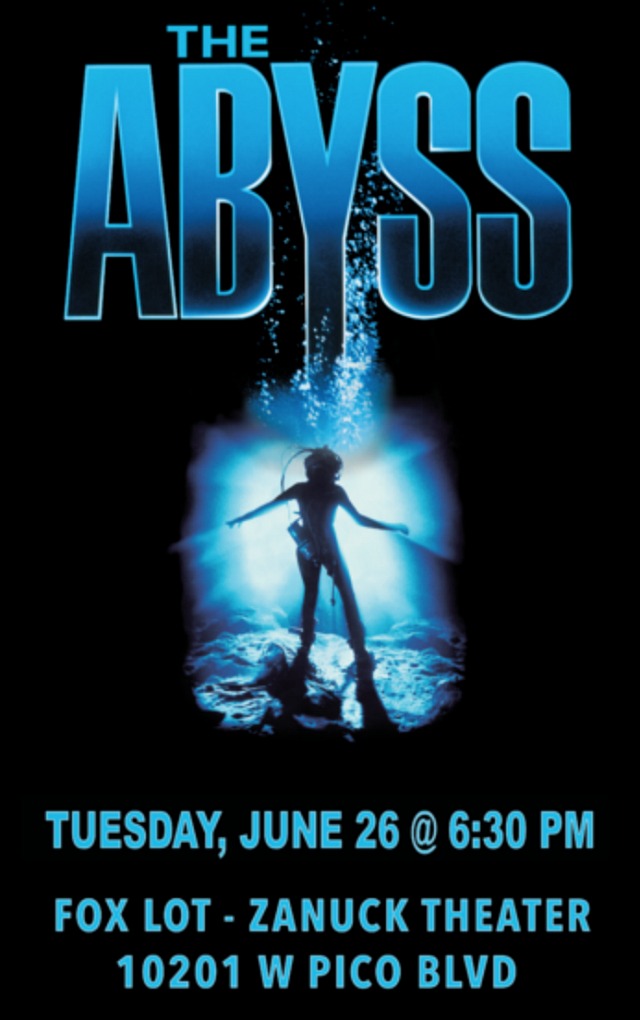
Last night HE correspondent David Chien attended a special 70mm mag-track screening of James Cameron‘s The Abyss (’89). Fox Movie Night, 6:30 pm, Zanuck theatre on the Fox lot. Thanks to Schawn Belston and James Finn for the invite. Here’s David’s report:

“The Zanuck was about half-filled. I haven’t been in this theater in over a decade — last time was for a weekend screening of X-Men: The Last Stand with the screenwriters in attendance. The theater is nice and cozy and state-of-the-art. In particular, its sound system holds up quite well. The space reminds me of the Aero in Santa Monica but with better upholstery and vibe. I have a soft spot for screening venues (such as the Academy Theater) at which food is prohibited.

“As people were filing in, a slideshow/video was projected (digitally) on the screen, featuring details about 35mm-to-70mm conversion on a projector as well as production photos and quotes about The Abyss. One that stood out: Gale Anne Hurd stating that this was the hardest film she ever made (I believe it). One fact that stood out: The Abyss was the first film of its kind to record sync-sound while actors were submerged in water (the weight of this achievement had not occurred to me as deeply until last night during the actual show).

“The screening started on time. Finn nd Belston shared additional details about the screening. The 70mm print used last night is especially rare as Kodak no longer produces this type of acetate film stock. Also, as a 6-track mag print, the analog sound associated with this version of the film is rather unique. For this Fox Movie Night event (something specifically for Fox employees and their friends/family), the planning took months. Apparently, the projectionist spent weeks to adjust picture and sound. On the website, in70mm.com, I located The Abyss projection letter, signed by Cameron and Hurd, on which they explain the importance of brightness and volume. I suspect the projection team at Zanuck studied such notes.

“The 70mm print still had the Cineplex Odeon logos and two Fox trailers attached. First up was War of the Roses. It was immediately apparent how damned loud the presentation would be (for me, a good thing, as I enjoy that kind of immersive volume). Then, there was a largely text-based teaser (one which I had never viewed) for Die Hard 2. Its punchline moment had the theater laughing.

“This was the theatrical cut of The Abyss. Like other films of the era — Aliens, Terminator 2, JFK, The Professional — I usually leaned towards the shorter versions. From a theatrical perspective, the tighter pacing and focused narrative play better for me. I feel the same about Close Encounters, which of course The Abyss owes a great debt. I also noticed this time how much of The Abyss was appropriated by Interstellar. Nolan was there last night, by the way — sitting dead center in the front row, Tarantino-style, for the most immersive journey.

“What can I say about The Abyss? I grew up watching it many times, with my father, via several editions of laserdisc sets. CLV and CAV, theatrical and extended, pan-and-scan (Super 35mm formatted) and letterboxed. It is a technical marvel, Das Boot meets Close Encounters. The last time I watched it — and the only time theatrically — was at the Aero, in fact, back during the summer of 2009. We were promised a 70mm print of both The Abyss and Aliens. If memory serves, that night it was only a 35mm of the former but a beat up 70mm of the latter. And Cameron was there and made an awfully funny joke about Michael Mann being way more of a pain on set than he.

Read more

Funny & Zippy, But Somehow Insubstantial

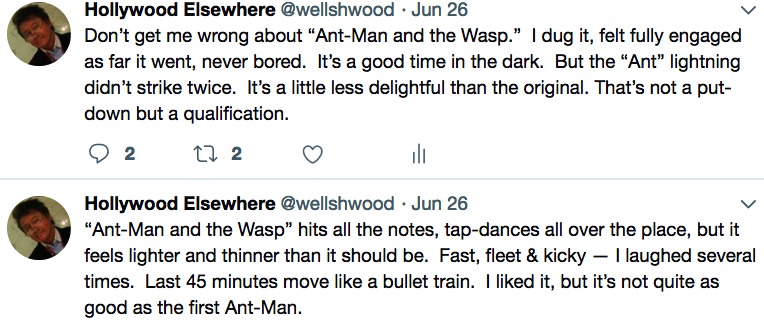
Peyton Reed‘s Ant-Man and the Wasp (Disney, 7.6) isn’t a problem unless you’re determined to complain about it not being as good as the original Ant-Man (’15). Which it’s not. But it’s still fleet, funny, disciplined, carefully honed, occasionally dazzling, light-hearted, pleasingly absurd…112 minutes worth of cool cruisin’ as you chow down on the overpriced crap. And those 112 minutes feel like 80 or 85, by the way. There are no significant downshiftings or speed bumps, or none that I noticed.

Please don’t let me (or any other sourpusss types) stop you from seeing it, but I’m telling you straight and true that Ant-Man and the Wasp is not quite as affecting, highly charged and/or head-turning as I wanted it be. It’s fairly proficient in the ways you might expect but at the same time it’s a bit of a slight letdown. You may feel the same way when you see it, but you’ll probably survive.

Why should anyone care if Ant-Man and the Wasp registers as an entertaining but inoffensive letdown? There are bigger fish to fry and meditate upon. See it or don’t see it. But don’t weep for the Marvel and Disney empires — they’re fine. On top of which the Rotten Tomatoes whores having given it a 96% approval rating.

What exactly is missing from Ant-Man and the Wasp that wasn’t missing from Ant-Man? The dopey subversive humor in Reed’s three-year-old original felt fresher, for one thing. And the story was more emotionally affecting as far as Paul Rudd‘s Scott Lang was concerned. He was in a fairly dark and despairing place as it began — ex-con, low-rent loser, not much of a role model for his daughter — so morphing into Ant-Man by way of Michael Douglas‘s (i.e., Hank Pym’s) brilliance and reluctant largesse really meant something. This time, not so much. But at the same time I didn’t feel burned by the story or journey or whatever you want to call it. I felt placated.

Good, occasionally amusing work by Rudd, Evangeline Lilly (Hope van Dyne / Wasp), Michael Douglas, Michael Pena, Walton Goggins (fated to play pain-in-the-ass, low-rent villains for the rest of his life), Bobby Cannavale, Judy Greer, Hannah John-Kamen (Ghost), Abby Ryder Fortson (Rudd and Greer’s daughter Cassie), Randall Park, Michelle Pfeiffer (Janet van Dyne — rescued in Act Three from the sub-atomic, micro-quantum realm or whatever you want to call it), Laurence Fishburne (punching the clock), etc.

The fact that Rudd is pushing 50 and Lilly is pushing 40 are not interruptions, but I’d be lying if I said I wasn’t aware of their biological earth-time factors.

Vulnerable Hollywood Buckaroos

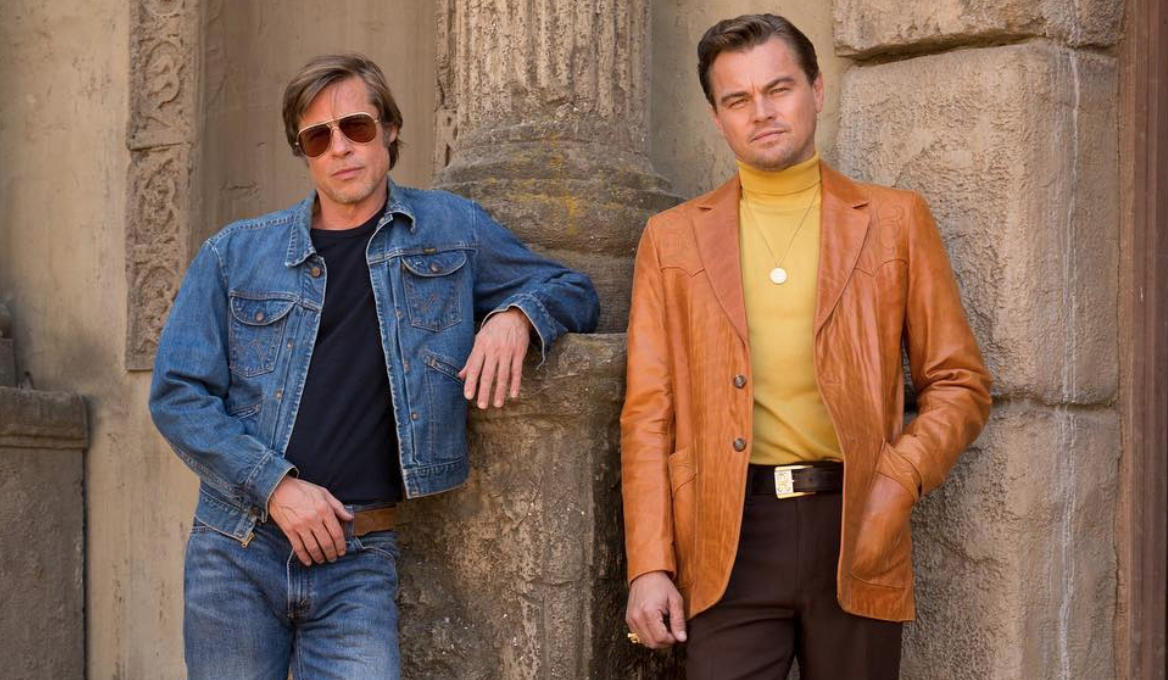
Quentin Tarantino has described the pairing of Leonardo DiCaprio and Brad Pitt in Once Upon A Time in Hollywood as a Butch-and-Sundance, Redford-and-Newman type deal. Maybe, but the wardrobes and hair stylings tell you everything you need to know about their characters.

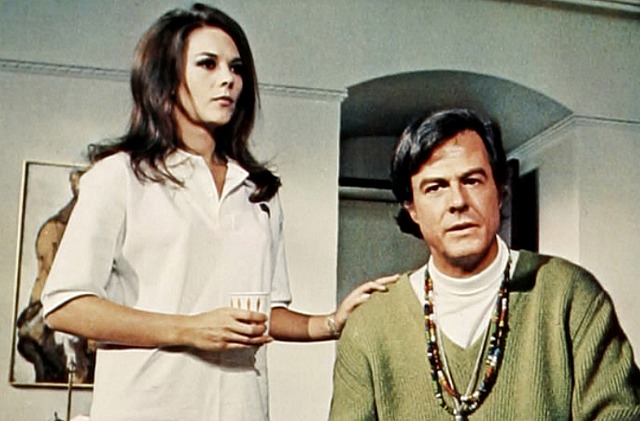
A dead ringer for Adam Roarke (Play It As It Lays, Dirty Mary, Crazy Larry) in the late ’60s, Pitt’s Cliff Booth is a down-to-basics, rough-and-ready stuntman. DiCaprio’s Rick Dalton is basically Robert Culp, a successful TV actor (I Spy) who began in the tradition-minded ’50s but struggled to find his footing when the industry pivoted toward youth fare in the late ’60s. Is that a peace medallion Leo is wearing? The mustard-colored turtleneck reminds me of a lounge shirt John Vernon wore in Point Blank (’67). If Dalton’s career was on a faster, more upward track, he might have landed Culp’s role in Paul Mazursky‘s Bob & Carol & Ted & Alice (’69).


Brad Pitt’s Cliff Booth, Leonardo DiCaprio’s Rick Dalton in Quentin Tarantino’s Once Upon A Time in Hollywood.

Natalie Wood and Robert Culp in Bob & Carol & Ted & Alice.

Klown Planet

I love my crazy Russian drivers. 22 minutes and 8 seconds of pure hilarity. I defy anyone to explain what they’re seeing around the 11:07 mark.

Son of Lost, Gone, Blown

4 and 1/2 years ago I posted a riff called “Lost, Gone, Blown.” It basically repeated the old saw about “happily ever after’ finales never sticking to your ribs. If they seem to half-deliver at first, they certainly don’t last in the memory.

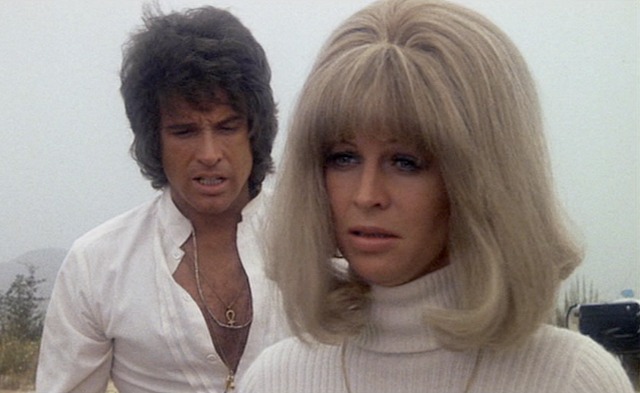
The best love-story endings, as Sydney Pollack pointed out time and again, are ones in which it hasn’t worked out and the lead protagonists realize it’s gone for good. Final, irreparable. My three favorites at the time were the finales of Ang Lee‘s Brokeback Mountain, Hal Ashby‘s Shampoo and Pollack’s The Way We Were.

HE commenters mentioned Vertigo, Lost in Translation, Now Voyager, Casablanca, In the Mood for Love, Brief Encounter, A Star is Born, Annie Hall, Husbands & Wives, The Rapture, Monsieur Hire, White Men Can’t Jump, 500 Days of Summer, Up In The Air, Remains of the Day, The Graduate, Age of Innocence and House of Mirth.

What about films within the last four years? Manchester By The Sea and Call Me By Your Name, certainly. What others?

Read more

Blind Spot

There’s a reason that the near-great Sicario: Day of the Soldado (Columbia, 6.29) has a 69% and 61% rating on Rotten Tomatoes and Metacritic, respectively. That reason is critics who don’t get it — specifically six who are strangely blind to the fact that this admittedly violent Mexican cartel film is not about nihilism and brutality as much as — hello? — parenting.

Which is why Soldado is not about unrelenting bleakness because it’s a film about a possibly better future, about Benicio del Toro‘s Alejandro Gillick influencing a pair of young Mexican teenagers who’ve been corrupted by the drug trade but might (one can hope!) be led in another direction.

Taylor Sheridan‘s story focuses on Isabela Reyes (Isabela Moner), the 15-year-old daughter of a drug cartel kingpin, and Miguel Hernandez (Elijah Rodriguez), a border-residing youth whom one of the cartels hires to be a “coyote” — a border-crossing guide for illegal Mexican immigrants. Both are forced to witness hellish scenarios throughout the film, and both arrive at a weary, contemplative finale. The viewer can reasonably infer that they’re both having serious second thoughts about living on cartel money. The agent behind this possible conversion is Gillick, a Mexican father figure of sorts. He’s certainly convinced Isabella to think twice about her father’s profession, and as the film ends he’s just beginning to influence Hernandez.

How the naysayers — Screen Daily‘s Tim Grierson, Indiewire‘s David Ehrlich, Movie Minute’s Joanna Langfield, N.Y. Daily NewsStephen Whitty, A.V. Club’s Ignatiy Vishnevetsky, TheWrap’s William Bibbiani — can watch Soldado and totally miss this teach-the-children aspect is beyond me.

Read more

Trump Lynch

While researching a 1995 Los Angeles magazine piece called “Right Face,” the late L.M. Kit Carson told me that he sensed a while back that David Lynch was an offbeat conservative. “He’s kind of like Jimmy Stewart on the surface, all golly-gee-gosh,” Carson said, “but dark and creepy underneath.”

I thought of Carson’s observation last weekend when I read Lynch’s oddball, left-handed praising of Donald Trump. I’m not sure Lynch was actually calling Trump a great president as much as a bull in a china shop.

Tuesday, 4:40 pm Pacific: A few hours ago Lynch posted a message to Trump on Facebook.

“Both the Breitbart article and Trump’s retweet show how hungry the Republican right is for acceptance by Hollywood. They are so famished for celebrity praise that they’ll even take it in the form of [a] very ironic and slippery statement from a film director who loves to cultivate an air of mystery.” — posted yesterday by New Republic‘s Jeet Heer.

Pollack Years

Sydney Pollack passed just over a decade ago. He came to mind a few hours ago when an HE commenter dismissed Pollack’s The Interpreter (’05) as “lame’ and “out of touch.” I reminded that The Interpreter has a bomb-in-a bus sequence that’s fairly brilliant. Otherwise it’s an above-average, reasonably engaging drama of its type. (Consider this Desson Thomson review.) Not a perfect film, but an above-average, reasonably decent one.

Pollack made a lot of films that fell under this category, but I’ve know very few filmmakers who worked harder at getting it right. Each and every time he really sweated bullets.

From my Pollack obit: “If you had told me 18 months ago that Pollack and Anthony Minghella, partners in Mirage Enterprises who worked together on The English Patient, Cold Mountain, The Quiet American and several other quality films…if you had told me then that both of these guys would be lights-out by May 2008, I would’ve said “what…?” Both of them were too active and alive. They had too much talent and know-how, too many miles to go.

People always bring up Out of Africa (’85) and Tootsie (’82), the hugely successful comedy with Dustin Hoffman as a straight cross-dressing actor, as Pollack’s finest, best-known films. They’re both solid and accomplished (Tootsie especially), but the Pollack pics that I’ve most enjoyed are the genre thrillers — Three Days of the Condor, particularly, and The Firm — because they exceed their boundaries and then some. They’re about Pollack adding shrewd and surprising things rather than just meeting expectations.

Both have melancholy emotional currents — feelings of loss and regret — and some graceful resignations, courtesy of the wry and understated dialogue by David Rayfiel, Pollack’s pinch-hit rewrite guy for decades. Plus they’re both driven by character as much as plot.

Gene Hackman‘s confession to Jeanne Tripplehorn in The Firm that he plays around “because my wife understands me.” (Too well, he meant.) European Condor assassin Max Von Sydow working with miniature models in his New York hotel room. Condor CIA guy Cliff Robertson asking his superior, played by John Houseman, if he misses the “action” he encountered during the World War II years, and Houseman responding, “No, I miss that kind of clarity.” Both films teem with this kind of stuff.

After these my favorites are (a) Sketches of Frank Gehry (Pollack’s wise, affectionate, layman-level appreciation of our greatest architect), (b) Jeremiah Johnson, (c) the final voice-over moment in Havana, (d) the first half of Random Hearts, (e) all of The Yakuza, They Shoot Horses, Don’t They? and Castle Keep, (f) the bomb-on-the-bus scene in The Interpreter and (g) portions of The Way We Were, particularly the final scene.

And, of course, there were Sydney’s first-rate performances — the divorcee in Husbands and Wives, that red-felt pool table scene with Tom Cruise in Eyes Wide Shut, a pair of cynical and corroded seen-it-alls in Changing Lanes and Michael Clayton.

Read more