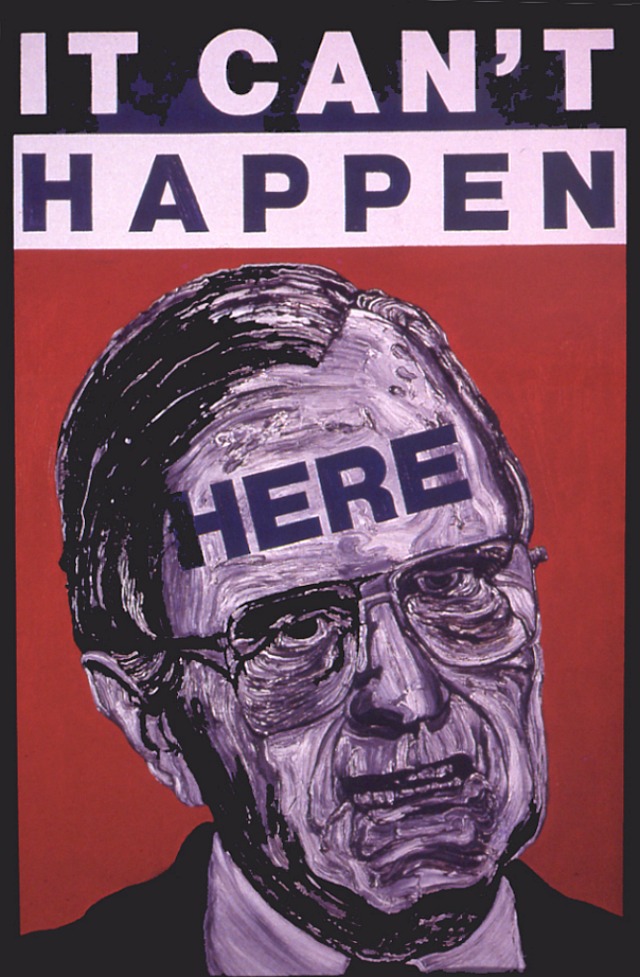
Poppy

Due respect for George H.W. Bush, whose long journey has ended at age 94. I realize he was far from evil personified and was, in fact, a semi-tolerable Republican president, especially when you compare him to Donald Trump.

But I was against Bush 41 in ’88. In fact, my ex-wife Maggie and I did some wild-posting with Robbie Conal‘s “It Can’t Happen Here” poster; we also rang doorbells for Michael Dukakis. Needless to add I was overjoyed when Bill Clinton beat him in ’92.

But climate-change obstructions aside, George Sr. wasn’t utterly horrible; he had some approvable qualities, laughed at Dana Carvey, etc.

I seem to recall his expressing uncertain reactions when the Berlin Wall fell and the Soviet Union broke apart. He didn’t seem to know what to say — wasn’t all that comfortable with the idea of governments being overthrown. Anyway, rest in peace and condolences to those who were close.

Loads In The Driveway

For all the things that I love and worship about Alfonso Cuaron‘s Roma, there’s one thing that doesn’t add up and seems increasingly bizarre the more you think about it. Until it all becomes clear.

Roma is a naturalistic family drama, set in Mexico City in ’70 and ’71. The main character is Yalitza Aparicio‘s Cleo, a saintly maid who helps to take care of four kids (along with mama, grandma and another domestic) as well as the family dog. There’s a father, but he’s mostly absent — at work, travelling or spending time with a girlfriend.

The bizarre thing is Cleo’s odd refusal to clean up the dog poop that’s constantly being deposited on the sheltered concrete driveway adjacent to the main home. Every time Cuaron (who also served as his own dp) shows us someone leaving or arriving there are always two or three loads, and once or twice we see the family car squishing them flat.

Yes, there’s a scene in which Cleo brushes the poop into a waste pan and spot-cleans the driveway with a sanitizer of some kind. But more often we see the loads just sitting there — naggingly, defiantly — and once you start noticing their persistent presence you can’t think of anything else.

And at the same time you can’t help but wonder why poor Cleo isn’t more focused, especially considering a moment in which she overhears the pater familias complaining about how “there’s dog crap everywhere” and especially after she’s sharply scolded by Marina de Tavira‘s mother character (i.e., Sofia) to stay on top of this.

After a while you begin to realize that Cleo isn’t forgetting to scoop the poop as much as deliberately avoiding it. Not angrily but in a kind of “well, I don’t know, not in the mood, maybe not” kind of way. And you start to ask yourself “why?” It’s obviously an unpleasant task, but she knows she’ll incur greater wrath from her employers if she lets the matter slide. And yet she does.

Once you start thinking about the loads there’s almost nothing else that gets into your head. They don’t become the whole movie, but they never go away either. The loads, the loads, the loads…why doesn’t she attend to them more frequently? Does she ever walk the dog?

Then your brain flips over and you begin to wonder if the loads are more than what they seem. Maybe the loads are there but maybe they’re not. Maybe they’re metaphors for family problems that are being ignored, or even broader social problems (i.e., what the street protests are about). Maybe the loads are reminders of those things in life that can never really be fixed or fully understood. Or those nagging spiritual issues that Albert Camus and Rainer Maria Rilke and Carlos Casteneda wrote about.

The Roma poop issue is never resolved, but I swear to God there’s more to it than just “Cleo should clean up more.” It’s an existential quandary of some kind.

Regina Hall Side Issue

I should have streamed Support The Girls last night. That way I’d have something substantial to say about Regina Hall having yesterday won the New York Film Critics Circle Best Actress award. But I probably won’t be able to see it until Sunday. I have to catch Mary Poppins Returns this evening, and tomorrow I’ll be running around Manhattan the whole day.

For the sake of discussion I’m just going to repeat the basics, and offer what others are saying.

I mentioned yesterday that “nobody” had Hall on their top-five Best Actress contenders list, although some critics (including Indiewire‘s Eric Kohn and David Ehrlich) wrote some very positive things about Support The Girls and Hall’s performance last March when it premiered at SXSW.

Magnolia and Ginsberg-Libby offered Support The Girls press screenings last July and August, but it opened two days before Telluride and — this isn’t nothing — it made a grand total of $129K domestic. Not a typo — it made $129K all in.

It would be one thing if the NYFCC had given Hall a special stand-out, we-love-you, keep-on-keepin’-on award, but they gave her their Best Actress award, and that presumably means they felt Hall was better (stronger, more penetrating, more extra-special, more shake-the-rafters) than Melissa McCarthy‘s performance in Can You Ever Forgive Me. Or Glenn Close‘s in The Wife. Or Viola Davis‘s work in Widows. Or even Lady Gaga‘s in A Star Is Born.

Really? Better than McCarthy?

Some are saying that the NYFCC voted for Hall as a show-off gesture, and that it’s (a) partly about looking hip and ahead-of-the-curve and and (b) partly about delivering a huge fuck-you to the Gold Derby prognosticators for sticking to the same five or six Best Actress contenders. I completely agree with this sentiment when it comes to 90% of the GD members having refused to put First Reformed star Ethan Hawke on their Best Actor lists, but I also sympathize with their not having paid any attention to Hall, mainly because I haven’t seen it. (And I’m obviously not proud of this dereliction.)

The L.A. Film Critics Association has been playing this “nyah, nyah” game this for years, handing out awards to eccentric outlier performances as a way of (a) giving the finger to conventional award-season wisdom and (b) trumpeting their own deliberative edge and outside-the-box coolness. Not to mention their totally infuriating foodie thing in which they take a bagel-and-lox-and-cream cheese break in the middle of voting.

I believe there’s something to both motives. I believe that the NYFCC wokers do want to be seen as The Cool Kidz Who Set Their Own Standards and Make Their Own Rules and are Voting Ahead of the Curve.

Indiewire film editor and NYFCC chair Eric Kohn replies: “There is no groupthink to the NYFCC voting process. The rules are right there on the site. Nobody’s ‘using’ any single award for their private agenda. A lot of people genuinely love this movie, myself included — it was on my favorite movies of the year list — and I raved about it way back at SXSW last March. It’s an amazing showcase for Hall’s talents, and a side of her most people have never seen before.”

Tourist Schmuck Avoidance Instinct

This five-year-old teaser for the TCM Classic Film Tour of Manhattan is, of course, painful to even glance at, much less consider. To think that there are people lazy or slow enough to sign up for this thing when all they have to do is visit a reputable NYC film location site (like Bob Egan’s PopSpots site) and use Google Maps to roam around town on their lonesome.

I myself have done my own little Taxi Driver, Mean Streets, Prince of the City, Twelve Angry Men and Midnight Cowboy tours at different times. Four or five years ago a friend and I improvised our own little folkie Bob Dylan/Inside Llewyn Davis tour of the West Village, including a visit to the West 4th and Jones street location of the cover photo for The Freewheelin’ Bob Dylan.

The only guided film tour I’ve ever taken was a San Francisco Vertigo tour sometime around ’02 or ’03, offered under the auspices of the San Francisco Film Festival.