Become The Bear

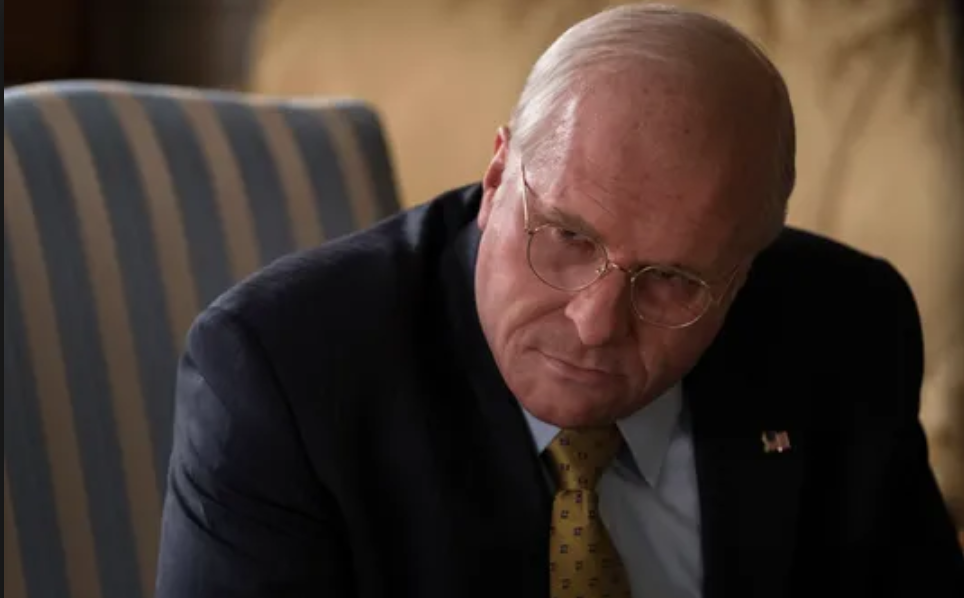
In his review of Vice, Variety‘s Owen Glieberman complains that Adam McKay‘s film never answers the big question, which is “who is Dick Cheney? How did he get to be the singular domineering bureaucrat-scoundrel he is? What is it that makes this scheming man tick?”

Gleiberman hasn’t been paying close attention. There’s one simple answer, not just about Cheney but all conservatives. The answer is ice-cold fear.

Fear of the dark and terrible unknown. Fear of the beast. Cheney needs to keep that bugger away from this doorstep. He woke up one day and felt the hot breath of the grizzly bear and saw that huge, terrible claw about to come down and rip half of his face off, and Cheney screamed and said “no! I won’t be destroyed! I will instead become the bear and I will snarl and smite others, and they will bow down and show obeisance before my power, and that will make me safer. Me and my fellow grizzlies. It’s a kill-or-be-killed world out there, and you simply have to decide which kind of animal you are.”

HE to Gleiberman: Now you know.
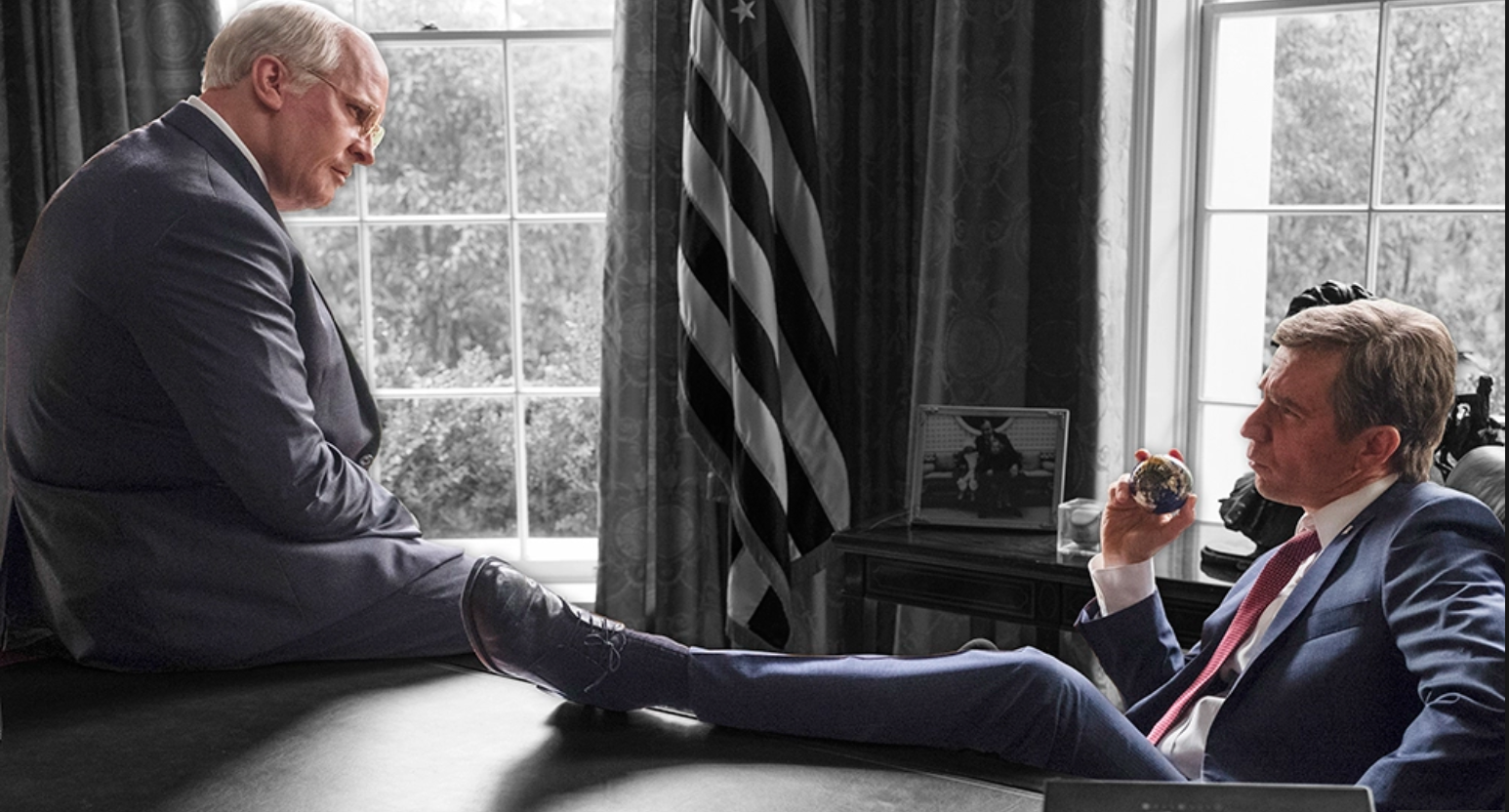
Another way of examining Cheney is that he became the bear to hold onto Lynne Vincent, a young Wyoming girl who became his wife.

N.Y. Times critic A.O. Scott: “The way Vice tells it, Dick Cheney, who would go on to become the most powerful vice president in American history, started out as a young man in a hurry to nowhere in particular. After washing out of Yale, he retreated to his home state of Wyoming, pursuing his interests in booze and cigarettes and working as a utility-company lineman on the side. Dick was saved from ruin — or at least from the kind of drab destiny unlikely to result in a biopic — by the stern intervention of his fiancée, Lynne Vincent, who told her wayward beau that they were finished unless he pulled himself together.

“Her reading of the romantic riot act would have far-reaching consequences. In that pivotal moment, Dick (Christian Bale) looks Lynne (Amy Adams) in the eye and swears he’ll never disappoint her again. The thesis of this film, written and directed by Adam McKay, is that Dick kept his promise. And that everyone else — including his daughter Mary (Alison Pill), thousands of American soldiers, hundreds of thousands of Iraqi civilians and just about everyone on the planet with a care for justice, democracy or simple human decency — paid the price.”


The World Is For The Few

Most Americans are not, for the most part, into catching new movies at the local plex. Partly because they’re streaming films at home, okay, but mainly because they’re lazy, low-energy, heavy-lidded types.

A recent Statista chart shows that one out of five Americans will pay to visit a megaplex about once a month. These are your basic go-getters, life-gulpers, active adventurers, and vigorous content-streamers at home. People with a pulse generally watch a lot of films, read lots of books, go on hikes, go out to restaurants, visit Paris or Rome every three or four years and so on.

Put another way, one in five are awake and alive with a gleam in their eye and the rest are on life support — sleeping a lot, eating shitty foods, wearing hush puppies, taking naps on the couch and walking around with glazed-over expressions.

54% of the populace pays to see movies in theatres “less often than once a month“, which probably means they go four or five times a year, if that. Another 14% don’t go out to movies at all. 8% attend “several times a month.”

Today’s news, courtesy of Variety‘s Brent Lang, is that Netflix isn’t cutting into theatrical viewing.

“A new study conducted by EY’s Quantitative Economics and Statistics group finds that people who go to movies in theaters more frequently also consume more streaming content,” Lang reports. “That flies in the face of the conventional wisdom of box office sages, who grimly ascribe flatlining theatrical attendance to the growing popularity of digital entertainment companies.

“If the study’s findings are accurate, it would appear that the two forms of entertainment consumption are more complementary than cannibalistic. The study found, for instance, that respondents who visited a movie theater nine times or more in the last 12 months consumed more streaming content than consumers who visited a movie theater only once or twice over the past year. Those who saw nine or more movies at the cinema averaged 11 hours of weekly streaming compared to the seven hours of streaming reported on average by those who saw one to two movies at the multiplexes.”

Bottom line: Most Americans are living dead-to-the-world lives, but 20% are going for the gusto. Either way Netflix isn’t discouraging movie-theatre attendance all that much.

Blown Away

It’s a critical cliche to praise a performance along the lines of “this isn’t acting but a channeling…a complete psychological and biological submission.” This certainly describes Christian Bale‘s must-see performance as former vice-president Dick Cheney in Adam McKay‘s Vice — no question. But I’m persuaded that even in this realm Bale has gone above and beyond.

I haven’t felt the same kind of chills since Robert De Niro‘s Oscar-winning performance as Jake La Motta in Raging Bull (’80), except this time I felt a deeper recognition and…I don’t know, something extra.

Mainly because I feel I know Dick Cheney pretty well, certainly in terms of his appearance and voice and laid-back, Prince-of-Darkness attitude, and I wasn’t at all familiar with Jake La Motta when I first saw Raging Bull 38 years ago. I was deeply impressed (who wasn’t?) by De Niro’s coarse, bellowing Bronx-Italian shtick — that primal beastliness that he’d obviously drilled into, body and soul. But experiencing Bale’s Cheney was, for me, slightly more of an “oh, wow” or a “holy moley” thing.

It’s like De Niro’s La Motta was Elvis Presley in the mid ’50s, and now Bale’s Cheney is the Beatles during their first American tour, and De Niro has just sent Bale a cable saying “okay, the torch has been passed — I had a nice long run as the king of wholly transformative weight-gain performances, and now you’re the standard-bearer…hats off, due respect.”

There’s always a slight gap between knowing what a certain famous person looked, acted and sounded like and how this or that actor registers when trying to make a performance happen. There’s always that “uh-huh…yeah, pretty close, good work” kind of acknowledgment. And sometimes not so much. Every time an actor has tried to portray John F. Kennedy (Bruce Greenwood, Greg Kinnear, Cliff Robertson, William Devane, Martin Sheen, Caspar Phillipson, etc.), the chasm has been distracting if not irritating. But not in the matter of Bale-as-Cheney. Bale is up to something else.

You can say “hold on, calm down…this is the exact same current that I got from Charlize Theron‘s Aileen Wuornos in Monster, Bruno Ganz‘s Hitler in Downfall, Ben Kingsley‘s lead performance in Gandhi, Meryl Streep-as-Maggie Thatcher in The Iron Lady, Helen Mirren in The Queen,” etc.

Maybe, maybe not. All I can say is that I felt the appliance of skill and technique with each of these. Plus the presence of makeup or prosthetics. On top of which, as mentioned, I didn’t know the real-life characters as well as I do Cheney.

Read more

Chuckling Forbidden

This Bananas scene used to be an amusing little hoot. Wait…who chuckled? I heard someone chuckling or at least tittering. Who did that? C’mon, fess up.

Woody Christina Manhattan

A few hours ago The Hollywood Reporter posted a Gary Baum-authored profile of former Woody Allen girlfriend Christina Engelhardt, and more precisely her eight-year relationship with the director-writer-actor-comedian that began in late ’76 and ended in ’84.

She was Allen’s secret sexual partner between the ages of 17 (although they first met when she was 16) and 24. No public dates, no dinners at Elaine’s — just furtive assignations at his Fifth Avenue apartment.

Engelhardt was one of two inspirations for Mariel Hemingway‘s Tracy character in Manhattan; the other was Stacey Nelkin, who hooked up with Allen when she was attending Stuyvesant High School in ’77 or thereabouts. Engelhardt tells Baum that she felt badly about how her Allen relationship came through in the film; it hurt to consider how Allen had objectified her or kept her at a distance.

But think about it — Tracy is the most centered and least neurotic or deceptive character in Manhattan.

Engelhardt’s Allen relationship was unequal and certainly exploitive on his end, but show me a relationship between any famous film-industry hotshot and any “civilian” that wasn’t similarly unfair or lopsided, especially in the context of the ’70s and ’80s when a whole different set of rules and assumptions were in effect.

Plus the Allen alliance opened a few doors. After they went their separate ways Engelhardt became a kind of half-employee and half-platonic muse for Federico Fellini. She’s currently working for producer Robert Evans and living in the Beverly Hills flats.

Baum’s article is smoothly written, carefully phrased, seemingly well-researched and for the most part fair-minded.

But at the same time a tad clueless. Because it applies a #MeToo filter to a story that happened during a time when urban upscale lah-lahs were frolicking in an almost I, Claudius-like culture that in some ways was more sexually impulsive and freewheeling and live-as-let-live than anything happening today. Which doesn’t seem quite fair.

The idea, at least on the part of Baum’s THR editor, seems to have been to “get” Allen by furthering the #MeToo-linked narrative that he used to be a manipulative and to some extent unscrupulous fellow who used his fame and power to get what he wanted from women. But Engelhardt doesn’t exactly cooperate with this goal. “I’m not attacking Woody,” she tells Baum. “This is not ‘bring down this man.’ I’m talking about my love story. This made me who I am. I have no regrets.”

Engelhardt was right in the thick of things when Allen began a somewhat committed relationship with Mia Farrow in ’80 or thereabouts. I’m using the term “somewhat” because Woody, Mia and Christine enjoyed a menage a trois thing for a while. Baum: “Despite the initial shock of jealousy, Engelhardt says she grew to like Farrow over the course of the ‘handful’ of three-way sex sessions that followed at Allen’s penthouse as they smoked joints and bonded over a shared fondness for animals.”

“The New Abnormal”

Earlier today, in a piece called “The Year Jimmy Carter Went Down,” I wrote that Robert Redford’s Oscar-winning Ordinary People “could probably never be made today, and if someone were to make it anyway it would get hammered for dwelling in its own secluded realm, a lack of diversity, a portrait of white-bread grief and neuroticism, etc.”

[Click through to full story on HE-plus]

“I Couldn’t Wait”

Let’s say Todd Field‘s In The Bedroom had never opened in ’01 and was instead released a couple of months ago with, say, an aged-up Matt Damon in the Tom Wilkinson role and an aged-up Jennifer Garner in the Sissy Spacek role. Would it now be (a) the leading front-runner for the Best Picture Oscar, (b) a hanging-in-there Best Picture contender, diminished in part because it’s a little too Maine-y, or (c) a respected small-town drama that, like First Reformed, is expected to do a lot better with the Spirit awards than the Oscars?

Boston Society of Film Critics Have Chosen

Best Picture: If Beale Street Could Talk. Best Director: You Were Never Really Here‘s Lynne Ramsay. Best Actor: John C. Reilly, Stan & Ollie. Best Actress: Can You Ever Forgive Me‘s Melissa McCarthy. Best Supporting Actor: Can You Ever Forgive Me‘s Richard E. Grant. Best Supporting Actress: If Beale Street Could Talk‘s Regina King. Best Animated Feature: Wes Anderson‘s Isle of Dogs. Best Foreign Language Film: Shoplifters.

“Mule” Meets Joe Popcorn

Two days ago Clint Eastwood‘s The Mule opened in 2588 situations and earned a not-bad $17,210,000, for a $6550 average. If it manages to triple this amount by the end of its domestic run, it’ll have $50M in the till.

It could do better than that. Ten years ago Clint’s somewhat similar Gran Torino opened wide (2808 theatres) to the tune of $29,484,388, or an average of $10,500 — a tad less than double what The Mule has done. Gran Torino concluded with a domestic tally of $148,095,302. If The Mule manages roughly half of this, the concluding domestic figure will be roughly $75K. But I doubt it’ll get there.

The Rotten Tomatoes and Metacritic ratings are only 62% and 58%, respectively.

You can chalk up some of the negativity to the p.c. complaints, as Clint’s character shares some racially-insensitive comments. Film Yap’s Chris Lloyd called it “a cross between a Faustian tragedy and a Greatest Generation road trip comedy…like a fantasy safari for Trump voters.” See?

From my own 12.12 review: “The Mule is Clint’s finest since Gran Torino…a modest, nicely handled film about family, aloofness, guilt and facing one’s own nature…a plain-spoken, well-ordered saga of a guy coming to terms with his failures as a man and a father — a selfishly-inclined fellow who’s always preferred work over family, etc. It’s an entirely decent effort in this respect, and a well-structured one to boot.”

Presumably a fair number of HE regulars have seen it. Reactions?

Moptop Madness

A Criterion Bluray of Robert Zemeckis and Bob Gale‘s ‘ I Want To Hold Your Hand pops on 3.26.19. Set during the Beatles’ first visit to the U.S. in February ’64, it’s a screwball farce about several kids trying to slip into the Plaza Hotel while the Beatles were staying there and/or score tickets to their first-ever performance on Ed Sullivan Show.

Screwball farce is a very tough thing to get right, I’ve always heard. I’m not calling I Want To Hold Your Hand a “bad” film, exactly, but so much of the material doesn’t “land” that it’s exhausting after a while — it makes you feel like you’re on a comedic forced march. The tone feels pushed and agitated.

After catching an all-media screening in March of ’78 or thereabouts I distinctly remember saying to myself “good God…not seeing that one again.” The word must have gotten out because it flopped commercially — cost $2.8 million to make, earned $1.9 million in ticket sales.

18 months later I became a huge fan of Zemeckis and Gale’s Used Cars, which had a similar farcical tone but also a much sharper script. And funnier performances — Kurt Russell, Jack Warden, Gerrit Graham, Frank McRae, et. al.

I Want To Hold Your Hand‘s mostly female cast includes Nancy Allen, Susan Kendall Newman (Paul’s daughter), Theresa Saldana and Wendie Jo Sperber. The nasal-voiced Eddie Deezen is the stand-out, I suppose, but like everyone else he overdoes the hyper. Deezen’s best all-time performance happened five years later in John Badham‘s War Games, in which he played the spazzy “Mr. Potato Head” — see after the jump.

Read more

The Year That Jimmy Carter Went Down

If the Academy’s expanded Best Picture nomination process (resulting in five to eight or nine nominees) were in effect in 1980/’81 and if the New Academy Kidz groupthink view that “exceptional genre films are award-worthy” had been in effect, it’s reasonable to presume that the following eight films would have been Best Picture contenders: Breaker Morant, Coal Miner’s Daughter, The Elephant Man, The Empire Strikes Back, Melvin and Howard, Ordinary People, Raging Bull and The Stunt Man.

No offense but I don’t believe that Fame and Private Benjamin — a pair of diverting, female-empowerment entertainments — would have been considered worthy of Best Picture consideration. Private Benjamin is the better of the two, I suppose, but I’m not sure that’s saying much. I saw it once and have never felt an urge to revisit.

If I’d been an Academy member marking my preferential ballot back then, I would have put Martin Scorsese‘s Raging Bull at #1 because it’s a blunt tool that nonetheless delivers delicacy, tragedy and the worst kind of aching, lonely-man anguish. Among the Best Picture hotties it was the most glamorously unglamorized, the least formulaic and the most against-the-usual-grain contender (raw, crude, earthy…the Florida jail-cell primal scream scene alone), the most flavorful (“I’m not an animal, I’m not that bad”, “Defeats its own purpose,” “I dunno whether to fuck him or fight him”) and the most…I don’t know, the most face-slappy or gut-punchy.

And I would have put Bruce Beresford‘s Breaker Morant as my #2. A Vietnam-metaphor drama about politicians and the military elite sticking it to rank-and-file soldiers in order to save their own necks — a kin of Paths of Glory (which at the time had been released 23 years earlier) and an equally-strong indictment. Arguably the finest hour of Edward Woodward, Bryan Brown and Jack Thompson.

My #3 would have been Robert Redford‘s Ordinary People. By today’s standards it would probably be called a “white people movie”, and could probably never be made today, and if someone were to make it anyway it would get hammered for dwelling in its own secluded realm, a lack of diversity, a portrait of white-bread neuroticism, etc.

I know that for a lot of people 1980 was a Raging Bull-vs.-Ordinary People year, but they’re closer in spirit that many would admit. Ordinary People was, in its own way, almost as full of anger and push-back, refrigerator-punching rage as the Scorsese-De Niro film. Except for the self-loathing “God hates me” factor, Raging Bull has never affected anyone emotionally — not really. Certainly no one I know, or, you know, anyone who parks their car in the HE garage. Okay, the jail-cell scene gets people.

My #4 would have been The Empire Strikes Back, and my #5 would have Melvin and Howard.

The remaining trio, in this order: Coal Miner’s Daughter (the third Best Picture contender that year to pass along a female-empowerment saga), The Stunt Man and The Elephant Man (i.e., primarily a production design effort).

Now I’m suddenly in the mood to stream Breaker Morant and Coal Miner’s Daughter. I love Tommy lee Jones in the latter — “Three ways to go in this town…coal mine, moonshine or move on down the line.”