Gangster’s Moll

From Guy Lodge’s 1.30.18 Variety review: “The water’s warm and inviting, and that goes for precisely nothing else in Holiday, a low-temperature, high-impact debut from Swedish-born writer-director Isabella Eklöf that impresses with its clinical construction and still, penetrating gaze into male violence.

“Scratch past its smooth, sun-whitened surface, however, and messy questions lie at the nominal heart of this glassy, nasty study of a Danish gangster’s moll caught between the material rewards of her position and the abusive price she pays for it.

“It’s up for vigorous debate whether Holiday‘s most shocking material offers substantive commentary on the toxic behavior it portrays, or simply eye-searing observation thereof; a steady female gaze behind the camera tilts the film’s politics in unexpected, deliberately discomfiting ways.

“The club of contemporary cinematic provocateurs to whose brand of formalism Holiday is likeliest to prompt comparisons — Ulrich Seidl, Michael Haneke, even Gaspar Noé — is an awfully male-dominated one, and one senses that hegemony is not far from Eklöf’s mind in her gutsy first feature. Perhaps not since Julia Leigh’s undervalued Sleeping Beauty has a distaff auteur film so brazenly tested the limits of how women’s bodies may be used and abused on screen, muddling empathy with exploitation in one pristinely composed shot after another.”

Malek Energy Pills

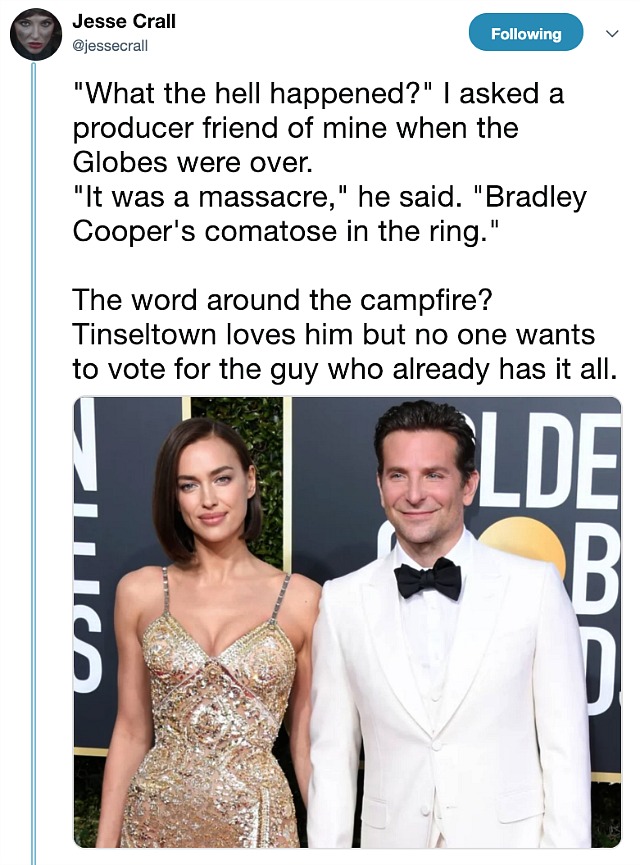
The awards-for-Rami Malek movement actually began two days before the Golden Globes, when the Australian Academy of Cinema and Television Arts staged its eighth annual AACTA International Awards at the Hollywood Mondrian. 48 hours before the HFPA gave Malek their Best Actor award for his Freddie Mercury in Bohemian Rhapsody, the Aussies did the same. Mahershala Ali, also awarded last night with a GG trophy, won a AACTA Best Supporting Actor award for his Green Book turn as Dr. Don Shirley.

Easily The Best Golden Globes Commercial

Apple copy: “Introducing Liquid Retina display on iPhone XR — the most advanced LCD in the industry. An innovative backlight design allows the screen to stretch into the corners…true-to-life color from one beautiful edge to the other.

I’m happy with my iPhone 8Plus. If I was going to upgrade I would get the iPhone XS Max, but that starts at $1100 and I need 256 gigs. Keep in mind also that the iPhone XR is not the most technologically advanced iPhone — many of the cooler components are reportedly exclusive to the iPhone XS Max.

The song is “Come Along” by Cosmo Sheldrake.

HE to WGA: You Blew Off Schrader’s “First Reformed”?

Among the 2019 Writers Guild Awards nominations, Paul Schrader‘s First Reformed screenplay has been given the cold shoulder — an all-but-unforgivable oversight. Schrader’s morally anguished script, in my judgment his best since Hardcore and one that Robert Bresson would have understood and approved of, has been Best Screenplay-nominated by both the Spirit and Critics’ Choice awards.

Scripts that made the WGA cut include BlacKkKlansman, Can You Ever Forgive Me?, Eighth Grade, Green Book, If Beale Street Could Talk, A Quiet Place Roma, A Star Is Born and Vice.

WGA ineligibles include Cold War, Caoernaum, The Favourite, Leave No Trace, Sorry to Bother You, The Death of Stalin, At Eternity’s Gate and Shoplifters.

The Bohemian Rhapsody screenplay was eligible but blown off.

The 71st annual Writers Guild Award winners will be announced on Sunday, 2.17.

Correction: HE made an error earlier about Black Panther not being nominated — it was and has been nominated for Best Adapted Screenplay.

Best Morning-After Golden Globes Impression

From Variety‘s Owen Gleiberman: “Whatever happens seven weeks from now, the Globes, last night, registered as strongly as they ever have as an agenda-setter, a kind of casual dry run for the Academy Awards that, in more categories than not (indeed, in nearly every one of them), had the effect of asking: What would it feel like on Oscar night if this happened?

“In that light, the Globes sent out several key messages — like, for instance, the re-establishment of Green Book as a contender voters can support with pride. For a while, the movie felt like tainted goods. Despite a slew of good reviews and an early reputation as a crowd-pleaser, it had become the object of critical controversy, accused of adopting a decades-old approach to racial historical drama that now (in the eyes of some) seems patronizing. When the Viggo Mortensen N-word flap happened, it seemed to lend a kind of support to the notion that there was something ‘unenlightened’ about Green Book.

“But last night, when it picked up three awards, the shift away from that dynamic seemed more or less complete. Green Book was a player again, and not just because it had won. Mahershala Ali’s speech for best supporting actor was a model of grace and affection, and the way he honored the character he portrays — the jazz innovator Dr. Don Shirley — helped to dissipate the criticism that Shirley’s life had been somehow de-authenticated by the movie.

“Last night the Golden Globes helped restore Green Book to what, in my book, it always was: An artfully enchanting movie that may come off as a little old-fashioned in form, but not in a way that justifies giving the movie a moral slap.

“And speaking of momentum, is that something Glenn Close now has? And that Lady Gaga, so exquisite to see in her cotton-candy blue hair, has less of?

“That’s a tough call, but what’s undeniable is that we’ve come a long way from the days when the Golden Globes were nothing more than the vulgar, downscale, champagne-bucket-at-the-table cousin to the Oscars that no one took seriously. They seem, more and more, like a dress rehearsal for the real thing — and a rehearsal, in some cases, where the understudy goes on instead of the expected star, and steals the limelight. You can agree or disagree with the Globes’ movie awards, but what leaps out about even the eyebrow-raising ones is that they’re connecting with currents that are out there and giving them added life.”

By Light of Silvery Swoon

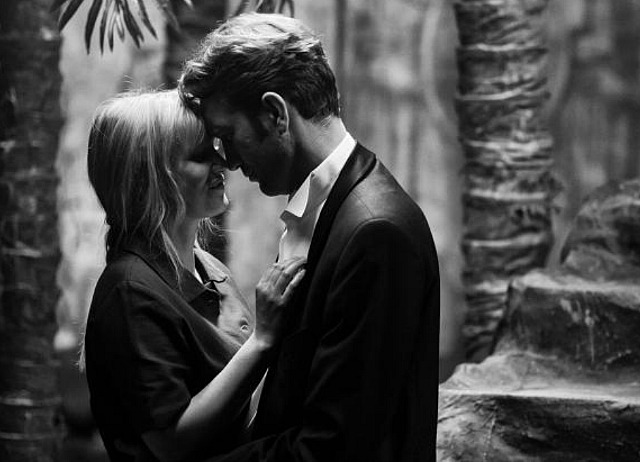
Seriously moved, enthralled or charmed as I am by Green Book, Roma, Vice, First Reformed, Can You Ever Forgive Me?, Happy as Lazzaro, Capernaum, The Mule, Black Panther, First Man, portions of Bohemian Rhapsody and the first half of A Star Is Born, Pawel Pawlikowski‘s Cold War sits at the top of the heap. Yes, even at a higher aesthetic station than Alfonso Cuaron‘s black-and-white masterwork. I’m sorry but I love Cold War a bit more.

If you ask me Cold War is the cleanest, sharpest and most tightly composed film of the year…a period haunter…a kind of half-Polish Communist, half-Montmarte jazz cavern love story that will knock your eyeballs out if you’re any kind of black-and-white connoisseur or a boxy-is-beautiful fanatic like myself.

No other 2018 film rang my bell quite the same. I don’t care what category it’s in — no other film is as concise and self-aware, as visually glistening and fatalistic and bang on the money as Cold War. It’s pure silvery pleasure, perfectly distilled, the highest manifestation of luscious arthouse porn I’ve run into all year. And it offers the greatest female performance of the year — Joanna Kulig as the sly, at times insolent, sometimes half-crazy Zula.

I recently insisted that Kulig deserves a Best Actress nomination. Her performance reignites the spirit of Jeanne Moreau in Jules and Jim (and if that doesn’t excite your spirit then I don’t know what) along with a spritz of early ’50s Gloria Grahame. A femme fatale songbird, an emotional force of nature, trouble from the word go.

You can’t watch Cold War and not fall in love with how it looks and feels. Those gleaming, whistle-clean silvery tones, Łukasz Żal‘s somewhat unusual bottom heavy framings, that feeling of being in a repressive but exotic realm, and yet one that becomes more and more of a “home” in a sense, and more familiar by the minute.

It also delivers something relatively rare in our 21st Century realm, which is a feeling that the viewer hasn’t been shown enough — that he/she hasn’t had enough time to really savor the flavor and atmosphere and characters.

Read more

Son of Art of Honest, Half-Assed Reviewing

Posted on 11.1.18: A follow-up to last night’s “Will Joe Popcorn Save Rhapsody?” post: I’ve said two or three times that Bryan Singer‘s Bohemian Rhapsody (20th Century Fox, opening tonight) is a generally pleasing in-and-outer — humdrum or “bizarrely anodyne” during stretches, but also one that occasionally catches the heat and delivers serious highs. Then it’s back to anodyne.

The Bohemian Rhapsody problem is that the Queen guys (Brian May in particular) wouldn’t grant rights to a biopic that didn’t deliver a basically positive spin — i.e., “Freddie had his excessive episodes but the fans loved him and the band plus he cared about his mum and dad and wife as far as it went, and of course the songs still rock.” So that’s the yoke — why the film doesn’t feel whole, much less transcendent.

It’s nonetheless a sporadically pleasing thing to sit through, and it really is unfortunate, I feel, that critics and editors (the Rotten Tomatoes and Metacritic fraternity that has rendered verdicts of 57% and 49% respectively) aren’t a little more comme ci comme ca about equivocating in an honest way when a film is a solid half-and-halfer.

The phrases “reasonably passable,” “not half bad and sometimes better than that,” “could be a lot worse,” “basically decent” and “imperfect but not a burn” are used by this columnist when the shoe fits, but you’ll hardly ever read them in a typical review. Because critics are trained early on to either pan or approve — to basically lean one way or the other. Don’t confuse the reader by sounding wimpy or uncertain.

Except the flighty, spazzy nature of Bohemian Rhapsody doesn’t (or at least shouldn’t) allow a critic or viewer to lean one way or the other. It’s a once-in-a-blue-mooner that sidesteps suckage but at the same time doesn’t quite get there. In mountain-climbing terms it’s about two thirds of the way between base camp and the peak. Okay, halfway.

Double clarification: The “bizarrely anodyne” comment is from a 10.31 New Yorker piece, “A Truly Perfect Thirty Seconds of Queen“, by Amanda Petrusich.