Some Films Fade, But Then They Return

In a chat with Indiewire‘s Anne Thompson, Luca Guadagnino mentioned the persecution of Woody Allen. He said he frowns strongly upon “the perverted and primordial enjoyment of a kind of ‘Scarlet Letter’ trial of a man. I still am a believer in [the] state of rights. Mr. Allen went through many investigations 20 years ago and was cleared.

“[And] the Woody Allen legacy –— those movies are there, and they are fantastic. Anyone who denies that Another Woman is a masterpiece is stupid!”

I can’t honestly say that Another Woman, released in October ’88, burns all that brightly in my memory. My most vivid recollection is a romantic confession moment with Gene Hackman, whose part is relatively small. Gena Rowlands has the lead role; Ian Holm and Mia Farrow costar. 31 years ago the film was regarded as Ingmar Bergman-esque, and specifically a riff on Wild Strawberries.

Now I want to see it again, except the only way I could do that would be to buy the 18 year-old DVD.

The primary focus of the Thompson chat was Luca’s The Staggering Girl, a 35-minute short which I saw and favorably reviewed last Tuesday. Its submission to Directors Fortnight led to Guadagnino’s first Cannes invitation. “I’m a Venice man,” said Guadagnino. “I am a nouvelle vague person, [and] this is my first time in Cannes. [But] I felt at home. Maybe this is the beginning of a new phase for me.”

John Frankenheimer’s “The Train”

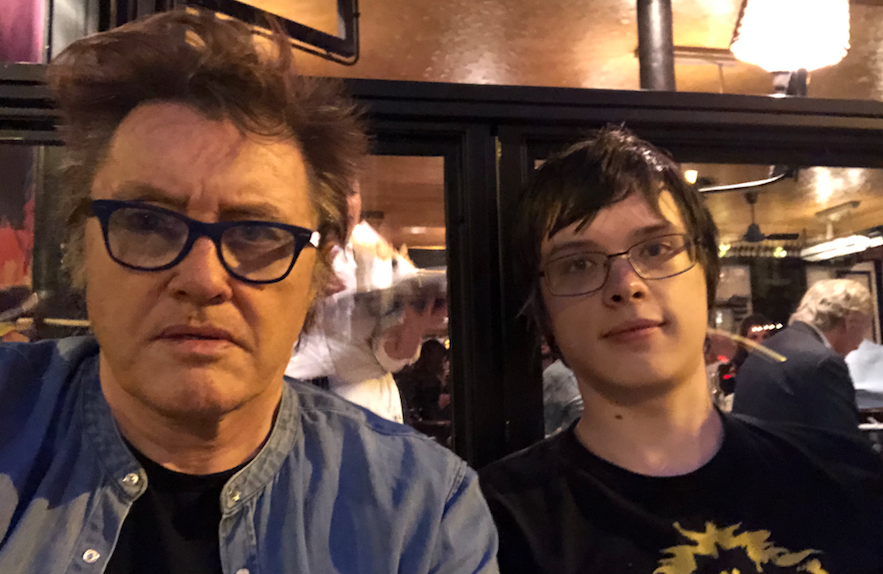
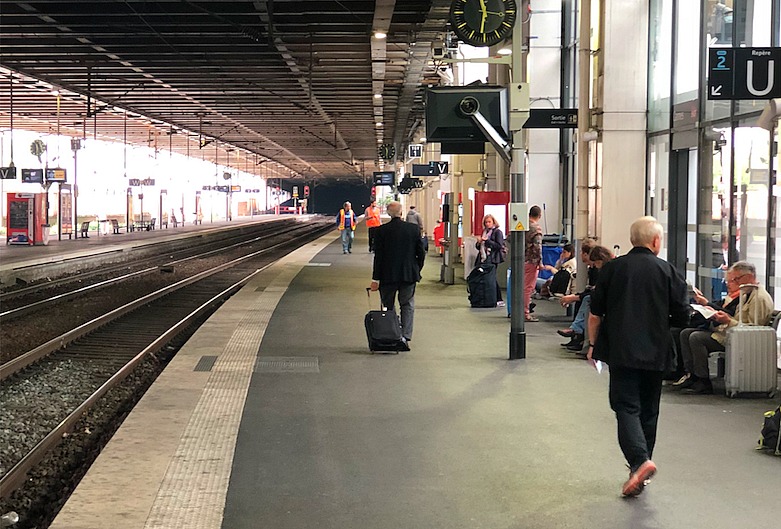
Mid-afternoon: I endured a miserable Cannes-to-Marseille journey earlier today on an overcrowded 2nd class car…awful. Now on a less crowded SNCF train, surging smooth and fast toward Paris. Expected arrival at 6:30 pm. Late evening: Arrived at the Paris apartment (22 rue Saint-Claude) around 8 pm, and was surprised to discover it’s a lot smaller than the Airbnb photos indicated. Tatyana’s 19-year-old son Gleb was already there. Alas, no Tatyana yet. Gleb and I went out for groceries, stopped by Cafe Charlot on rue Bretagne.

Too pooped to boogie, too whipped to think. Whatever I can add to the conversation will have to keep until tomorrow morning.

Read more

212 Minutes of Audacious, Defiantly Empty Butt-Shaking

It’s 2:24 am — almost an hour since the 10 pm press screening of Abdellatif Kechiche‘s Mektoub, My Love: Intermezzo ended. I can’t write a proper review because I need to be up by 7:30 or 8 am. But I can at least report that this plotless (but not character-less) 212-minute beach blanket buttathon with a 15-minute cunnilingus interlude …this crazy-ass film wildly defies all notions of what cinematic substance or intrigue or even worthwhile flavor amounts to.

It is so effing monotonoous, so long and so plot-averse that it’s like “c’mon, Abdellatif…really?” And he’s replying in the exuberant affirmative.

Intermezzo is nervy as fuck but also brazenly, outrageously empty (but not really if you’re perversely determined to give Kechiche a break or if you’re especially susceptible to the relentless sight of women’s shaking, quivering ass cheeks).

Kechiche is pretty much defying people like me to call him out for making a three-and-a half-hour movie about intensely sexual male-gazing on a beach and in a nightclub…relentlessly provocative sex-throb dancing and eyeballing and shuddering quiver-butts.

Kechiche knows how to make the kind of film that most of us will respond to favorably. He made Blue Is The Warmest Color a few years back. He just chose to go radical this time.

Gaspar Noe‘s Climax (which screened here last year via Directors Fortnight) went in this all-orgiastic-dancing direction for a fairly long spell, but at least he introduced the idea of LSD-spiked sangria. Kechiche introduces no such shaker-upper.

There’s probably no way in hell Intermezzo gets distribution in the States. The sexuality is way too pronounced (the bathroom cunnilingus scene is pure Pornhub) and the #MeToo community would totally freak if any of the usual suspects picked it up.

Roughly three-quarters of this epic is set in a club in Sete, France, and is mainly about three youngish, good-looking Tunisian guys (played by Shaïn Boumédine, Salim Kechiouche and Roméo De Lacour) gently but persistently hitting on a loose-knit crew of casually responsive 20something girls, whom the Tunisians have met on the beach earlier that day.

Intermezzo breaks down into five sections: (a) A 40-minute chat scene on the beach between Kechiouche and Lacour and most of the girls, (b) a 105-minute drink-talk-and-dance sequence that offers character shadings among the principals but mainly just pumps and throbs and dances for endless stretches, (c) a 15-minute cunnilingus scene in the bathroom, (d) a second talk-drink-and-dance sequence that runs about 45 minutes, and (e) a brief morning-after epilogue that doesn’t pay off in any way, shape or form.

Not long after Jack Kerouac‘s “On The Road” was published, Truman Capote famously said “that’s not writing — that’s typing!” I could just as easily say that Mektoub, My Love: Intermezzo isn’t filmmaking but cinematography. A crew of young, attractive actors, a whole lotta butt-shaking and flirting and erotic playfulness and footage that just goes on and on and on.

I’ll probably add to this sometime tomorrow.

Diverse Terminator Realm

Tim Miller and James Cameron‘s Terminator: Dark Fate (Paramount, 11.1) is embracing diversity by emphasizing female and Latino characters. Linda Hamilton, taut and 62, is back as Sarah Connor, but Mackenzie Davis is the new Arnold Schwarzenegger-like protector and Gabriel Luna (unfortunately sporting a tennis-ball haircut) is the new version of Robert Patrick‘s T-1000. And “Dani Ramos”, the new Terminator target who must be shielded at all costs, is played by Natalia Reyes.

But what about actors and characters of African persuasion, not to mention a LGBTQ player or two? Will the Twitter hyenas erupt in protest over these two groups being absent or under-represented? Will they burn Miller and Cameron at the stake for selectively favoring women and Latinos over other tribes that deserve not just equal recognition but equal paychecks?

A white-bearded Schwarzenegger makes a brief appearance in the trailer, presumably as some kind of cyborg cousin of the characters he played in the ’84 and ’91 originals. But if he’s a cyborg, why has he aged?

Dump Gimpy Craig?

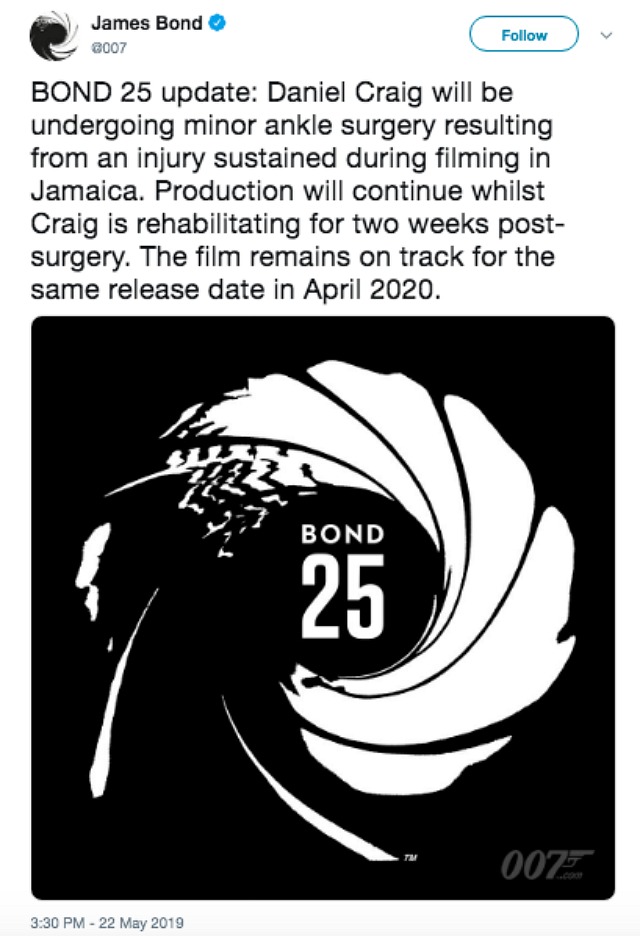
Daniel Craig will be undergoing minor ankle surgery resulting from an injury sustained during filming in Jamaica. Production will continue whilst Craig is rehabilitating for two weeks post-surgery. The film remains on track for the same release date in April 2020.”

So Craig’s ankle wasn’t bruised or sprained — it was sufficiently snap-crackle-popped to require surgery. Doctors, nurses, local anesthetic. And post-surgery Craig will only need two weeks before he’s back to running, jumping, face-kicking and fisticuffing? Sounds like a push. I would think a good three to four weeks would be more like it, if not four or five.

If Craig was required to just stroll around and say dialogue, fine, but 007 has evolved past the guy he used to be — an elegant smoothie who would occasionally punch or plug a bad guy with aplomb — to an X-treme pugilist martial-arts superman. How do you jump back into that only two weeks after ankle surgery? Craig is 51 years old — five years past the normal prime period for a typically fit male.

If I was running Bond 25 I would be seriously thinking about cutting bait and starting fresh. I would let Craig go (paying him off with insurance money) and hire Richard Madden to take over.

“Cinematic Karaoke”

All along I could smell…okay, sense the reportedly antiseptic soullessness of Guy Ritchie‘s Aladdin. We all could. Then came the initial blurbs that said “surprisingly charming!” and “better than expected,” etc. Then came the immensely satisfying Rotten Tomatoes and Metacritic scores of 59% and 54%, respectively.

The column demands that I submit to this film sooner or later. I could catch a 7:15 show this evening at Cannes’ Olympia plex or wait to see it this weekend in Paris. Or I could just blow it off entirely. God, that would be wonderful.

From A.O. Scott’s 5.22 N.Y. Times review, “This Is Not What You Wished For”: “Aladdin, the new live-action re-whatever with a blue Will Smith popping out of the lamp, may not be the worst product of the current era of legacy intellectual property exploitation (it’s likely that the worst is yet to come), but like most of the others it invites a simple question: Why?

“The answer — spoiler alert: ‘money’ — may not surprise you. I know it’s pointless to complain about Disney’s drive to wring every last dollar from its various brands. You might as well complain about the animal sidekicks (and I will). But the movie itself, while not entirely terrible — a lot of craft has been purchased, and even a little art — is pointless in a particularly aggressive way.

None of these [digital reboots] has surpassed the original, but that might be too much to ask. I can’t think of one — not The Jungle Book, not Mary Poppins Returns, not the recent, somber Dumbo, certainly not this Aladdin — that seems able to stand alone in the popular imagination. They are weird and grotesque hybrids, belonging to no particular era, style or creative sensibility, like dishes at a chain restaurant that fuse disparate food trends to produce flavors alien to every known earthly cuisine.”

The “cinematic karaoke” line is from the Chicago Tribune‘s Michael Phillips.

Countdown

I decided against catching an 11:30 am screening of Arnaud Desplechin‘s Oh, Mercy! (aka Roubaix, une lumiere). The consensus is that it’s mostly an unexceptional police procedural — a pilot episode for C.S.I Roubaix. (Desplechin’s home town of Roubaix isn’t far from Lilles and adjacent to the Belgian border.)

So today is a double-header instead — a 4:30 pm showing of Marco Bellochio‘s The Traitor at the Debussy, and then that 10 pm screening of Abdellatif Kechiche‘s Mektoub My Love – Intermezzo, which runs four hours. I’m kicking myself for having overlooked a two-day-old invitation to a Salle Bazin screening that started a little more than an hour ago — 11.:15 am.

Between now (12 noon) and 4 pm I have 90 minutes of writing and editing, plus some packing, washing and cleaning. You always want to leave a sublet tidy and at least mostly clean. Tomorrow morning is a wake-up, a shower, a short Mektoub review and then off to the Cannes gare. The train leaves at 11:55 am, arrives in Paris at 6:25 pm.

Read more

“Sometimes Trouble Wants You”

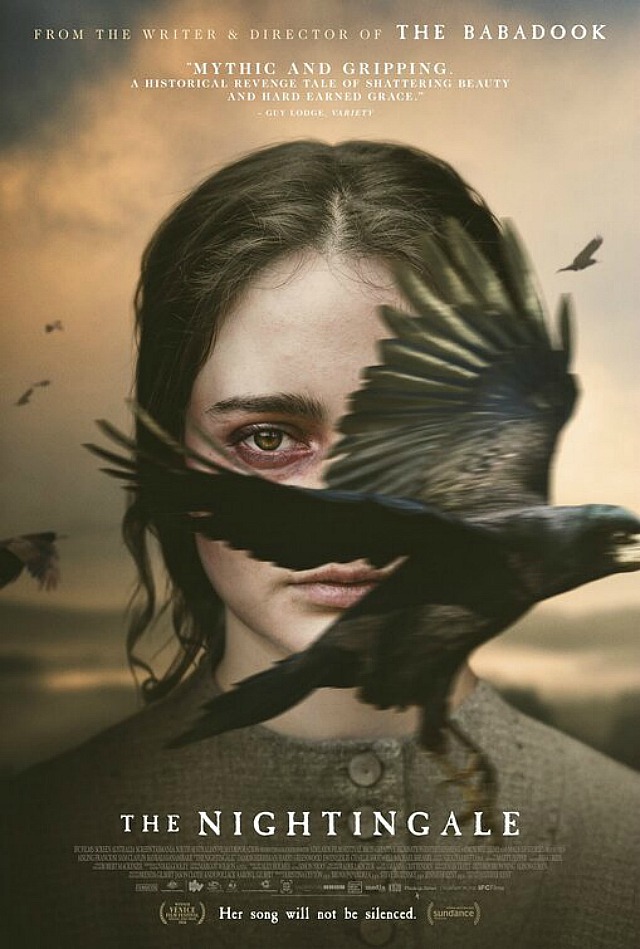
The new trailer for Jennifer Kent‘s The Nightingale (IFC Films, 8.2) is framed within a 1.37:1 aspect ratio, and yet none of the reviews I’ve read since last September’s Venice Film Festival have even mentioned it.

A.A. Dowd review, posted on 1.27.19: “’This is not an easy sit,’ we were told [by a Sundance] programmer. But even this warning didn’t seem to properly brace the crowd for…nearly two-and-a-half hours of relentless, unspeakable violence, [which] provoked distressed walkouts. Judging from some overheard post-screening grumbles (‘I thought it was going to be scary, but then it wasn’t‘), plenty of those who stayed for the whole thing were expecting something closer in spirit to Kent’s The Babadook, which premiered at Sundance five years ago. What they got instead was ceaseless, numbing brutality — a Western revenge yarn of such heightened cruelty and suffering that it basically demands to be read as allegory.”

The designer of the first-rate Nightingale poster deserves a salute. Haunting and oddly beautiful.

Primal Concerns

There’s a line in Stanley Kubrick‘s Spartacus that I’ve always found slightly irksome. I don’t know if it came from Dalton Trumbo‘s screenplay or the original Howard Fast novel, but…

Tony Curtis to Kirk Douglas: “Are you afraid to die, Spartacus?”
Douglas to Curtis: “No more than I was to be born.”

Babies don’t have the first idea of what fear is. That comes later when they enter school and are challenged and sometimes chewed up by the various meat-grinder rituals. All babies know is that the womb is warm, safe and comfortable, and that they’d prefer not to deal with the unknown, not to mention the elements. Not “fear” but reluctance.

As for Curtis’s line, everyone is afraid of the moment of mortal transition (i.e., crossing the footbridge, the ceasing of breath) and no one wants to be eaten by crocodiles. But no one really “fears” death as much as senses the terrible infinite loss of the great rapture of living.

Read more

“I’ll Play What’s Dealt”

I knew Tommy Lee Jones would be a star of some magnitude after watching him play Coley Blake, a hard-luck loser and accused murderer, in Michael Miller‘s Jackson County Jail.

An above-average exploitation flick, Jail was produced by Roger Corman and released by New World into subruns and drive-ins in the spring of ’76.

Donald E. Stewart‘s script is about a Los Angeles ad exec named Dinah Hunter (Yvette Mimieux) who’s wrongfully arrested in shitkicker country and then raped in a small-town jail cell. She and Blake break out of the slam and go on the run. It gradually becomes apparent that Blake, who wears the shell of an outlaw nihilist, carries shreds of decency and compassion.

Blake’s bitter signature line, spoken to a surly cop, is “I’ll play what’s dealt.”

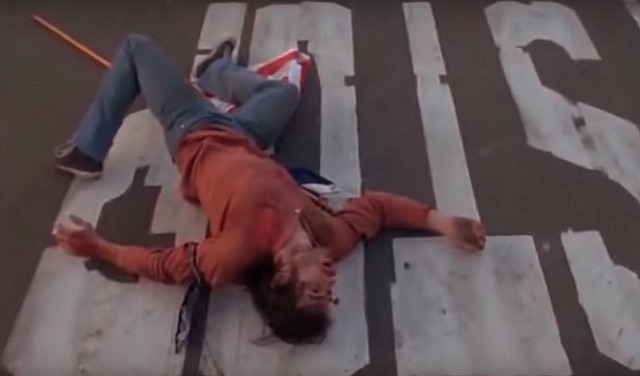
Jones’ big climactic scene happens at the end of the clip (starting around 8:30). Blake is running from the law during a small-town 4th of July celebration. The cops shoot him two or three times in the back. He staggers and falls to the pavement alongside an American flag. Blake dies with a long exhalation of breath, just like Stephen Boyd‘s Messala in Ben-Hur.

When the film ended I knew right away that Jones, 29 when the film was shot, was X-factor and waiting to happen.

You can stream Jackson County Jail on Amazon, but only in standard def.

Read more

“Well, I Reject your Hypothesis”

The flashpoint moment during this morning’s Once Upon A Time in Hollywood press conference came when Quentin Tarantino was asked by a N.Y. Times reporter why Margot Robbie‘s Sharon Tate character doesn’t have very many lines. The reporter mentioned Robbie’s acclaimed performances and lamented that she’s pretty much limited to marginal or insubstantive dialogue. Which is true. Robbie has only one mostly non-verbal scene on her own, during which she watches herself perform in The Wrecking Crew, the 1969 Matt Helm/Dean Martin flick, at Westwood’s Bruin Theatre. Tarantino brusquely but non-dramatically dismissed her “hypothesis” The exchange begins at 31:15.

Odds of Cannes Prizes To Come

Thursday is my last full day of Cannes Film Festival showings, and it’ll be a triple-header: Arnaud Depleschin‘s Oh, Mercy at 11:30 am, Marco Bellochio‘s The Traitor at 6:30 pm, and Abdellatif Kechiche‘s four-hour Mektoub, My Love — Intermezzo, starting at 10 pm. My Paris train departs Friday at 11:30 am. And the Cannes awards ceremony happens on Saturday night.

It’s been predicted that Pedro Almodovar‘s Pain and Glory, a deeply personal and subtle meditation on creative blockage and the gradual end of things, is an odds-on favorite to win a top festival prize — the Palme d’Or, a special Jury Prize, Best Director. Maybe, but I sensed more respect than great waves of passion after it screened, and I’m not sure that the Almodovar is strong enough to float a large boat.

The passion levels are very strong for Celine Sciamma‘s Portrait of a Lady on Fire. The fact that I wilted when it came time to write a review, and that I only managed the following tribute — “By my sights as close to perfect as a gently erotic, deeply passionate period drama could be” — doesn’t mean it’s not emotionally impactful and superbly composed. That long closing shot of Adèle Haenel melting as she listens to a concert performance of Vivaldi’s “Four Seasons” (or perhaps just a performance in her head) is devastating.

I can’t see any big prizes going to Terrence Malick‘s A Hidden Life. As I more or less said in my review, the substance and ramifications of Franz Jägerstatter‘s anti-Hitler stance aren’t really delved into or articulated, and the style and mood of this 173-minute film falls completely in line with Malick’s last four films (Song to Song, Knight of Cups, To The Wonder, The Tree of Life). It’s basically more of the same with an Austrian WWII backdrop.

If Robert EggersThe Lighthouse had been given a competition slot instead of opting for Directors’ Fortnight, it would definitely be a top Palme d’Or contender. Or a likely winner of the Best Director prize. Or so I keep thinking, and keep hearing.

I remain a staunch champion of Ladj Ly‘s Les Miserables. I would find it stunning if the Cannes jury doesn’t honor it with some kind of significant award come Saturday.

And I remain floored by the vibrant stylistic brio that energizes Diao Yinan‘s The Wild Goose Lake. Critics have complained that the internals don’t live up to Black Coal, Thin Ice and maybe they don’t, but Goose Lake‘s direction is nonetheless genius-level. I was awestruck.

I chose to write a longish review of Once Upon A Time in Hollywood rather than see Bong Joon ho‘s Parasite so I’ve nothing to say on this. I also failed to see Mati Diop‘s Atlantique and Jessica Hausner‘s Little Joe — apologies.

As much as the Cannes jury may enjoy the flash and pizazz of Once Upon a Time in Hollywood, I doubt it will land a major award. It’s heartfelt on a certain level, but…hell, I don’t know how this’ll shake out. If they’re in a giving, light-hearted mood they might hand a Best Actor to Brad Pitt for the confident muscular swagger element. I would certainly push for Pitt if I were a jury member.

Jim Jarmusch‘s The Dead Don’t Die hasn’t a prayer.

In my humble opinion that Kleber Mendonça Filho‘s ultra-violent Bacurau hasn’t a chance of winning anything. Ditto Corneliu Porumboiu‘s The Whistlers. Ditto Xavier Dolan‘s Matthias et Maxime, which I saw earlier today and was bored by.

Ken Loach’s sad and straightforward Sorry We Missed You addresses the anguish of working-class Brits being squeezed by heartless employers and corporations (obviously a situation that applies to other countries), but I found it merely sufficient. Now watch it take the Palme d’Or — what do I know?

I’ll likewise be flabbergasted if Ira Sachs‘ morose, flatly written, on-the-nose Frankie wins anything.