Gerwig’s “Little Women” Avoiding Festival Circuit?

The copy for Eric Kohn and Anne Thompson’s latest “Screen Talk” podcast (#250) states that Greta Gerwig‘s Little Women (Columbia, 12.25) “seems to be avoiding the festival circuit altogether.” Really? I hadn’t heard that. Word around the campfire is that the second half of Gerwig’s film delivers the goods, and that acting-wise Saoirse Ronan is “great as ever” and “a “lock” for a Best Actress nomination, and that Florence Pugh has “an earth-shattering monologue”.

Jeff Sneider tweet: “After surveying the awards landscape, chatting with sources & listening to the infamous InSneider gut, I’m prepared to go way out on a limb and tell you in July that one year after the Green Book win, the Oscar will go to one of these two movies — Melina MatsoukasQueen & Slim and Destin Daniel Cretton‘s Just Mercy.” What Sneider means, I gather, is that an anti-Green Book, authentic-black-experience pushback vote will constitute a good part of the support for these two.

The fall hotties are still Martin Scorsese‘s The Irishman, Marielle Heller‘s A Beautiful Day in the Neighborhood, Ed Norton‘s Motherless Brooklyn**, Jay Roach‘s Fair and Balanced, Kasi LemmonsHarriet, Dee ReesThe Last Thing He Wanted, Steven Soderbergh‘s The Laundromat, Gavin O’Connor‘s Torrance, Roger Michell‘s Blackbird, Rupert Goold‘s Judy, Tom Harper‘s The Aeronauts. Which others?
Read more

Essential IMAX Viewing

I saw Todd Douglas Miller‘s Apollo 11 last February at a press screening inside the AMC Century City IMAX theatre, and it was flat-out wonderful. I was knocked flat by the sheer textural dazzle of the 70mm large format images. The 93-minute doc takes you back 50 years and into the launch of Apollo 11 and of course the moon landing that happened on 7.20.69.

A significant portion of this stunning immersion — narration-free and sans talking heads — is composed of unreleased 70mm footage from the launch (look, it’s Johnny Carson!) and the ocean recovery of Apollo 11. This is blended with uprezzed 35 and 16 mm film, still photography and closed-circuit television footage, all of which was digitally scanned at Final Frame, a post-production firm in New York City.

The sum effect is one of a wowser, you-are-there voyage into the past. Except it feels like the present during those 93. It delivers an unmistakable spiritual current.

This evening I’ll be attending a special Apollo 11 screening inside the huge IMAX Corporation theatre in Playa Vista, to be followed by a chit-chat mixer with Miller. The idea, of course, is to commemorate the half-century anniversary, which is only 8 days from now. And, of course, to remind press people that this Neon release needs to be seen on a big, big screen. And that it needs to be nominated for the Best Feature Doc Oscar.

Universal release Apollo 11 on DVD, Bluray and digital streaming on 5.14.19.

The 50th anniversary of Ted Kennedy’s Chappaquiddick tragedy will happen six days hence, on 7.18.19.

Drug Dealer Subs Aren’t Slick Enough

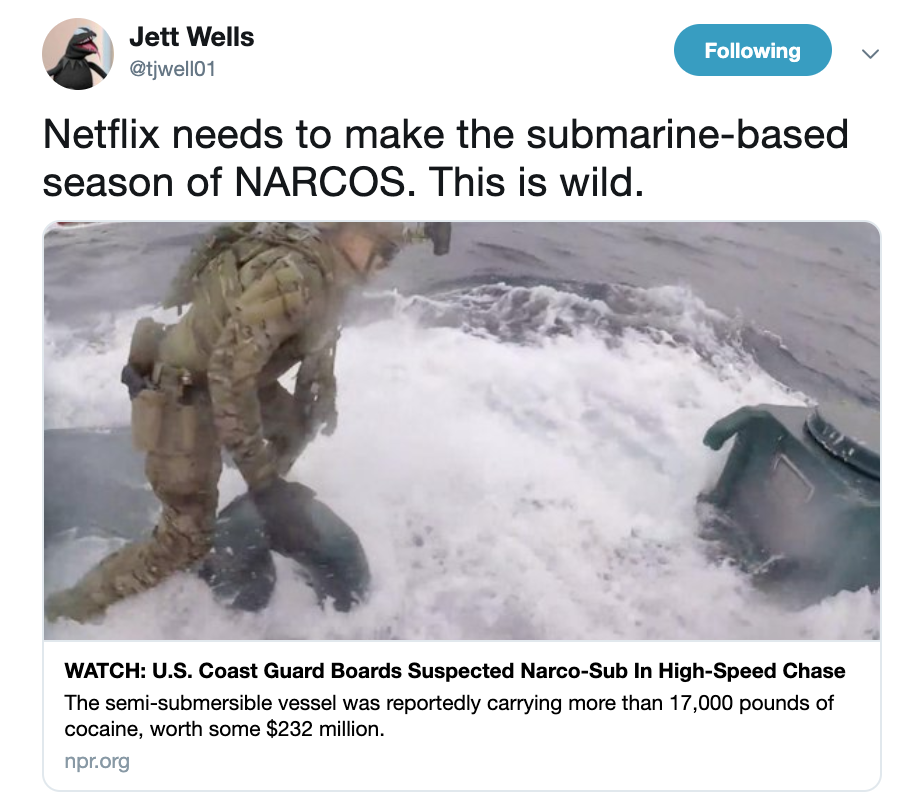
An exciting 60-second drug-smuggling video was released yesterday by the U.S. Coast Guard. Recorded somewhere in the eastern Pacific on 6.18.19, it shows Coast Guard commandos chasing a semi-submersible drug smuggling vessel (SPSS) carrying “more than 17,000 pounds of cocaine, valued at about $232 million,” according to The Washington Post.

“Alto tu bote! Alto tu bote!” the Coast Guard guy yells. The approximate English translation is “stop your motherfucking boat, assholes! You’re fucking busted!”

All hail the can-do, take-charge, super-macho attitude of the Coast Guard, but Hollywood Elsewhere has a question for the drug dealers. You guys allegedly have lots of dough so why are you trying to smuggle cocaine inside a semi-submersible, or a small Nautilus-like, Captain Nemo-styled craft that’s visible to patrol boats? Why don’t you use fully submersible subs, or the kind that Coast Guard guys can’t see because, you know, they’re underwater and therefore visually undetectable?

We Love You, Now Step Aside

I know that the HE commentariat disapproves of my watching HBO all the time, but I’ve forgotten if they approve or disapprove of Big Little Lies. I’ve been watching season #2 all along, mostly because of Meryl Streep. I wasn’t all that big on season #1, which was directed by Jean-Marc Vallee; season #2 has been directed by Andrea Arnold, but not in a style that anyone would call Arnold-esque (hand-heldy, here and there, natural light). It just feels smooth and steady for the most part.

Today an Indiewire piece by Chris O’Falt (“Big Little Lies’ Season 2 Turmoil: Inside Andrea Arnold’s Loss of Creative Control“) reports that after Arnold finished shooting season #2 last year, Vallee and Big Little Lies producer David E. Kelley stepped in and ordered extra shooting, and then cut Arnold’s creative balls off during editing.

O’Falt: “According to a number of sources close to the production, there was a dramatic shift in late 2018 as the show was yanked away from Arnold, and creative control was handed over to executive producer and Season 1 director Jean-Marc Vallee. The goal was to unify the visual style of Season 1 and 2. In other words, after all the episodes had been shot, take Arnold’s work and make it look and feel like the familiar style Vallée brought to the hit first season.”

“It was [just] as Arnold started to assemble scenes that Kelley and HBO started to see there was a problem,” O’Falt continues. “Before Arnold and her London editing team were able to even complete an official cut of an episode, Vallée started to take over. Post-production shifted from London to Vallée’s home city of Montreal, where his own editorial team started cutting what is now airing on HBO. Soon after, 17 days of additional photography were scheduled.”

So why did Kelley and his HBO bosses agree to hire a headstrong director with a distinctive dart-and-shoot style if what they really they wanted was someone who would more or less ape Vallee’s approach?

The apparent answer is that Kelley and HBO execs weren’t all that familiar with Arnold’s previous films (Red Road, Fish Tank, American Honey) and were therefore taken aback when they saw her season #2 footage. O’Falt reports that Arnold was more or less hired because of Vallee’s recommendation.

O’Falt: “The optics were not lost on many associated with Big Little Lies: A show dominated by some of the most powerful actresses in Hollywood hired a fiercely independent woman director…who was now being forced to watch from the director’s chair as scenes were shot in the style of her male predecessor.”

An Affair To Remember

Unusual Dispensation: As the following is one of my favorite HE Plus essays over the last few months, I’m offering it for free as a special HE promotion. Feel free to click through:

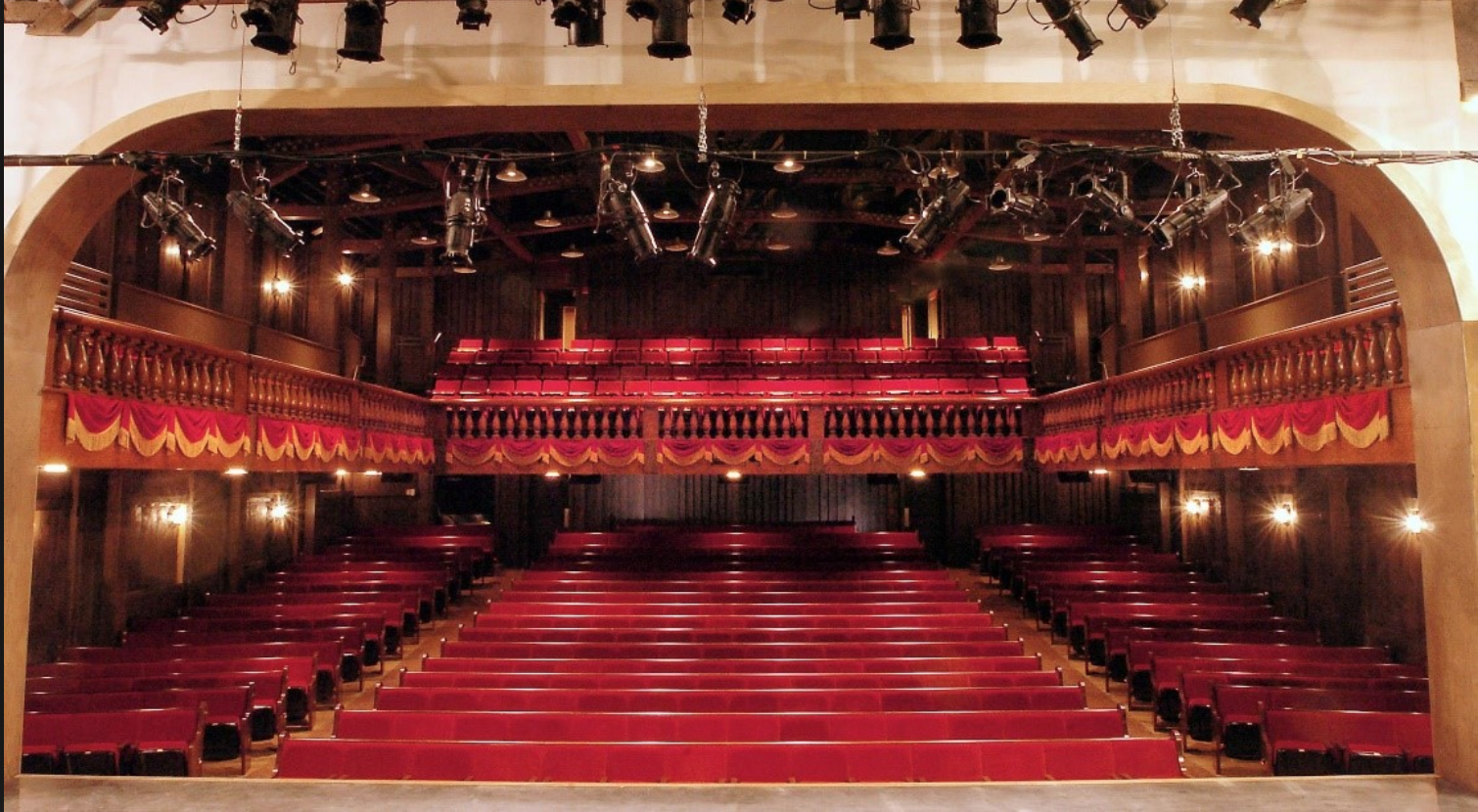
I became an amateur stage actor between ’75 and ’76. I was living in Westport, Connecticut. My big move to Manhattan was about a year and a half off. The usual nocturnal distractions prevailed, of course — carousing, partying, movies. I also wrote program notes for the Westport Country Playhouse Cinema. And I acted in front of paying audiences. First I played the timid “Dr. Spivey” in a Stamford Community Playhouse production of One Flew Over the Cuckoo’s Nest (which I mentioned to Ken Kesey when I interviewed him in Park City in ’98 or thereabouts), and then a macho backwoods type named “Marvin Hudgens” in a Westport Playhouse production of “Dark of the Moon.”

Click through to full story on HE-plus]

Terry Lennox, Adios

To this day I’ve never read Jim Bouton‘s “Ball Four.” I meant to a long time ago but I never did. With Bouton having just passed I’m thinking maybe I will. [Update: I just bought a Kindle version for ten bills.] To me Bouton was always Terry Lennox and vice versa. That’s how I saw it, channelled it. In The Long Goodbye, Marlowe shooting his old pal Terry was a striking, decisive ending. It wasn’t really believable — Elliot Gould‘s Marlowe wasn’t the type to plug anyone in cold blood, much less an ex-friend — but it more or less “worked” in movie terms.

Read more

Final “Divorce” Season

Let’s say you’re the new boyfriend of a recently divorced woman (Sarah Jessica Parker), and you’ve both been invited to dinner with her ex- (Thomas Haden Church) and his current live-in girlfriend or wife.

Question: Would you sit on your side of the dinner table with your arm protectively draped over the back of your girlfriend’s chair and perhaps with your hand resting between her shoulder blades? Isn’t that a bit much? Wouldn’t this fall under the heading of “overly protective” or “needlessly defensive body language”?

If I’d invited my ex to my home and her new fella pulled this arm-draping shit, I wouldn’t say anything but inwardly I’d be thinking “dude, what is your issue?”

I’ve had a reasonably engrossing time with Divorce over the past couple of seasons. It’s very well directed, written, acted…it moves right along without any false or cloying steps. It’s been running since 7.1.19 but for some reason I haven’t yet tuned in, but I will this weekend.

Side comment: Thomas Haden Church, whom I still look upon as the randy Jack Cole in Sideways, is suddenly looking really lined and gray. Is this for the part or…? As recently as eight or nine years ago he was dark haired. I don’t like to think of Jack as a getting-older guy. I want him to hang in there and keep it up.

Ignominious Facebook Betrayal

Karim Amer and Jehane Noujaim‘s The Great Hack (Netflix, 7.24) “exists as a giant contradiction sure to evoke strong responses from anyone impacted by its drama, which is basically everyone,” wrote Indiewire‘s Eric Kohn last January. “As a Netflix production, it has a puzzling identity in the marketplace: Audiences for this revealing movie are poised to discover it through the very same process of hidden algorithms at the center of its alarming narrative. That’s either a bitter irony or exactly right.”

Uniform and Homogenous

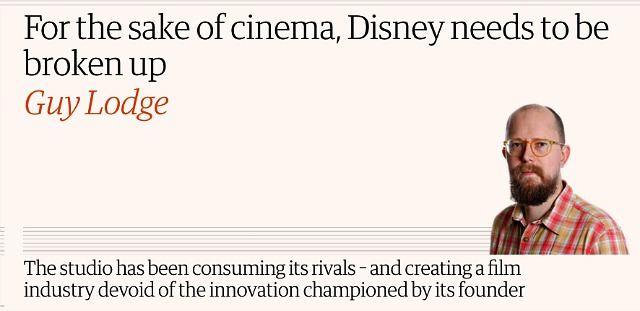
“For the sake of cinema, Disney needs to be broken up“…yeah! Rousing headline! Sounds like a mission statement or a call to arms. Except that Observer columnist Guy Lodge doesn’t precisely urge this course of action. Well, in a roundabout way by inserting the word “might.”

What he mainly says is that the Disney dominance or “box-office stranglehold” of the last five or six years translates into the fact that Disney has become a kind of engulfing Hollywood colossus — “the principal architect of an ever more uniform and homogeneous popular cinema.”

In other words, the studio that Walt and Roy Disney worked and struggled so hard to build has is no longer about creativity but corporate rubber-stamping and the serving of familiar stories, characters and formulas. Obviously nothing radical or new in this observation,

Lodge’s central thought is that “this kind of Hollywood imperialism is not encouraging news if you fear that reduced competition begets reduced creativity,” which of course it has. “What other acquisitions are on [Disney’s] wishlist?,” Lodge asks. “Are we seeing a return to the rigidly controlled Hollywood studio system of the 1940s and 1950s — only with one studio effectively as the system? If so, a movement not dissimilar to the demands to break up big tech currently rippling towards Silicon Valley might be in order.”

Read more

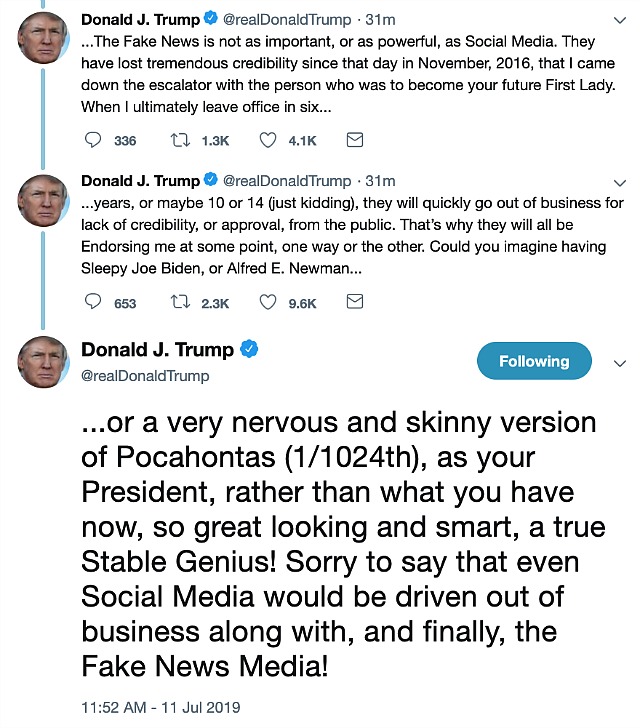
“True Stable Genius”

An attorney friend said this morning that he’s starting to think that Trump will be re-elected. Because the Democratic primary echo chamber is one thing, and mainstream voters are another. Biden is too old and too yesteryear, he feels, and that reality will sink in more and more as the months wear on. And he fears that average voters will be reluctant to support someone perceived as overly owned by or indebted to the leftist-outrage woke camp.

I love the idea of Kamala Harris or Elizabeth Warren winning, but I’m also scared. Harris will kick Trump all over the stage in a debate and will almost certainly win the blue states and city voters, but how will she do with the same Middle American slowboats who couldn’t stand Hillary? I can imagine Warren snagging the Democratic nomination but I’m extremely fearful of her being out-tweeted and out-bludgeoned by Trump. I’m heartened by the polls that show Biden leading Trump by a large margin and I’ll vote for him , of course, if it comes to that, but he’s the wrong guy for the 2020s. We all know this in our gut, but many, like myself, are also afraid of what might happen with Harris or Warren.

Mayor Pete is the guy, but African American voters are apparently dead-set against him (or so I’m reading) along with what I’m guessing are millions of closet homophobes.

Read more

Life With Lions

I forgot to attend last night’s Lion King all-media screening. Apologies. We all understand that “forgetting” to do something is usually a result of a lack of interest in same. I know it’ll be slick and “satisfying” to the serfs and make a lot of money, but what’s the point, really, of sitting through another CGI reboot of another Disney animated feature from 15 or 20 years ago? I felt so Lion King-ed out back in the mid to late ’90s (two viewings of the 1994 original, a viewing of the Broadway musical in the fall of ’97) that 20-plus years later I’m still reluctant to revisit any further permutation. Make that deeply reluctant.

It has always struck me as ludicrous that the dominant predators of Africa could somehow be re-imagined as possessors of royal blood. Not to mention the idea of various species of prey bowing their heads in respect to the lordly Simba…please!

Every day on YouTube I watch at least one African wildlife killing **, and each one is cruel and horrific. The poor victim cries and howls in terrible agony and death is never quick. In my humble opinion the daily YouTube murder channel (which of course didn’t exist in the mid ’90s) has not only desanitized but fundamentally altered our understanding of what predators actually do and how they operate. Predators are part of the nature’s natural order, of course, but try watching hundreds of these videos and see how it affects your basic outlook. A quarter-century ago I found myself half-investing in the Lion King mythology, largely out of deference to the kids. But no longer.

My lack of interest is such that I wasn’t even interested in reading Lion King reviews. But now I feel differently. Because I’ve been revived and rejuvenated by what Indiewire‘s David Ehrlich has written:

“Unfolding like the world’s longest and least convincing deepfake, Jon Favreau’s (almost) photorealistic remake of The Lion King is meant to represent the next step in Disney’s circle of life. Instead, this soulless chimera of a film comes off as little more than a glorified tech demo from a greedy conglomerate — a well-rendered but creatively bankrupt self-portrait of a movie studio eating its own tail.

“With the possible exception of 2015’s Cinderella, which was touched with just enough magic to feel like a new wrinkle on an old fairy tale, all of Disney’s live-action rehashes have been faint echoes of their animated predecessors. But The Lion King isn’t an echo, it’s a stain. This zombified digital clone of the studio’s first original cartoon feature is the Disney equivalent of Gus Van Sant’s Psycho.”

Read more

Will Fincher’s “Mank” Be Welles Hit Job?

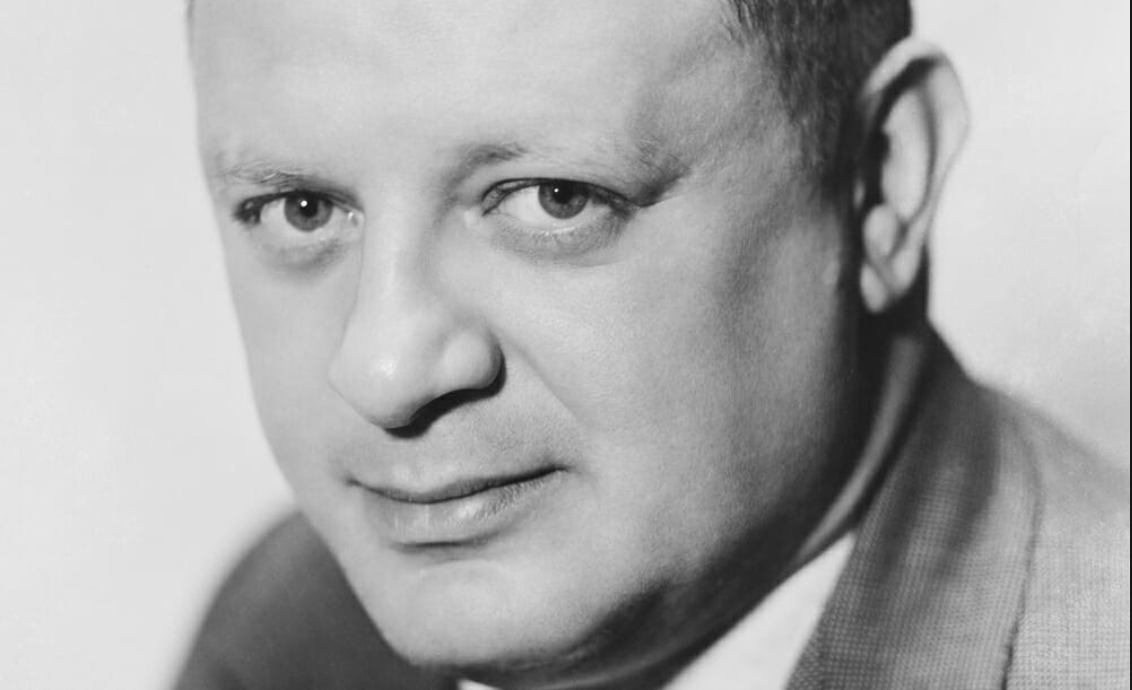
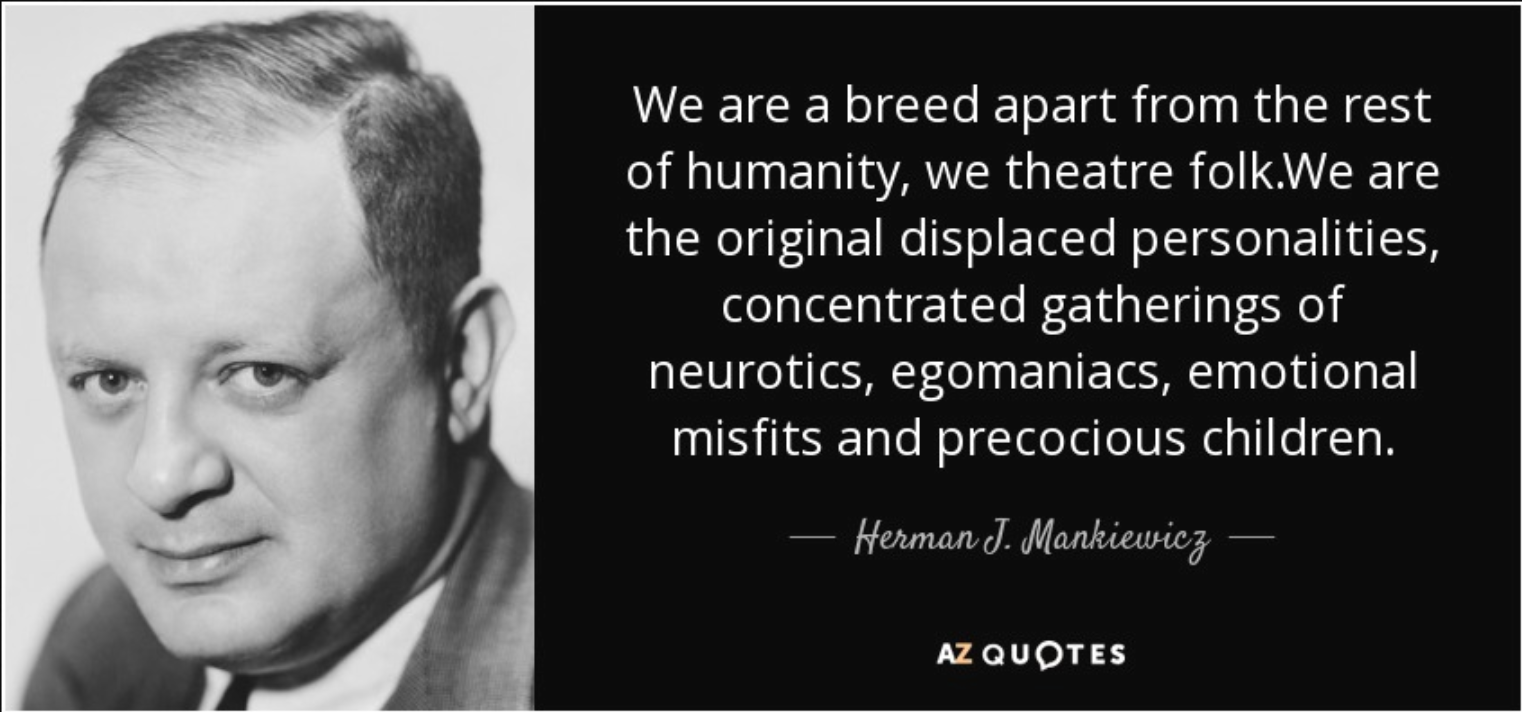
It seems logical, at least from a dramatic standpoint, that David Fincher‘s Mank, a forthcoming Netflix feature about the life and times of Citizen Kane co-screenwriter Herman Mankiewicz, would portray Kane director, producer and star Orson Welles in a less than flattering light.

The whole Welles-vs-Mankiewicz mishegoss has been the subject of fierce debate for nearly 50 years, or since the 1971 publication of Pauline Kael’s disputed essay that claimed Kane was almost entirely written by Mankiewicz. Where’s the drama if the third act isn’t about Welles trying to buy Mankiewicz off or otherwise elbow him aside?

Calling Joseph McBride and other Welles biographers and admirers! To arms! To arms! Pass out the muskets and gunpowder!

I have to be honest and say I’m not all that keen on watching Gary Oldman play Mankiewicz. Oldman is a little too old for one thing (61) — a little too weathered and blinkered. Born in 1897, Mankiewicz worked on Kane when he was a relatively spry 43 and 44, and who enjoyed his main Hollywood heyday during his 30s and 40s. Mank died of drink at age 55, in 1953.

You know who should play Herman Mankiewicz? Bill Hader or somebody in that vein. A clever 40something or nudging-40 type with a twinkle in his eye. Mankiewicz was chubby, yes, but not overly so. A thin guy could pull if off.

Wiki excerpt #1Mank and The Wizard of Oz: “In February 1938, he was assigned as the first of ten screenwriters to work on The Wizard of Oz. Three days after he started writing he handed in a seventeen-page treatment of what was later known as ‘the Kansas sequence’. While Baum devoted less than a thousand words in his book to Kansas, Mankiewicz almost balanced the attention on Kansas to the section about Oz. He felt it was necessary to have the audience relate to Dorothy in a real world before transporting her to a magic one. By the end of the week he had finished writing fifty-six pages of the script and included instructions to film the scenes in Kansas in black and white. His goal, according to film historian Aljean Harmetz, was to “capture in pictures what Baum had captured in words — the grey lifelessness of Kansas contrasted with the visual richness of Oz.” He was not credited for his work on the film.

Wiki excerpt #2: “Mankiewicz was an alcoholic. He once famously reassured his hostess at a formal dinner, after he had vomited on her white tablecloth, not to be concerned because ‘the white wine came up with the fish.’ He died March 5, 1953, of uremic poisoning, at Cedars of Lebanon Hospital in Los Angeles.”

Read more